
Link Building Metrics: How to Measure Link Building Success
 Written by Alistair MacLeod

Why Link Building Measurement Needs a Goal-to-KPI Framework
Most link building reports fail before the data is collected: they start from whatever the tool displays instead of the decision the campaign was meant to answer. Link building metrics only become useful when each one is tied to a campaign goal, so a goal-to-KPI framework maps the goal to the link, SEO, and business metrics that prove or falsify success. You decide what to track first, run the campaign, and read the numbers against a baseline that was set in advance.
Link building success is not one thing. A campaign built to grow authority needs a different metric set than one built to earn referral traffic or support a product launch, and treating them as interchangeable is the most common source of false conclusions. The framework keeps each goal separate so the same dashboard does not quietly compare different campaigns against one KPI.
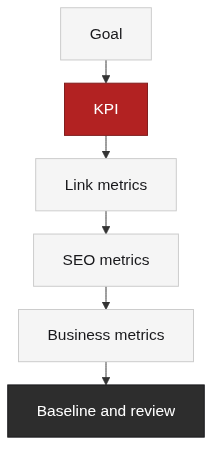
The framework has four parts: define the goal, pick a primary KPI, add supporting metrics that explain why the KPI moved, and set a baseline with a review cadence. Order matters, because a baseline set after the campaign starts has nothing to compare against, and a review cadence that is missing turns measurement into a one-time screenshot. Agencies reporting link building metrics to clients benefit most here, since every number can be traced back to a goal. When you need the data structures behind the profile review, Semrush’s Backlink Audit documentation covers them [3].
Link Metrics to Track for Each Campaign Goal
The link building metrics in this section describe the links themselves: where they come from, how strong they are, how they are placed, and how they are written. Start here whenever the campaign goal is defined in terms of the profile, and resist adding more link metrics before the business layer below has its own column.
Referring Domains vs Total Backlinks
For an authority-focused campaign, referring domains are the stronger signal: they count unique sites, while total backlinks count every placement, including several from one site. Track referring domains when the goal is breadth and authority, and track backlinks when the goal is coverage, such as filling a gap across a topic cluster. The number that misleads most is total backlinks on its own, because a small number of sites can inflate it without adding real diversity. If you are reading your own reports and need the practical difference, our referring domains guide walks through it (https://www.trafficlimb.com/referring-domains-vs-backlinks/).
Link Authority and Relevance
Relevance decides whether a link can influence rankings for the page it targets; authority estimates how much strength the linking page can pass. Weight relevance first for commercial pages, where a topically aligned link does more work, and authority first for informational pages, where the link mostly passes trust. Both scores are estimates, so treat a single value as directional rather than proof. Before counting a placement as a positive metric, evaluate the link the way our high-quality backlinks guide does, and use the relevance checklist when the link points at a money page (https://www.trafficlimb.com/high-quality-backlinks-evaluation-guide/)(https://www.trafficlimb.com/relevant-backlinks-link-relevance-seo/).
Anchor Text Distribution
Watch the anchor text distribution before worrying about any single link, because it is the earliest warning of over-optimization. The mix of branded, partial-match, and exact-match anchors should be compared with your own baseline, not with a borrowed ideal ratio. A profile that shifts quickly toward exact-match phrases signals risk before rankings move. Exact-match percentage alone misleads, because a small profile can swing it with one or two placements, so read it together with the referring domain count.
Placement, Dofollow Status, and Traffic Potential
A link in the body of a relevant article behaves differently from one in a sidebar, so placement and dofollow status should be logged at acquisition time. In-content links sit where readers engage, while footer and sidebar links mostly pass static value, and a nofollow link passes no link equity at all. Traffic potential matters when the campaign goal is exposure or referral traffic rather than raw count, because a high-authority placement nobody clicks still fails a traffic goal. Retrofitting placement data later is unreliable, which is why the log happens during outreach.
SEO Metrics That Show Link Building Impact
SEO metrics sit between the links you built and the business outcomes they produce, and they show whether profile changes produced organic impact. These link building metrics answer different questions, so choose them per goal instead of reporting the same five positions for every campaign.
Organic Rankings for Target Keywords
Rankings are the closest measurable outcome of link building for a specific page, but only when read against a baseline. Record keyword positions before the campaign starts, then compare movement within the campaign time window rather than after an indefinite period. A single position snapshot says nothing about trend, so the report should show the movement, not the point. Ahrefs’ link audit workflow is a useful reference for connecting position changes to links that appeared or disappeared [4].
Organic Visibility and Search Share
Visibility aggregates ranking positions across a keyword portfolio, which smooths out single-keyword noise. Use it when the campaign goal is sitewide lift, because many pages gaining a few positions can be worth more than one page jumping to the top. The metric hides which keyword moved, so pair it with the keyword-level view before drawing conclusions. For niche sites with a small portfolio, visibility swings fast and should be read with that volatility in mind.
Referring Domain Growth
Referring domain growth shows whether outreach is producing new sources or recycling the same ones. Track new referring domains separately from new backlinks, because a campaign can add many backlinks while barely moving the number of sites that matter. The signal to watch is stagnation: if referring domains stop growing while backlinks keep rising, outreach is feeding existing relationships instead of expanding reach. Compare growth against the rate observed before the campaign, not against an absolute number.
Authority and Trust Signals
Authority and trust signals estimate the strength of pages that received links, and they belong in the report as directional checks. They do not prove ranking outcomes, and different tools can disagree on the same page, so no decision should run off a single score. Use them to triage placements: a link from a low-trust page may need review even when its authority score looks acceptable. When these signals look wrong, check the underlying page first, not the score.
Business Metrics That Connect Links to Revenue
Business metrics answer the question no link tool can: did the links help the business? They connect links to revenue using analytics and CRM data, not the backlink database, and attribution is the hard part. A link building metrics framework that skips this layer measures effort instead of outcome. If the business layer is missing, the report can only prove that links were placed, not that they worked.
Referral Traffic and Engagement
Referral traffic measures whether links bring qualified visitors, not just crawlers. In analytics, filter sessions by source and check engagement signals such as time on page and pages per session before declaring a link successful. Raw sessions mislead, because a placement on a busy but irrelevant page can look strong in volume and convert badly. If referral traffic is high but engagement is low, review the placement and the anchor text before assuming the audience matches your buyer.
Conversion Rate and Lead Quality
Conversions show whether the audience from a link matches the buyer profile, and they outweigh traffic when the campaign supports sales. Attribute leads to the source campaign first, because a link that appears in several reports will otherwise take credit twice. Lead quality matters as much as conversion rate: a campaign that converts slowly but attracts the right accounts may still be the one to scale. When conversion numbers look wrong, check the attribution window and the landing page before questioning the links.
Revenue and ROI
Revenue ties the whole framework to the business goal, and ROI is the number that survives a budget review. ROI compares the cost of link building with attributed revenue, but attribution limits make it an estimate, not an exact figure. Document the window and the touch model used so the number can be reproduced next quarter. If revenue cannot be attributed reliably, report the leading indicators instead of inventing a precise return.
The Measurement Table: Mapping Campaign Goals to KPI
Turn the framework into a working document with a measurement table mapping each campaign goal to its primary KPI and supporting metrics. The rows below are a starting point; adjust them to the goals your campaign actually has, and treat the table as the source of truth for what gets reviewed.
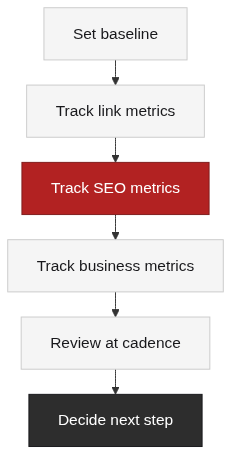
The table is where link building metrics become comparable across campaigns, because every row shares the same structure. Each row carries a baseline and a review cadence, because a KPI without a comparison point is just a number. Decide what to track before the campaign starts so the table is a plan, not a post-hoc description. When a row misses its KPI, treat it as the start of a diagnosis and check the data in order: links first, then SEO, then business metrics, because that is the direction cause and effect actually flows.
| Campaign goal | Primary KPI | Link metrics | SEO metrics | Business metrics | Review cadence |
|---|---|---|---|---|---|
| Authority growth | New referring domains | Referring domains, link authority, relevance | Organic visibility, referring domain growth | Referral sessions | Monthly |
| Ranking support | Target keyword positions | Anchor text distribution, dofollow share | Organic rankings, search share | Organic conversions | Biweekly |
| Referral traffic | Referral sessions | Placement, traffic potential | Organic visibility | Referral engagement, lead quality | Monthly |
| Revenue support | Attributed revenue | Dofollow status, placement | Organic rankings, visibility | Conversion rate, ROI | Monthly |
How to Turn Measurements into Decisions
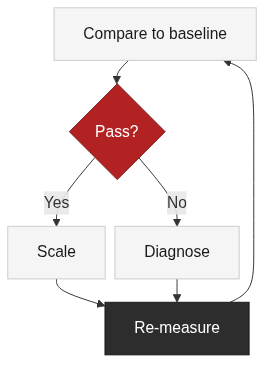
Knowing how to measure link building success is only half the job; measurements earn their cost when they change the next decision. Revisit the goal-to-KPI table at fixed intervals, compare actual values with the baseline, and sort channels by whether they consistently hit or miss their KPI. Cut the channels that miss across multiple reviews instead of judging from one report, and scale the ones that pass while their unit economics still hold. Context belongs next to every number: a channel that missed because placement quality dropped tells a different story than one that missed because the goal was wrong. When prioritization is the open question, connect the findings to a gap analysis to decide where the next budget goes backlink gap analysis guide. Decisions built on link building metrics also need a fixed review owner, because a table without an owner is just documentation.
Common Measurement Mistakes
The failures below show up in most measurement setups, and each one is cheaper to prevent than to fix later. Tracking every metric at once hides the metrics that matter for the goal, because noise buries the signal in a dashboard of equal weights. Comparing campaigns with different goals against the same KPI produces false conclusions, since an authority campaign and a traffic campaign share almost nothing except the word campaign. Ignoring the time window makes early SEO metrics look like failure, while judging too late makes the report too slow to act on. The final mistake is measuring only positive links: monitor for risky links alongside the growth metrics, because a profile that gains placements while accumulating unnatural patterns is not succeeding. Google’s spam policies define which patterns count as manipulative [1], and when a risky link cannot be removed through outreach, the disavow workflow documented by Google Search Console [2] marks the boundary of what measurement alone can fix. Our guide on unnatural and risky backlinks covers the profile signals worth watching (https://www.trafficlimb.com/unnatural-links-link-spam-risky-backlinks/).
FAQ
References
Google Search Central, “Google Search Essentials – Link spam”: https://developers.google.com/search/docs/essentials/spam-policies
Google Search Console Help, “Disavow links to your site”: https://support.google.com/webmasters/answer/2648487
Semrush Knowledge Base, “Backlink Audit”: https://www.semrush.com/kb/859-backlink-audit
Ahrefs Blog, “Backlink Audit: The Complete Guide”: https://ahrefs.com/blog/link-audit/