
Unnatural Links: How to Identify Link Spam and Risky Backlinks

What Unnatural Links Are
A backlink is a link from one page to another [2], and it becomes unnatural when its purpose is to inflate a ranking signal instead of helping a reader. Search engines use links among the signals that decide which pages deserve visibility [1], which is why links created purely to influence that signal draw scrutiny. The label describes intent and pattern, not a single link in isolation.
Most profiles contain a few weak links that appeared by accident, and a handful is usually not a problem. Unnatural links become a problem when they share a pattern: the same anchor, the same timeframe, or the same source. The identification task is to separate those patterns from ordinary noise, which is why the rest of this article walks through each risk type.
Link Schemes and Paid Links: The Core Risk
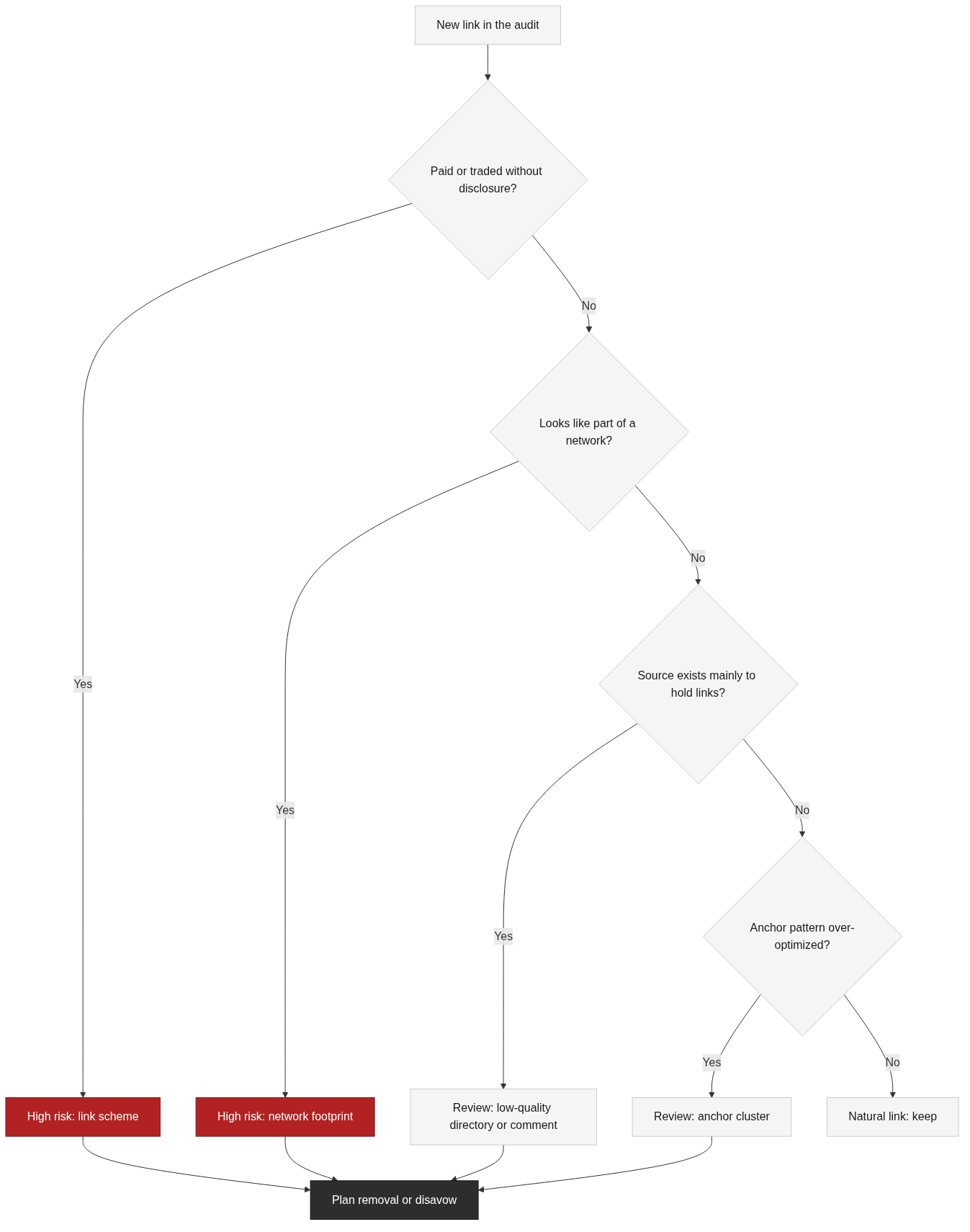
Link schemes are coordinated attempts to pass link equity in ways that look artificial, and paid links without disclosure sit at the center of them. Buying links, selling links, and exchanging large numbers of links are the practices Google’s spam policies describe as violations, and the practical test is simple: if the link exists because of a payment or a trade rather than because a publisher wanted to share your content, it is a scheme [4].
Not every paid placement is a scheme. Sponsored content that is clearly labeled and marked as such is a normal business practice, and the distinction is disclosure. The risk grows when links are paid for quietly and placed across many sites in a short window, because the pattern is what makes them look manufactured.
PBN Footprints: How They Get Identified
A private blog network is a set of sites controlled by the same owner, built to place links on demand. The links are not the risk by themselves; the footprint is. Networks get identified when the sites share the same hosting, the same registration details, the same theme, or the same content patterns, and once one site is recognized, the others usually follow.
Treat any domain that looks like part of a network as high risk, regardless of how strong its metrics appear. The referring domains guide explains how to check whether a set of domains shares the kind of footprint that networks leave, and the backlink profile guide shows how those patterns show up in the whole profile.
Low-Quality Directories and Comment Spam
Low-quality directories accept any submission for a fee or with no review, and comment spam places links in blog comments that have no editorial oversight. Both produce links that look machine-generated because they usually are: the same anchors, the same pages, and the same templates across hundreds of sites. A directory with real editorial standards is different from one that lists every submission.
Judge the source, not the category. A directory can be legitimate in your niche while a hundred similar-looking sites are pure link lists, and the difference shows in whether the listing makes sense to a reader. When the source exists to hold links rather than to serve readers, the links from it belong in the risk column.
Exact-Match Anchor Over-Optimization
Exact-match anchors repeat your target phrase in identical form, and a few of them are normal. The risk is over-optimization: when the same phrase dominates the profile, or when clusters of identical anchors arrive in a short window from unrelated pages, the profile looks coordinated. The pillar guide to high-quality backlinks covers how anchor text fits into the full quality framework, and this is the pattern that framework is meant to catch.
Judge anchors in distribution, never one at a time. A single exact-match anchor tells you nothing, while a distribution that leans heavily on one phrase is a signal worth investigating. The question is not whether the anchor is exact but whether the pattern around it matches how publishers would naturally describe your page.
Toxic Referring Domains and Risk Patterns
Toxic referring domains are domains whose links carry more risk than value, and they usually appear in groups. Watch for domains that appeared in the same week, sites that all link to each other, domains with the same template, and sources whose only purpose is placing links. These are the patterns that make a profile look manufactured, and they are the ones audits flag first.
The link building strategies guide shows the legitimate side of the same picture: methods that earn links editorially and naturally produce diverse, explainable growth. When growth cannot be explained by the content and outreach you actually did, the unexplained portion is where the risky links live [3].

Understanding Google’s Unnatural Links Policy
Google’s spam policies describe the link practices that can trigger manual or algorithmic action, and they center on links created to manipulate rankings [4]. The policy does not say every weak link is a violation; it targets schemes, paid links without disclosure, and networks built for the purpose of passing link equity. Understanding the policy matters because it tells you which links to treat as urgent and which to treat as noise.
The policy also explains the safe path. When links exist that violate it, the expected action is to remove them where you can, and to use the disavow tool for the rest. The link reclamation guide covers the removal side in detail, and the section below explains when disavowal makes sense.
Safe Action: Removal Requests vs. Disavowal
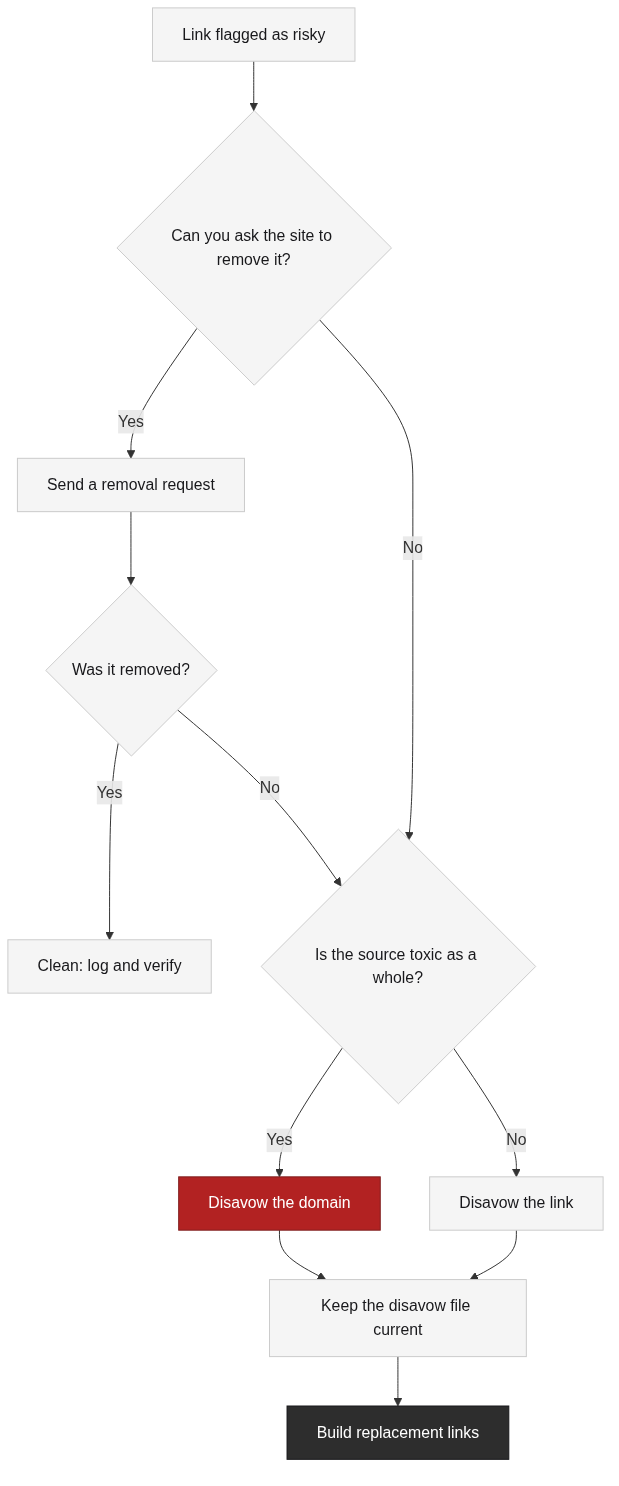
Start with removal. Contact the site, ask for the link to be taken down, and keep a record of the request, because removal is always the cleaner outcome. A link that is removed no longer exists, while a link that is only disavowed still lives on a page you do not control. Removal requests work best for links on sites with real editorial staff; they fail on networks and link lists, which brings you to the disavow decision.
Use disavowal when you cannot remove the link, when the pattern is widespread, or when a manual action is already in place. Disavow the domain rather than the individual link when the whole source is toxic, and keep the file current, because a stale disavow file becomes part of the audit itself. The broken link building guide offers a constructive follow-up: replacing weak links with strong ones after the cleanup is done [5].
FAQ
References
Google, “SEO Starter Guide,” developers.google.com. Official documentation describing links among the signals that help pages gain visibility.
Moz, “Backlinks,” moz.com. Public glossary explaining what backlinks are and how natural and unnatural links differ.
Ahrefs, “Link Building for SEO: The Definitive Guide,” ahrefs.com. Public industry guide describing how audits separate natural growth from risky patterns.
Google Search Central, “Spam policies for Google web search,” developers.google.com. Official documentation describing link spam practices that Google treats as policy violations.
Search Engine Journal, “Link Building Strategies,” searchenginejournal.com. Public industry article surveying link building methods and their trade-offs.
Next Steps
Unnatural links are identified by pattern, not by single links: link schemes, paid links without disclosure, network footprints, low-quality directories, comment spam, and anchor over-optimization all leave traces across the profile. Start with removal requests, disavow what you cannot remove, and keep the cleanup records. Related coverage in this cluster goes deeper into high-quality backlinks, backlink profiles, and referring domains, and each article treats risk identification as part of the same evaluation framework.
If you prefer to focus on the strategy while a specialist handles execution, TraffiClimb builds premium link building programs for ambitious brands.