
Backlink Gap Analysis: How to Find Link Opportunities Your Competitors Have

What a Backlink Gap Analysis Delivers
A backlink gap analysis answers one question: which links do competitors have that you could realistically earn? It does not rank competitors, predict rankings, or tell you which pages to build, because links are one input among many in how pages perform [1]. The output is a filtered list of referring domains and the pages that earned them, ready for outreach or asset planning.
The analysis is only as good as the filter. Raw differences between profiles include plenty of links you should never pursue: irrelevant sources, sitewide placements, and risk patterns. The gap analysis is the step that keeps the difference between “competitors have it” and “you should want it” explicit [2].
Build the Competitor Set and Pull the Profiles
Start with five to ten competitors whose audience and content intent match yours. Mix direct competitors with content competitors that rank for the same terms, because the latter often hold the links that are genuinely transferable [3]. For each competitor, pull the backlink profile and export the fields you will compare: referring domains, linked pages, and the placement context of each link.
Deduplicate the profiles before comparing. The same referring domain can link to several competitor pages, and the same site often appears in multiple profiles; collapse those into a single row so the comparison counts unique sources, not repeated mentions. Keep the linked page for each unique domain, because it tells you what earned the link.
Export your own profile with the same fields. The comparison needs a common shape, and exporting your own referring domains with linked pages keeps the analysis honest about what you already have.

Find the Links You Are Missing
The gap is the set of referring domains that appear in competitor profiles and not in yours. Run the comparison and build the difference list, then group it by the linked pages that earned those links. The grouping matters because a domain alone does not explain the opportunity: the page format, the content angle, and the context are what you would reproduce or pitch against [3].
Ignore the comparisons that do not survive a sanity check. A competitor may hold links from a domain that is irrelevant to your audience, from a page that no longer exists, or from a section of a site that never covers your topic. The gap list is the starting point, not the deliverable.
Filter by Relevance and Quality
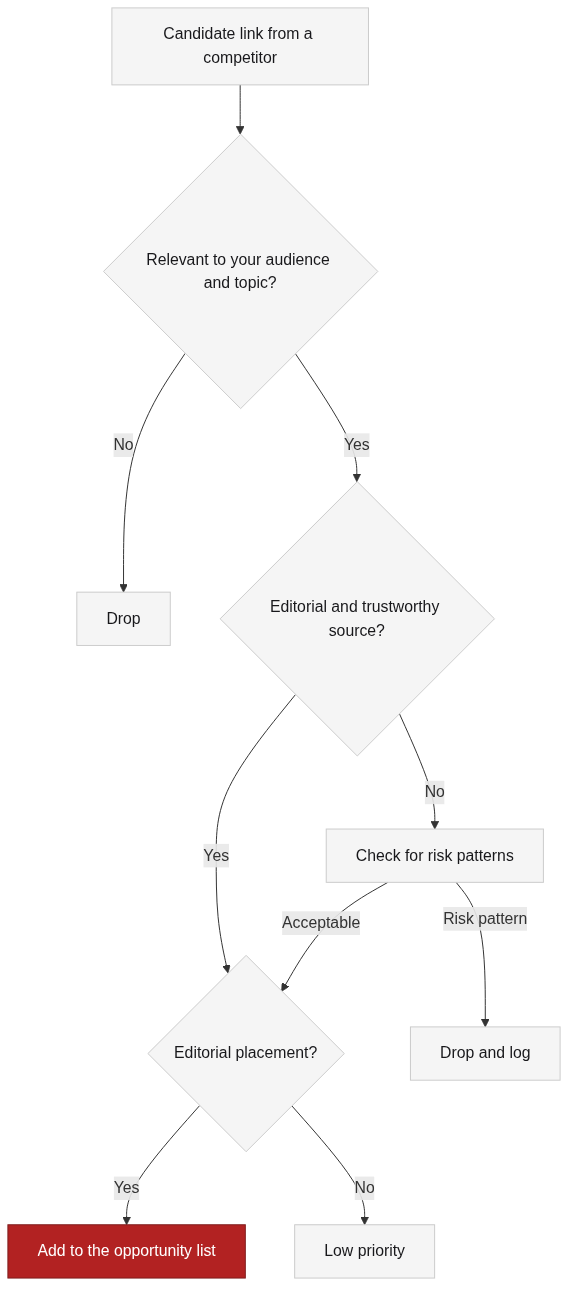
Apply the relevance filter first, because it removes most of the noise. A link is relevant when the linking page serves an audience that could reasonably become yours and when the page topic sits inside or directly adjacent to your niche. Links from general directories, unrelated news sections, or bulk resource lists usually fail this test, regardless of the domain’s authority [2].
Then apply the quality filter. Editorial placement inside main content, a trustworthy publisher, and a stable page are the signals that make a link worth pursuing. Footer, sidebar, and template-wide links are weak even when the domain looks strong, and pages built mainly to pass links are risk patterns you should not copy [4].
Drop the risk cases explicitly instead of carrying them forward. If a gap list keeps links from link networks or obvious paid schemes, removing them is part of the analysis, not a loss of opportunity.
Prioritize by Fit and Effort
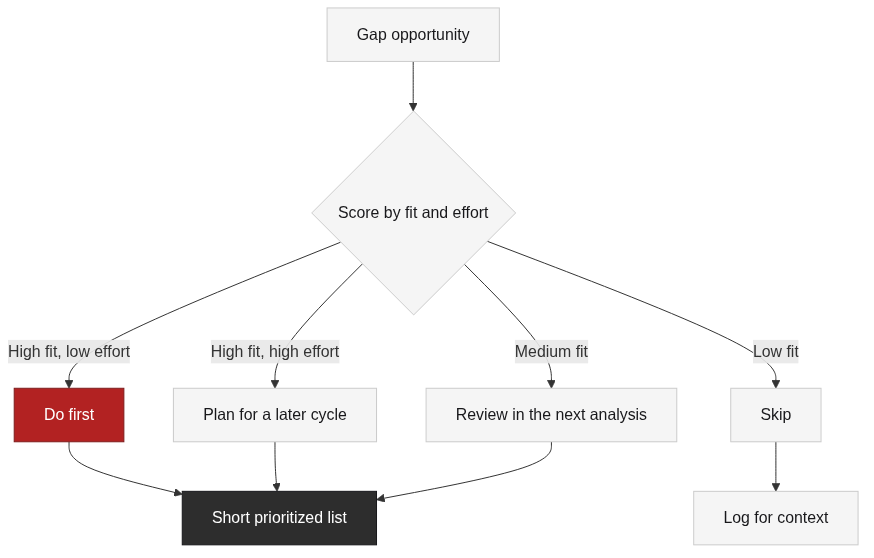
Score the remaining opportunities by fit and effort, then sort them into tiers. Fit measures how well the linking site matches your audience and how naturally your page fits its context; effort measures what it takes to earn the link, from creating an asset to running outreach. The opportunities with high fit and low effort go first, high fit and high effort go into a later cycle, and anything with low fit is logged and skipped [5].
The scoring does not need to be elaborate. A simple high, medium, low judgment per opportunity, written down with a reason, is enough to make the priority explicit and reviewable. The point of the tiering is that the list becomes actionable: the campaign starts with the top tier instead of whatever domain happened to be easiest to export.
Keep the Analysis Actionable
Run the analysis on a fixed cadence and keep the output small. Quarterly is a reasonable rhythm for most sites, and between cycles you should track only the top-tier opportunities rather than re-exporting everything. The deliverable is a short prioritized list that fits the next campaign decision, not a full database.
When the campaign stalls, resist the reflex to re-run the gap analysis immediately. The usual causes sit inside your own pages and targets, and a fresh export of competitor data does not fix weak page quality or an unfocused pitch [1]. Re-run the analysis on the cadence, and use the time between cycles to work the list.
FAQ
References
Google, “SEO Starter Guide,” developers.google.com. Official documentation describing links among the signals that help pages gain visibility, and why rankings depend on many factors.
Moz, “Backlinks,” moz.com. Public glossary explaining what backlinks are and why relevance and placement determine their value.
Ahrefs, “Link Building for SEO: The Definitive Guide,” ahrefs.com. Public industry guide covering link profile comparison and competitor gap analysis.
Google Search Central, “Spam policies for Google web search,” developers.google.com. Official documentation describing link schemes and practices that Google treats as policy violations.
Search Engine Journal, “Link Building,” searchenginejournal.com. Public industry article covering gap analysis and prioritizing link opportunities.
Next Steps
A backlink gap analysis works when it ends in a short, filtered list: the competitor set you compared, the gaps that survived the relevance and quality filters, and the tier that gets worked first. Keep the cadence fixed and the output small, and the analysis becomes a routine input to campaign planning instead of a one-off report.
The link building strategies guide shows where gap analysis sits inside a full campaign, the resource page link building guide explains how to turn the gaps you find into linkable pages, and the broken link building guide covers a method for opportunities that point to pages worth restoring or replacing.
If you would rather focus on the strategy while a specialist handles the research and execution, TraffiClimb builds premium link building programs for ambitious brands. Visit the TraffiClimb website to see how the approach works.