
Link Prospecting: How to Find Backlink Opportunities Worth Pursuing

What Is Link Prospecting?
Link prospecting is the process of identifying, qualifying, and prioritizing the sites you will contact for a backlink, and it ends where outreach begins. The output is not a raw export of URLs; it is a scored list where each entry has a topic, a reason it fits your target page, a quality signal, and a way to reach the right person. The input is a definition of the page you are promoting and the audience you want to reach [1].
Prospecting matters because it is the cheapest place to improve link building results. A page earns links when relevant sites reference it, so the list decides whether the outreach team spends its time on likely placements or on dead ends. Campaigns that underdeliver usually fail here first, long before the first email is written.
Prospect vs Backlink Opportunity
A backlink opportunity is any site that could technically add a link to your page; a prospect is a site that could add a link that helps your page, your audience, or your rankings. The difference is fit. An industry forum with thousands of posts is an opportunity, while a niche guide that your audience reads and that links out to quality resources is a prospect.
Use the distinction to sort candidates into two buckets. Sites that fail the fit test but still look interesting belong on a watch list, not in the outreach queue. Keeping the buckets separate prevents the common mistake of measuring prospecting by the size of the list instead of the quality of the fit [2].
Define Target Page, Link Goal, Topic, and Audience First
Before searching, write down four things: the target page that should earn the links, the link goal for that page, the topic it covers, and the audience it serves. The target page is the destination a reader will visit, so it must be worth the visit on its own. The link goal names the outcome, such as more organic visibility for a pillar guide or authority for a cluster of support pages.
The topic and the audience are the filters that make every later step faster. When you evaluate a candidate, you are asking whether its readers overlap with the audience the target page serves. Without that definition, prospecting turns into a random walk across the web, and the list you build will not survive qualification.
Prospect Discovery Methods
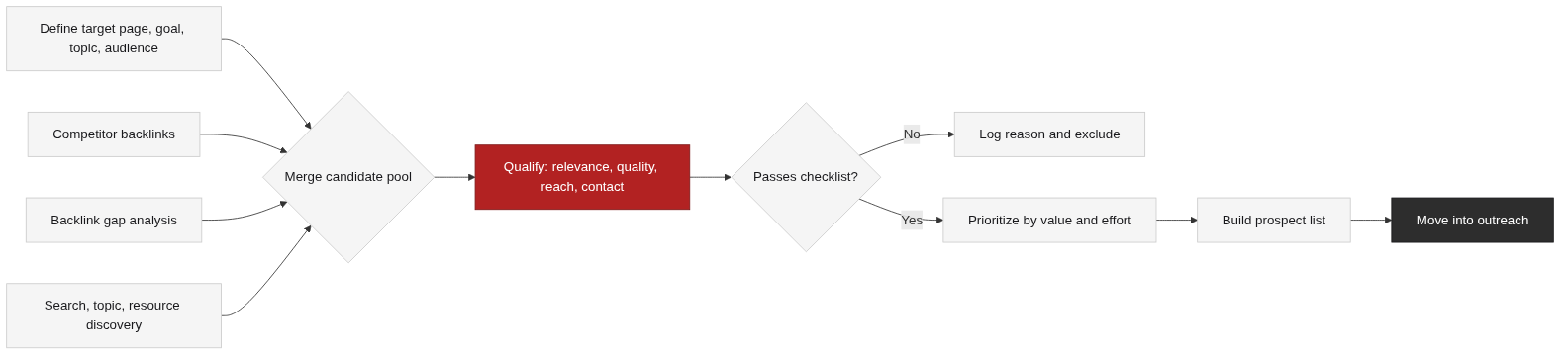
Discovery is the search for candidate sites, and four methods cover most of the practical ground: competitor backlinks, backlink gap analysis, and search, topic, and resource discovery. Competitor backlinks show you where pages like yours already earn links. Gap analysis shows you which of those sites link to competitors but not to you. Search, topic, and resource discovery find sites that cover your topic and would plausibly link to a better resource.
Run the methods in sequence and merge the results into one candidate pool before qualifying. Each method finds a different kind of site, so relying on a single one skews the list toward one type of opportunity. The diagram below shows how the four sources feed the same pipeline.
Find Opportunities in Competitor Backlinks
Competitor backlink analysis answers one question: where do pages that already rank for your terms earn their links? Pull the referring domains of two to five comparable pages, note the context around each link, and flag the sites that link to content similar to yours. Those sites have already demonstrated that they link to the kind of resource you are building [3].
Do not copy the list blindly. A competitor can have links that no longer make sense for your page, from directories, badges, or placements you would not want. The value of the method is the starting set: it points you to sites that are reachable and that reference your topic, and it saves the prospecting time of finding them from scratch.
Find Opportunities in the Backlink Gap
Gap analysis is the comparison between the referring domains of pages that rank for your terms and the referring domains of your own pages, and the difference is your gap. Sites that link to your competitors but not to you are the highest-value prospects in the list, because they already link to content in your space and your audience overlaps with theirs.
Treat the gap as a prioritized starting point rather than a complete list. Some sites in the gap will be out of reach because of the assets they require, such as original data or an industry survey you do not have. Log those as future opportunities, and focus the current round on the gap sites your target page can satisfy today. The backlink gap analysis guide covers the comparison in depth, and the competitive link analysis guide explains how to read a competitor profile without copying it.
Use Search, Topic, and Resource Discovery
Search and topic discovery find sites that do not appear in competitor profiles yet. Search for your topic plus words that indicate linkable content, such as “resources,” “roundup,” “best guides,” or “what we read,” and look for pages that curate external links. Resource pages, industry lists, and roundups are natural prospects because their format is built around linking out [4].
Topic discovery works from the audience side. List the publications, newsletters, and communities your audience follows, then check whether those properties link out and how they accept submissions. A site does not have to rank for your keyword to be a good prospect; it has to be read by the people your page helps.
Score Domain and Page Relevance
Relevance is the first filter and the hardest to automate, because it is about the fit between your page and the context of the link. Score each candidate on two levels: domain relevance, or whether the site as a whole covers your topic, and page relevance, or whether the specific page that would host the link matches the intent of your content.
A page-level check matters more than the domain. A high-authority site with an unrelated page is a weaker prospect than a smaller site where the exact page fits your topic. When the fit is unclear, look at what the page links to and what surrounds those links, because the context determines how much the link is worth [2]. The relevant backlinks guide explains why fit beats raw authority.
Check Basic Quality Signals
Quality signals separate sites that pass a relevance filter from sites that are safe and useful to pursue. Check whether the site is indexed and reachable, whether it has a real editorial process, whether it links out to credible sources, and whether its own content is current. A relevant page on a broken or abandoned site is still a poor prospect.
Keep the quality bar consistent with your brand and with search guidance, because a link from a low-quality site can hurt more than it helps [1]. Sites built for link selling, thin content, or automated syndication belong in the exclusion list rather than the outreach queue. The high-quality backlinks guide defines the quality bar in more detail.
Read Traffic and Site Signals
Traffic and site signals estimate whether a placement has reach, and they are secondary to relevance. Useful signals include the site’s organic visibility, its audience size, how often it publishes, and how much engagement its content receives. The referring domains count of a page is one proxy for its link value, and the referring domains guide explains how to read it.
Do not treat traffic as the deciding factor. A smaller site read by exactly your audience usually beats a larger site with a scattered readership, and a page with strong relevance but modest traffic can still move your metrics. When traffic data is missing or ambiguous, mark the signal as unknown and let relevance and quality decide.
Confirm Contactability
A prospect is only actionable if you can reach the right person. Confirm contactability before you spend time writing an email: find the site’s contact policy, identify who handles link requests, and record the best channel and any submission guidelines. Sites without a contact route are low priority regardless of how relevant they are.
Contactability also includes responsiveness signals. A site that posts a writer’s email, answers comments, or links to sources with named authors is easier to reach than one that hides every contact behind a form. Record the contact details in the prospect row so the outreach step does not have to redo the research.
Apply a Prospect Qualification Checklist
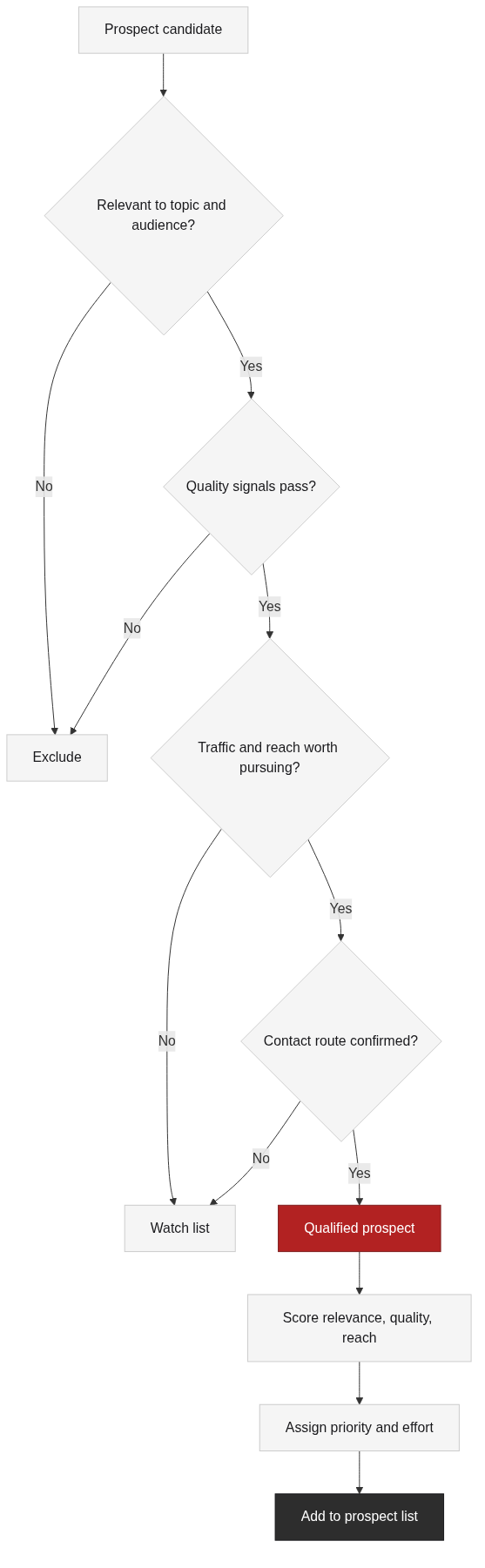
The qualification checklist turns the individual signals into a decision. A prospect passes when it has sufficient relevance, passes the quality signals, shows acceptable reach, and has a real contact route. A prospect fails when any core signal is missing, especially relevance, because a link from an off-topic site rarely helps and can signal manipulation [1].
Use a fixed checklist so decisions stay consistent across the team. Five questions are enough: does the site cover the topic, does it link out to external sources, is the site credible and maintained, is there reach worth pursuing, and can you contact the right person? If the answer to the first or the fifth is no, exclude the site without further scoring.
Prioritize the List
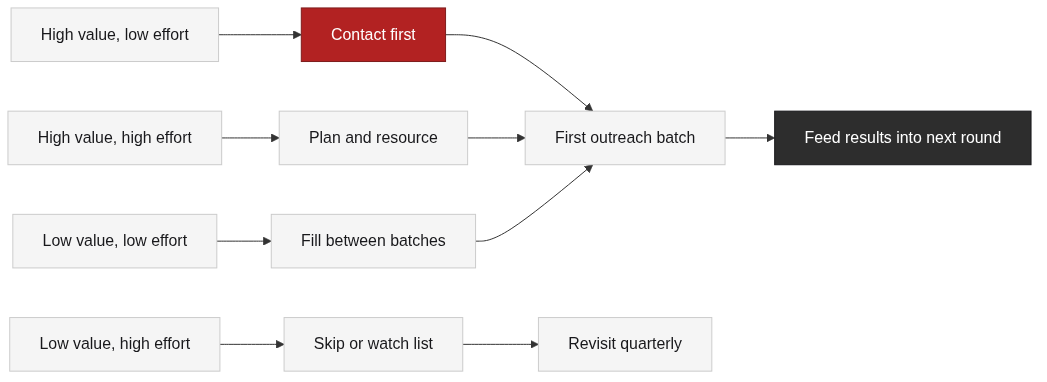
Prioritization ranks the qualified prospects by expected value and effort, so the outreach team starts with the placements most likely to matter. Score each prospect on relevance, quality, and reach, then estimate the effort to win the link, such as whether the site requires original data, a guest post, or just a good resource. A simple score, like high, medium, or low, is enough for the first pass.
Order the list by the ratio of value to effort, not by authority alone. A high-relevance site with an easy submission route can outperform a high-authority site that requires a campaign to impress. Keep the top of the list small enough to contact in the first batch, and let the first results confirm the scoring before you scale.
Build the Prospect List
The prospect list is the working document that carries a candidate from discovery to outreach. Each row should hold the site URL, the target page context, the reason it fits, the relevance and quality scores, the traffic signal, the contact route, and a status that moves from discovered to qualified to contacted. A shared table keeps discovery, qualification, and outreach on the same record.
Build the list in batches and qualify each batch before adding the next. A list of a few dozen fully qualified prospects with reasons is more useful than a few hundred raw URLs, because the qualified list can go straight into outreach while the raw list only adds noise. The link building outreach guide picks up from here and shows how the list becomes emails and placements.
Apply Exclusion Rules
Exclusion rules protect the list from sites that look like opportunities but are not safe or useful to pursue. Exclude sites built for link selling, link farms, automated content, directories that add no value, and any site that conflicts with your brand or your quality standards. Also exclude pages that would bury the link in a context your audience never reads [5].
Write the exclusion rules down so they apply consistently. When a candidate trips a rule, record the reason in the list so the decision can be reviewed later. The unnatural links guide explains the risk patterns that prospecting should filter out before outreach.
Move Qualified Prospects Into Outreach
Prospecting is complete when the qualified, prioritized list is ready for outreach, and the handoff is a handoff of context, not just URLs. Each prospect that enters outreach carries its reason for fit, its score, and its contact route, so the outreach writer can personalize the message without redoing the research.
The handoff also sets the next decision: which prospects to contact first and what the offer will be. Keep the list updated as outreach proceeds, moving prospects from contacted to replied to placed, and send the ones that stall back to qualification if the pattern repeats. The link building strategies guide shows how prospecting fits into the wider method mix.
FAQ
References
Google, “SEO Starter Guide,” developers.google.com. Official documentation describing links among the signals that help pages gain visibility, and why quality matters.
Moz, “Backlinks,” moz.com. Public glossary explaining what backlinks are and why relevance and context determine their value.
Ahrefs, “Link Building for SEO: The Definitive Guide,” ahrefs.com. Public industry guide covering link audits, competitor analysis, and prospecting.
Backlinko, “Link Building Strategies,” backlinko.com. Public industry guide surveying link building methods and how prospecting fits into them.
Search Engine Journal, “Link Building,” searchenginejournal.com. Public industry article covering link quality, risk patterns, and safe outreach practices.
Next Steps
Link prospecting is a pipeline, not a search: define the target page and audience, discover candidates through competitor backlinks, gap analysis, and topic research, then qualify, prioritize, and exclude until the list is small enough to act on. The two habits that protect the whole pipeline are writing the target definition down first and applying a fixed qualification checklist, because they keep every later decision consistent.
Start with one target page and run the four discovery methods once, then qualify the merged pool and keep the top of the list for the first outreach batch. When the list is ready, the link building outreach guide explains how to turn qualified prospects into emails, follow-ups, and placements. If you would rather focus on strategy while a specialist handles the execution, TraffiClimb builds premium link building programs for ambitious brands; visit the TraffiClimb website to see how the approach works.