
White Hat Link Building: Strategies for Building Backlinks Safely
 Written by Alistair MacLeod

Link building is going through a quiet but decisive shift. The old playbook—buying links, trading placements, and firing off automated campaigns—is losing value faster than most teams realize, while a handful of editorial, content-driven backlinks are carrying more weight than ever. The risk for most SEO professionals today is not “doing no link building.” It is not being able to tell which tactic is safe white hat link building, which one sits in a grey zone, and which one has already crossed into territory Google treats as a link scheme.
This guide gives you a working framework for making that call. You’ll learn what white hat link building actually means, how to separate it from grey and black hat practice, which methods are safe and where their boundaries sit, and how to build a sustainable link building framework that compounds over time.
What Really Is White Hat Link Building?
White hat link building is the set of practices for earning backlinks that follow search engine guidelines: links given voluntarily by editors because your content is genuinely worth referencing, not bought, exchanged at scale, or manufactured by automation. It is the compliance baseline for link building—the default you measure every placement against, not a special “type” of link you switch on when you feel careful.
Why the “Quantity to Quality” Shift Changes Everything
The link building market has moved from volume to quality. Low-tier tactics—mass directories, automated link placement, and networks of low-value pages—are being devalued by algorithm updates and the rise of AI-driven search, while high-tier links (PR-level placements and content-native integrations) are becoming more valuable [1]. The practical consequence is that a single relevant editorial link can carry more long-term weight than dozens of irrelevant ones, and a strategy built on volume is now the riskier one.
The Question That This Guide Answers
So here’s the question that matters: that “harmless-looking” link sitting in your report—is it white hat, is it grey, or has it already crossed Google’s link scheme red line? Most teams can’t answer this with confidence, because the difference is rarely about where the link points. It’s about how it was earned. This guide gives you a repeatable way to decide.
What You’ll Walk Away With
By the end, you’ll have a five-question safety checklist you can run on any link before you send or accept it, a clear picture of where the white, grey, and black boundaries fall, and a four-step sustainable framework you can build a long-term program around.
White Hat Is Not “Another Type of Link” — It’s the Compliance Baseline
Many people treat white hat as one of several link types, alongside grey and black. That framing is misleading. White hat is not a category of link—it’s the subset of all link building that is compliant, sustainable, and does not manipulate ranking signals. Ordinary link building is the broad set of everything people do to acquire backlinks; white hat is the portion of that set that holds up to scrutiny over years, not months.
The Five Judgement Criteria
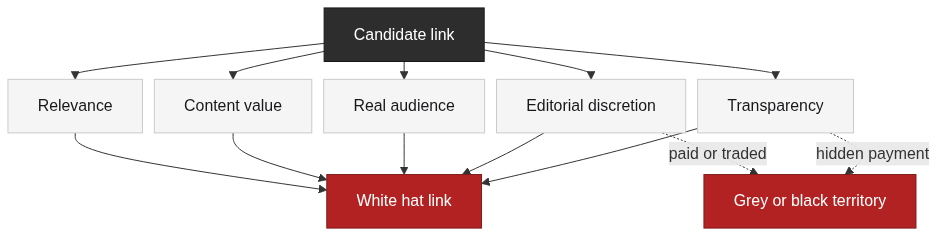
To tell whether a link belongs in that compliant subset, run it against five criteria:
| Criterion | What it asks | Why it matters |
|---|---|---|
| Relevance | Is the linking page topically related to your target page? | Irrelevant links signal manipulation and dilute value. |
| Content Value | Would this content be worth reading even if it didn’t carry a link? | Value is what a real editor references. |
| Real Audience | Does the source site have genuine, active readers? | A link only means something if humans see it. |
| Editorial Discretion | Was the link given voluntarily by an editor, not bought or exchanged? | This is the core test of a natural link. |
| Transparency | If payment or sponsorship is involved, is it disclosed? | Hidden paid relationships are the classic scheme signal. |
Editorial, Earned, and Relevant Links — Cut Clean
These five criteria are exactly what separates editorial, earned, and relevant links from paid, exchanged, and automated ones. An editorial link is given voluntarily by a third-party editor because the content is good enough to reference, not because you paid for it. An earned link is won through a linkable asset, data, or a PR angle rather than a transaction. A relevant link comes from a page whose topic matches yours—relevance and quality together determine a link’s value [1]. Paid links, large-scale exchanges, and automated links fail the editorial discretion and transparency tests, which is precisely why Google treats them as schemes.
White Hat vs Grey Hat vs Black Hat: Where Is the Boundary?
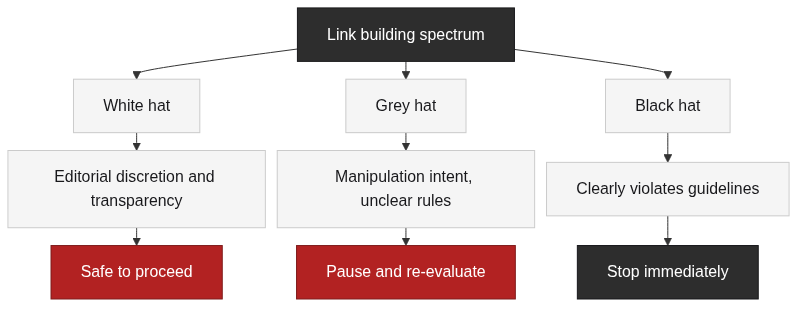
The three-way split is a spectrum defined by intent and disclosure, not by the link itself. Understanding where each sits helps you spot a grey tactic before it becomes a problem.
| Category | Definition | Typical signals |
|---|---|---|
| White Hat | Follows guidelines; links given by editors for content value | Editorial discretion, relevance, transparency |
| Grey Hat | Not clearly against guidelines but relies on manipulation intent | Mass guest post networks, link exchanges, some paid content |
| Black Hat | Clearly violates guidelines | Buying links, automated link farms, hidden paid relationships |
The Core Judgement Point
The single most useful question is: would a real editor give this link voluntarily because it’s worth giving? If the answer is yes, you’re in white hat territory. If you’re paying or trading for a “guaranteed placement,” you’ve moved into grey or black—regardless of how authoritative the site looks. Google’s own policy makes this explicit: buying or selling links that pass PageRank, excessive link exchanges, and automated link creation are all classified as link schemes [2].
Google’s Link Schemes as the Red-Line Reference
Rather than inventing your own boundaries, anchor to what Google officially defines as a link scheme. Buying or selling links for ranking purposes is the clearest violation, but the definition extends to excessive link exchanges and automated link building through software or services [2]. If a tactic exists primarily to pass PageRank rather than to serve a reader, it sits on the wrong side of the line.
7 White Hat Link Building Methods and Their Safe Boundaries
Here are the methods that belong in a white hat program, with the safe boundary for each. None of them are safe by default—each one can drift into grey or black territory depending on how you run it.
Method Overview
- Guest Posting — writing for another site’s audience, with editorial approval.
- Digital PR — earning coverage through data, news hooks, and expert commentary.
- Linkable Assets — creating data studies, tools, or guides that people want to reference.
- Resource Pages — getting listed on genuinely useful curated link pages.
- Journalist Outreach — pitching reporters and editors with genuinely newsworthy angles.
- Link Reclamation — recovering unlinked mentions of your brand or content.
Guest Posting: Safe Zone vs Grey Zone vs Risk Zone
Guest posting is the method most likely to drift, so it deserves a dedicated boundary check. Run each placement across five dimensions:
| Dimension | Safe (White) | Grey | Risk (Black/High-Risk) |
|---|---|---|---|
| Content quality | Original, high-value writing for real readers | Template-based, mass-replicated articles | Machine-generated content with no reader value |
| Editorial discretion | Editor accepts voluntarily based on merit | Paid “guaranteed publish,” little review | Paying purely to pass PageRank |
| Relevance | Site and page strongly match your topic | Weak relevance, broad directory pages | Off-topic link farms |
| Transparency | Follows nofollow/sponsored labeling norms | Hidden or blurred paid relationship | Deliberately concealing manipulation |
| Anchor text | Natural, varied, brand/URL dominant | Over-optimized, keyword-stuffed anchors | Large-scale exact-match anchors |
Why This Maps to a Quality-First Strategy
This boundary matrix is not theoretical—it reflects where the market is heading. Low-tier links (volume-based) are being devalued, while high-tier links (PR-level, content-native) are gaining value [1]. A guest post that only exists to carry a link fails the content value and editorial discretion tests; a guest post written to genuinely serve that site’s readers passes them. That distinction is the entire difference between a sustainable asset and a liability.
Google Link Schemes: The Red Lines You Must Know
Google’s spam policies define link schemes as practices that create links primarily to manipulate search rankings. Understanding these red lines protects you from tactics that look harmless on the surface but carry real risk.
What Google Officially Treats as a Scheme
The core red lines are: buying or selling links that pass PageRank, excessive link exchanges, and using automated tools or services to create links [2]. These are the practices that fail the transparency and editorial discretion tests at the most fundamental level—they exist to pass ranking signal, not to serve a reader.
Which Behaviors Drift Into the Risk Zone
Some behaviors are more likely to slip into risk territory than you’d expect:
- Mass directory submissions — paying for hundreds of low-value directory listings.
- Automated link placement — using software to blast links across the web.
- Low-quality guest posts — thin, template content published purely for the link.
- Weak-relevance link networks — placements on pages that have nothing to do with your topic.
The Value Divergence Between Low-Tier and High-Tier Links
The trend is clear: low-tier volume links are being devalued, while high-tier links (PR-level placements and content-native integrations) are increasing in value [1]. This means the cost of a grey or black tactic is no longer just “it might not help”—it’s that you’re accumulating liability in an asset class that’s losing worth. The data supports a quality-first stance: relevance and editorial quality together determine a link’s value, not its volume [1].
How to Build a Sustainable Link Building Framework
A sustainable link building framework turns the principles above into a repeatable process. It starts with a checklist you can run on every link, then moves into a four-step cycle for building the program itself.
The Pre-Send / Pre-Accept Safety Checklist (White Hat Five Questions)
Before you send or accept any link, run these five questions:
- Relevance — Is the linking page strongly related to my target page? Would a reader naturally see this link in the same article?
- Content Value — Is the content (mine, or that carries the link) worth reading even without the link?
- Real Audience — Does the source site have genuine, active readers, or is it a shell built for SEO?
- Editorial Discretion — Was this link given voluntarily by an editor, not bought or traded as a “guaranteed publish”?
- Transparency — If payment or sponsorship is involved, is it properly labeled? Would I be comfortable with how this link was acquired being public?
How to Read the Results
Apply a simple rule:
- All five pass → White hat. Proceed with confidence.
- One or two are questionable (especially editorial discretion or transparency) → Grey. Pause and re-evaluate before proceeding.
- Any one of these applies — buying link equity, automated link creation, or large-scale exchange → High risk. Stop immediately.
The Four-Step Sustainable Framework
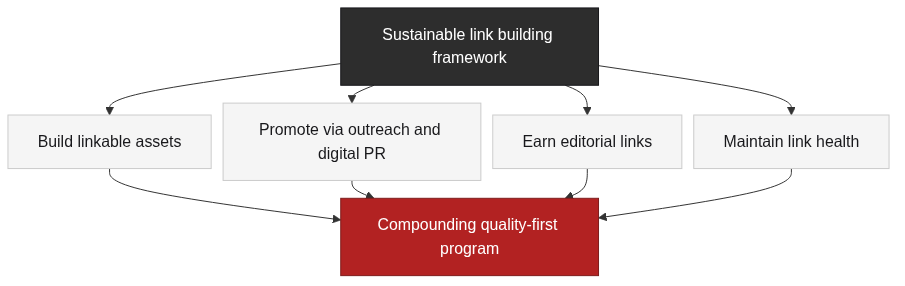
Once your checklist is in place, build the program around four stages:
- Build — Create genuinely linkable assets: original data, tools, or deep guides that people want to reference.
- Promote — Actively reach out through journalist outreach and digital PR to real editors and reporters.
- Earn — Let links come because the content is worth giving them, not because you bought them.
- Maintain — Continuously monitor link health and relevance (monitoring and upkeep, separate from a full audit or disavow workflow).
The Bottom Line: Earn Links Because They’re Worth Giving
White hat link building is not “another type of link” you select when you feel cautious. It’s the foundation of sustainable growth—the subset of link building built on content value and editorial discretion rather than manipulation. The market has already moved from volume to quality, and the tactics that fail the transparency and editorial tests are losing value while genuinely earned links are gaining it [1].
Your Next Step
Make the five-question checklist your default step before every link decision. Start by building one linkable asset, then promote it to real editors, and let the links follow because the content earns them. If you’d rather have a team handle the strategy and execution behind a compliant, content-driven program, we’d be glad to talk it through with you — explore how TraffiClimb approaches premium link building.
FAQ
References
Google Spam Policies for Web Search — Google’s official definition of link spam and link schemes, including buying/selling links, excessive exchanges, and automated link creation.
What Is a Link Scheme in SEO and How Does Google Spot It? — Explains the extended definition of link schemes, including excessive link exchanges and automated link building through software or services.
Google’s Backlink Policy in 2026 — Breaks down what Google’s guidelines say and enforce about link schemes and paid links that pass PageRank.