
Types of Backlinks: A Guide to Different Backlink Types in SEO
 Written by Alistair MacLeod
# Types of Backlinks: A Guide to Different Backlink Types in SEO
Most beginners assume that “backlink types” comes down to a simple dofollow versus nofollow choice — as if every link is either good or bad. It isn’t that clean. A single backlink can be contextual, editorial, dofollow, and acquired through a guest post all at the same time. In this guide to the different types of backlinks in SEO, we’ll break down the classification frameworks you’ll actually encounter, why no single label tells you a link’s value, and how to judge any link by the factors that matter.
The key idea to keep in mind: when you evaluate a backlink, look less at what it’s called and more at why it was placed, where it sits, and how it was earned. Types describe dimensions; they don’t measure quality.
What Counts as a Backlink Type?
Types of Backlinks: a backlink is simply a link from another website pointing to a page on yours. When people talk about “backlink types,” they’re usually grouping links along several independent dimensions — and this is where beginners get tripped up.
The beginner mistake: treating “type” as a single label
New SEOs often think a link is either a dofollow link or a nofollow link, period. In practice, one link can carry several attributes at once. Consider a link that:
- sits inside the body text of a highly relevant industry article (contextual),
- was added naturally by an editor who genuinely found your resource useful (editorial),
- passes PageRank because it carries no
relattribute (dofollow), - and was obtained through a guest post you pitched (guest post source).
That single link is simultaneously all four of those things. So when someone asks “what type of backlink is this?”, the honest answer is “it depends on which dimension you’re using to classify it.”
Two links that are both backlinks — but worlds apart
Compare a dofollow link placed naturally in the middle of a relevant article by an editor who chose it on merit, against a link sitting in the footer of 50 different sites, repeated on every page of each. Both are technically backlinks. Their value, however, is not remotely comparable.
The first earns an editorial vote in a relevant context. The second is a sitewide placement that Google has historically treated with suspicion when it appears in volume. The label “backlink” tells you nothing about which one you’re looking at.
The one-sentence framework
So here’s the mental model to carry through the rest of this guide: judge a link by why it was placed, where it lives, and how it was acquired — not by the name we give its type. The classification systems below are useful because they help you ask the right questions, not because they hand you a good/bad verdict.
Backlink Types by Attribute: Dofollow, Nofollow, Sponsored & UGC
This is the most fundamental — and most misunderstood — layer. These four categories come directly from Google’s official link attributes, and they describe the signal a link sends, not its quality.
The four Google link attributes, defined
Google recognizes four ways a link can be marked, and each tells the search engine something specific [1]:
- Dofollow — the default. A normal link with no special
relattribute, treated as a standard editorial endorsement. - Nofollow (
rel="nofollow") — signals that the link should not be treated as a vote for the target page. Typically used for user-generated content, paid placements, or links the site owner doesn’t want to endorse [1]. - Sponsored (
rel="sponsored") — marks links created through paid, sponsored, or advertising arrangements — in other words, “a vote obtained through a transaction” [1]. - UGC (
rel="ugc") — marks links inside user-generated content such as comments, forum posts, wikis, and community Q&A [1].
The key correction: nofollow is not “worthless”
Here’s where the conventional wisdom gets it wrong. In September 2019, Google introduced sponsored and ugc as new link attributes alongside the existing nofollow, and simultaneously announced that nofollow would no longer be ignored but instead treated as a hint when evaluating links [2]. That change matters: a nofollow link is no longer simply discarded.
All three attributes — nofollow, sponsored, and ugc — signal that Google should not treat the link’s PageRank flow as a normal editorial vote [1]. But “not a normal editorial vote” is not the same as “zero value.” Correctly marking a sponsored or UGC link is actually more compliant than leaving it unmarked and letting Google guess at its nature.
Comparing the four attribute signals
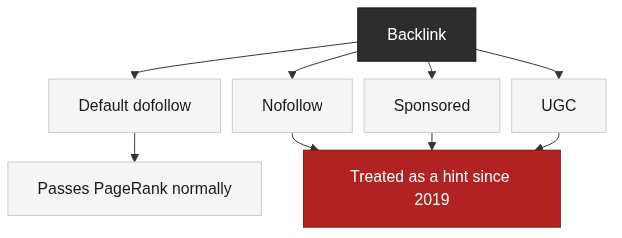
| Dimension | Dofollow | Nofollow | Sponsored | UGC |
|---|---|---|---|---|
| —— | ———- | ———- | ———– | —– |
| Google’s definition | Default, normal editorial vote | Signals “not a vote” | Signals “paid / sponsored / ad” | Signals “user-generated content” |
| Who adds it | Editor recommending a link freely | Owner not endorsing, or unsure | Paid, sponsored, or partnership links | Comments, forums, wikis, Q&A |
| PageRank treatment | Passes normally | Treated as a hint since 2019 | Treated as a hint | Treated as a hint |
| Compliance meaning | Must be genuine, no transaction | Must be marked honestly | Must be marked (unmarked paid links carry risk) | Must be marked |
| What it means for you | “Default” ≠ “better” | “No vote” ≠ “no value” | Paid links must be honest | Large UGC volumes can look like spam |
The takeaway for an SEO learner: don’t chase dofollow as if it were the only thing that matters. A relevant nofollow from a respected publication can still drive traffic and brand visibility, while a poorly placed dofollow from an irrelevant directory can do more harm than good. If you want the deeper distinction, our guide to dofollow vs nofollow links walks through the signal differences in detail, and our breakdown of sponsored and UGC attributes explains when each label is the right call.
Backlink Types by Source: Editorial, Guest Post, Digital PR & More
The second dimension groups links by where they come from — the origin or the way a link entered existence. This is where “earned” links get separated from actively acquired ones.
Editorial and natural links: the “earned” category
An editorial (or natural) link appears because an editor or author decided, on their own initiative and without a transaction, that your page deserved a mention. It’s the classic “earned” link. Because there’s no exchange involved, editorial links are tough to scale — you can’t order them by the dozen. But when they arrive, they tend to sit in relevant, authoritative context, which is why they’re prized for long-term, sustainable growth.
Actively acquired sources: guest posts, digital PR, niche edits
Guest posts, digital PR placements, and niche edits are all actively acquired sources — you invest effort (and sometimes resources) to make them happen:
- Guest post — you write an article for another site in exchange for a link back to yours.
- Digital PR — you create newsworthy content or data and pitch it to journalists and media outlets to earn coverage and links.
- Niche edit — you get a link added into an existing, already-published article on a relevant site.
The compliance and quality of these all hinge on the value of the content and its relevance — not on the method itself. We’re not going to teach you how to run these campaigns here (that’s a deeper topic), but it’s worth knowing they exist as distinct backlink types.
The key correction: “source” is not a “quality label”
A thin, irrelevant guest post placed on a weak site can easily be weaker than a single high-relevance editorial link. The reverse is also true: a highly relevant niche edit on an authoritative page can outperform a vague, generic editorial mention. The source tells you how the link came to be; it doesn’t hand you a quality verdict.
The value spectrum by source
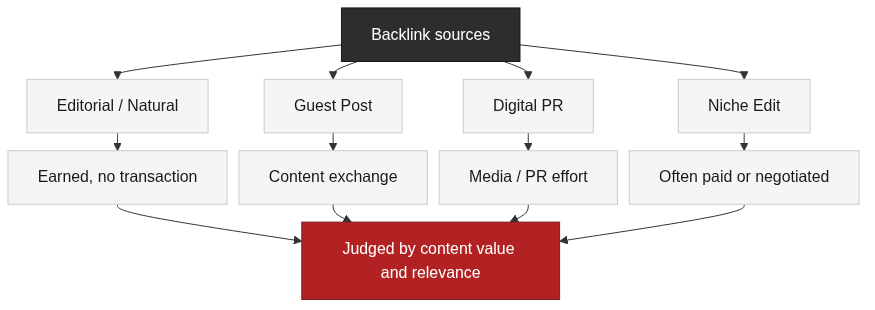
| Source type | Transaction | Typical quality signals | What to watch for | Best for |
|---|---|---|---|---|
| ———- | ———- | ————– | ————– | ——– |
| Editorial / Natural | None (earned) | Editor’s free choice, topical relevance, natural context | Hard to scale | Long-term, sustainable growth |
| Guest Post | Content exchange | Content quality, site relevance and authority | Thin sites, pure link drops | Mid-size sites with content teams |
| Digital PR | Media / PR effort | Authoritative outlets, newsworthiness | Requires sustained PR effort | Brands and growth teams |
| Niche Edit | Often paid / negotiated | Relevant sites, insertion into existing content | Need to judge content authenticity and relevance | Precision relevance |
| Forum / Comment | Often self-created | Low relevance, easily seen as spam | Very easy to be flagged | Not a primary strategy |
| Directory / Social Profile | Often self-created | Low value, diminishing returns | Bulk submissions cross red lines | Supplement only |
If you’re wondering where to even start building links, our link building strategies guide maps the full playbook, and our high-quality backlinks framework explains how to evaluate what you’re earning.
Backlink Types by Page Placement: Contextual, Image, Homepage & Sitewide
A third way to classify links is by where on the page they sit. Placement shapes how naturally a link reads and how much contextual relevance it carries.
Contextual and in-content links
A contextual (or in-content) link sits inside the body text of an article, surrounded by related content. Because the surrounding text gives the search engine clear topical context, contextual links are generally considered more valuable than links tucked away in page furniture. The anchor text and surrounding sentences both reinforce what the target page is about.
Image, homepage, and sitewide links
- Image link — the link is carried by an image’s anchor (the image itself points to your page). Its value depends heavily on whether the image’s alt text and surrounding context are relevant.
- Homepage — a link to the site’s homepage, which is usually the highest-authority page on a domain.
- Sitewide / footer / sidebar — links that repeat across many pages (or every page) of a site. Historically these were heavily abused, and large volumes of repeated sitewide and footer links have drawn algorithmic penalties.
The key correction: placement matters, but it’s not a rule
The idea that “sitewide is always bad and contextual is always good” is an oversimplification. A single sitewide link from a highly authoritative homepage can still carry real value, especially if the source site is relevant. What raises red flags is volume — dozens of sitewide or footer links from low-relevance sites, repeated across hundreds of pages. Judge the source quality and relevance first, then weigh the placement.
Placement differences at a glance
| Placement | Contextual relevance | Historical risk | What to check |
|---|---|---|---|
| ———- | ———– | ———- | ————– |
| Contextual / In-content | High (inside body text) | Low | Anchor text and topic relevance, natural context |
| Image | Medium (image anchor) | Medium | Image alt text and topic relevance |
| Homepage | Medium (highest-authority page) | Medium | Overall source-site authority |
| Sitewide / Footer / Sidebar | Low (repeated site-wide) | High (historically abused) | Watch for large-scale repetition |
Context and relevance are the real drivers here. For a deeper look at why topical fit matters, see our piece on relevant backlinks, and pair it with our high-quality backlinks guide for the full evaluation picture.
Backlink Types by Acquisition Method: Earned, Outreach, Paid & Self-Created
The fourth dimension describes how the link was obtained — the process that brought it into being.
Four acquisition routes
- Organic / earned — the link appears naturally because someone found your content and chose to reference it, with no outreach on your part.
- Outreach — you proactively contact site owners, editors, or journalists to request or pitch a link.
- Paid / negotiated — you pay for placement or negotiate an exchange (advertising, sponsorship, or a commercial arrangement).
- Self-created / link insert — you create the link yourself, for example in a directory listing, a comment, a social profile, or by inserting a link into existing content.
How acquisition maps to compliance
Acquisition method and compliance are tightly linked. Paid links must be correctly marked with rel="sponsored" so Google understands their nature — an unmarked paid link carries compliance risk [1]. Self-created links (directories, comments, social profiles) tend to carry low value and are easily judged as spam when done in volume, so they’re best treated as a minor supplement rather than a strategy.
The key correction: method describes “how,” not “how valuable”
The acquisition method tells you where a link came from, but the real determinants of value remain source quality and relevance. An earned link from a weak, irrelevant page is still weak. A carefully negotiated placement on a highly relevant authority site can be excellent. Don’t let the acquisition label substitute for judgment.
What Actually Determines the Quality of Different Types of Backlinks
After all these classification dimensions, here’s the central point: a link’s type is a descriptive dimension, but its quality is decided by a handful of core factors — source authority, topical relevance, anchor text, context, and whether the link is compliant (paid or spam-free).
The factors that matter more than the label
- Source authority — a link from a trusted, established domain carries far more weight than one from a thin or unknown site.
- Topical relevance — a link from a page about your subject area is more useful than one from an unrelated niche.
- Anchor text — the clickable text should describe the target page naturally and relevantly.
- Context — the surrounding content should relate to your page, not read as a forced insertion.
- Compliance — whether the link is paid, unmarked, or self-created in volume changes how Google treats it.
Google’s own guidance frames links as editorial votes whose value depends on exactly these qualities — the authority of the source, the topical relevance, the anchor text, the context, and whether the link is genuinely editorial versus paid or spam [3].
Why “good vs. bad” is the wrong lens
This is the heart of the whole discussion, and it’s also where a compliant, content-driven approach to link building earns its keep. No single type is inherently “good” or “bad.” A nofollow link can be valuable; a dofollow link can be worthless. A sitewide link from the right source can help; a contextual link from the wrong one can hurt. The label is a starting point for questions, not a verdict.
If you want to understand how the words you use on a link change its impact, our anchor text guide covers it in depth.
A Quick Checklist to Judge Any Backlink
Let’s turn the frameworks above into something you can actually use. Before you pursue, accept, or build a backlink, run it through this four-question checklist.
The four-question checklist
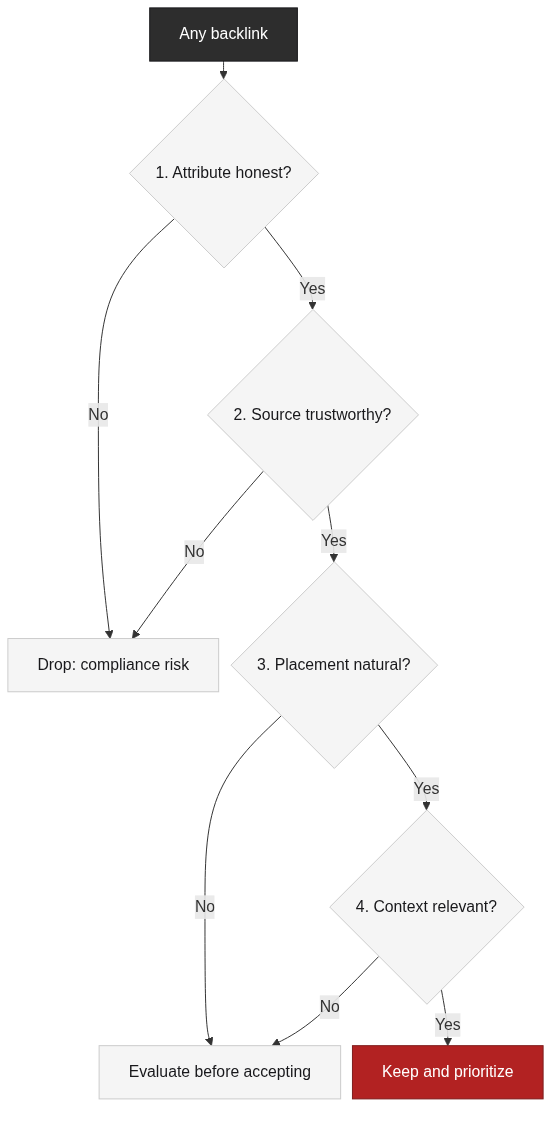
- Is the attribute honest? If it’s a paid or sponsored link, is it correctly marked with
rel="sponsored"? If it’s a user comment, is it markedrel="ugc"? An unmarked paid link is a compliance risk. - Is the source trustworthy? Is the source site relevant to your industry and genuinely authoritative — rather than part of a mass-produced site network?
- Is the placement natural? Is the link inside body-text context, or is it stacked in a footer, sidebar, or repeated site-wide?
- Is the context relevant? Does the anchor text and surrounding content relate to your target page, reading naturally rather than being forced in?
Reading the results
- All four pass → worth prioritizing.
- First three pass, but relevance is weak → keep it, but don’t treat it as a priority.
- The first two fail → consider dropping it; the compliance and trust risks outweigh the benefit.
Choosing types by business goal
| Your goal | Prioritize | Secondary | Avoid |
|---|---|---|---|
| ———- | ———- | ———- | —— |
| Build overall authority and sustainable growth | Editorial / Natural, Digital PR | Highly relevant Niche Edit | Bulk Directory / Comment |
| Quickly lift a specific keyword | Highly relevant Contextual Niche Edit | Relevant Guest Post | Generic sitewide placements |
| Small site / limited-resource start | Relevant Guest Post, Niche Edit | A few quality Directory listings | Bulk self-created links, site networks |
| Compliance-sensitive market (e.g., EU) | Honest links marked sponsored/ugc | Editorial | Any unmarked paid link |
Core Takeaway & Next Steps
If you take one thing from this guide, make it this: backlink types are descriptive dimensions, not quality labels. The actual value of a link comes from its source, its relevance, and its context — not from the category we file it under.
Where to go from here
Now that you understand the different types of backlinks in SEO, the natural next step is learning how to tell which links are worth building and which to avoid. Start with our high-quality backlinks framework to judge what’s genuinely valuable, and our relevant backlinks guide to understand why topical fit matters. When you’re ready to move from theory to action, our link building strategies guide walks you through a systematic approach.
A note on expectations
Building a sustainable link profile is a long-term effort, and no honest strategy promises fast wins or a fixed ranking position. What a compliant, content-driven approach does deliver is durable visibility and steady growth — which is exactly the type of foundation worth building on.
FAQ
References
Google Search Central Docs: Qualify outbound links — official definitions of nofollow, sponsored, and ugc, and how each signals PageRank treatment
Google Search Central Blog: Evolving “nofollow” – new ways to identify links — 2019 introduction of sponsored and ugc attributes and the change of nofollow to a hint
Google Search Central Docs: Backlinks — Google’s guidance on how the value of backlinks depends on source authority, relevance, anchor text, and context