Testimonial Link Building and Event Link Building: How to Earn Backlinks Through Events
 Written by Sanja Gajic
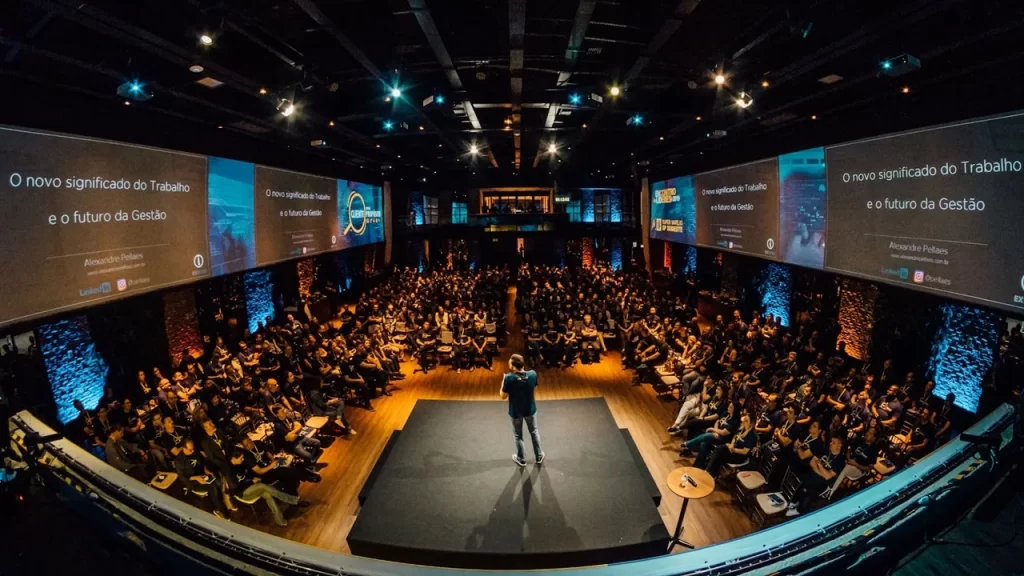
Most marketing teams treat an event as a line item on the acquisition spend: tickets sold, leads captured, brand impressions earned. That framing misses what may be the highest-leverage output of the whole enterprise. The same event that fills your pipeline can also batch-produce the type of links SEO teams spend months chasing one at a time. Testimonial link building follows the same earned-link principle: a genuine customer or partner endorsement can create a relevant third-party mention, while events create many such opportunities at once.
Event link building is the practice of treating hosted events, conferences, webinars, speaking slots, sponsorships, directories, and association memberships as link-acquisition scenarios. Done right, one event can generate event listings, partner mentions, speaker pages, media coverage, and recap content — each one a distinct, naturally earned backlink. This guide walks through the definition, the seven earning scenarios, the assets that convert event outputs into links, and a repeatable before/during/after workflow you can run for every event from here on.
Why Your Next Event Could Be Your Best Link Asset
Here is the direct answer: a single event is not one link opportunity — it is a batch of them. The same funding you already spend on an event can produce five to six distinct linkable assets, each pointing back to your site from a third-party domain you did not control.
Testimonial link building belongs in the same earned-link framework: a genuine customer or partner endorsement can create a relevant third-party mention, while an event can create several related mentions across organizers, directories, speakers, partners, and media.
Reframing the event spend — from marketing cost to a batch-produced link asset machine
When you fund an event, you are not only renting attention. You are also creating a set of pages and mentions that other people will build for you. An event page you host, a directory listing you submit, a speaker bio a conference publishes, a sponsor page a partner runs — all of these are links that get recorded, not requested. The shift is simple: stop counting only attendee ROI, and start counting the link assets each event produces.
The hidden gap: most teams count attendee ROI but overlook the 5–6 linkable assets every event generates
The gap is structural. Marketing teams measure signups, cost per lead, and post-event pipeline. SEO teams measure referring domains and anchor text. Rarely are the two reconciled. The result is that the same event quietly produces event listings, partner mentions, speaker pages, media coverage, and recap content — and nobody files them as backlinks. Closing that gap is the whole point of event link building.
What this guide covers — the seven earning scenarios and the full before/during/after workflow
We cover seven event scenarios that earn real backlinks, the assets that turn event outputs into links and media citations, a practical comparison to help you choose the right route, and a checklist-style workflow you can run before, during, and after every event. We deliberately keep this focused on link acquisition — not the full event marketing playbook.
What Is Event Link Building and Why It Works
Event link building is the practice of treating online and offline events as systematic link-acquisition scenarios, rather than as isolated marketing moments. Instead of chasing one link at a time through cold outreach, you design an event so that it naturally produces listings, partner mentions, speaker pages, media coverage, and recap content across third-party domains.
Definition — treating hosted events, conferences, webinars, speaking, sponsorship, directories, and associations as link-acquisition scenarios
Any event touchpoint that lives on a domain you do not own is a potential link source. A hosted event’s own page can be cited by industry calendars. A conference panel page lists your speaker and links to your site. A webinar registration page carries a guest bio. A sponsor page, a partner page, an association member directory, an event-directory listing — each of these is a distinct domain that mentions you because you participated. That is the working definition of event link building: engineering participation so that third parties record links to you.
Why event links are naturally editorial — third-party mentions that are hard to fake and align with search engine preferences
Search engines have long favored links that are earned rather than manufactured. Editorial links — those a third party adds because your participation or content is genuinely relevant — are the signal of trust that Google’s guidelines treat as distinct from paid or manipulated placements [1]. Event links are editorial by construction: a conference lists you as a speaker, a directory lists your event, a journalist cites your data report. None of these require you to ask for a link; they record one because you were there and you were relevant.
Event links vs. outreach links — earned and recorded, not requested
The distinction matters for both quality and risk. Outreach links are requested: you pitch a site, ask for a placement, and often negotiate the anchor text. Event links are recorded: the conference, directory, association, or media outlet adds the mention as a natural part of its own content. That makes event links harder to fake, more aligned with how search engines evaluate trust, and less exposed to the risk of manufactured, low-value placements.
The Seven Event Scenarios That Earn Real Backlinks
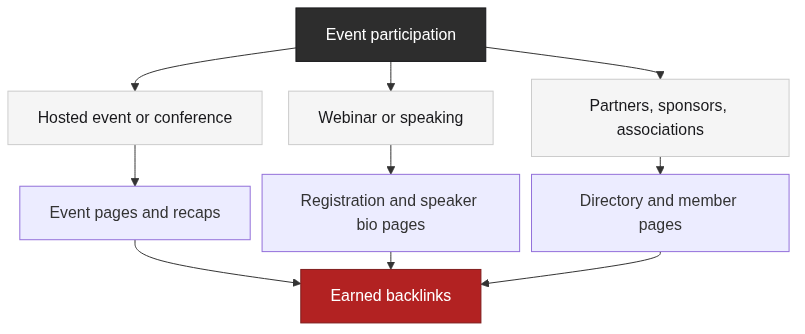
There are seven event scenarios that reliably produce backlinks. The tradeoffs differ by effort, link certainty, and fit, but every one of them can be turned into a repeatable source of editorial links.
Hosted events and conferences — event pages, session pages, and recaps as linkable assets
When you host an event, the event page on your domain becomes a linkable asset that industry calendars, media, and attendee blogs can cite. When you participate in a conference, the organizer’s event page, panel or session page, and the conference recap all become third-party domains that can link back to you. Hosted events give you the most control over the asset, while conference participation gives you the most natural, editorial links.
Webinars and speaking — registration, replay, guest, and speaker bio pages
Webinars generate registration pages, replay pages, and guest-bio pages — each a linkable surface, especially when you co-host with a partner. Speaking is the single most underestimated route. When you speak at an event, the organizer publishes a speaker bio page that naturally carries a link to your site. You do not ask for it; it is part of how organizers present speakers. For a team with a credible expert, speaking is often the highest-certainty path to an editorial link.
Event directories, partners/sponsors, and associations — listings, partner pages, and member directories
Event directories such as 10times, Eventbrite, and industry calendars accept event submissions and publish listing pages that link to the event. Partner and sponsor pages run on the organizer’s domain and link to your brand. Association memberships produce member directories, event pages, and activity listings on the association’s site. These routes tend to be lower-effort and more predictable, though the link value depends heavily on the context and traffic of the page that hosts the mention.
Turning Event Outputs Into Linkable Assets and Media Coverage
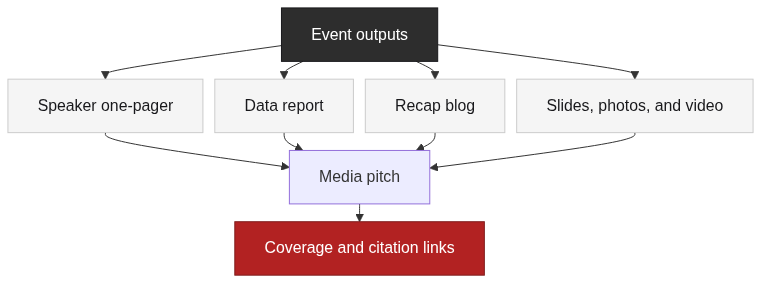
The event itself is only the first half. The second half is converting what the event produced — data, visuals, talks, and stories — into assets that earn links long after the event ends.
Event assets — speaker one-pagers, data reports, recap blogs, slide decks, and photo/video pages
Every event leaves behind raw material you can package into linkable assets: a speaker one-pager, a data report drawn from attendee responses, a recap blog, a slide deck, and a photo or video page. These assets do two jobs. Internally, they give you something worth linking to from your own recap and from outreach. Externally, they give journalists and industry blogs something worth citing. A recap blog that links back to your event page is itself a link; a data report is the type of asset other sites link to on their own.
Using Digital PR to push the event story to industry media for coverage and citation links
An event is a story, and stories are what earn media coverage. If you package the event’s data, a notable speaker, or a surprising audience insight into a pitch, you give industry media a reason to cover it — and coverage pages carry citation links back to your site. This is where event link building and Digital PR overlap: the event gives you a fresh, newsworthy hook, and the PR push converts that hook into third-party citations. We keep the full Digital PR workflow in its own guide; here, the point is that the event is the raw material that makes the pitch credible.
Why contextual, high-traffic, relevant links beat controllable but isolated ones
Not all event links are equal. A link on a relevant, high-traffic, contextual page — a well-read industry publication citing your data, a niche directory your audience actually uses — is worth far more than a controllable but isolated link buried in a low-context sponsor list. When you choose between event routes, prioritize the link that sits in a natural narrative on a page your target audience reads, even if you have less control over its exact placement.
The Before, During, and After Event Link-Building Workflow
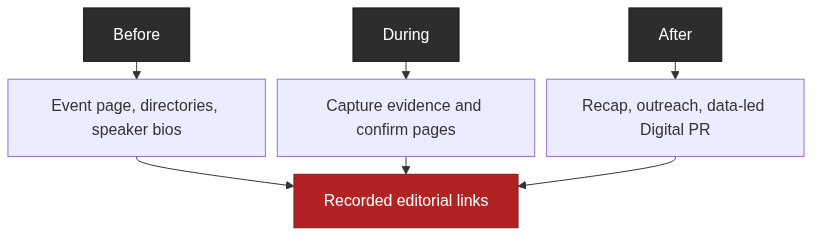
The repeatable part of event link building is not the event — it is the workflow around it. Run this before/during/after sequence for every event and you turn a one-off into a standard operating procedure.
Before the event — build the linkable event page, submit to directories, prep speaker bios, and brief PR contacts
Before the event, lay the groundwork for links. Publish a linkable event page with dates, agenda, speakers, and a clear call to action. Submit the event to the directories and industry calendars your audience uses. Prepare speaker bios that include your site and a relevant service page, so organizers can link correctly. Brief your PR contacts on the story angle and the data you plan to release. Each of these steps creates a surface that will earn a link later.
During the event — collect attendee lists, capture reusable visuals, and confirm speaker/sponsor pages go live
During the event, capture what you will need afterward. Collect attendee lists and consent for follow-up so your recap outreach has a target audience. Capture reusable visuals — photos, screenshots, and data points — that can feed a recap or a data report. And confirm with organizers that your speaker and sponsor pages actually went live with the correct link. This is the moment a recorded link either happens or gets lost.
After the event — publish the recap, run recap outreach, and package event data into a Digital PR asset
After the event, convert the outputs into links. Publish a recap blog that links back to the event page and the assets you created. Run recap outreach to attendees, speakers, and partners, sharing the recap so they link to it from their own channels. And package the event data into a linkable asset — an industry data report, for example — then push it through Digital PR to earn media citations. This after-phase is where most of the actual links accumulate.
Choosing the Right Event Type: A Practical Comparison
Not every event type fits every team. The decision comes down to how much effort you can invest, how certain you need the link to be, and what your audience values.
Scenario comparison matrix — effort, link certainty, and fit across hosted, speaking, webinar, sponsorship, and association routes
| Event type | Primary link assets | Typical link types | Effort | Link certainty | Best fit |
|---|---|---|---|---|---|
| Hosted event | Event page, recap, data report | Industry calendars, media, attendee blogs | High | Medium-high (most control) | Brands with content/PR teams |
| Conference speaking | Speaker bio, session page, conference recap | Organizer pages, media, peer blogs | Medium | High (easiest editorial link) | Teams with credible experts |
| Webinar | Registration, replay, guest-bio pages | Co-hosts, attendee blogs | Low | Medium | Teams building authority with limited spend |
| Sponsorship | Sponsor page, partner page | Organizer, industry directories | Medium | High (but assess context) | Teams with funding seeking stable mentions |
| Association | Member page, event page, member directory | Association site, member aggregators | Low | Medium-high | Teams deep in a vertical |
Speaking vs. sponsorship — the quality-versus-control tradeoff and how to decide
Speaking and sponsorship sit at opposite ends of a tradeoff. Speaking earns the most natural, editorial link — the organizer lists you because you add value — but you do not control the anchor text or placement; organizers typically link your brand name. Sponsorship gives you more control over placement and anchor, but if the page is a bare sponsor list with no surrounding context, the link may carry less weight and look less natural. The decision rule: prefer the link that sits in context with real traffic and relevance, even if you control it less.
The five-dimension link quality checklist — relevance, traffic, context, indexability, and anchor naturalness
Whatever route you choose, evaluate every event link against five dimensions before you count it as a win:
- Relevance — does the page’s topic match your industry or service?
- Traffic and authority — does the page have real visitors and a credible domain?
- Context — is the link embedded in natural narrative, not an isolated list?
- Indexability — will search engines actually crawl and index the page?
- Anchor naturalness — does the anchor read like a brand or descriptive mention, not a forced keyword?
A link that scores well on all five is a strong editorial link. One that scores well on control but poorly on context may not be worth the cost.
Core Takeaways and Your Next Step
Event link building is not a separate, exotic tactic. It is a way of looking at work you are probably already doing and extracting the link value from it.
Recapping the event link-building playbook — from the seven scenarios to the repeatable workflow
The playbook is straightforward: treat events as link-acquisition scenarios, pick from the seven routes based on your effort and link-certainty needs, convert event outputs into linkable assets, and run the before/during/after workflow every time. The result is a stream of editorial links that are earned and recorded — not requested — which is exactly the type of signal search engines reward.
Start with one event, build the assets, and scale into a repeatable SOP
You do not need a large outlay to start. Pick one event — a webinar, a directory submission, a single speaking slot — and run the full workflow around it. Build the event page, capture the assets, publish the recap, and record every link you earned. Once one event proves the process, package it into a standard operating procedure and scale it across your calendar. If you want to see how this fits into a broader acquisition engine, our guide to Link Building Strategies is the natural next read, along with Link Building Outreach for the outreach half of the loop.
When you’re ready for a full link building campaign, we can help
Running events while also running a full link building program is a lot to hold. When you are ready to scale beyond what your team can manage in-house, our Link Building Services are built around the same principles this guide covers — compliant, content-driven, premium placements that drive sustainable growth. You bring the strategy; we help you execute the campaign end to end.
FAQ
What is event link building?
Event link building is the practice of treating hosted events, conferences, webinars, speaking slots, sponsorships, event directories, and association memberships as systematic link-acquisition scenarios. Each participation point — a speaker bio, a directory listing, a sponsor page, a recap — becomes a naturally earned backlink from a third-party domain.
How many backlinks can one event generate?
There is no fixed number, and the exact count varies by event type and promotion effort. A single event can realistically produce several distinct link types — an event listing, a partner mention, a speaker page, media coverage, and recap content — but the value depends on the context, traffic, and relevance of each page that hosts the mention.
Are event backlinks better than outreach backlinks?
Event links tend to be more naturally editorial because a third party records them as part of its own content rather than because you requested a placement. That alignment with how search engines evaluate trust makes event links valuable, but the strongest results come from combining event-based links with a well-run outreach program.
Do I need to attend conferences to do event link building?
No. Webinars, hosted events, directory submissions, and association memberships all work without travel. Speaking at conferences is a high-certainty route if you have a credible expert, but the lower-effort routes — directories, webinars, associations — can be just as effective for teams with limited spend.
How do I measure the results of event link building?
Track the referring domains each event produces, the context and relevance of each page, and whether the links are indexed. You can also compare the authority and traffic of the linking pages against the five-dimension checklist — relevance, traffic, context, indexability, and anchor naturalness — rather than counting raw link volume alone.
Is event sponsorship worth it for links alone?
Sponsorship can produce stable, controllable links, but only if the sponsor page has real context and traffic. If the page is a bare sponsor list with no surrounding narrative, the link may carry less weight. Assess the page’s relevance, traffic, and context before treating a sponsorship link as a win.
How long does event link building take to show results?
Because event links accumulate through the before/during/after workflow — and media and directory citations can keep appearing for months after the event — results typically build over weeks to a few months rather than in a single day. The recap and data-report phase is where most links accumulate, so plan time for that after-phase.