
Startup Link Building: Strategies for Early-Stage Companies
 Written by Warren Reed

Your product just shipped. Your site has ten blog posts, zero high-quality backlinks, and your competitors are already occupying the first page through PR and guest posts. You have roughly $1,000 a month to change that. What do you do first?
Most founders answer that question wrong. They assume startup link building means buying links and stacking volume, so they funnel their limited capital into weak directories and low-value placements. Three months later, nothing has moved. The real problem isn’t execution — it’s selection. When resources are scarce, choosing and prioritizing the right methods matters more than doing more of everything.
This guide gives you a practical priority framework for startup link building: which pages deserve your first links, why founder expertise is your most undervalued asset, how to sequence campaigns by stage, and a decision checklist you can use before you spend a single dollar. Let’s start with why most startups get this wrong.
Why Most Startup Link Building Fails
Most early-stage link building doesn’t fail because the team is lazy. It fails because the strategy is built on a false premise: that more links automatically mean more authority.
The $1,000-a-month dilemma every early-stage founder faces
When your monthly spend is tight, every decision carries real opportunity cost. One overpriced placement can eat a third of your month’s allocation. A batch of weak links can waste even more. The temptation is to spread thin — a handful of links here, a handful there — so that at least you’re “doing something.” That instinct is exactly what keeps startups stuck.
The common misconception: link building equals buying links and stacking volume
The belief that link building is a numbers game is the most expensive myth in early-stage SEO. In practice, search engines have spent years devaluing volume-based link schemes and rewarding relevance and editorial trust instead [1]. A single editorial link from a genuinely relevant publication carries more weight than a dozen placements from sites nobody reads. For a startup with scarce capital, that distinction is the difference between a strategy that compounds and one that burns cash.
The real promise: choosing and prioritizing the right methods under resource constraints
The honest promise of startup link building is not “get more links.” It’s “get the right links, in the right order, with the least waste.” Because your constraints are unique, your playbook has to be unique too. The rest of this article is a framework for that — starting with the three constraints that force you to be selective.
The Three Startup Constraints That Make Selection Matter
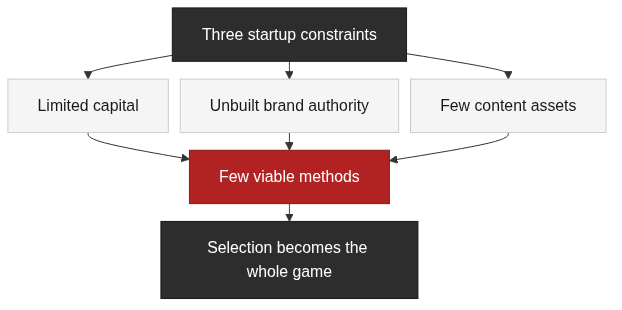
A mature company can run PR, content marketing, and guest posting in parallel because it has the team and the cash. A startup cannot. Three specific constraints make method selection the whole game.
Limited capital, unbuilt brand authority, and few content assets
Early-stage companies operate under three simultaneous limits: a small monthly spend, no established brand authority, and a thin library of content assets. Each one narrows your options. Limited capital rules out expensive campaigns. Unbuilt authority means high-authority sites have no reason to link to you yet. Few assets mean you can’t manufacture dozens of linkable pages on demand. These aren’t minor obstacles — they define which methods are even viable [2].
Why you can’t copy a mature company’s high-spend playbook
Copying a mature competitor’s approach is a trap. Their scaled PR machine works because they already have brand recognition, a large content engine, and capital to absorb slow returns. When you replicate that playbook with a fraction of the resources, the results don’t scale down proportionally — they collapse. What works for a company with an established name simply isn’t available to one that’s still earning its first links.
Concentrating scarce resources on the few actions that build trust and earn first links
The solution is concentration. Instead of spreading thin, you focus your limited capital and effort on the handful of actions most likely to build initial trust and earn your first high-quality links. That means choosing methods that are low-cost, highly relevant, and fast to show results — and deferring the expensive, slow-burn tactics until you have the authority to make them work.
Which Pages Deserve Your First Links
Where you point your links matters as much as how you earn them. With few assets, you can’t afford to scatter links across your whole site.
Prioritize money pages and high-converting pages over blog pages
Your first links should point at the pages that directly drive conversion: product pages, pricing pages, core feature pages, and key landing pages. These are the pages that turn authority into revenue. Blog pages support discovery, but they rarely convert on their own — and for a startup with limited assets, every link should pull its weight commercially.
Fewer strong links to 3 money pages beats weak links to 20 posts
The math is simple. Twenty blog posts each earning one weak link is a diluted effort that moves nothing. Three money pages each earning two or three strong, relevant links is a concentrated effort that can move rankings. When your content library is small, focus is your only scalable advantage.
How this maps to your “few content assets” constraint
This maps directly to the constraint of having few assets. You don’t need to produce dozens of posts to get started. You need to identify your three or four highest-value pages and build authority toward them first. That turns a weakness — a thin site — into a strength: a tight cluster of pages worth linking to.
Founder Expertise and Launch Stories: Your Most Undervalued Asset
If you have limited capital and few assets, you might assume you have nothing to offer the media. You’d be wrong. You have something most mature companies can’t easily replicate: a real founder, a real product, and a real story.
Why media and industry blogs cite real people and real stories
Journalists and industry blogs routinely cite real people with real experiences because those stories are credible, quotable, and differentiated. A founder who shares a candid launch story, a product post-mortem, or a hard-won lesson gives publications a reason to mention your company — and to link to it. This is a form of “content currency” that costs almost nothing to produce [3].
Founder viewpoint, product launch stories, and post-mortems as content currency
Founder expertise is the closest thing a startup has to a natural linkable asset. A well-told launch story, a transparent post-mortem, or a pointed industry opinion positions you as a source worth citing. Media and blogs don’t just link to data — they link to people who say something worth referencing. That’s an asset you can create with a few hours of writing instead of a large content investment.
Near-zero content production cost, naturally matching a tight spend
This path matches your constraints perfectly. It requires almost no cash, only your time and perspective. It’s highly relevant, because your story is unique to your niche. And it directly builds the brand authority you don’t yet have. For early-stage teams, founder expertise should be one of the first campaigns you run, not an afterthought.
Prioritize by Stage: What to Do at 0-3, 3-6, and 6+ Months
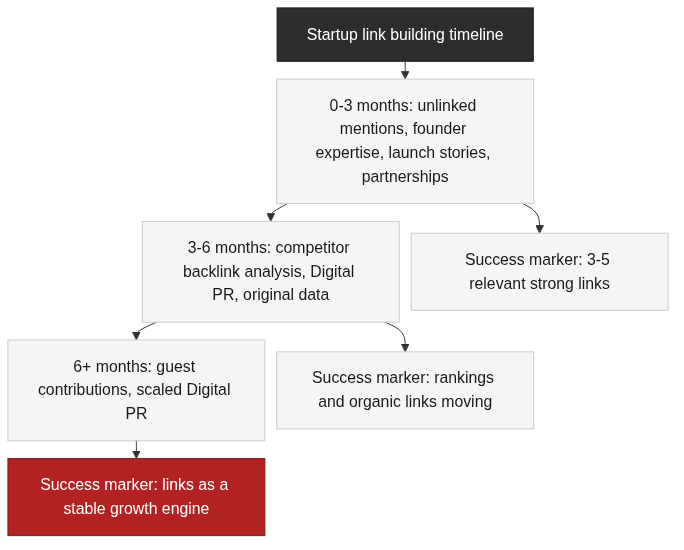
Startup link building is not a single campaign — it’s a sequence. Each stage has a different goal, and the methods you should prioritize change as your authority grows. Expect meaningful impact to take three to six months, so set expectations accordingly [4].
Early stage (0-3 months): unlinked mentions, founder expertise, launch stories, partnerships
In the first three months, your goal is to build initial trust and earn your first high-quality links. Prioritize methods that are low-cost, highly relevant, and fast:
- Unlinked brand mentions: find where your brand (or your founders) is mentioned without a link, then ask for the link. This is one of the fastest and most relevant wins available [3].
- Founder expertise and launch stories: publish and pitch your founder narrative to relevant publications.
- Partnerships: collaborate with complementary brands or communities for mutual, relevant links.
Your success marker here is 3-5 relevant strong links in place. Keep the scope tight; spreading thin is the biggest early-stage risk.
Mid stage (3-6 months): competitor backlink analysis, Digital PR, original data, linkable assets
Once you have initial authority, start building scale. This is when you begin investing in content:
- Competitor backlink analysis: study where your competitors earn links, then target the same relevant sources [5].
- Digital PR: pitch stories and angles to relevant media to earn editorial coverage [6].
- Original data and linkable assets: create a piece of original research or a genuinely useful resource that others naturally want to cite.
Your success marker here is rankings starting to move and organic links beginning to appear.
Late stage (6+ months): guest contributions and scaled Digital PR
At six months and beyond, you have accumulated authority you can amplify. This is the stage for guest contributions on reputable industry sites and scaled Digital PR campaigns. Because you’ve built relevance and trust, these placements now convert into sustained growth rather than isolated wins. Your success marker is links becoming a stable growth engine.
Relevance and quality above all, compliance first, throughout
Across every stage, two principles hold constant. Relevance beats volume: a link from a site your audience actually reads is worth far more than a link from an unrelated high-authority domain. And compliance comes first: every placement should follow search engine guidelines, because one risky link can undo months of progress [1]. Quality is not negotiable — it’s the entire strategy.
A Practical Decision Framework for Startup Link Building
By now you understand why selection matters. Here’s a repeatable framework for deciding what to do — before you spend anything.
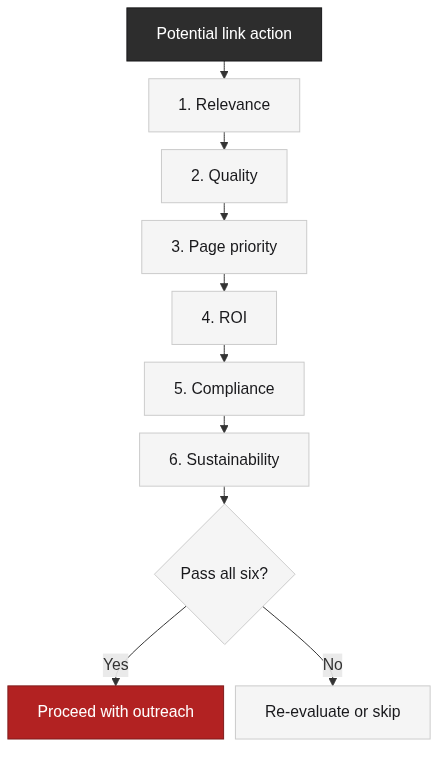
The “decide before you build” checklist: relevance, quality, page priority, ROI, compliance, sustainability
Run every potential action through this six-point checklist:
- Relevance: Does this target site’s audience overlap with your product or content? If not, skip it.
- Quality: Is this a real editorial site or a link directory? Filter out anything that isn’t genuine.
- Page priority: Which page does this link point to? Prioritize money pages over blog pages.
- ROI: Does the cost of earning this link justify its expected value? With limited capital, you must rank every option.
- Compliance: Does this placement follow search engine guidelines? Compliance comes first.
- Sustainability: Is this a one-off transaction or a reusable asset (like a founder story or original data)? Prioritize reusable assets.
Method selection matrix for startups
Use this matrix to match each method to your stage and constraints:
| Method | Cost | Relevance | Speed | Stage fit | Startup fit |
|---|---|---|---|---|---|
| ——– | —— | ———– | ——- | ———– | ————- |
| Unlinked mentions | Low | High | Fast | Early | ★★★★★ |
| Founder expertise | Low | High | Medium | Early | ★★★★★ |
| Product/launch stories | Low | High | Medium | Early | ★★★★★ |
| Partnerships | Low | Medium | Medium | Early | ★★★★ |
| Competitor backlink analysis | Medium | High | Medium | Mid | ★★★★ |
| Digital PR | Medium-high | High | Slow | Mid | ★★★ |
| Original data / linkable assets | High | High | Slow | Mid | ★★★ |
| Guest contributions | Medium | Medium | Medium | Late | ★★★ |
Scenario comparison: startup vs. mature company
| Dimension | Startup | Mature company |
|---|---|---|
| ———– | ——— | —————- |
| Capital | Limited, must rank by ROI | Ample, can run parallel lines |
| Brand authority | Unbuilt, must earn trust first | Established, links easier to earn |
| Content assets | Few, must focus on money pages | Many, can spread wide |
| Best path | Founder stories + precise strong links | Scaled PR + content marketing |
| Partner choice | Value strategy + content integration | Value scale + delivery speed |
Core Takeaways and Your Next Step
The one-sentence summary: selection beats execution when resources are limited
When capital, authority, and content are all scarce, choosing the right few actions beats executing many mediocre ones. Startup link building is a discipline of prioritization, not volume.
A phased action plan for your first 90 days
- Weeks 1-2: Identify your 3-4 money pages and set up unlinked-mention tracking.
- Weeks 3-6: Run unlinked-mention outreach and publish your first founder story or launch post-mortem.
- Weeks 7-12: Pitch your founder narrative to relevant publications and form one or two partnerships.
- Success marker: 3-5 relevant strong links pointing at your money pages.
When to outsource link building — and how to choose the right strategic partner
As you move into the mid and late stages, scaling becomes harder to do alone. That’s the natural point to consider outsourcing. When you do, choose a partner by strategy and content integration, not raw link volume — a partner who works alongside your team, follows compliance-first practices, and treats your campaign as a partnership rather than a transaction. That’s how sustainable growth is built. If you’re ready to scale your outreach, explore how a dedicated link building campaign or a Digital PR program could fit your next stage.