
Skyscraper Technique: How to Build Better Content and Earn Backlinks
 Written by Sanja Gajic

Most teams describe the skyscraper technique as “find a page that ranks, then write something longer.” That is precisely why it fails. The skyscraper technique is not a word-count strategy. It is an evidence-driven workflow: you find content the market has already proven link-worthy, understand exactly why it earned those links, build a version that is genuinely and visibly better, then reach the people who already voted for the original with their links. When you treat it that way, it remains one of the most reliable link building playbooks in SEO.
What the Skyscraper Technique Really Is
The name comes from an analogy: instead of building a taller version of an existing building, you find the tallest building in the neighborhood and raise the bar on top of it. In practical terms, you take a topic where strong, heavily-linked content already exists and deliver a meaningfully superior asset. The skyscraper technique is fundamentally a method for lowering the reasons a prospect would say no.
Why “Write Longer” Is the Wrong Mental Model
If the whole technique were “make it longer,” every long blog post would rank and earn links. It does not work that way. Length without added value produces pages that are harder to scan, slower to load, and indistinguishable from the thousands of other padded articles on the same subject. When the only differentiator is word count, prospects have no reason to replace an existing citation. The skyscraper technique fails at the moment you reduce it to content padding.
The Definition, as Brian Dean Framed It
The skyscraper technique was introduced by Brian Dean on Backlinko in 2015 [1]. The original method has three steps:
- Find content that has already accumulated a significant number of backlinks—content the market has effectively endorsed.
- Create something genuinely better—not just longer, but more complete, more current, more usable, and ideally backed by original data.
- Reach out to the people who linked to the original piece and show them the improved version.
The two words that carry the method are “proven” and “genuinely better.” The first means you are not guessing what earns links; you are reading the evidence left by the market. The second means the improvement must be real and perceptible, not cosmetic.
What This Guide Covers (and What It Does Not)
This guide walks through the full skyscraper workflow end to end: finding proven link-worthy content, reading backlink and referring-domain signals, diagnosing why the original earned links, defining “better” across seven actionable dimensions, building the improved asset, identifying the right prospects, and running a Skyscraper-specific outreach. It is deliberately not a general content optimization guide, and it does not expand into a full link prospecting or outreach email tutorial—those deserve their own walkthroughs. The focus stays on the logic that makes the technique work.
How the Technique Works: The Three-Step Logic
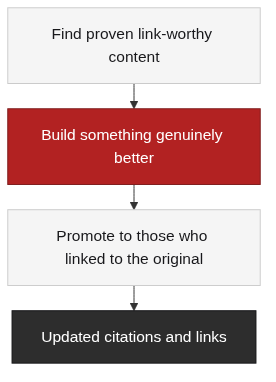
The skyscraper technique is a closed loop, and each step feeds the next. Skipping any one of them collapses the whole method.
Step 1: Find Content the Market Has Proven Link-Worthy
The first step is to locate the “skyscraper”—the single piece of content in your niche that has already accumulated the most referring domains. You are not looking for the best-ranking page, because rankings can be driven by site authority, internal links, or a strong domain. You are looking for the page that other sites have actively chosen to cite. That choice is the signal that matters. A page with a high number of distinct referring domains has been repeatedly endorsed by independent publishers, which makes it the strongest available candidate for improvement.
Step 2: Build Something Genuinely Better
The second step is where most executions fall apart. “Better” means the improved asset is visibly superior across dimensions the original ignores: fresher data, corrected errors, deeper coverage, original research, real examples, better UX, clearer structure, and stronger visuals. The improvement must be perceptible at a glance, because that is what gives your outreach a reason to exist. If a prospect cannot see why your version is better within a few seconds, there is no reason for them to swap their existing citation.
Step 3: Promote to the People Who Already Linked to the Original
The third step is precise, not broad. The highest-converting prospects are the people who already linked to the original content. They have already decided the topic is worth citing; they simply cited an older or weaker version. When you reach them with a clearly better asset, you are offering an upgrade rather than asking them to adopt something new. This is why the skyscraper technique has a built-in targeting advantage over cold, unrelated outreach.
Finding Proven Link-Worthy Content
Before you can build anything, you need to identify the piece of content worth outdoing. This step is about reading the market’s existing vote.
Sort by Referring Domains, Not Total Backlinks
The core signal is referring domains—the number of distinct websites linking to a page—rather than the raw total of backlinks. A single site linking to the same page hundreds of times is far less meaningful than a hundred different sites each linking once. When you sort candidate content by referring domains, you surface the pages that genuinely resonate across many independent publishers. Tools such as Ahrefs Site Explorer and Semrush Backlink Analytics let you inspect a page’s backlinks and referring domains and identify which pages in a niche attract the most distinct citations [2][4].
Read the Backlink Signals Carefully
Raw numbers are only the start. To pick the right target, examine the quality of the links behind the count:
- Authority of referring sites: A link from an established industry publication carries far more weight and is harder to replicate than a link from a low-authority directory. Prioritize content cited by authoritative, relevant sources.
- Context and relevance: Is the link placed inside content that is topically related, or is it a generic footer or sidebar placement? Links from relevant on-page context indicate genuine editorial endorsement.
- Anchor text diversity: A natural profile uses varied anchor text. If nearly every link uses the same exact-match anchor, that is a red flag rather than a strength.
- Referral pattern over time: A page still earning new referring domains is a better target than one that peaked years ago and has gone quiet.
Screen for a Real Improvement Window
Not every heavily-linked page is a good skyscraper target. The candidate should be one you can genuinely outdo. Ask whether the original is outdated, incomplete, poorly structured, or lacking original data—if the answer is no on every dimension, the improvement window is too small to justify the effort. The best targets are strong pages with clear, addressable weaknesses.
Diagnosing Why the Original Earned Links
Once you have a candidate, stop and diagnose. You cannot build something “better” until you know precisely what made the original successful in the first place.
Attribute the Success to a Specific Cause
Work through the likely reasons the original earned links: Is it built on original data no one else has? Is it a comprehensive list or resource that other writers naturally cite? Does it capture a time-sensitive topic that publishers keep referencing? Is it structured so that it is easy to quote and cite? Naming the root cause tells you what to preserve and what to outdo.
Write Three Concrete Gaps or Opportunities
Translate the diagnosis into at least three specific, addressable gaps. For example: the original is three years out of date on a fast-moving statistic; it misses a set of edge cases your audience cares about; or its data is not available in a form others can copy or reuse. These three gaps become the input for your “better” definition. If you cannot name at least three, you have not diagnosed deeply enough.
Judge Whether the Success Is Replicable
Finally, decide whether the original’s success can be transplanted and scaled. If the page earned links because of genuinely original data only the author can produce, you may not be able to replicate it—and the skyscraper technique may not be your best route. If the success came from structure, freshness, or completeness, those are replicable advantages you can amplify.
Defining “Better”: Seven Actionable Dimensions
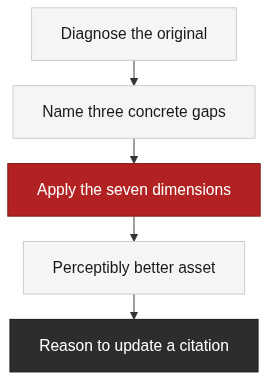
“Better” is a checklist, not a feeling. Here are the seven dimensions that, in combination, define a genuinely superior asset.
Freshness and Accuracy
Outdated content is the single largest opportunity in most niches. Update every statistic, claim, and example to the current state, and correct the errors the original got wrong. Accuracy also means covering the edge cases the original omitted. If the original is two years old and your industry changes monthly, freshness alone can justify the swap.
Depth and Original Data
Depth means more complete coverage measured by information value, not word count. The skyscraper technique explicitly rejects the idea that longer content is automatically better content [3]. The strongest differentiator in a crowded niche is original data—first-party research, a survey, an analysis of a dataset, or hands-on testing no one else has done. Original data is difficult to replicate, which makes it the most defensible form of “better” in 2026.
Examples, UX and Structure, and Visuals
- Examples: Real, specific, reusable examples are far more valuable than abstract advice. Show the reader exactly how something works.
- UX and structure: A clear table of contents, logical headings, scannable sections, and sensible internal links make the page easier to use than a wall of text.
- Visuals: Charts, diagrams, and copy-paste-ready tables or templates make the content quotable and linkable.
The Key Principle: Improvement Must Be Perceptible
Every improvement you make must be visible to a prospect within seconds of opening your page. If the improvement is not immediately apparent, your outreach has no hook. And to be explicit: a longer article is not automatically a better article. Length is only one lever, and usually the weakest one.
Building the Improved Asset and Identifying Prospects
With the diagnosis and the seven dimensions in hand, you build the asset and line up the people who should see it.
Create the Improved Asset Around the Seven Dimensions
Build the landing page by systematically applying the seven dimensions to the gaps you identified. Ensure the page has enough depth to genuinely support incoming links—a shallow page gives a prospect nothing to cite. Confirm that the original data, structure, and visuals are all present and that the improvement is obvious at a glance. This is the moment where the skyscraper technique either succeeds or dies: the asset must be worth linking to on its own merits.
Identify High-Conversion Prospects
The best prospects are the sites and writers who already linked to the original content. They have already voted for the topic, which makes them measurably more likely to update their citation than a cold contact. Use the backlink data you gathered to list everyone who linked to the original, then cross-check against the tools to confirm topical relevance and current activity. Filter out irrelevant or weak placements and keep the list focused.
Skyscraper-Specific Outreach, in Brief
The outreach message for the skyscraper technique is fundamentally different from a generic link request. You are not asking for a favor; you are offering an upgrade. The pitch is essentially: “We built a clearly better version of a resource you already cite—you may want to update your link.” Because the prospect already linked to the topic, the relevance question is already answered. This is a high-level overview; the full mechanics of prospecting and outreach deserve their own dedicated guides.
When the Technique Works, When It Fails, and a Pre-Launch Checklist
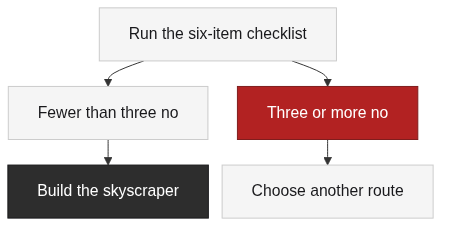
The skyscraper technique is powerful but not universal. It works in specific conditions and fails in others.
Decision Matrix: When It Works vs. When It Fails
| Judgment dimension | Works (✅) | Fails (❌) |
|---|---|---|
| Winner content | A clear, persistently-linked list, resource, or data page exists | No clear winner, or the winner is already saturated |
| Topic activity | Topic is still searched, cited, and regularly updated | Topic is too narrow, dated, or has no link targets |
| Target site depth | Your site has enough content to host and support the link | The landing page is thin and gives nothing to cite |
| Differentiation | You can add original data, first-hand experience, or better UX | The niche has been repeatedly skyscrapered with no real gap left |
| Outreach relevance | You can precisely reach people who linked to the original | You can only blast broadly, with weak topical relevance |
Common Mistakes
- Only adding length, not value. Padding a page without improving any real dimension produces nothing worth linking.
- Chasing total backlinks instead of referring domains. A high raw count from one or two sites is not the same as broad endorsement.
- Blasting unrelated prospects. Reaching out to sites with no topical connection wastes effort and burns goodwill.
- Ignoring the landing page’s ability to host the link. If the improved asset is too shallow to support a citation, the outreach has nowhere to land.
A Six-Item Pre-Launch Feasibility Checklist
Run this quick assessment before committing resources to a skyscraper build:
- Does a clear winner exist? Is there one page with a large number of referring domains? Verify by sorting on referring domains.
- Is the winner’s success diagnosable? Can you name the cause—data, structure, freshness, or citability—and list three concrete gaps?
- Is there a real improvement window? Can you deliver at least three perceptible upgrades across the seven dimensions?
- Can your site host the link? Is the improved landing page deep enough to be worth citing?
- Are there enough prospects? Is the number of sites that linked to the original substantial and relevant?
- Is the topic still active? Is it still searched, cited, and updated?
If three or more of these are “no,” the skyscraper technique is likely the wrong route for that topic—consider original data or link bait instead.
Modern Limitations and the Bottom Line
The skyscraper technique is not the same playbook it was in 2015, and the differences matter.
Modern Limitations
The rise of AI-generated content has raised the bar for what counts as “more comprehensive,” because anyone can now produce a broad, well-structured page in minutes [5]. Google’s helpful content guidance reinforces that pages need to demonstrate real value, expertise, and first-hand experience rather than just completeness [5]. And because so many teams have already applied the skyscraper technique to the most obvious topics, the remaining differentiation increasingly comes from original data and hands-on experience—things that cannot be replicated by a prompt.
The Core Conclusion
The skyscraper technique is, at its heart, this: on a topic the market has already validated, deliver an asset that is visibly and genuinely superior, then show it to the people who already linked to what you are replacing. Evidence and real improvement decide the outcome. When the improvement is real, the outreach has a reason to exist; when it is not, no amount of promotion will save it.
Your Next Step
If you want to put this into practice, start by mapping the technique onto the rest of your acquisition stack. Learn how to design assets worth linking to with our guide to Linkable Assets, see what makes content inherently shareable in our Link Bait breakdown, and understand how to source and vet opportunities in Link Prospecting. When you are ready to reach out, our Link Building Outreach walkthrough covers the messaging, and our guide to Relevant Backlinks explains how to judge whether a link is actually worth earning. If you would rather have an experienced partner handle the execution, TraffiClimb builds compliant, content-driven, high-quality backlinks that fit this exact methodology.
FAQ
References
Backlinko – The Skyscraper Technique: Introduces the original skyscraper technique, its three-step method, and the case study where the author earned links from major publications. https://backlinko.com/skyscraper-technique
Ahrefs Blog – Backlinks and Referring Domains: Explains how to analyze backlinks and referring domains to identify content that earns links and the signals that matter. https://ahrefs.com/blog/
Ahrefs Blog – Does Content Length Affect SEO?: Provides analysis showing longer content does not automatically earn more links, supporting the “longer ≠ better” principle. https://ahrefs.com/blog/content-length/
Semrush Blog – Backlink Analytics and Backlink Gap: Describes how to compare your backlink profile with competitors and discover citation opportunities. https://www.semrush.com/blog/
Google for Developers – Creating Helpful, Reliable, People-First Content: Outlines the helpful content approach and why original value and first-hand experience matter. https://developers.google.com/search/docs/fundamentals/creating-helpful-content