
Should I Buy Backlinks? Costs, Risks, and What to Consider

What Buying Backlinks Really Means
Buying backlinks means paying for placements instead of earning them through outreach and content. The phrase covers two very different transactions.
The first is paying for a service that produces editorial placements: outreach, content, and placement on pages that would link anyway. You are paying for the process, and the link is earned within the rules of the page. The second is paying for the link itself: a placement on a page whose purpose is selling links, often without disclosure and without regard for relevance. Google’s spam policies treat link schemes as a violation regardless of how they are sold, so the second kind carries risk that no price tag shows [1].
The distinction matters because it decides the risk profile. If you are considering buying backlinks, the first question is not “how much” but “what kind of placement is this?”
The Costs of Buying Backlinks
The sticker price is the smallest cost. The real cost includes relevance, survival, and rework.
A placement on an irrelevant page adds a link without adding value, and the price you paid for it is the price of nothing. A placement that disappears after publication, because the page changed or the seller cleaned up, must be replaced with another cycle of outreach and content work. Both costs land on your budget, not the seller’s, and neither appears in the quote.
There is no reliable single price for a backlink, because relevance, page quality, and content work vary with every campaign [2]. The number worth tracking is the all-in cost per accepted, live, relevant placement: total spend divided by placements that survive your quality gate. Compare vendors on that number, and treat a price that is far below the market as a warning, not a bargain.
The Risks of Buying Backlinks
The risks concentrate in three places: the method, the placement, and the profile.
Method risk is buying from a vendor whose process depends on link schemes, link farms, or automated placements. Even a single obvious pattern can draw scrutiny to your profile, and cleanup costs more than the original purchase [1]. Placement risk is a page that looks relevant in a report but is irrelevant to your audience, or a link that vanishes after the report is sent. Profile risk is the accumulation: one weak placement is not an emergency, but a pattern of them is a reason to reassess the whole approach.
None of these risks mean every purchase is dangerous. They mean the due diligence belongs before the purchase: name the method, verify the placement, and check the link live. If a seller cannot show you the actual page and explain why it fits, you are buying trust without evidence.

When Buying Backlinks Can Make Sense
There are legitimate reasons to pay for backlink work, and they share one trait: you are paying for the process, not for the link.
Buying outreach capacity makes sense when you have the content and the target list but not the hours to run the outreach. Paying for editorial placements through a disclosed sponsorship or a review copy can make sense when the page clearly labels the relationship, because the link is transparent to readers and to search engines. Buying a managed service that produces editorial placements can make sense when the alternative is doing nothing, because a slow campaign that respects quality beats a fast one that does not [3].
The line to hold is the same in every case: the placement must be relevant, editorial in nature, and consistent with your quality bar. If the offer requires you to stop asking questions, it fails that test.
What to Consider Before You Decide
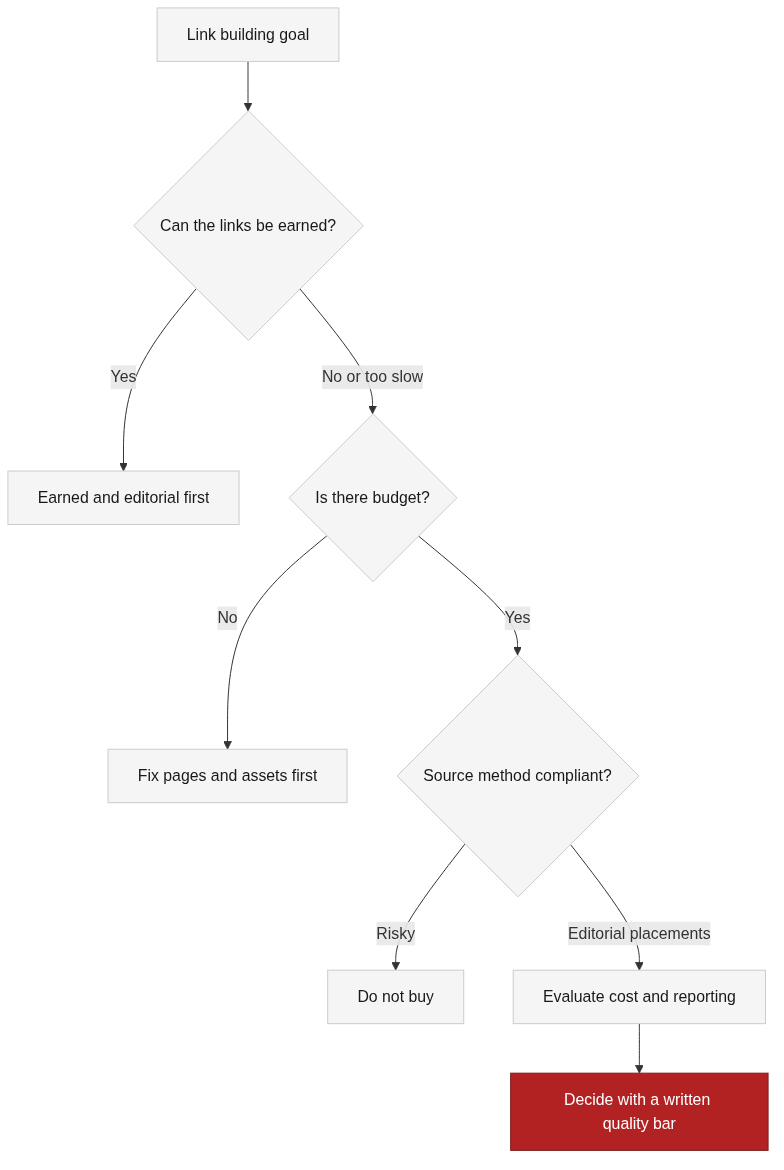
Before you buy, answer four questions in writing.
First, can the link be earned instead? Earned and editorial links should always come first, because they carry no purchase risk and often perform better [4]. Second, is the target page ready? A page that is thin or off-intent will not benefit from any link. Third, what is the relevance and quality bar, and who enforces it? A written bar turns a purchase into a managed decision instead of a bet. Fourth, what does the reporting contain? Placement-level detail, live-link checks, and the reasons each placement passed the filter.
If the answers expose gaps, fix those before spending. Buying backlinks to compensate for a weak page or an undefined strategy is the most expensive way to discover the problem.
Alternatives to Buying Backlinks
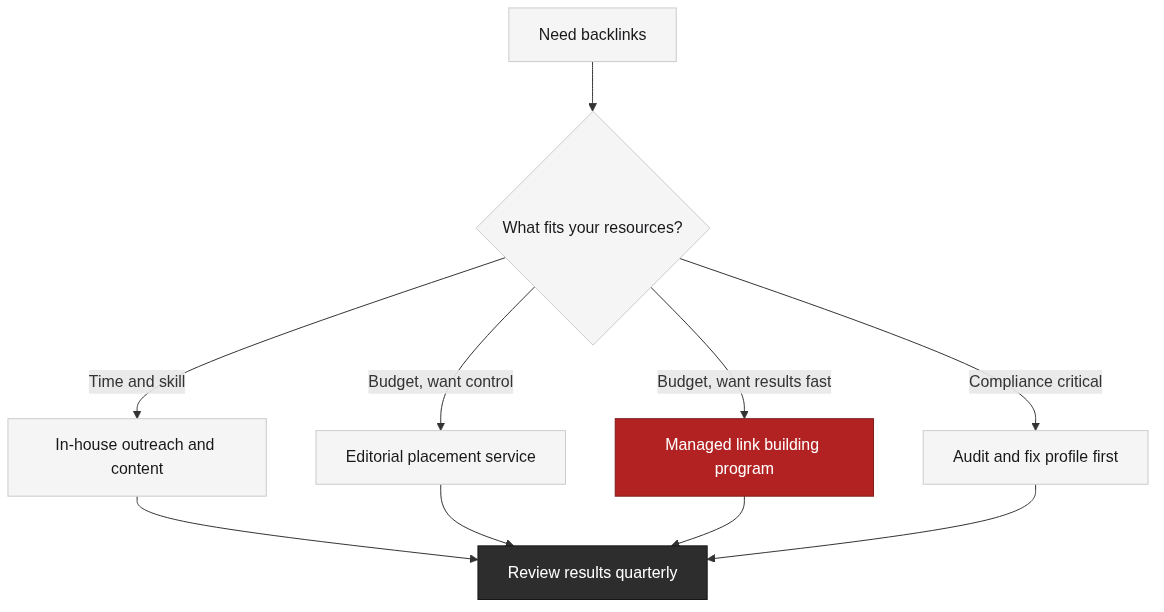
The main alternatives are earned links, content-driven link building, and in-house outreach, and each fits different resources.
Earned links come from pages and assets people want to reference, and they fit when you can invest in content quality first. Content-driven link building produces linkable assets and promotes them to relevant pages, and it fits when you have budget but want the links to stand on their own. In-house outreach fits when you have time and skill, and it keeps the process and the knowledge inside your team.
The practical path for most teams is a mix: in-house for the assets, a service for the placements, and a quality gate over all of it [3]. Buying backlinks is not a shortcut around the mix; it is one input to it.
FAQ
References
Google Search Central, “Spam policies for Google web search,” developers.google.com. Official documentation describing link schemes and practices that Google treats as policy violations.
Moz, “Backlinks,” moz.com. Public glossary explaining what backlinks are and why relevance and placement determine their value.
Ahrefs, “Link Building for SEO: The Definitive Guide,” ahrefs.com. Public industry guide covering outreach, editorial placements, and campaign planning.
Google, “SEO Starter Guide,” developers.google.com. Official documentation describing links among the signals that help pages gain visibility, and why page quality and time matter.
Next Steps
Decide in this order: try earned and editorial links first, check the target pages, write the relevance and quality bar, then evaluate a purchase only on the all-in cost per accepted, live, relevant placement. The link building strategies guide explains the earned method mix, the unnatural links guide helps you spot the risk patterns before you buy, and the resource page link building guide covers a method that earns links without buying them.
If you would rather have the decision handled with a clear method and reporting, TraffiClimb builds premium link building programs for ambitious brands. Visit the TraffiClimb website to see how the approach works.