
SaaS Link Building: A Practical Guide for B2B Software Brands

Why SaaS Link Building Is Different
The tactics are mostly the same as in any link campaign, but the inventory is not. A SaaS site has a product page, pricing, docs, changelog, templates, benchmarks, and a blog competing for the same links. Product-led brands should point links at pages that survive releases: guides, benchmarks, free tools, and high-value documentation, not at a pricing page that changes quarterly [1].
The second difference is the audience. B2B software buyers read reviews, comparisons, and community threads before they trust a vendor. A link from a page that a buyer actually reads matters more than a link from a high-metric directory nobody visits. Relevance to the buyer’s research path, not domain authority alone, is the filter that protects the profile [2].
The third difference is velocity. SaaS companies ship constantly, so assets go stale fast. The campaign needs a review rhythm that matches the release cadence, or the links accumulate on pages that no longer describe the product.
Which Pages and Assets Deserve the Links
Start from the asset, not from the backlink profile. Export the pages that can actually move a deal and survive the next release, then research who already links to similar pages.
- List the link-worthy assets: benchmarks and data studies, free tools and calculators, templates, comparison pages, and detailed guides. A handful of assets beats a catalog of thin pages.
- For each asset, find pages that already cover the problem your asset solves. Those editors are the realistic audience for the link.
- Compare referring domains with competitors on the same terms, and keep only the gaps where the linking page has a real readership and a real reason to mention a tool like yours [3].
- Split the list by effort: digital PR, resource pages, guest posts, and community placements. The split decides which tactics run first.
The most common mistake is treating every competitor backlink as a target. A link from a low-traffic directory works for the competitor’s brand awareness, not for your trial pipeline. Filter by whether the page would plausibly link to a software product.

Building the Opportunity Pipeline for a Product-Led Team
The pipeline turns the asset list into a repeatable outreach process. It has three parts: the audience list, the pitch, and the follow-up.
The audience list comes from the pages that cover your category, not from a generic influencer list. Analysts, comparison sites, newsletter writers, and independent tool reviewers are the realistic hosts for a SaaS link. Keep the list small and specific; a list of fifty highly relevant editors beats five thousand scraped emails.
The pitch that works for SaaS leads with the user problem, not the product. Show the host what their readers gain: a benchmark, a template, or a working example. The link building strategies guide explains how to match methods to the asset you have.
Most placements come from the second touch, so plan a follow-up sequence and log every reply. The pipeline is working when the acceptance rate stays stable as the list grows.
Start with resource pages and roundups when the team is small; add digital PR when there is a dataset or a benchmark worth telling. Running every tactic at once spreads a small team too thin, and the acceptance rate becomes the signal that tells you which method to drop [4].
Choosing the Tactics That Fit a SaaS Brand
No tactic is inherently right for SaaS; fit depends on the asset, the audience, and the team. These four cover most product-led brands, with different entry costs and failure modes.
Digital PR around proprietary data. A benchmark, a pricing study, or a survey from your own install base can earn links from news and industry sites. This needs a real insight and a budget for design and outreach. It fails when the story is a thinly disguised product launch.
Resource pages and tool roundups. Many sites publish lists of tools and resources, and updating a stale entry is a low-effort, high-acceptance play. This fits products with a clear category. The failure mode is chasing hundreds of low-relevance roundups that add nothing.
Guest posts on B2B and SaaS publications. A guest post works when it teaches something the host audience needs and links to an asset that supports the claim. It fits teams that can produce genuinely useful content, and it fails when the post exists only to carry a link.
Community and founder-led placements. Answers on community platforms, useful forum threads, and founder interviews can earn natural links over time. This is the slowest source, and also the cheapest, so treat it as a compounding channel rather than a campaign.
Use the resource page link building guide for the tactic most teams should run first, and the referring domains guide when you need to read the profile.
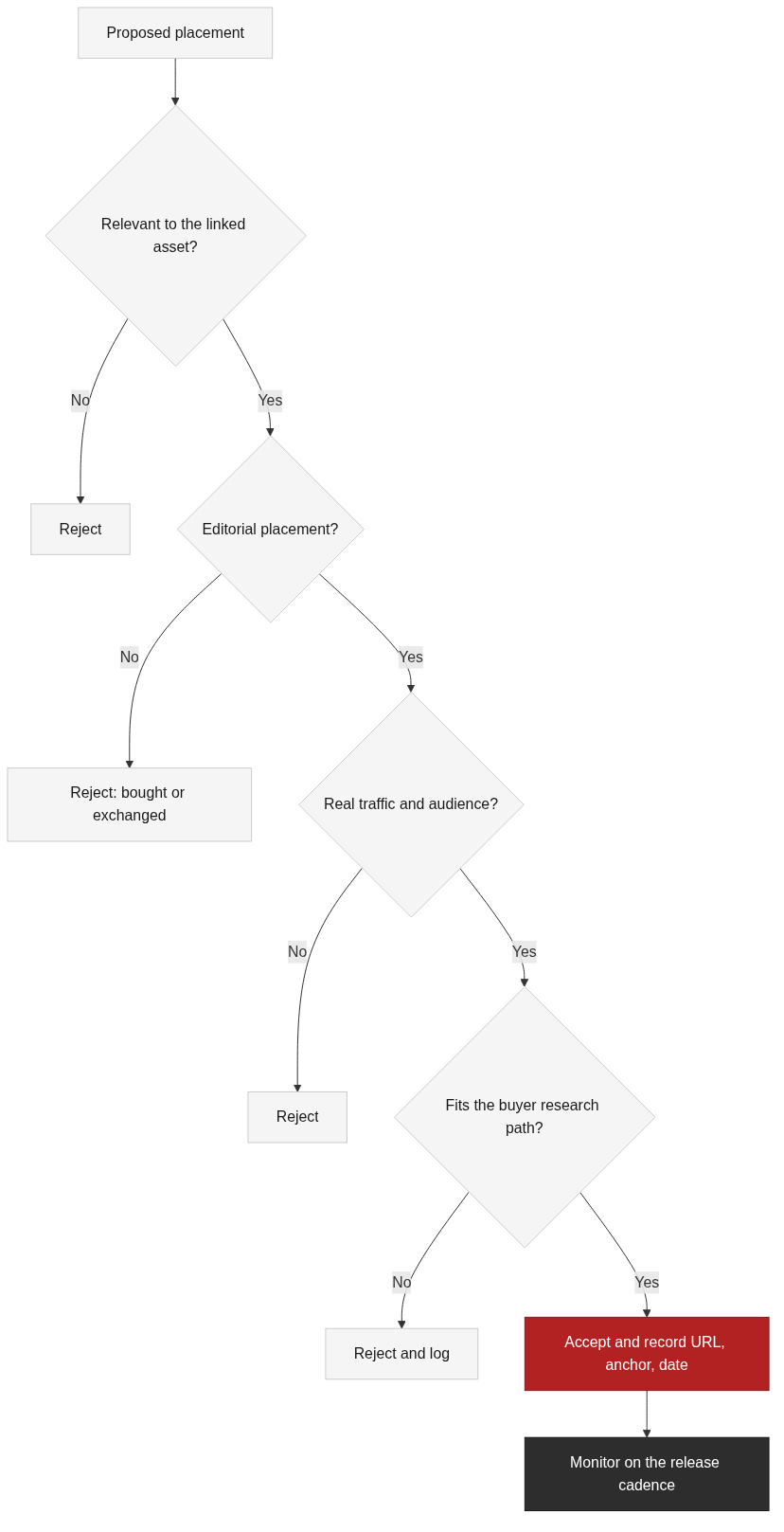
The Quality Gate: What to Accept and What to Reject
Every placement passes the same gate before it counts: the linking page is relevant to the linked asset, the placement is editorial rather than bought or exchanged, the publisher has real traffic and a real audience, and the anchor fits the context. A link that fails any of these is a liability, not an asset [5].
The pattern that matters most for SaaS is context. A link on a page about “best analytics tools” pointing to your benchmark is natural; the same link on a page about web hosting is noise. Judge the linking page the way a buyer would: does it fit the research path, and would a reader trust it? When in doubt, skip it. One bad placement is harder to clean up than one missed link.
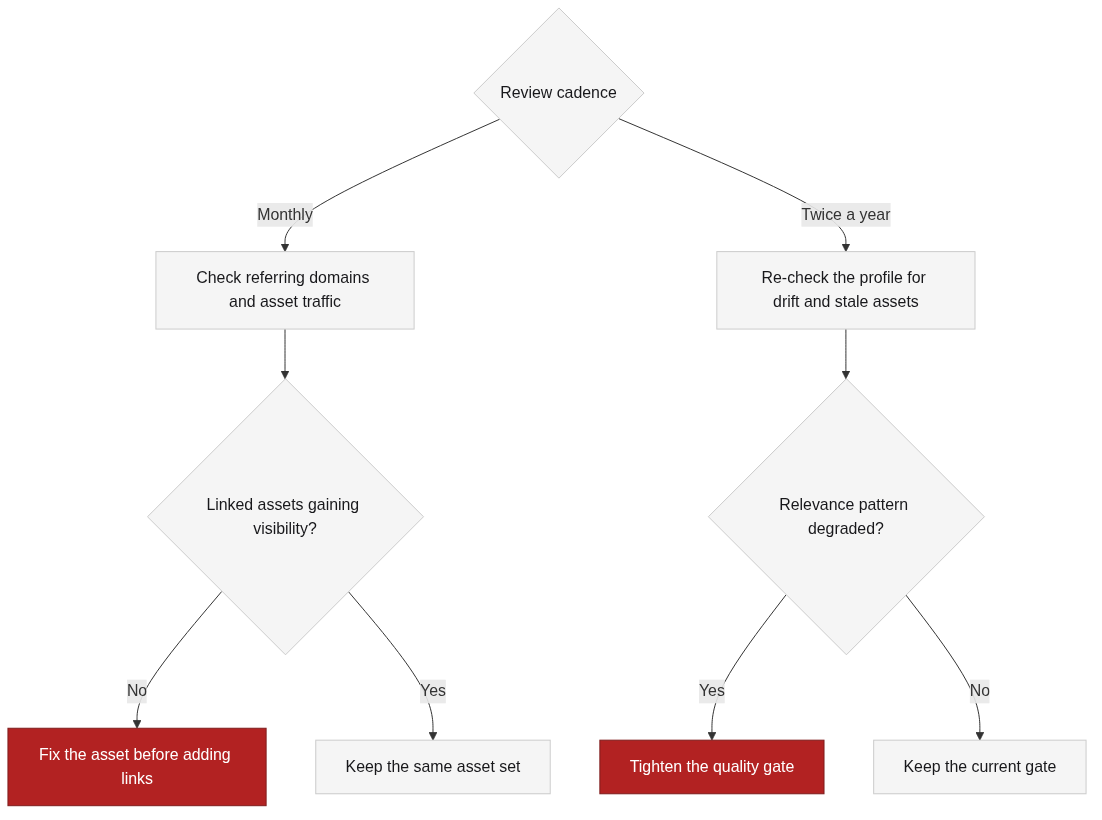
Measuring Whether the Links Are Working
Judge links on the asset they point to, not on aggregate metrics. Track referring domains and their relevance over months, watch how the target pages rank for their own terms, and compare trial signups or demo requests attributed to the linked pages before and after the campaign. A link is working when the right asset gains visibility, not when the total backlink count grows [3].
Check the profile for drift twice a year: links that disappeared, assets that changed, and patterns of low-relevance placements. When results lag, the usual cause is the asset, not the link volume: a benchmark nobody trusts will not convert better because more links point at it.
FAQ
References
Google, “SEO Starter Guide,” developers.google.com. Official documentation describing how links help pages gain visibility and why page quality and relevance determine value.
Moz, “Backlinks,” moz.com. Public glossary explaining what backlinks are and why relevance and placement determine their worth.
Ahrefs, “Link Building for SEO: The Definitive Guide,” ahrefs.com. Public industry guide covering competitor analysis, gap analysis, and campaign planning for different site types.
Search Engine Journal, “Link Building,” searchenginejournal.com. Public industry article covering outreach, digital PR, and the risks of low-quality placements.
Google Search Central, “Spam policies for Google web search,” developers.google.com. Official documentation describing link schemes and practices that Google treats as policy violations.
Next Steps
Start with the asset: pick the pages that deserve links, build a filtered opportunity pipeline, and choose one or two tactics you can actually run. Gate every placement, and measure the linked assets on a monthly rhythm. The campaign compounds when the same assets earn more links over time, so keep the target set small and stable.
If you would rather focus on the strategy while a specialist handles the execution, TraffiClimb builds premium link building programs for ambitious brands. Visit the TraffiClimb website to see how the approach works.