
Real Estate Link Building: Local, Market & Content Opportunities That Set It Apart
 Written by Warren Reed
Real estate link building looks nothing like the generic outreach playbook most sites run. The same high-DA national blog placement that works for a SaaS company often does almost nothing for a brokerage targeting “homes for sale in Austin.” That is not a coincidence. It is the direct result of how search intent in real estate is anchored to geography. In this guide, we walk through the local, market, and content resource opportunities that make real estate link building genuinely different—and how to judge which backlinks actually move the needle.
Why Generic Link Building Fails on Real Estate Websites
In real estate link building, relevance to a specific market comes before any generic metric.
Most link building advice is written for topic-driven sites: pick a relevant blog, pitch a guest post, earn a citation. In real estate, that framing breaks down because the search intent is anchored to a place. A national real estate news site may carry strong domain authority, but it does not tell Google that your brokerage is the trusted source in a specific metro area.
The local-anchoring dilemma: why a high-DA national blog backlink underperforms a local market citation
Consider two backlinks. The first comes from a national real estate publication with strong metrics. The second comes from a local city magazine that published a market-data roundup in which your team was cited as the source for median price trends. For a real estate website, the second link is more valuable for local rankings, even though the first site looks stronger on paper. The reason is that real estate rankings are built on local signals, and a link from a source in the same geography carries a signal no national site can replicate. This is the local-anchoring dilemma: relevance to the place matters more than raw authority.
The data behind it: NAR’s 90%+ of buyers searching locally and BrightLocal’s 76% local-search conversion signal
The behavior that drives this is measurable. The National Association of Realtors (NAR) reports that a large majority of home buyers begin their search online, and the overwhelming share of those searches carry local intent—”homes for sale in [city],” “best neighborhoods in [city]” [1]. Separately, BrightLocal’s long-running local consumer survey has consistently found that roughly three-quarters of local searches lead to an in-store visit, call, or inquiry within a week [2]. When local intent drives both discovery and conversion, the backlinks that reinforce local relevance carry disproportionate weight. A generic link cannot deliver that signal.
Positioning this guide as the vertical application of Local Link Building
This article is deliberately scoped as the vertical application of the general discipline covered in our Local Link Building guide. If that guide explains the shared regional tactics—local directories, community engagement, geographic citations—this one explains how real estate applies them to its own market structure. We do not re-teach general outreach here. We focus on what is unique: the dual-relevance test, market data as a linkable asset, and a source network that most verticals cannot replicate.
The Dual-Relevance Rule: Local + Industry Must Both Be Present
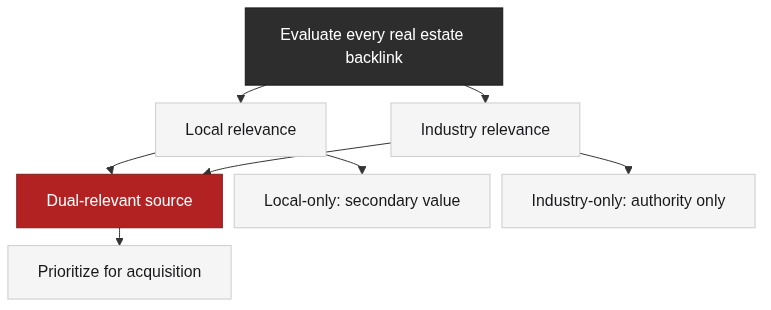
The single most important judgment in real estate link building is the dual-relevance rule. A backlink should be evaluated on two conditions at once: whether the source is relevant to your local market, and whether it is relevant to the real estate industry. Meeting only one of the two is usually not enough.
Why geographic relevance dominates in a local-intent vertical and outranks topic-only relevance
In a local-intent vertical, geographic relevance does not merely add value—it is the dominant factor. A source located in your target metro, covering home buying, moving, and community topics, passes a local-relevance signal that a topically relevant source in another city cannot. When both conditions hold, the link serves a dual purpose: it reinforces your position as the local real estate expert and it tells search engines that your site belongs to that geography. Topic-only relevance, by contrast, may build topical authority but does little for the local ranking battle that real estate sites actually fight [3].
The “both conditions” test: local-only vs industry-only vs ideal dual-source
The cleanest way to apply this is a three-way test.
- Local-only source: a local chamber of commerce directory or a community civic site. It is geographically aligned but not industry-specific. It still has value for local signals, so treat it as a secondary acquisition.
- Industry-only source: a national real estate news site or a general real estate blog. It is industry-relevant but not anchored to your market. Use it for brand and authority, but do not expect it to move local rankings.
- Ideal dual-source: a local real estate publication, a local market-data citation, or a local association page. It satisfies both conditions and is the priority target for real estate link building.
A scoring matrix to evaluate candidate real estate backlinks
To make this operational, score every candidate source across five weighted dimensions. The weights reflect the reality that local relevance is the non-negotiable anchor.
| Evaluation dimension | Weight | Score (1–5) | What to check |
|---|---|---|---|
| Industry relevance | 30% | Does the source cover real estate, home buying, moving, or community topics? | |
| Local relevance | 40% | Is the source’s geography aligned with your target market? | |
| Authority & editorial trust | 15% | Is it editorial or partnership-backed, not a paid directory or low-trust site? | |
| Outreach feasibility | 10% | Can you acquire it through content, partnership, or sponsorship rather than a paid link? | |
| Audience intent match | 5% | Is the source’s audience made up of local buyers or sellers? |
Total the weighted score. A score of 4.0 or higher is worth pursuing. Between 3.5 and 4.0, pursue only if resources allow. Below 3.5, set it aside. This matrix is the practical tool behind the Relevant Backlinks framework.
Market Data as Your Strongest Linkable Asset
If there is one asset type that separates real estate from most verticals, it is market data. Real estate generates a steady stream of quantifiable information—prices, trends, inventory, timing—that other industries simply do not produce at the same cadence.
Property and market data content: median prices, rent trends, inventory, days-on-market, school and commute analysis
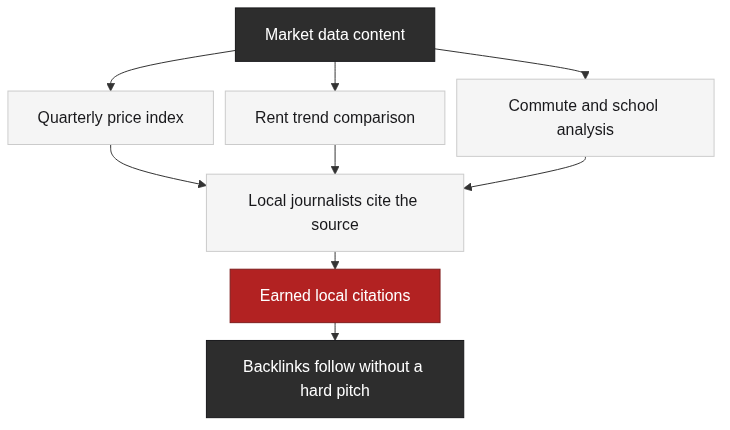
The raw material is everywhere. Median home prices by neighborhood, rent trends over time, inventory levels, average days-on-market, school district ratings, and commute analysis are all things your team already knows or can compile. The opportunity is to package that knowledge into shareable content. A quarterly price index, a neighborhood rent comparison, or a commute-time study becomes a distinct piece of property that other sites want to cite.
Why data assets naturally earn citations from local media, journalists, and lifestyle blogs
Data has a natural citation property that opinion content lacks. A local news outlet writing a story about “where prices are rising fastest” needs a source for the numbers. A lifestyle blog covering “best neighborhoods for young families” needs a credible citation for school and cost-of-living claims. When your site is the one that publishes the clean, current, well-sourced data, you become the default reference—and the links follow without a hard pitch. This is the mechanism that makes market data the most reliable linkable asset in the vertical [4].
Converting data into Digital PR: quarterly price indices and community guides as repeatable outreach hooks
The key is repeatability. A one-off data study earns a burst of links and then goes quiet. A quarterly price index, refreshed on a predictable schedule, gives you a recurring outreach hook: every quarter you have a reason to contact local journalists and bloggers with a fresh, newsworthy number. The same logic applies to community guides updated as data changes. This turns digital PR from a one-time campaign into a cadence. For the broader mechanics of turning assets into earned coverage, our Digital PR guide and our Linkable Assets guide cover the execution in depth.
Local Guides and Neighborhood Resources as Citation Magnets
Beyond raw data, real estate websites sit on a unique resource: deep, specific knowledge of neighborhoods that no national site can match. This is the content that other local publications need and will link to.
Local guides and neighborhood resources: schools, commute, safety, cost-of-living as “moving decision” content
Home buying is a moving decision, and moving decisions are made on neighborhood-level information. School quality, commute times, safety, cost of living, walkability, and local amenities are the questions buyers actually ask. A well-built neighborhood guide answers those questions with specifics—not a brochure. This is content that local publications, relocation sites, and community blogs routinely need to reference.
Why these resources serve double duty as user value and earned-link material for local publications
These guides pull double duty. They serve your users directly, which is the primary purpose. And they function as earned-link material because they are the type of reference that local publications link to when they need neighborhood specifics. A city guide writing “where to live in [city]” naturally points readers to a detailed neighborhood resource. That is a relevant, dual-condition link earned through content value rather than outreach pressure.
Structuring guides to be citable (clear data, visual asset, shareable summary) rather than brochure-like
The difference between a guide that earns links and one that does not is structure. A citable guide leads with clear data, includes a visual asset such as a comparison table or map, and provides a short shareable summary that another writer can quote. A brochure-like guide buries the useful information in marketing language and gives a journalist nothing to cite. Structure your neighborhood resources for citation first, and the links will follow the same logic as your market data.
The Real Estate-Specific Source Network: Publications, Associations, Partners, Sponsorships
Real estate has a source network that most verticals cannot replicate. These are the places where relevant backlinks actually live, and many of them are only accessible because of the industry’s structure.
Local publications: local news, lifestyle mags, city guides, and community blogs with higher editorial trust
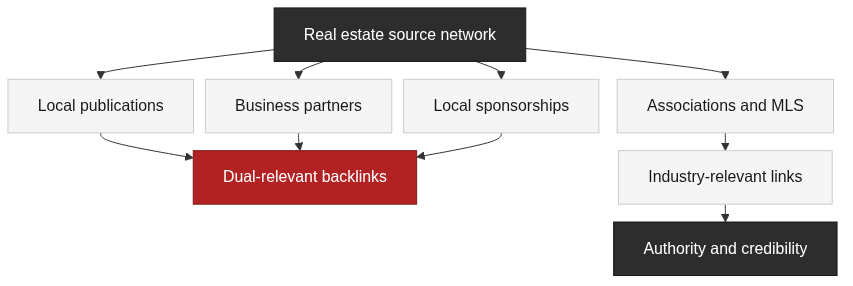
Local publications are the highest-value source group for real estate link building. Local news, lifestyle magazines, city guides, and community blogs carry editorial trust that generic directories lack, and they are geographically aligned by definition. Because they cover moving and housing as part of their beat, they are also industry-relevant. This makes them the ideal dual-source, and the reason the local publication layer is the backbone of a real estate backlink portfolio [3].
Real estate associations and MLS: NAR local chapters and industry directories as industry-relevant links
The industry layer comes from associations and MLS systems. Local real estate associations, NAR local chapters, and industry directories provide links that are unambiguously industry-relevant. They may not carry the strongest local signal on their own, but they establish your membership in the professional real estate community and pass the industry-relevance condition of the dual test. They are the “industry-only” sources that still earn their place for authority and credibility.
Business partnerships and local sponsorships: lenders, title companies, inspectors, contractors, and community events as sources most verticals can’t replicate
The most distinctive part of the real estate source network is the ecosystem of adjacent businesses. Lenders, title companies, home inspectors, contractors, and relocation services all serve the same buyer journey and all have reasons to link to a trusted local partner. These partnerships produce relevant links that are hard for other verticals to reproduce. Add local sponsorships—funding a community event, a school program, or a nonprofit—and you convert community participation into local-relevant citations while reinforcing your brand’s presence in the market [5]. This is where the general discipline of Local Link Building meets the specific structure of real estate.
Amplifying Opportunity With Competitor Research and Expert Commentary
The opportunities above grow faster when you know exactly which sources your local competitors already own. Competitor research and expert commentary are the two levers that turn a good real estate link building program into a systematic one.
Competitor backlink research: reverse-analyzing local top brokerages and portal sites to expose dual-relevant sources
Your strongest competitors are not national giants—they are the local brokerages and portal sites already ranking for your target terms. Run a backlink analysis on them and you will see the exact dual-relevant sources they have already secured: local publications, association pages, partnership sites, and sponsorship pages. That list is your acquisition roadmap. Every source your local competitor holds is a source you can pursue through a better asset or a stronger relationship. The full method for this is covered in our Competitor Backlink Analysis guide.
Expert commentary and Digital PR: positioning your team as the “local market expert” cited by media and data reports
The second lever is positioning. When your team is the named local market expert, media and data reports cite you directly—and those citations are high-value relevant backlinks. Expert commentary works because journalists covering housing trends need a credible local voice. Publish your market data, respond to local press queries, and make your principals available for commentary. Over time, your brand becomes the default source, and the citations arrive on a recurring basis.
Tying content resources and source networks together into a coherent link building campaign
None of this works in isolation. A coherent real estate link building campaign connects the assets to the sources: your market data and neighborhood guides are the bait, your partnerships and sponsorships are the relationships, and your competitor research tells you where to aim. When those three pieces work together, you are not running scattered outreach—you are running a repeatable system. For the end-to-end structure of that system, our Link Building Campaign guide and the strategic overview in Link Building Strategies walk through the full workflow.
Practical Application: A Decision Framework for Real Estate Backlinks
Putting all of this into practice means making consistent decisions about which sources to pursue. The comparison below and the checklist that follows give you a working framework.
Scenario comparison: real estate link building vs general link building
| Dimension | General website link building | Real estate website link building |
|---|---|---|
| Dominant relevance axis | Topic or industry relevance | Dual relevance: local + industry |
| Core linkable asset | General content, tools, data | Market data, local guides, neighborhood resources |
| High-value sources | Industry media, authority blogs, directories | Local publications, associations, MLS, adjacent partners, sponsorships |
| Geographic anchor | Optional | Required, must match target market |
| Digital PR path | Data or opinion cited by industry media | Cited as the “local market expert” by local media |
| Competitor research focus | Industry-leading sites | Local top brokerages and portal sites |
| Conversion signal | General traffic | Local searches converting within a week (BrightLocal ~76%) [2] |
The pre-outreach checklist
Before you invest in any candidate source, run it through this checklist.
- Does the source’s geography match your target market (local relevance holds)?
- Does the source cover real estate, home buying, community, or moving topics (industry relevance holds)?
- Is it an editorial or partnership-backed source, not a paid directory or low-trust site?
- Can you acquire it through content, partnership, or sponsorship rather than buying a bare link?
- Is the anchor text and landing page natural and compliant?
- Does the link serve both brand exposure and ranking signal goals?
- Have you confirmed through competitor research that this source is not already dominated by your local competitors?
Balancing local vs industry relevance
The balance rule is simple to state and takes discipline to apply. Prioritize dual-source links that satisfy both local and industry relevance. Accept local-only sources for their local signal. Be cautious with industry-only sources—they build authority but do not move local rankings. And skip high-DA sites that satisfy neither condition, no matter how strong their metrics look. Relevance beats authority in a local vertical, and the scoring matrix above is the tool that keeps the balance consistent.
Core Takeaways and Next Steps
Real estate link building is not a harder version of generic link building. It is a different discipline with its own rules, assets, and source network.
Recap: real estate link building’s specialness lives in the dual local + industry relevance, market data assets, and a unique source network
The specialness comes down to three things. First, the dual-relevance rule: local and industry relevance must both be present for a link to move the needle. Second, the asset base: market data and neighborhood guides are linkable assets most verticals cannot produce. Third, the source network: local publications, associations, adjacent business partners, and sponsorships form an ecosystem that is unique to the industry. Together, these are what make real estate link building distinct.
Tying back to the broader strategy
This is the industry-specific application of Local Link Building. The general discipline explains the regional tactics; this guide explains how real estate applies them to its own market structure. If you are building a real estate backlink portfolio, the two guides are meant to be read together.
Next step: evaluate your current portfolio against the scoring matrix
The practical next step is to pull your current backlink portfolio and score every source against the matrix in this guide. You will quickly see which links are earning their keep and which are high-DA but irrelevant. If you want a structured evaluation of your real estate link building campaign—or help building the market data and source network to support it—a consultation is the right move. We work as a strategic partner on premium, content-driven link building, and we can help you turn these opportunities into a repeatable system.
FAQ
References
National Association of Realtors (NAR) — NAR’s Home Buyers and Sellers Generational Trends research documents that the overwhelming majority of home buyers search online with strong local intent.
BrightLocal — BrightLocal’s Local Consumer Review Survey has consistently found that roughly three-quarters of local searches lead to an offline action within a week.
Ahrefs — Ahrefs’ backlink analysis practice and industry guides document that local publications and community resources are the highest-density relevant sources for real estate, and that relevance beats authority in local verticals.
Semrush — Semrush’s industry guides support the dual-relevance evaluation framework and the role of market data and local sponsorships as real estate-specific link building assets.