
Podcast Link Building: How to Earn Backlinks Through Podcasts
 Written by Sanja Gajic
You landed a guest spot on an industry podcast. The host loved the conversation and promised to link to you in the show notes. Then the episode went live, and your site gained exactly zero indexable links. If that feels familiar, the problem isn’t that you did a podcast—it’s that you never turned that podcast participation into real editorial mentions, show notes links, and speaker profile links. This guide is not another “podcast marketing” overview. It focuses on podcast link building: how guest appearances and expert interviews convert into editorial backlinks, and how to systematically find, qualify, pitch, and follow up on podcast opportunities that actually move your link profile.
Why Podcasts Are an Untapped Source of Editorial Backlinks
Most SEO teams treat podcasts as a brand-awareness play. That is a missed opportunity. A podcast episode is a natural home for editorial mentions, and hosts routinely link to guests they genuinely believe in. The gap is almost always execution: guests rarely prepare the assets that make a link easy to place, and almost nobody follows up to confirm the link actually landed.
The Scenario That Exposes the Gap
Imagine this: you record a 45-minute interview, the host calls you “one of the sharpest people in the niche,” and the episode performs well. You check your backlink report a week later and find nothing new. The host liked you—they just had no obvious resource to link to, and nobody reminded them. That is the entire difference between “doing a podcast” and “doing podcast link building.”
What This Article Does (and Doesn’t) Cover
We will not write a full outreach email guide, rehash link prospecting, or turn this into a podcast marketing tutorial. Instead, we focus on one thing: how podcast participation produces indexable editorial backlinks, and the repeatable process for finding, qualifying, pitching, and following up on relevant podcast opportunities.
The Definition at a Glance
Podcast link building is the practice of earning natural, contextually relevant editorial links—typically in show notes, speaker bios, and episode transcripts—by participating in podcasts as a guest or expert. The core principle is simple: one relevant, high-quality editorial link is worth more than dozens of irrelevant low-value links [1]. That principle shapes every decision in this guide.
What Podcast Link Building Is: The Three Types of Links You Can Earn
Podcast link building is distinct from paid placements, directory submissions, or comment-signature links. It earns links through context—a host references you inside a real conversation, then links to you because it genuinely helps their audience. That is why podcast backlinks tend to be higher quality and more aligned with search engine guidelines than most other link types [2][3].
The Three Main Link Sources
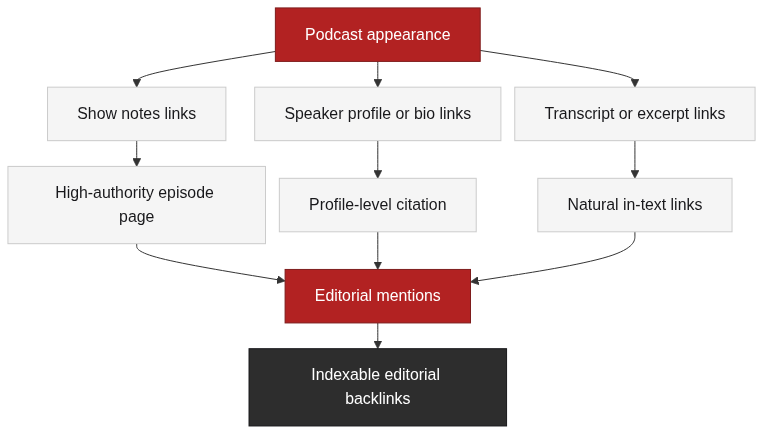
When you appear on a podcast, three types of link placements matter most [4]:
Each source serves a slightly different purpose, but all three share one trait: they are editorial mentions placed inside content context, rather than transactional links dropped into a sidebar or footer. Speaker profile and bio links are often discoverable through podcast databases that catalogue guest appearances [5].
| Link source | Where it lives | Why it matters |
|---|---|---|
| Show notes links | The episode notes page on the podcast’s domain | Usually sits on a high-authority, topically relevant domain |
| Speaker profile / bio links | The podcast’s site or a directory like Listen Notes or Podchaser | Adds a profile-level citation that is easy for hosts to add |
| Transcript / excerpt links | Full episode transcripts published by the podcast | Natural in-text links embedded in genuinely useful content |
Why Context Makes These Links Higher Quality
Relevance plus editorial discretion is the combination that search engines reward. When a podcast links to you from a show notes page that discusses your exact topic, the link is self-explanatory to both readers and crawlers. This is precisely the “content-driven, high-relevance editorial link” pattern that aligns with a compliant, sustainable link building strategy. It is the opposite of a link dropped into a directory with no surrounding context.
Guest Appearances & Expert Interviews: The Main Route to Podcast Backlinks
Guest appearances and expert interviews are the dominant way to earn podcast backlinks. When you appear as a subject-matter expert, the host has a natural reason to reference your work, your data, and your site. That is the editorial justification that directory links and paid placements never have. Expert interviews are a widely used route to both authority and editorial mentions [6].
Doing the Podcast vs. Using the Podcast for Link Building
The distinction matters. “Doing a podcast” optimizes for reach and exposure—you want to be heard. “Using a podcast for link building” optimizes for indexable editorial links—you want to be linked, from context, in a way that survives indexing. The best appearances do both, but you have to design for the link outcome, not just the exposure outcome.
Prepare Link-Worthy Resources
The single biggest variable in whether a host links to you is whether you gave them something worth linking to. Original data, a tool, a template, a checklist, or a detailed case study gives the host an obvious, defensible anchor for a show notes link. Without a link-worthy resource, the host may genuinely want to link you and still have nothing to point at. Bring one or two link-worthy assets to every appearance. Offer them explicitly: “If it helps your audience, you’re welcome to link to our template in the show notes.” That single sentence dramatically raises the probability the link gets placed.
Set Honest Expectations on Timeline
Link building takes time to show measurable impact. A podcast episode you record this month may not even publish for several weeks, and the link’s SEO effect typically compounds over months. Expect a realistic 3–6 month window before a podcast link building effort shows measurable results. Do not promise immediate rankings, and do not judge a podcast campaign by next week’s analytics.
How to Find, Qualify, and Pitch Relevant Podcasts
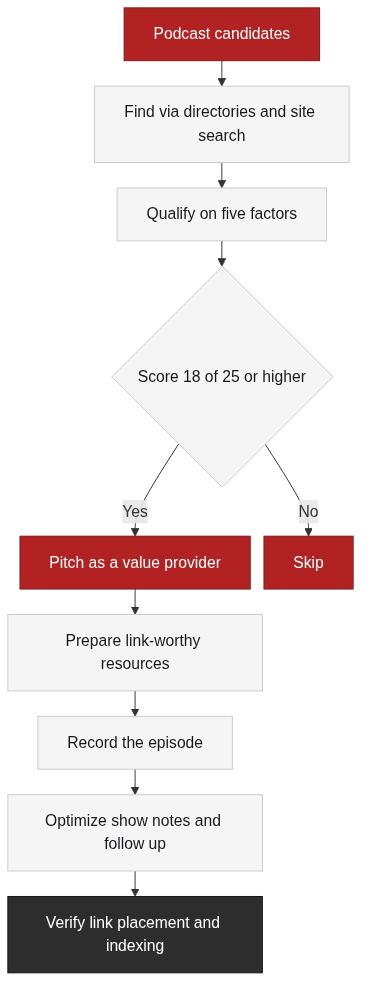
The pipeline for podcast link building mirrors good link prospecting, but with a podcast-specific lens. You find candidates, qualify them against a clear bar, and pitch them as a value provider—not as someone asking for a link.
Finding Relevant Podcasts
Start with podcast directories. Apple Podcasts, Spotify, Listen Notes, and Podchaser all let you search by keyword and niche [7][5]. Use site search operators to surface podcasts that discuss your topic, and study where your competitors or industry peers have already appeared as guests—those shows have proven they accept guests in your space.
Qualifying Podcast Opportunities
Not every podcast is worth your time. Score each candidate on five factors using a 1–5 scale, and only invest in a pitch when the total reaches at least 18 out of 25:
The difference between a high-value and a low-value podcast opportunity usually comes down to relevance and link history. A large show with no indexable guest links is less valuable than a smaller, tightly matched show where every guest gets a natural show notes link.
| Factor | What to check |
|---|---|
| Topic relevance | Does the show’s niche align with your audience? (highest weight) |
| Domain authority & authenticity | Is the DA/DR genuine and is the show actively maintained? |
| Audience size & fit | Is the audience large enough and actually relevant to you? |
| Past guest link quality | Do past guests get real, indexable editorial links? |
| Link attributes | Are links editorial (dofollow / natural) rather than paid/sponsored? |
Pitching as a Value Provider
Your pitch should answer one question for the host: what does your audience get from this episode? Lead with specific topic angles, mention that you have listened to past episodes and understand their format, and attach verifiable credentials. Never frame the pitch around the link. The link is a natural byproduct of a good episode, not the reason the host should book you. Before you send any pitch, run it through a quick checklist: confirm topic fit, listen to at least one or two episodes, prepare two to three concrete value-driven topic angles, have a link-worthy resource ready, and attach credentials that are verifiable.
Optimizing Show Notes, Following Up, and Judging Link Quality
Earning the appearance is only half the work. The link still has to be placed, indexed, and verified. This is where most podcast link building efforts quietly fail.
Optimize for the Show Notes
Do not leave the show notes link to chance. After recording, send the host a short, ready-to-use guest intro and a suggested anchor text for your link. This makes it trivial for them to place a correct, natural link. Most hosts appreciate the help, and the result is a link that uses the anchor text you actually want.
Follow Up to Confirm the Link Landed
After the episode publishes, thank the host and confirm the show notes link exists. Check that the page is indexable using a site search or your Search Console data. If the link is missing, politely request it and attach the suggested anchor text and intro. Then maintain the relationship—a good podcast connection can be reused, cross-promoted, or revisited in a future season.
Judge Link Quality Honestly
Not every podcast link is worth keeping. Evaluate each one on whether it appears naturally in context, whether the page is actually indexed, whether the host site is genuinely active, and whether the placement is editorial rather than paid or sponsored. A link that only exists because the host was paid is a sponsored placement, not an editorial backlink, and it does not carry the same value or risk profile [3].
Choosing the Right Route: Podcast Links vs. Other Backlink Sources
Podcast editorial links are one route among several, and they are not always the right fit. A clear-eyed comparison helps you decide when to invest in podcast link building versus other tactics.
For a brand positioned around content-driven, compliant, sustainable growth, podcast editorial links are an unusually good fit: they combine high relevance, high editorial quality, and low compliance risk [2].
| Comparison | Podcast editorial links | Guest posts | Digital PR | Directory / comment links |
|---|---|---|---|---|
| Link context | Natural mention in show notes / bio | In-article body | Media coverage / data citation | Little to no context |
| Acquisition cost | Medium-high (time + prep) | Medium (content creation) | High (needs newsworthy asset) | Low |
| Editorial quality | High | Medium-high | High | Low |
| Compliance risk | Low (natural mention) | Medium (avoid over-optimized anchors) | Low | High (spam-prone) |
| Side benefits | Brand authority + audience exposure | Referral traffic + relevance | Brand visibility + citations | Minimal |
| Scalability | Medium (limited by shows) | High | Medium | High but not recommended |
High-Value vs. Ordinary Podcast Opportunities
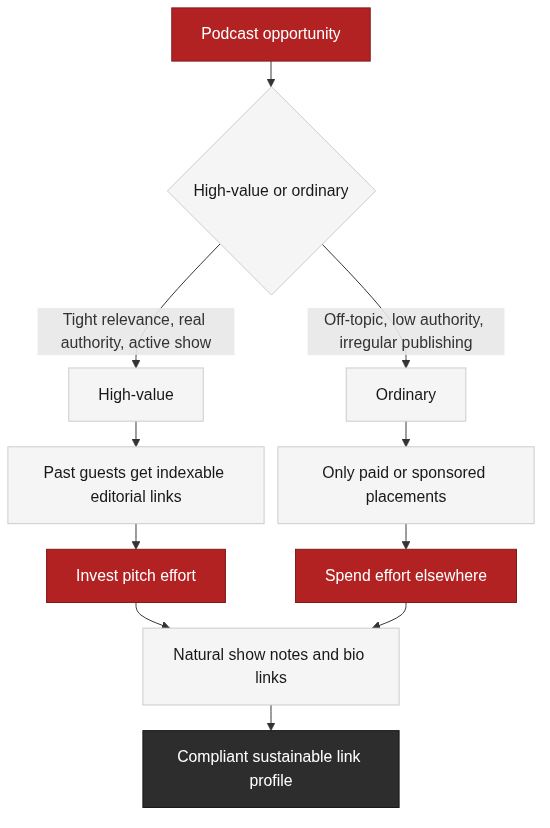
As you build a pipeline, you will see two very different categories of shows. High-value opportunities are tightly relevant, have genuine authority, match your audience, publish consistently, grant real indexable guest links, and place links editorially. Ordinary opportunities are broadly relevant or off-topic, have low or questionable authority, mismatch your audience, publish irregularly, or only place paid/sponsored links. Spend your pitch effort on the first category.
Common Mistakes to Avoid
- Chasing quantity over relevance, and ending up with a pile of irrelevant links
- Ignoring whether the show’s audience actually matches yours
- Writing a pitch that reads like a link request instead of a value offer
- Showing up without a link-worthy asset, so the host has nothing to link to
- Never confirming whether the link landed or got indexed after publishing
- Treating a podcast appearance as a paid ad slot with a sponsored tag, rather than an editorial mention
Core Takeaways & Your Next Step
Podcast link building works when you treat podcasts as a high-quality editorial link channel, not just a content marketing activity. The links that land are the ones you planned for: you prepared a link-worthy resource, optimized the show notes, followed up to confirm placement, and judged the result honestly.
Your Next Step
Start small and systemic. Use the qualification matrix to shortlist 5–10 high-value shows, prepare your pitch and your link-worthy resource against the pre-pitch checklist, and set up a post-publication follow-up routine. Then fold podcast link building into your overall, compliant, sustainable link building strategy—because a single editorial link from a relevant show is worth more than a stack of unrelated ones. If you want to scale this without doing it all in-house, a strategic partner who handles compliant, content-driven link acquisition across multiple channels—including podcast editorial links—can help you move faster. Explore our link building strategies to see how podcast backlinks fit into a broader, results-driven program.
FAQ
References
Backlinko — Link Building Strategies: documents editorial link acquisition tactics and the value of contextually relevant links https://backlinko.com/link-building
Ahrefs — Link Building Guide: provides the industry-standard framework for earning editorial backlinks, including the relevance-and-quality principles underpinning podcast link building https://ahrefs.com/blog/link-building/
Google Search Central — Link Spam Policies: defines the distinction between editorial links and paid/sponsored link schemes that guides quality judgment https://developers.google.com/search/docs/essentials/spam-policies
Search Engine Journal — Podcast SEO: covers the role of show notes, transcripts, and guest appearances in earning podcast backlinks https://www.searchenginejournal.com/
Podchaser — Podcast Database: the podcast database where speaker profiles and guest links can be discovered and verified https://www.podchaser.com/
Content Marketing Institute: provides context on using expert interviews and guest content to build authority and editorial mentions https://contentmarketinginstitute.com/
Listen Notes — Podcast Directory: the directory used to find and qualify relevant podcasts by niche and keyword https://www.listennotes.com/