Paid Backlinks: Should You Buy Backlinks? Costs, Risks, and What to Know
 Written by Alistair MacLeod

Every SEO professional has faced the same temptation. A competitor outranks you on a high-value keyword, and then an email lands in your inbox: a “high-DR backlink for a fixed price,” delivered fast, no questions asked. The first instinct is to reach for your wallet. Paid backlinks are one of the most purchased, least understood parts of search marketing — so before you spend anything, it’s worth understanding exactly what you’re buying, what it costs, and which risks you’re actually taking on.
Here’s the core fact that reframes the whole debate: buying links is not illegal, and paying for exposure is not inherently wrong. But buying links specifically to manipulate rankings violates Google’s Link Spam Policy [1]. That single distinction — intent and marking — separates a legitimate sponsorship from a link purchase that can hurt your site. This guide treats paid backlinks as a policy-and-risk decision, not a moral one, so you can evaluate an offer on facts before you commit.
What “Paid Backlinks” Actually Means
Paid backlinks are any links you acquire in exchange for money, a product, a discount, or another form of compensation. That broad definition covers everything from a transparent sponsored placement to a privately sold link whose entire purpose is to pass ranking signals. The term is useful because it groups these transactions together — but it hides a wide range of risk.
The temptation that starts the question
You see a competitor ranking ahead with a profile full of high-authority links. You get pitched a “high-DR backlink for $XX” that promises to close the gap. The pitch is designed to make buying feel like the fastest path to parity. And sometimes it is fast — but speed is not the same as safety or durability.
The core fact that reframes the debate
Buying and selling links is not forbidden outright. What Google’s Link Spam Policy forbids is “buying or selling links for the purpose of manipulating rankings” [1]. The defining element is intent: a link bought to pass PageRank and influence rankings is treated as link spam, regardless of how the seller frames it. This is why the same transaction can be compliant in one context and a policy violation in another.
Setting the frame
So the real question isn’t “is it okay to pay for a link?” It’s “does this purchase aim to manipulate rankings, and is it marked as compensated?” Every decision in this guide flows from those two checks. If you want a structured way to judge any offer, the checklist in this article walks through them one by one.
Paid Backlinks vs. Sponsorship vs. Advertising: Drawing the Line
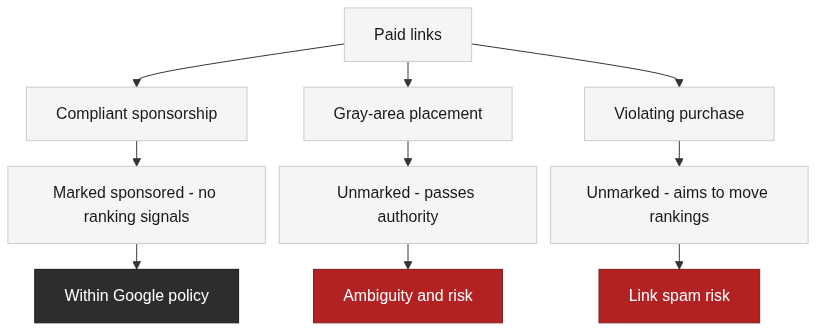
Not every paid link is a paid backlink in the risky sense. The line comes down to how the link is marked and what it’s meant to do.
Defining paid backlinks and the three categories
In practice, paid links fall into three broad groups:
- – Compliant sponsorship and advertising — a link placed as part of an ad, sponsorship, or other compensation agreement, marked with
rel="sponsored"(orrel="nofollow"/rel="ugc"). It doesn’t pass ranking signals and is fully within policy. - – Gray-area paid guest posts and content placements — a link bought inside an article without any sponsored marking, with the unstated goal of passing authority. This is where most of the ambiguity lives.
- – Clearly violating link purchases — a link sold explicitly to move rankings, unmarked, often in bulk. This is the definition of link spam under Google’s policy [1].
The decisive boundary
The boundary is not “did you pay.” It’s two things: whether the link carries rel="sponsored" (or nofollow/ugc), and whether the intent is to pass PageRank for ranking. Google’s guidance is explicit: use rel="sponsored" to mark links created as part of advertisements, sponsorships, or other compensation agreements [2][3]. A link that is both paid and unmarked, placed to pass authority, crosses that line.
Why the sponsored attribute matters
The attribute matters because it tells search engines the link is compensated, so it doesn’t pass ranking signals. In 2019 Google introduced rel="sponsored" as a dedicated way to identify sponsored links, alongside nofollow and ugc [2]. When a link is properly marked, you get the brand exposure without the ranking-manipulation risk. When it isn’t, Google may treat it as an attempt to game rankings.
Common Ways People Pay for Links and What Drives the Cost
Understanding the forms and the cost drivers helps you read any quote with clearer eyes.
The common forms
Paid link acquisition typically takes a handful of shapes: marketplace bulk purchases, private blog networks (PBNs), paid guest posts, link rentals, sponsored and ad slots, and directories or link farms. The risk profile varies sharply across these — a transparent sponsored slot sits at one end, while an unmarked PBN placement sits at the other.
What actually drives the price
Several factors push the price of a paid backlink up or down, and they vary by vendor and over time:
- – Domain authority (DR/DA) — higher-authority domains command higher prices, but authority alone doesn’t make a link safe.
- – Traffic — a site with real visitors is more valuable for exposure than an empty shell.
- – Relevance — a link on a site in your niche is worth more and looks more natural.
- – Content creation — whether the price includes writing the article or only the placement.
- – Placement duration — permanent links cost more than temporary or rented placements.
- – Sponsored marking — whether the link is marked
rel="sponsored"/nofollow, which changes its policy status.
The pricing reality
Any specific price you see — whether a low-end directory placement or a premium editorial placement — changes over time and varies by vendor and quality. Treat any number you’re quoted as a snapshot, not a constant. And keep this in mind: an expensive link is not automatically safe, and a low-priced link is not automatically a deal. Price is a poor proxy for policy risk.
The Risk Spectrum: From PBNs to Compliant Sponsorship
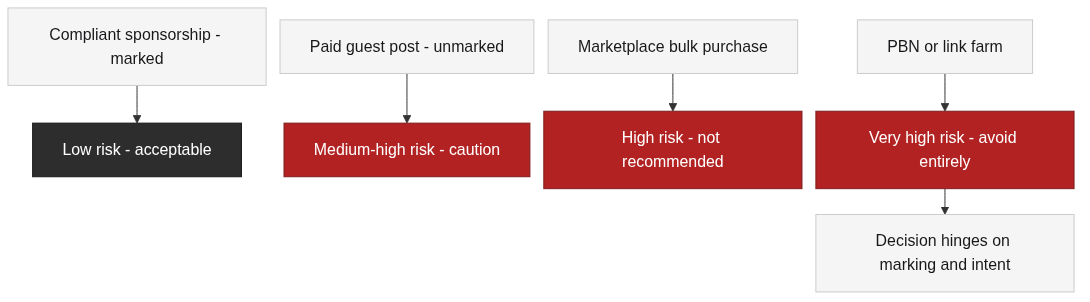
Risk is not evenly distributed across paid links. It clusters by how the link is marked and what it’s trying to do.
Mapping the risk spectrum
| Scenario | Paid? | Marked sponsored/nofollow? | Passing ranking intent | Google policy risk | Recommended handling |
|---|---|---|---|---|---|
| Compliant sponsorship / ad slot | Yes | Yes (marked) | No | Low (compliant) | Acceptable, but set expectations: don’t expect a ranking boost |
| Paid guest post (unmarked) | Yes | No | Yes | Medium-high | Caution; should be marked sponsored or converted to editorial |
| Marketplace bulk purchase | Yes | No | Yes | High | Not recommended |
| PBN / link farm | Yes | No | Yes | Very high | Avoid entirely |
| White-hat editorial / digital PR | Service fee | As appropriate | Earned naturally | Low (compliant) | Recommended (content-driven) |
The core takeaway: risk is not determined by how much you spend. It’s determined by whether the link is marked and whether it’s built to manipulate rankings [1].
Google’s enforcement
Google actively detects and neutralizes bought links. Since 2021 it has run targeted updates against link spam, including purchased links and PBNs, and in December 2022 it upgraded to a link spam system powered by SpamBrain that identifies and neutralizes these signals at scale [4][5]. This isn’t theoretical — enforcement is automated, continuous, and aimed directly at the patterns that paid link networks produce.
The real costs beyond penalties
The downside isn’t only a manual action. Even without a penalty, bought links can be devalued so they pass no weight, produce abnormal anchor-text patterns that look spammy, cause traffic swings, and leave you with cleanup work later. Because you don’t control the publisher, removing a bad link is often out of your hands — the exit cost can be higher than the original purchase.
Before You Buy: A Checklist to Judge Any Offer
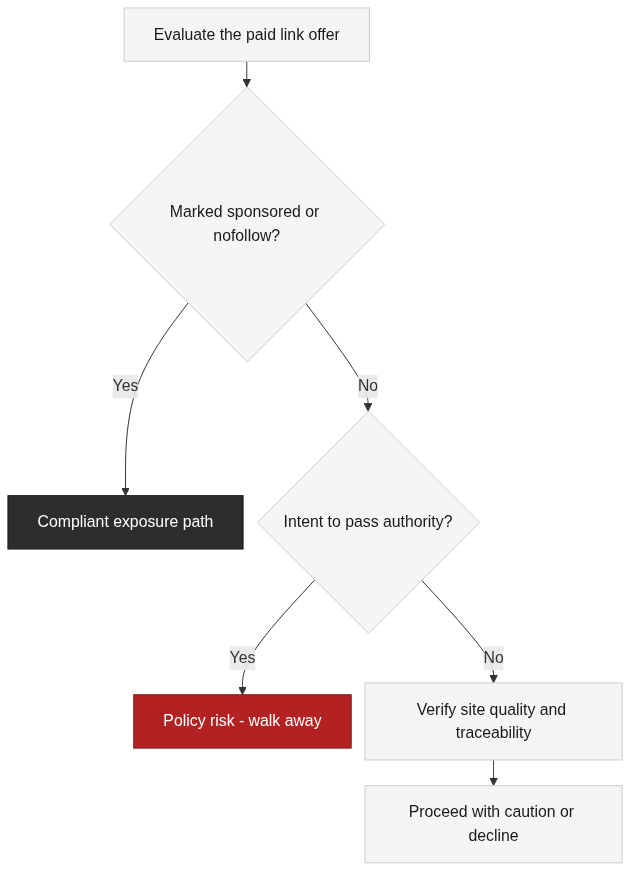
If you’re still considering a paid link, run it through this checklist first. Any single failure on the first few items should end the conversation.
The Before-You-Buy checklist
- 1. Intent self-check — Do you want ranking signals, or compliant exposure? If the former, you’ve already triggered policy risk.
- 2. Marking check — Will the seller mark the link
rel="sponsored"ornofollow? Unmarked but “passes authority” = red flag. - 3. Site quality — Is the source domain actually operated, with real content and traffic, or is it an empty shell, directory, or farm? Cross-check independently.
- 4. Relevance — Does the link fit naturally in your niche and content? An irrelevant high-DR link is low-value and suspicious.
- 5. Anchor text — Does the deal push exact-match anchors? Abnormal anchor distribution is a spam signal.
- 6. Traceability — Can the seller transparently explain placement, site ownership, and verification? No transparency = red flag.
- 7. Price sanity — Is the quote too good to be true? Extremely low prices usually mean risky sites; high prices don’t guarantee safety.
- 8. Exit cost — If you later need the link removed, can you control that? With bought links you usually can’t.
Red flags that should end the conversation
- – A promise of a top ranking or fast results — unrealistic and against how search works.
- – Refusal to disclose sites, refusal to mark sponsored, or demands for exact-match anchors.
- – Bulk packages like “50 high-DR links for a fixed price.”
- – Source domains with no real content, no traffic, or signs of being a PBN or farm.
Buy vs. outsource vs. white-hat partner
| Dimension | Buy links yourself | Outsource to bulk sellers | White-hat strategic partner |
|---|---|---|---|
| Policy risk | High (easy to cross the line) | High (hard to control) | Low (compliance-first) |
| Control | Medium | Low | High |
| Sustainability | Low | Low | High |
| Cost transparency | Medium | Low | High |
| Fits | Experienced, compliance-aware teams | Not recommended | Anyone pursuing long-term growth |
Core Conclusion and Your Next Step
The takeaway
Risk isn’t about how much you spend — it’s about marking and intent. A link bought to manipulate rankings and left unmarked carries the same policy risk whether it costs $20 or $2,000. Sustainable growth comes from content-driven editorial links that are earned and, where compensated, properly marked. That’s the difference between a short-term gamble and a durable strategy.
The recommended path
The more sustainable alternative is to move from buying links to a compliant, content-driven link building strategy — and to work with people who build links the right way. If you’re weighing whether to buy paid backlinks, outsourcing to a professional link building service or a white-hat partner removes most of the policy risk while keeping the growth.
Invitation to explore
A strategic partner can help you grow without the policy risk — building editorial, relevant, content-driven links that compound over time. If you’re ready to stop gambling on individual link purchases and start building something sustainable, explore professional link building services and outsourcing options to see how a compliance-first approach fits your goals. For a deeper look at what different options cost, read our guide to link building cost, and compare link building packages before you commit. You can also learn about the risks of PBN backlinks and how sponsored and UGC links fit into a compliant strategy.
FAQ
References
Google Search Central — Spam policies (link spam) — defines “buying or selling links for the purpose of manipulating rankings” as link spam.
Google Search Central — Evolving “nofollow”: new ways to identify links — introduces rel="sponsored" and ugc for marking compensated and user-generated links.
Google Search Central — Qualify outbound links — guidance on using rel="sponsored" for advertisements, sponsorships, and compensation agreements.
Google Search Central — New ways Google detects unnatural links — describes the 2021 link spam update targeting bought links and PBNs.
Google Search Central — December 2022 link spam update — documents the SpamBrain-based link spam system that neutralizes purchased links and link farms.