
Outsource Link Building: When It Makes Sense and How to Do It

Before You Decide: What Outsourcing Actually Buys You
Outsourcing buys capacity, skill, and existing relationships, in that order, and it does not buy a shortcut around page quality.
If your bottleneck is hours, a vendor converts budget into placements faster than hiring does, because the team, the tools, and the outreach lists already exist. If your bottleneck is skill, a specialist vendor compresses months of trial and error into a working method. If your bottleneck is access, a vendor with established publisher relationships can reach sites your cold outreach cannot.
The three things outsourcing does not solve: a thin or outdated target page, an unrealistic expectation of results, and a brand that cannot articulate what a good link looks like. Decide those three first, because they decide whether any vendor can succeed for you. A page that is not worth linking to will not become linkable just because someone else does the outreach [1].
In-House vs Outsource: Where the Real Trade-Offs Are
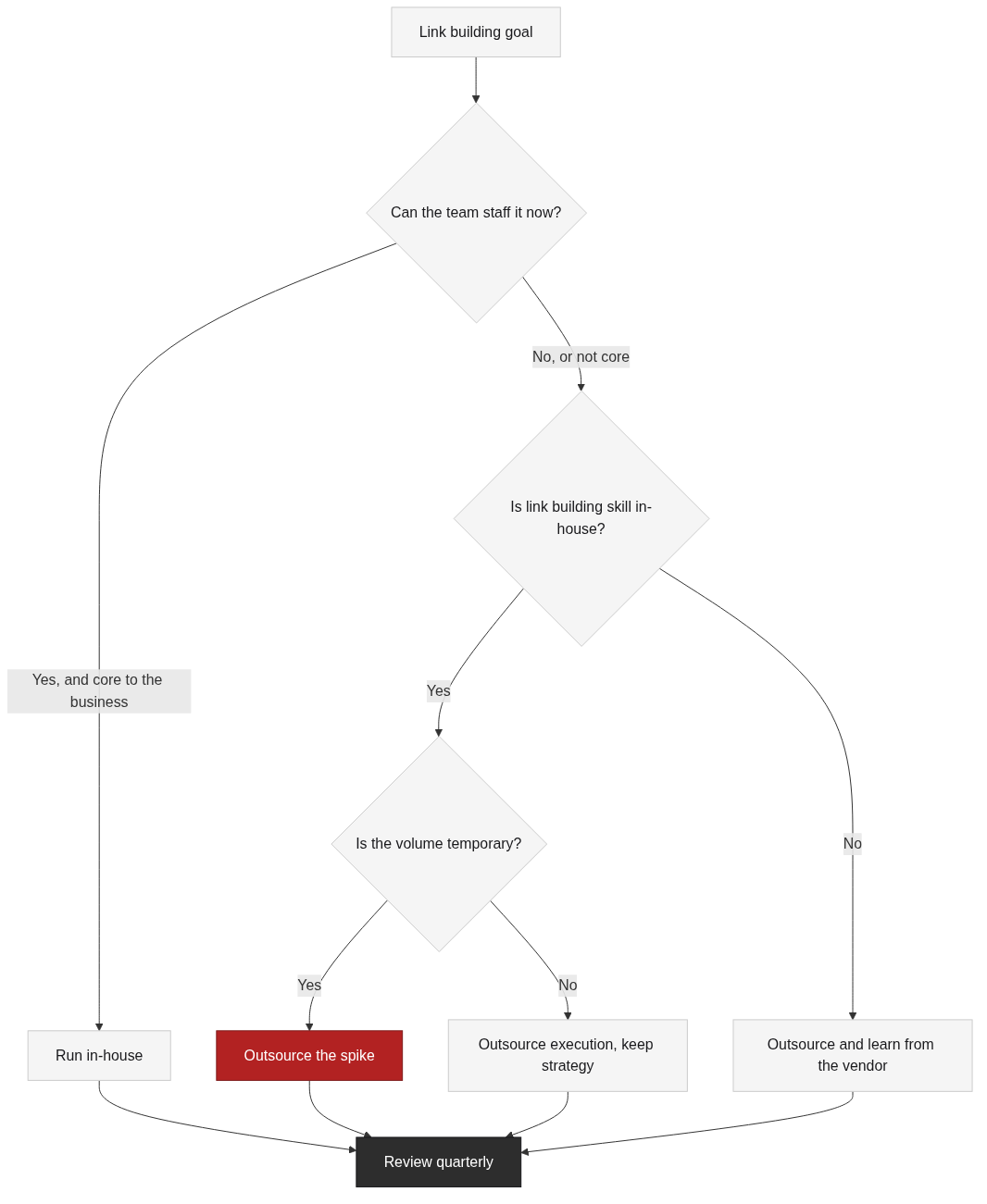
The in-house versus outsourcing comparison is a trade-off between control and speed, with cost somewhere in the middle.
In-house gives you direct control over outreach voice, anchor text, and targeting, and it builds knowledge your next campaign reuses. It costs you hiring time, tooling, and the discipline to keep quality gates running when the founder is doing outreach. Outsourcing gives you a running process and a known cost, but you trade away day-to-day visibility unless the vendor reports well.
The practical split depends on the role the work plays. If link building is core to your product, keep strategy in-house and outsource the execution you cannot staff. If it is a support channel, outsourcing the whole function is usually the lower-risk choice, because a vendor with a process beats a team that is learning the method in production.
The failure condition to watch is vendor dependence. If your reporting does not tell you which placements were earned, how, and why they matter, you have outsourced the decision along with the work. Treat every report as training material so the knowledge stays yours even if the vendor changes.
Agency vs Freelancer: Which Model Fits the Work
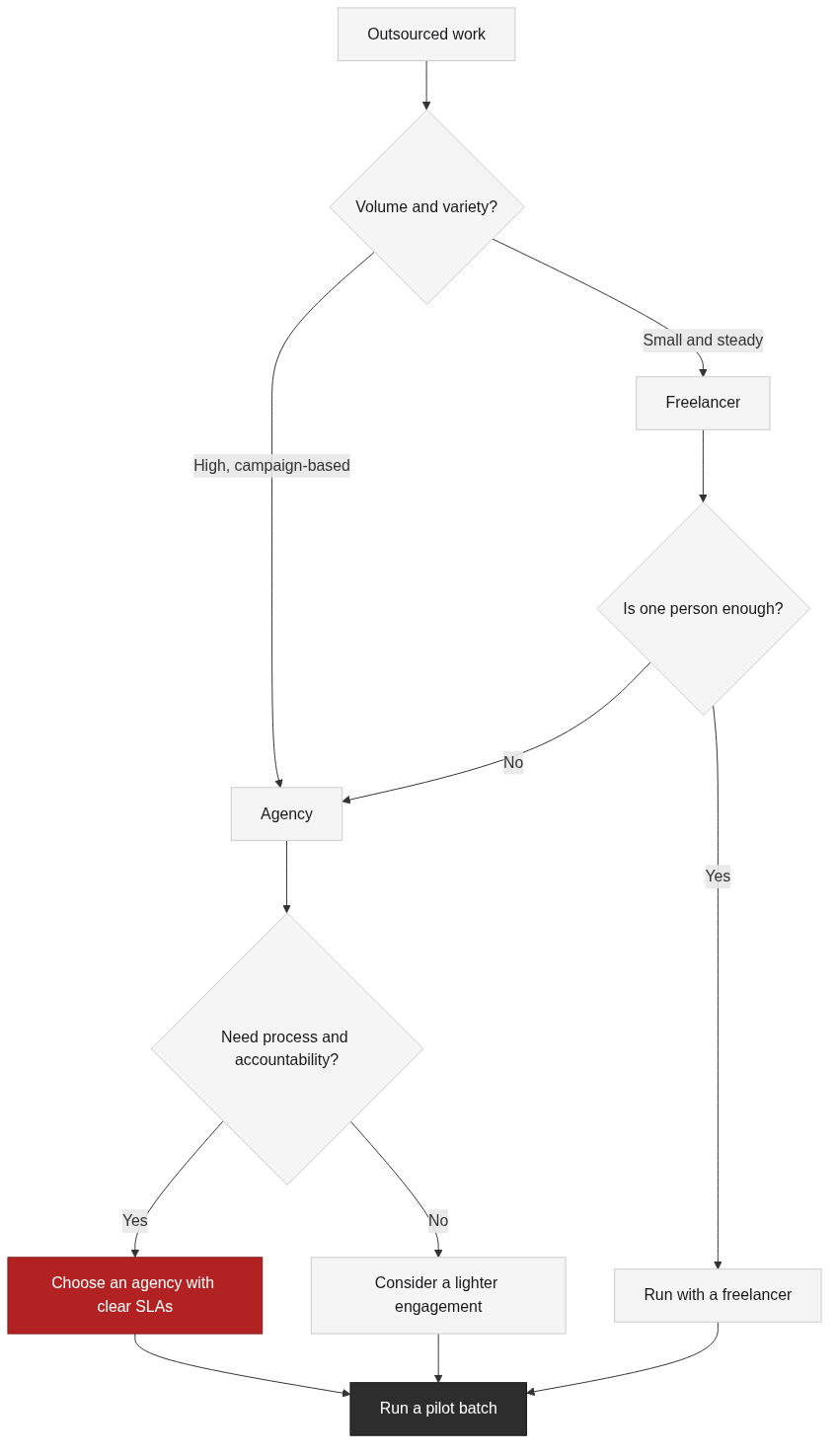
Agency and freelancer are different answers to different constraints, not different price tiers of the same service.
An agency suits campaign-based work: a defined goal, a deadline, and a volume that needs a team with role separation between outreach, content, and reporting. You pay for process and accountability, and you lose some flexibility, because a campaign runs on the agency’s schedule and templates.
A freelancer suits small, steady, well-specified work: a few placements a month against an established target list. You pay less and communicate directly, but capacity is a single person, and absence, sickness, or a client overload can stall the whole channel.
The selection signal is volume and variety. If the work is a few placements with a clear brief, a freelancer is enough. If the work mixes outreach, content creation, and reporting across multiple campaigns, an agency model fits, because the risk of one person holding the entire channel outweighs the cost difference [3]. Test whichever you choose with a small pilot before committing to a long engagement.
How to Select a Vendor Without Regretting It
Selecting a vendor is screening for transparency and compliance before you ever discuss price.
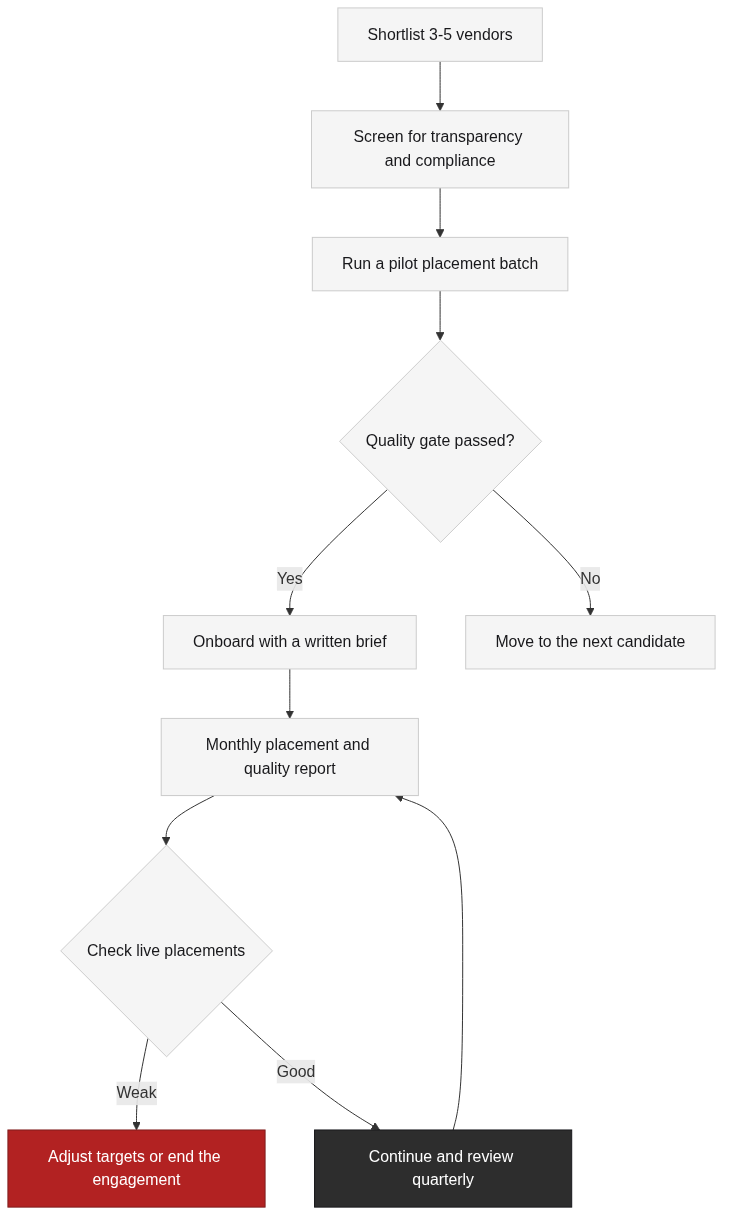
Start with a shortlist of three to five candidates, and ask each the same questions: what methods they use, what they refuse to do, how they source placements, and what their reporting contains. The answers matter less than the specificity. A vendor who cannot name their method mix, or who answers with “guaranteed rankings,” is a signal to move on, because link building results cannot be guaranteed by any legitimate process [2].
Check the compliance stance explicitly. Anyone who mentions cheap bulk links, PBNs, link exchanges, or automated outreach is disqualifying for most brands, because the risk to your profile outlasts any short-term gain [4]. Ask for sample outreach, a sample report, and client references, then verify the placements in the sample are real, relevant, and editorial.
Run the pilot before the contract. A small placement batch with a written brief, a quality gate, and a defined review date tells you more than any sales call: whether the outreach matches your voice, whether the placements survive your relevance filter, and whether reporting arrives on time and in a usable form.
Running the Relationship: Briefs, Reports, and Quality Gates
A good outsourcing relationship is three documents: a brief, a report, and a quality gate.
The brief fixes what good means: target pages, the relevance bar for linking pages, the quality bar for publishers, the budget, and the review rhythm. Without it, the vendor optimizes for their definition of done, which is usually placements published, not placements that help you.
The report should tell you what was placed, where, when, and why each placement passed the filter. Treat placement counts as activity, not outcome. The metrics that matter are relevance of linking pages, quality of publishers, and whether placements stay live, so check live links after publication instead of trusting the spreadsheet [5].
Run the review on a fixed rhythm, monthly for activity and placement quality, quarterly for strategy. When quality drops, check the brief and the filter before blaming volume, because the usual failure is the target or the criteria, not the outreach pace. If the vendor cannot fix it in one review cycle, that is evidence the engagement needs to change.
When Outsourcing Link Building Is the Wrong Call
Outsourcing is the wrong call in three situations, and recognizing them early saves both time and money.
First, when the target pages are not ready. Outsourcing link building to a page that is thin, outdated, or off-intent multiplies the weakness, and no vendor relationship fixes that. Second, when you cannot define a good link, because a brand that cannot state its relevance and quality bar cannot hold a vendor accountable. Third, when compliance is mission-critical and you cannot verify the method. If your industry treats even a questionable placement as a real risk, the in-house filter is the safer investment.
It is also worth pausing when the only reason to outsource is a deadline you set arbitrarily. A spike in volume can be outsourced, but the decision to grow the channel should survive a month of reflection, not just a quarter-end push.
FAQ
References
Google, “SEO Starter Guide,” developers.google.com. Official documentation describing links among the signals that help pages gain visibility, and why page quality and time matter.
Moz, “Backlinks,” moz.com. Public glossary explaining what backlinks are and why relevance and placement determine their value.
Ahrefs, “Link Building for SEO: The Definitive Guide,” ahrefs.com. Public industry guide covering campaign planning, method selection, and outsourcing considerations.
Google Search Central, “Spam policies for Google web search,” developers.google.com. Official documentation describing link schemes and practices that Google treats as policy violations.
Search Engine Journal, “Link Building,” searchenginejournal.com. Public industry article covering outreach, placement quality, and reporting.
Next Steps
Decide in this order: fix the target pages, define a good link, then compare in-house versus outsourcing, agency versus freelancer, and finally screen vendors on transparency and compliance. The link building strategies guide explains the method mix you should expect from any vendor, the resource page link building guide covers a method that fits most campaigns, and the unnatural links guide helps you judge whether a placement belongs in your profile.
If you would rather keep strategy in-house and let a specialist run the execution, TraffiClimb builds premium link building programs for ambitious brands. Visit the TraffiClimb website to see how the approach works.