
Media Pitching in 2026: 7 Essential Steps to Get Journalist Coverage
 Written by Sanja Gajic
Journalists open roughly 46% of the pitches they receive, yet the overall reply rate sits at only about 3.43% [1][2]. That is the reality of media pitching in 2026: even when your email gets opened, there is a 96% or better chance it gets ignored. The good news is that reply rates are climbing — up 8.89% quarter over quarter in the latest Propel data, the highest on record [1]. The difference between a pitch that vanishes and a pitch that earns coverage is not luck. It is a repeatable process: research the journalist, shape a story angle with evidence, write a subject line and opening that earn a read, and follow up with intelligence instead of annoyance.
This guide walks through the complete journalist pitching workflow — from deciding what a media pitch actually is, to researching the right reporter, to writing and following up — so you can stop spraying and start earning coverage.
Why Your Media Pitch Gets Ignored — and How to Fix It
In Media Pitching, most pitches fail before a journalist reads a single word. With inboxes flooding in daily, the odds are stacked against you from the start.
The Numbers Behind the Noise
The volume is the first problem. PR Daily reports that 49% of journalists say they receive at least six pitches a day, and 12% face more than 21 [3]. Fractl’s research goes further: 46.5% of journalists receive at least 11 pitches daily, and 28.64% get more than 26 [4]. Multiply that across a working week and it is easy to see why a generic, company-first email never breaks through.
The second problem is the gap between open and reply. Propel’s Q2 2024 Media Barometer, built on more than 405,000 pitches, found an average reply rate of 3.43% [1]. A separate survey of over 1,100 journalists found that 49% say they “rarely or never” reply to pitches at all [5]. In other words, the best subject line in the world only gets you to the open — everything after that has to convince a busy reporter that your story is worth their time.
The Core Question This Guide Answers
So how do you proactively recommend a story, a dataset, or an expert angle to a journalist in a way that makes them want to cover it? The answer is not a cleverer template. It is a sequence of deliberate choices: researching the right reporter, shaping the story around their readers, backing the angle with evidence, and making it effortless to say yes.
The Mindset That Changes Everything
Treat every pitch as a proposal to a specific person, not a broadcast to a list. Journalists do not report on companies; they report on stories that serve their audience. When you lead with reader value instead of company messaging, you stop being noise and start being a source. That is the shift this guide is built around — and it is the same discipline behind premium, compliant, sustainable link building that earns placements rather than chasing them.
Research the Journalist Before You Write a Single Word
The single highest-leverage step in media pitching happens before you draft a sentence. Research is what separates a pitch that feels personal from one that reads like a blast.
Relevance Over Reach
A daily inbox of 11 to 26 pitches means the spray-and-pray approach is guaranteed to fail [4]. Before you send anything, confirm three things: does this journalist actually cover your topic, what have they written recently, and what format do they prefer? If the answer to the first question is no, move on — no subject line can overcome a relevance mismatch.
A Tiered Research Strategy
You cannot spend 30 minutes researching every contact, and you should not. Onclusive recommends a tiered approach: invest 20 to 30 minutes of deep research and highly personalized pitching on your top 10 to 15 priority journalists, and spend 10 to 15 minutes on tier-two contacts with semi-personalized outreach [6]. This concentrates your effort where it is most likely to pay off.
The Relevance Test and Research Checklist
Before hitting send, apply the relevance test: *does this story have value to this journalist’s readers, not just to my company?* If you cannot articulate the reader value in one sentence, the pitch is not ready.
Build a research checklist for each priority journalist:
- – Beat and coverage area: Do they write about your industry or adjacent topics?
- – Recent work: What have they published in the last few weeks, and what angle did they take?
- – Format preference: Do they favor data stories, features, expert commentary, or listicles?
- – Reporting cadence: How often do they publish, and are they actively accepting pitches?
Turn a Company Message Into a Story Angle With Evidence
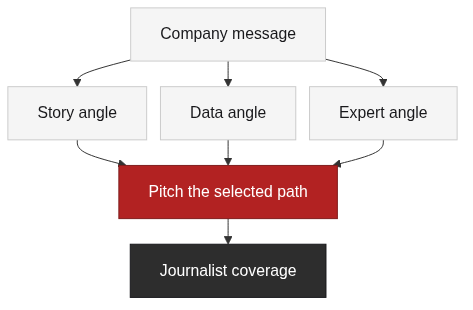
The hardest transition in media pitching is moving from “here is what we announced” to “here is a story your readers will care about.” Those are two different documents.
Media Pitch vs Press Release vs Generic Outreach
Before you write, know which document you are producing. A media pitch is a short story proposal sent to a specific journalist to spark interest in an idea [7]. A press release delivers the complete story in one structured document, designed for a busy reporter to publish quickly [8]. Generic outreach is a scaled, templated request for links or exposure rather than a targeted story pitch.
| Dimension | Media Pitch | Press Release | Generic Outreach |
|---|---|---|---|
| Purpose | Spark interest in a story angle | Distribute a complete announcement | Request links or exposure at scale |
| Recipient | A specific, researched journalist | Media and news wires | A large, non-specific contact list |
| Length | 100–150 words | 300–600 words, structured | Short, templated |
| Personalization | High (references recent work) | Low (standardized) | Low (batch template) |
| Evidence | Data, original research, expert quotes | Factual statements | Weak or absent |
| CTA | Clear: interview, exclusive, data | None specific | Link request |
| When to use | Proactively recommending a Story/Data/Expert Angle | When there is a formal announcement | Link building scenarios |
Journalists Don’t Report Companies — They Report Stories
Frame every pitch around reader value rather than company news. The evidence backs this up: Cision’s 2024 State of the Media found journalists are about twice as likely to follow up on a pitch that includes multimedia, and 61% say they value original research and market data above most other content [9]. Original data, first-hand research, and expert quotes are the evidence that makes an angle credible enough to cover.
Three Pitch Paths: Story, Data, and Expert Angle
Not every pitch travels the same route. Match the angle to the evidence and the journalist:
| Path | Lead angle | Core evidence | Target journalist | Exclusive strategy |
|---|---|---|---|---|
| Story | Character or company narrative, trend | Case study, timeline, Why now | Feature or column writers | Exclusive interview |
| Data | Original data, industry insight | First-hand dataset, charts | Data or business reporters | Data first-publish |
| Expert Angle | Expert viewpoint, commentary | Authoritative quotes, byline | Opinion or commentary editors | Byline column |
Write a Pitch That Gets Opened and Answered
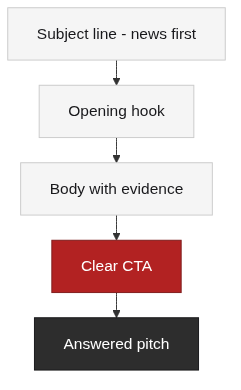
Once you have a researched journalist and a story angle with evidence, the writing itself becomes a craft of restraint. Every element has to work together.
The Subject Line: News First, Not Company First
PRSA recommends a subject line of 6 to 10 words that leads with the news or angle itself rather than your company name [9]. “Notion raises $275M at $10B valuation” outperforms “Exciting funding news from leading productivity startup.” BuzzStream’s analysis of more than 450 subject lines puts the optimal range at 9 to 13 words [10]. The takeaway: keep it short, lead with the story, and leave the marketing adjectives out.
The Opening and Body Structure
Open with one sentence of personalization that references the journalist’s recent work or beat [11]. Then use two to three sentences to present the story angle, and close with a specific offer — an interview, exclusive access, or a data link. The full body should stay around 100 to 150 words [11]. Anything longer risks losing a reporter who is scanning between deadlines.
The CTA and Good vs Bad Pitch
End with a clear, low-pressure call to action. A concrete CTA — “Would you like a 15-minute briefing on the data?” or “Can I send the full dataset your way?” — gives the journalist a simple next step. Contrast that with the marketing-speak that gets ignored:
| Good pitch | Bad pitch |
|---|---|
| “Your March piece on remote work spending was spot on. Our survey of 2,000 managers shows a new pattern.” | “We are a leading SaaS company with exciting news.” |
| “I can share the full dataset and set up a 10-minute call with our analyst.” | “Please let us know if you’d like to feature us.” |
| “This angle fits directly with the productivity series you’ve been writing.” | “Our product is the best in the industry.” |
Follow Up With Intelligence, Not Annoyance
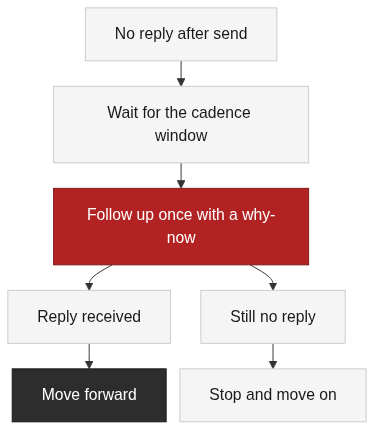
A single send is rarely enough. But follow-up is a discipline, not a permission to keep pinging.
Give Journalists a “Why Now”
Every pitch should carry a clear reason to act in the present: an industry trend, a seasonal hook, or a new data release window. A timely angle raises the urgency of coverage and gives the journalist a natural peg for their story.
The Follow-Up Cadence
Only 6% of journalists say they “always” reply to pitches, according to Sword and the Script — a figure that has held steady for two years [12]. Follow-up is normal, not a nuisance. If you hear nothing three to five business days after your first send, reply once with a short note that adds a new piece of evidence or a fresh angle, rather than resending the same message.
Polite Follow-Up vs Harassment
Stop after two follow-ups with no response and move to your next priority journalist. If a reporter explicitly declines, thank them and ask whether they would be open to being added to a future story-ideas list — that is how you build a relationship for the next pitch. Avoid the common mistakes that kill credibility: self-congratulating about your company, hedging language that weakens your point and using all-caps or exclamation marks.
Your Send-Before-You-Send Checklist and Pitch Playbook
Before any pitch leaves your outbox, run it through the checklist. If anything fails, fix it first.
The Send-Before-You-Send Checklist
- – [ ] Have I researched this journalist — their recent work, beat, and format preference?
- – [ ] Does this story pass the relevance test — value to their readers, not just my company?
- – [ ] Is the subject line 6–13 words, leading with the news or angle, and free of marketing cliches?
- – [ ] Does the opening reference the journalist’s recent work in one sentence?
- – [ ] Is the body 150 words or fewer, covering story angle plus evidence (data/expert/case)?
- – [ ] Is there a clear “Why now” — a timely reason to cover this now?
- – [ ] Does it end with a specific, low-pressure CTA (interview/exclusive/data link)?
- – [ ] Is there immediately citable evidence attached (data table/expert quote/downloadable file)?
- – [ ] Does it avoid self-promotion, hedging language, all-caps, and exclamation marks?
Follow-Up Decision Framework
- – No reply after 3–5 business days → send one short follow-up that adds a new piece of evidence or angle.
- – Explicit decline → thank them and ask if they would join a future story-ideas list (build the relationship).
- – Two follow-ups with no reply → stop and move to the next priority journalist; do not harass.
- – “Not right now” → log it in your CRM with the topic and preference for future pitching.
The Pitch Quality Scorecard
Score each pitch before sending across six dimensions:
| Dimension | Weight | Self-check |
|---|---|---|
| Relevance | High | Does the journalist actually cover this topic? |
| Story value | High | Is it reader value, not company messaging? |
| Evidence strength | High | Is there data, original research, or expert quotes? |
| Personalization | Medium | Does it reference recent work or preferences? |
| Timeliness (Why now) | Medium | Is there a clear reason to cover this now? |
| Conciseness | Medium | Is it 150 words or fewer, with no filler? |
Core Takeaway and Your Next Step
Media pitching succeeds through the combination of researching the journalist, shaping a story angle, and backing it with evidence — not through volume. From the subject line to the sign-off, every element has to work together, because a 46% open rate means little if the reply rate stays near 3.43% [1][2].
Apply the Checklist to Your Next Pitch
Take the send-before-you-send checklist and run it against your next pitch. Score it with the quality scorecard, fix the weakest dimension, and only then hit send. Iterate on your reply rate the way you would any other metric — measure, adjust, improve.
Turn Media Pitching Into a Sustainable Growth Channel
Earned coverage compounds. When a pitch earns a placement, that story becomes a linkable asset that supports both visibility and authority. If you want to fold media pitching into a broader, content-driven visibility strategy built on premium, compliant placements, book a consultation with TraffiClimb and we can map your next campaign together.
FAQ
References
Propel Q2 2024 Media Barometer — provides the average pitch reply rate of 3.43% and the +8.89% quarter-over-quarter increase based on 405,000+ pitches.
The Anatomy of a High-Performing Media Pitch — Ronn Torossian, Medium — provides the journalist open rate of roughly 46% and the open-vs-reply gap.
By the Numbers: What Journalists Really Think of Your Pitches — PR Daily — provides data that 49% of journalists receive at least 6 pitches daily and 12% receive 21+.
The Anatomy of a Media Pitch — Prowly citing Fractl — provides Fractl data that 46.5% of journalists receive at least 11 pitches daily and 28.64% receive 26+.
Media Pitch Email Templates That Get Responses — OBA PR — provides the survey of 1,100+ journalists finding 49% rarely or never reply.
How to Pitch Journalists — Onclusive — provides the tiered research strategy of 20–30 minutes for top 10–15 journalists and 10–15 minutes for tier-two contacts.
Media Pitching vs Press Releases: What’s the Difference? — Cision — defines the media pitch as a short story proposal versus a complete press release.
Media Pitch vs Press Release: What Journalists Need — Presspage — distinguishes the brief pitch proposal from the complete, publishable press release.
Media Pitch Examples: 12 Templates That Get Journalist Replies in 2026 — PRSA — provides subject line guidance of 6–10 words leading with news, plus Cision 2024 data on multimedia and original research.
How to Write Subject Lines — BuzzStream — provides analysis of 450+ subject lines showing the optimal 9–13 word range.
Press Release vs Media Pitch — Presslei — provides the 100–150 word pitch length standard and the recommended pitch structure.
Follow-Up PR Pitches — Sword and the Script — provides data that only 6% of journalists “always” reply, a figure steady for two years.