
What Is Link Equity? How Link Juice Works in SEO
 Written by Alistair MacLeod

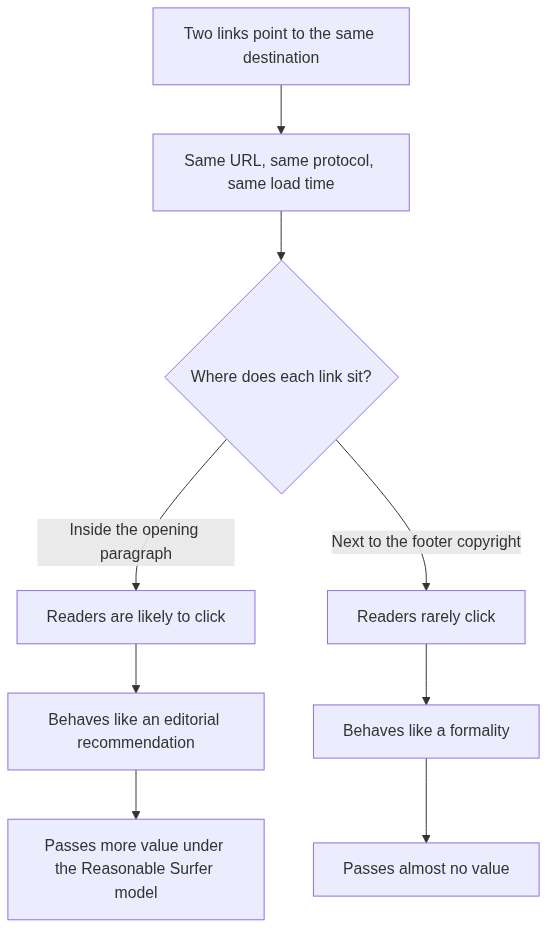
Picture two links on the same page pointing to the same destination. One sits inside the opening paragraph, wrapped around a descriptive phrase. The other is buried in the footer, next to a copyright line. They point to the same URL, use the same protocol, and load in the same millisecond. Yet in practice one of them can help push that destination page up the results, while the other barely registers.
That gap is what people mean when they talk about link equity — and it is also what makes “link juice” such a slippery term. This guide explains what link equity is, how it moves between pages, and what actually determines how much value a single link carries. It stays at the conceptual level on purpose: link equity is a way of thinking about link value, not a score you can look up.
What Is Link Equity? (And Why Link Juice Means the Same Thing)
Link equity is the value, authority, or ranking weight that a hyperlink passes from one page to another. Link juice is the informal industry nickname for the same idea. The two terms describe one mechanism; only the register differs.
Two links, two very different outcomes
Start with the scenario above, because it captures the whole concept in one image. A link’s value is not fixed by the fact that it exists. It depends on where it lives, what surrounds it, and how likely a real person is to click it. A prominent in-content link invites clicks; a footer link usually does not. The first one behaves like a recommendation, the second like a formality.
Search Engine Land, writing about Google’s “Reasonable Surfer” patent, put the underlying logic plainly:
“The concept is that the value a link should pass to a target page will be largely based on the probability that a user would click on it.” [1]
That single sentence explains why two identical-looking links can behave so differently, and it is the thread that runs through everything below.
One sentence definition
Link equity is the transferable value a hyperlink passes from the page that hosts it to the page it points to. Link juice is the same thing under a looser name. If you see “link juice” in an SEO article, read it as “link equity” and the meaning holds.
What this article does and does not claim
This guide covers how link value is transferred and what influences that transfer. It does not treat link equity as a number Google publishes or lets you query. There is no official “link equity score,” no dashboard field, and no API endpoint. Any tool that shows you a link-value metric is estimating, not reporting. Keep that boundary in mind — it is the difference between a useful mental model and a fantasy.
Link Equity vs Link Juice: Where the Concept Comes From
The idea behind link equity traces back to PageRank, Google’s original method for judging a page’s importance by the links pointing to it. Understanding that origin explains why the concept exists — and why it was never meant to be a public number.
The PageRank origin story
PageRank was developed by Larry Page and Sergey Brin, who filed the original patent behind it in September 1998 as a way to calculate the importance of web pages. [2] The core intuition was simple and durable: a link is a vote, and the weight of that vote depends on the importance of the page casting it.
Google eventually stopped exposing PageRank data publicly. The toolbar metric that once let anyone glance at a page’s PageRank was retired in 2016, which removed the last official window into how Google scored link value. [3] What remained was the concept — now universally called link equity or link juice.
Why it is not a number you can look up
Because Google no longer publishes PageRank, every “link value” figure you encounter outside Google’s own systems is a third-party estimate. Those estimates can be useful for comparison, but they are built from crawl data and their own models, not from Google’s internal scoring. Treat them as directional signals, not as the thing itself.
This is the key conceptual move: link equity is a model of value transfer, not a measurement. You reason with it the way you reason with “brand strength” — useful for decisions, impossible to pin to a single decimal.
A quick terminology map
| Term | What it refers to | Where it fits |
|---|---|---|
| Link equity | The value a link passes between pages | The neutral, formal term |
| Link juice | The same value, informal name | Industry shorthand; interchangeable |
| PageRank | Google’s original link-based importance measure | The historical origin of the concept |
| Third-party authority metrics | Independent estimates of a page or domain’s strength | Approximations, not Google values |
The practical takeaway: use “link equity” when you want to be precise, expect “link juice” in casual conversation, and never treat either as a score you can retrieve.
How Link Equity Flows Between Pages
Link equity does not travel as a fixed package. It is shaped by the page it leaves, how many exits that page offers, and — crucially — how likely each individual link is to be clicked.
The three inputs to link value transfer
In the classic PageRank model, the value passed along a link depends on three things: the linking page’s own importance, the number of outgoing links on that page, and a damping factor that tempers how much weight survives each hop. [4] Put simply, a strong page with few outbound links passes more per link than a weak page with hundreds.
The damping factor is why link value tends to decay as it travels. Not all of a page’s weight flows onward; some is retained, and each additional hop dilutes the rest.
The Reasonable Surfer refinement
The original model treated every link on a page as equally likely to be followed. Google’s later “Reasonable Surfer” model — described in US Patent 7,716,216 — changed the assumption: it weights each link by the probability that a user would actually click it. [10]
Bill Slawski, who tracked Google patents closely, described the shift this way: the Reasonable Surfer model “looks at different probabilities involving the likelihood that a person might click upon specific links based on features associated with those links.” [6] In other words, the value a link passes stops being a page-level constant and becomes a link-level variable.
What drives click probability
If value tracks click probability, then the features that make a link more clickable also make it more valuable. Those features include font size, color, anchor text, and position on the page. [5] A large, clearly labeled link in the middle of a paragraph reads as clickable; a small, low-contrast link in a navigation strip does not.
This is the mechanism behind the opening example. The in-content link and the footer link point to the same place, but they carry very different click probabilities — and therefore very different equity.
Internal Links vs External Links: How Link Equity Moves
Link equity reaches a page through two channels: internal links that redistribute value already inside your site, and external links that bring new value in from elsewhere. They play different roles and carry different levels of control.
Internal links redistribute value you already have
Internal links do three jobs at once. They help search engines discover pages, they move link equity from stronger pages to weaker ones, and they guide users through your content. [9] A page with no internal links pointing to it — an orphan page — may never be crawled or indexed at all, no matter how good its content is.
Orphan pages are more common than most site owners assume. Crawl analyses of large sites regularly find that a substantial share of URLs have no internal links pointing to them, leaving content stranded inside the CMS. Internal linking is the most accessible fix available, because you control the placement and anchor text completely.
External links bring new value in
External links — backlinks from other domains — are the only way to import link equity from outside your site. They function as external votes of confidence, where the relevance and authority of the linking site count for far more than the raw number of links. [8]
The trade-off is control. You decide nothing about a backlink’s position, surrounding context, or anchor text; you can only influence them through outreach and the quality of the content you publish. That is why external link building is slower and more expensive than internal linking — and why internal linking is usually the first place to look.
Side-by-side comparison
| Dimension | Internal links | External links (backlinks) |
|---|---|---|
| Where value comes from | Redistributed from pages you already own | Imported from other domains |
| Control | Complete — you choose placement and anchor text | Partial — influenced through outreach and content |
| Primary role | Discovery, equity redistribution, topical grouping | Authority signal, relevance vote |
| Common problems | Orphan pages, buried pages, vague anchor text | Low relevance, poor placement, nofollow attributes |
| Where to start | First — low cost, fast effect | Second — higher cost, long-term investment |
The sequence matters. Fixing internal links is within your control and shows results quickly; external link acquisition compounds more slowly and should build on a site that already distributes value well.
What Affects How Much Link Equity a Link Passes
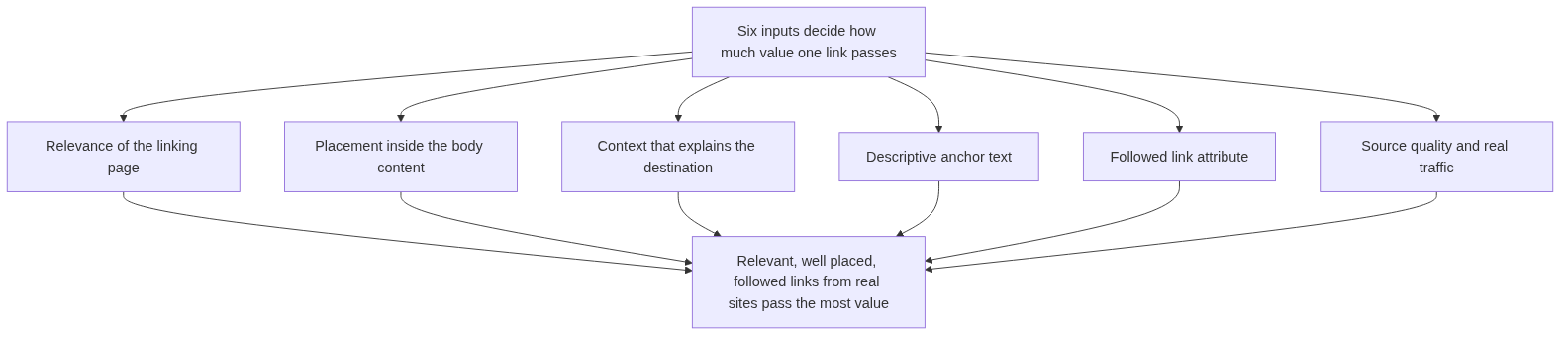
Not all links are equal, and the reasons are concrete. Relevance, source quality, placement, context, anchor text, and link attributes each shape how much value actually arrives.
Relevance and source quality
A link from a page that has nothing to do with your topic passes less value than a topically related one, even if the unrelated page is technically stronger. [4] Relevance is the filter that decides whether a link reads as a genuine endorsement or a random mention.
Source quality works the same way in reverse. A link from a page with real traffic, original content, and topical authority carries more weight than one from a thin page that exists mainly to host links. Low-value sources dilute the signal rather than amplify it.
Placement and context
Placement is where the Reasonable Surfer logic becomes practical. A link inside the body copy of a page sits in a context that makes it clickable and relevant; the same link in a footer or sidebar sits in a generic, site-wide context that rarely earns a click. [5] In-content placement consistently outperforms boilerplate placement.
Context matters beyond position, too. A link surrounded by supporting sentences that explain why the destination is worth visiting reads as a recommendation. A bare, isolated link reads as an afterthought. The surrounding text is part of the link’s value.
Anchor text and link attributes
Anchor text tells search engines what the destination page is about. Descriptive, natural anchor text — the kind a person would actually write — reinforces relevance. Vague anchors like “click here” waste the opportunity, and keyword-stuffed anchors read as manipulation rather than description.
Link attributes decide whether ranking weight is passed at all. Google documents several: standard followed links, rel="nofollow", rel="sponsored" for paid or compensated placements, and rel="ugc" for user-generated content. [7] The followed link is the one that passes ranking weight; the others signal that the link should not be treated as an endorsement.
Scenario comparison
| Dimension | In-content, first-paragraph link | Footer / sidebar link | Nofollow / sponsored / UGC link |
|---|---|---|---|
| Click probability | High | Low | Usually low |
| Link equity passed | High (highest under Reasonable Surfer) | Low | Generally does not pass ranking weight |
| Contextual relevance | Strong — matches the page topic | Weak — site-wide boilerplate | Depends on whether the link is relevant |
| Best use for the target page | Driving rankings and redistributing weight | Navigation and discovery | Compliance and disclosure |
| SEO decision | Put your most important target pages here | Do not expect weight transfer | Use for compliance, not for building weight |
Read the table as a priority order. If a page matters, link to it from body content. If you are disclosing a paid relationship, use the correct attribute — and do not expect it to build ranking weight.
Does Link Equity Get Diluted? Why Not All Links Pass the Same Value
Yes, link equity is divided across the links on a page — but that mechanism is widely misunderstood. “Dilution” describes how value is split, not a punishment for having many links.
How dilution actually works
Every page has a finite amount of link equity to distribute, and it splits across the outgoing links on that page. [4] Add more outbound links, and each one receives a smaller share. That is arithmetic, not a penalty.
The practical consequence is about prioritization, not fear. If a page has fifty outgoing links, each gets a thin slice. If it has five, each gets a meaningful one. The fix is not to strip links out of fear but to be deliberate about which destinations deserve the strongest placement.
The dilution myth
The myth says that adding an external link costs you ranking weight, so you should hoard links and avoid pointing outward. That misreads the mechanism. Sharing value through a well-placed link does not punish the linking page; it distributes value, and a page that links generously to genuinely useful resources often earns links back.
What actually determines long-term value is not the raw count of outgoing links. It is relevance, placement, context, and sustained quality. A page with a handful of highly relevant, well-placed links outperforms one with dozens of scattered, generic ones — every time.
Common misconceptions, corrected
- “Link equity is a score I can calculate.” It is a conceptual model of value transfer. No public number exists, and third-party metrics are estimates.
- “Nofollow links pass nothing at all.” They do not pass ranking weight, but they still exist as references and can drive traffic and discovery.
- “Internal links steal weight from other pages.” They redistribute weight within your site. Redistribution is the point.
- “More outbound links always means less value.” More links means each link gets a smaller share — which is a reason to prioritize, not to hoard.
How to Apply Link Equity Thinking in Real SEO and Link Building
The concept is only useful if it changes decisions. Use it as a filter: before you place or pursue a link, ask whether it is relevant, well-placed, contextually supported, and likely to last.
A six-point link equity checklist
Run this before publishing an internal link or accepting an external one:
- Relevance — Does the linking page’s topic match the target page? An irrelevant link passes little value regardless of the source’s strength.
- Placement — Is the link inside body content rather than a footer, sidebar, or author bio?
- Context — Is there supporting text around the link that explains why the destination matters?
- Anchor text — Is the anchor descriptive and natural, rather than “click here” or keyword-stuffed?
- Attribute — Is the link followed, nofollow, sponsored, or UGC? The attribute determines whether ranking weight is passed.
- Source quality — Does the linking page have real traffic, original content, and topical authority?
Six checks, one decision: is this link worth placing or pursuing?
Matching the approach to your goal
| Your goal | Priority action | Avoid |
|---|---|---|
| Fast results for a new or small site | Fix internal linking and topical grouping; repair orphan pages | Buying a large volume of low-value external links up front |
| Improve rankings for a key page | Link to it from body content in high-click positions | Relying only on footer or navigation links |
| Build long-term authority | Earn relevant, naturally embedded external links | Chasing link counts and ignoring relevance |
| Manage compliance and risk | Label paid, sponsored, and UGC links with the correct attributes | Using hidden links or unlabeled paid placements |
The pattern across all four rows is the same: relevance, placement, context, and durability beat volume.
Internal linking as the first move
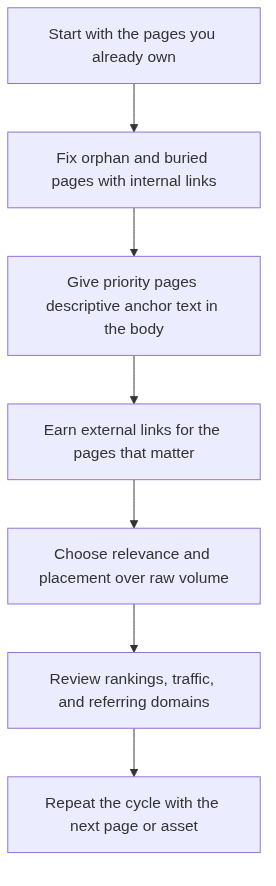
Before chasing new backlinks, audit the links you already control. Put your most important pages in body-content links at high-click positions, and repair orphan pages so nothing valuable sits unreachable. This is where link equity thinking pays off fastest.
If you want to go deeper on the pieces that sit around this topic, these are worth reading next: how to judge High-Quality Backlinks, the difference between Dofollow vs Nofollow Backlinks, how to read a Backlink Profile, and why Relevant Backlinks carry more weight than generic ones.
Key Takeaways and Next Steps for Link Equity
The question that matters is not “how many links did I get?” It is “where does this link sit, what surrounds it, how relevant is it to my topic, and how long will it last?”
The core conclusion
Link equity is a model for how value moves between pages — through internal links that redistribute what you already have and external links that import new authority. Its amount is shaped by relevance, placement, context, anchor text, attributes, and source quality. Dilution is a description of how value is divided, not a penalty to fear.
The strategic shift follows directly. Link building that chases raw counts misunderstands the mechanism. Link building that focuses on relevance, placement, context, and sustained quality works with it.
From understanding to action
Take the six-point checklist and run it against your own site. Look for orphan pages, buried key pages, and links sitting in footers where they cannot earn clicks. Then look at your external links and ask the same questions — are they relevant, well-placed, and contextually embedded, or are they generic mentions that pass little value?
That reframing is the whole point. When you stop counting links and start evaluating how value actually moves, your link building decisions get sharper — and so do your results.
At TraffiClimb, we build compliant, content-driven link building strategies for site owners, SEO teams, and digital agencies, with a focus on relevance, placement, and long-term quality rather than volume. If you would like to see how that approach applies to your site, explore our link building services — or subscribe to our newsletter for more practical guides on link quality and evaluation.
FAQ
References
Search Engine Land — SEO Implications of Google’s “Reasonable Surfer” Patent — provides the quote explaining that a link’s passed value is largely based on the probability a user would click it.
Wikipedia — PageRank — documents PageRank’s origin as Google’s link-based importance measure, developed by Larry Page and Sergey Brin, with the original patent filed in 1998.
LinkStorm — Link Juice in SEO: What It Is, How it Works, & SEO Benefits — defines link juice (link equity) as the value or authority passed from one page to another through hyperlinks, and notes Google’s 2016 retirement of public PageRank data.
LinkLaboratory — Link Equity Explained: How Link Juice Flows in SEO — explains the factors that determine how much link equity flows along a link, including page authority, relevance, and link type.
Search Engine Watch — How to Use PageRank for Ecommerce Websites — describes the link-level features (font size, color, anchor text, and position) that influence how likely a link is to be clicked.
SEO by the Sea — Google’s Reasonable Surfer Patent Updated — provides Bill Slawski’s explanation of how the Reasonable Surfer model weights links by click likelihood based on link features.
Google Search Central — Qualify Outbound Links for SEO — documents the standard, nofollow, sponsored, and UGC link attributes and their effect on how links are treated.
Voctos — Backlinks: How to Build a Strong Link Profile — explains that backlinks act as external votes of confidence where relevance and authority count more than link count, and that dofollow links pass ranking value.
Widepool Creatives — Why Internal Linking Matters for SEO Rankings — explains that internal links aid discovery, guide users, and distribute link equity from one page to another.
LinkDaddy — The Reasonable Surfer Model: Why Not All Links Are Equal — identifies US Patent 7,716,216 and describes how the Reasonable Surfer model weights link equity by the probability a real user would click the link.