
How Much Does Link Building Cost? Link Building Pricing Models Explained

What Link Building Pricing Actually Covers
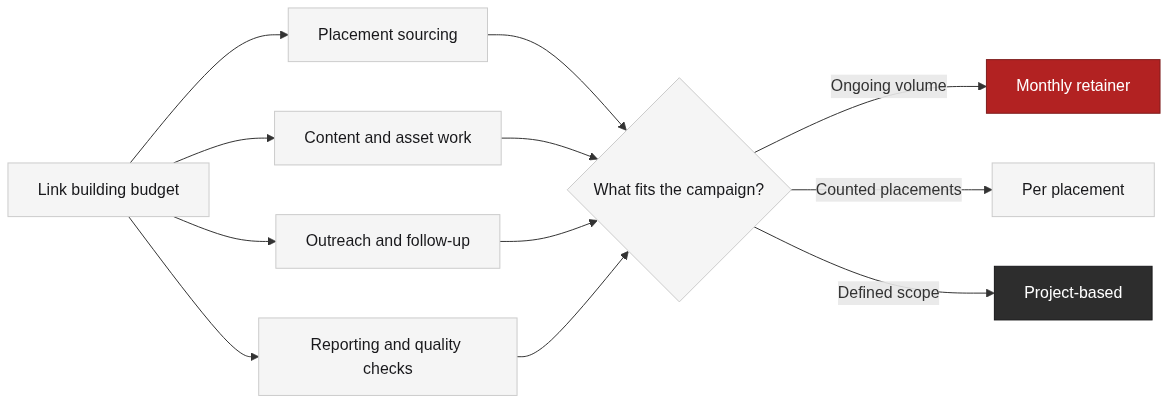
A link building quote is a bundle of four cost centers, and the split between them explains most price differences.
Placement sourcing is the cost of finding and qualifying publishers that match your relevance and quality bar. Content work is the cost of the pages or assets that earn the link. Outreach is the cost of the messages, follow-ups, and relationship work that turn a target into a placement. Reporting is the cost of verifying placements, checking live links, and documenting what happened.
If a quote is much cheaper than its peers, the usual reason is a missing cost center: placements from directories or link pages, no original content, automated outreach, or no verification. None of those savings survive contact with a quality gate [1]. Before comparing prices, list which of the four centers your campaign actually needs, and ask every vendor to state what is included in each one.
The Main Link Building Pricing Models
Three models dominate the market, and each one prices a different unit: time, placements, or a defined scope.
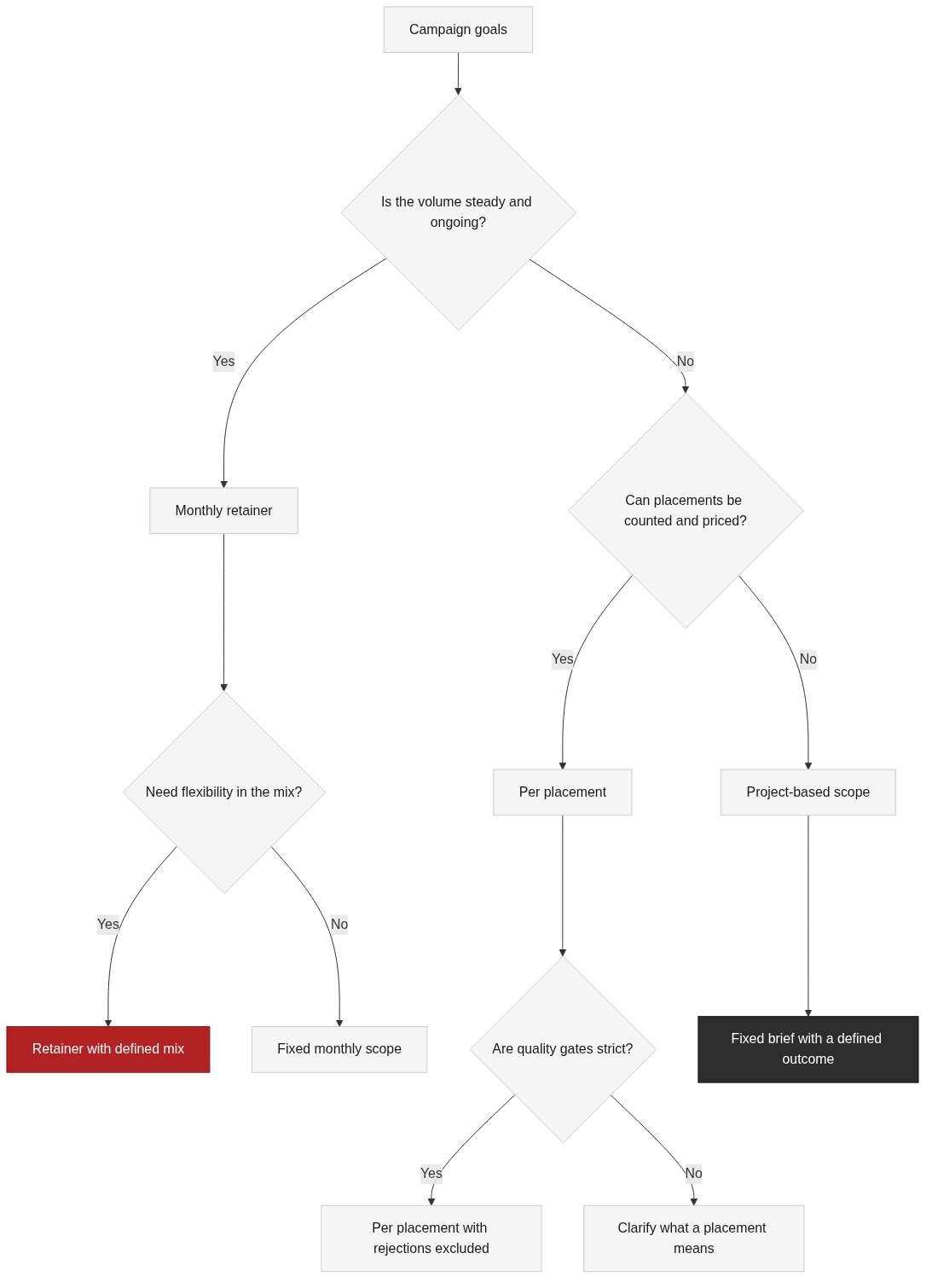
A monthly retainer prices access to a working process: a fixed budget buys a defined mix of outreach, content, and placements every month. It fits campaigns with steady volume and a long horizon, because the vendor can build relationships that pay off after several months. Retainers fail when the campaign is short and the vendor has no incentive to place anything fast, so tie the retainer to a minimum placement flow.
Per-placement pricing prices a countable unit, usually a published link or a placed mention. It fits campaigns where volume is uneven and you want to pay only for accepted work. The trap is the definition of a placement: rejections, no-follow placements, and links that vanish after publication should not count, so define “done” in the contract [2].
Project-based pricing prices a fixed outcome: a defined set of pages, a target number of placements, and a deadline. It fits launches, content amplification pushes, and campaigns with a clear end. The risk is scope drift, because “the project” expands unless the brief fixes the relevance and quality bar in writing.
What Drives the Price of a Backlink
The price of a single placement is set by the publisher’s quality, the relevance of the page, and the work required to earn it, in that order.
High-quality, relevant, editorial publishers are scarce, and scarcity sets the floor of any per-backlink price. A placement on a page that matches your topic and audience costs more than a generic link because the vendor must find it, pitch it, and fit your content to it. Content quality moves the price too: an original asset costs more than a rewritten article, and a linkable asset pays for itself by attracting placements beyond the first [3].
Scale changes the number, not the unit price. Buying in volume lowers the marginal cost of the process, but it does not make weak publishers relevant, so a bulk discount is only real if the relevance and quality bar survives the volume. The cost per backlink you should track is the all-in number: total spend divided by accepted, live, relevant placements, which is the only measure that compares fairly across vendors [4].
How to Read a Link Building Quote
Reading a quote means checking four things: the method mix, the exclusions, the definition of a placement, and the reporting.
Ask what methods produce the placements and what the vendor refuses to do. A quote built on PBNs, link farms, or automated outreach is cheap for a reason, and the risk to your profile is not priced into it [5]. Ask what counts as a placement and what happens to rejections, then put the answer in the contract.
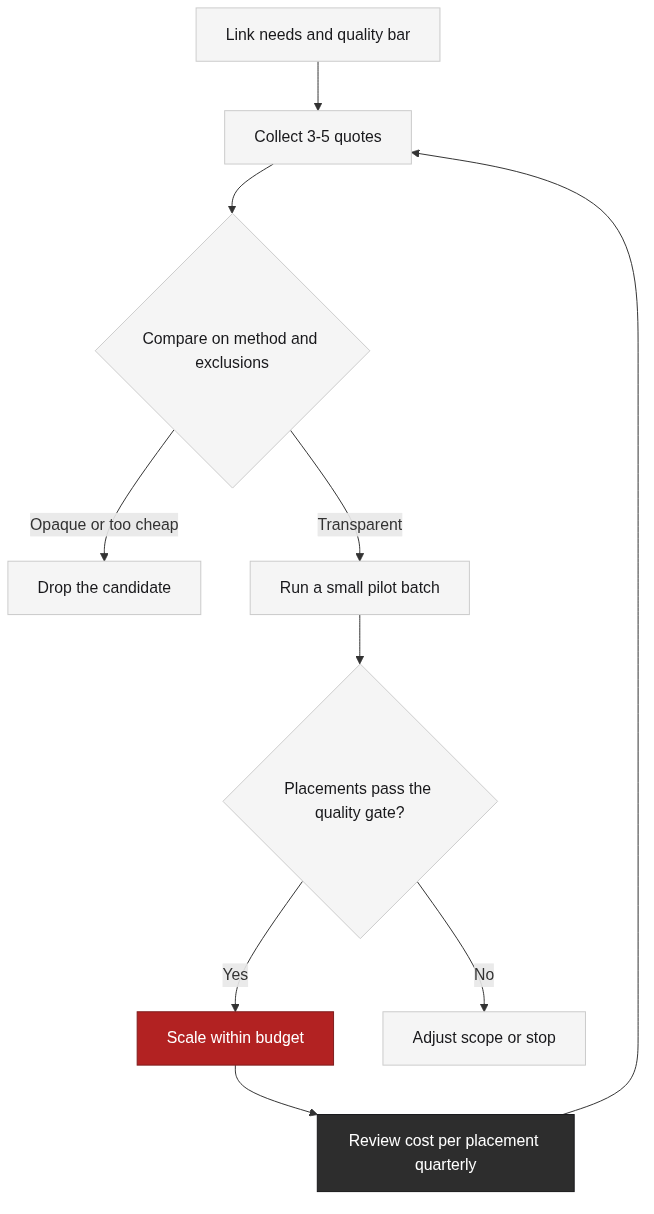
Ask what the report contains and when it arrives. A vendor who reports placement counts but not the linking page, the anchor, the publisher, and the date is asking you to buy trust you cannot verify. Compare quotes on the all-in cost per accepted placement, not on the headline number, and treat any quote that promises guaranteed rankings as a disqualifier, because rankings depend on factors no vendor controls.
Building a Realistic Link Building Budget
A realistic budget starts from needs, not from a number a vendor suggested.
Define the goal and the target pages first, then estimate the number of placements you need as a range, using the gap between your referring domains and the middle of your competitors’ distribution. Convert that range into an all-in cost using quotes that passed your method and exclusions filter, and add a reserve for content work and rejected placements.
Start with a pilot rather than a full commitment. A small batch with a written brief, a quality gate, and a fixed review date tells you the real cost per accepted placement before you scale. When the budget is tight, cut volume before cutting relevance: fewer relevant placements beat more irrelevant ones every time. Review the all-in cost quarterly, because publisher quality and your competitive gap both change [3].
When Cheap Link Building Pricing Costs More
The cheapest quote is rarely the cheapest outcome, and the gap is usually paid in risk and rework.
A placement from a low-quality or irrelevant page adds little and can pull the profile down, and replacing it means another cycle of outreach and content work. Links that disappear after publication have to be re-earned. Worst of all, a pattern of risky placements can leave your profile harder to repair than it was to build, which is why the compliance stance of a vendor matters more than the price tag [5].
That does not mean the most expensive quote wins. It means the price should be judged after the quality gate, not before it, and that a vendor who excludes the risky methods is worth more than one who simply charges less.
FAQ
References
Google, “SEO Starter Guide,” developers.google.com. Official documentation describing links among the signals that help pages gain visibility, and why page quality and time matter.
Moz, “Backlinks,” moz.com. Public glossary explaining what backlinks are and why relevance and placement determine their value.
Ahrefs, “Link Building for SEO: The Definitive Guide,” ahrefs.com. Public industry guide covering placement quality, content assets, and campaign planning.
Google Search Central, “Spam policies for Google web search,” developers.google.com. Official documentation describing link schemes and practices that Google treats as policy violations.
Search Engine Journal, “Link Building,” searchenginejournal.com. Public industry article covering outreach, placement quality, and reporting.
Next Steps
Decide in this order: fix the target pages and quality bar, list the four cost centers you need, compare quotes on method and exclusions, then pilot a small batch before scaling. The link building strategies guide explains the method mix behind any quote, the resource page link building guide covers the cheapest legitimate entry point, and the unnatural links guide helps you judge whether a quoted method belongs in your profile.
If you would rather work with a specialist who is explicit about methods, exclusions, and reporting, TraffiClimb builds premium link building programs for ambitious brands. Visit the TraffiClimb website to see how the approach works.