
Link Building Outreach: How to Find Prospects, Send Emails, and Earn Backlinks

What Link Building Outreach Is and When It Matters
Outreach is needed whenever the link you want belongs to a decision you cannot make alone, which is true of most high-value placements. A resource page update, a guest post, a digital PR mention, or a broken link replacement all require the site owner to say yes [3][4]. The email is not the tactic; it is the delivery mechanism for a reason to link.
Outreach pays off when you already have something linkable, such as a genuinely useful guide, a dataset, or a page that solves a real problem. It rarely rescues thin content, because editors can see quickly whether a page deserves a link. If the asset is weak, fix the page before spending time on the list; if the asset is strong, outreach is usually the fastest way to get it seen [1].
Finding Prospects Worth Contacting
Start with pages that already cover your topic or link to pages like yours, because those editors have demonstrated interest. Search for roundups, resource lists, and articles that mention similar tools or guides, then look at the sites that link to competitors on the same terms [3]. A prospect that has never linked to anything like your content is a harder sell rather than an impossible one, but it should not be the focus of a first campaign.
Keep the search intent-based instead of directory-based. A list of popular blogs in a niche contains thousands of sites, most of which will never link to you; a list of pages that actively curate resources on your exact subtopic is small and worth the time. The resource page link building guide explains how to find and update those pages, and the unlinked mentions guide covers prospects that already talk about you.
Qualifying and Prioritizing the Outreach List
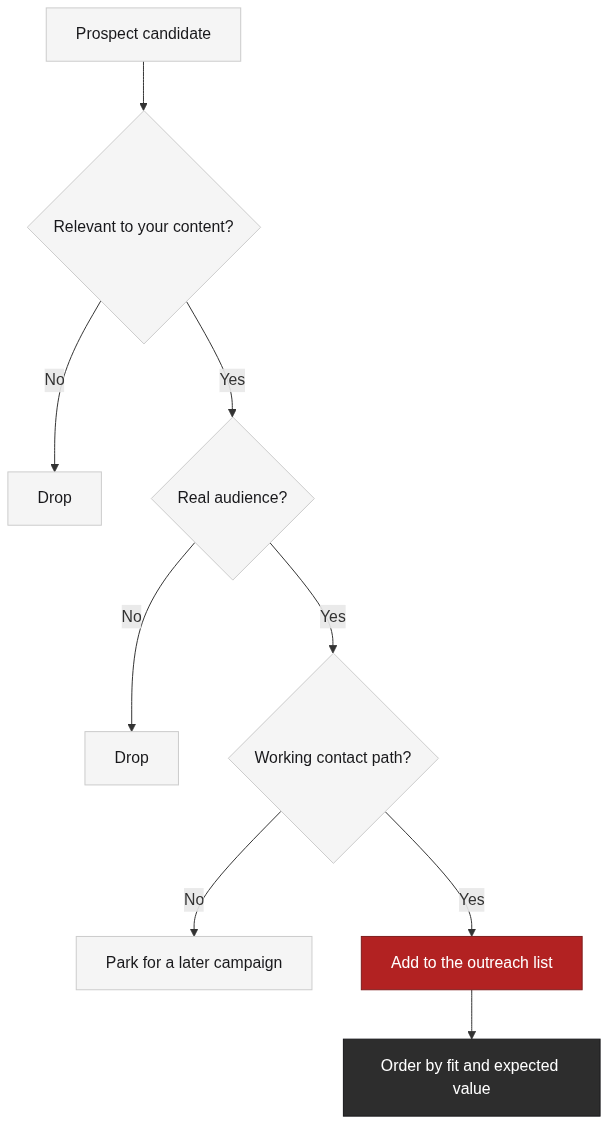
A prospect belongs on the list only when relevance, audience, and reachability all check out. Relevance means the linking page fits your content and your audience; audience means real people visit the page; reachability means there is a working contact path [2]. Drop prospects that fail one of these instead of sending anyway, because a single low-quality placement can cost more than a missed link [5].
Then prioritize by expected value and effort. A page that updates resource lists regularly and links to similar sites deserves the first email; an authority site with a strict submission process might deserve the same page, but only after you have practice. For a small team, start with twenty to thirty well-qualified prospects and learn what the response rate looks like before scaling the list [3]. The qualification flowchart below turns these three checks into a repeatable filter.

Writing Outreach Emails That Earn Replies
Write the email around the recipient, not around your page. Open with why this specific site and this specific person, state the value of the placement in one or two sentences, and make the ask small enough to answer quickly [3][4]. A short email with a clear reason outperforms a long pitch, and it is easier to write once you know the page you are referencing.
Tailor the first line to something you actually observed, such as a resource list missing a strong entry or a broken resource you can replace. Do not claim your page is the best or invent traffic numbers, because editors check those claims and unsupported superlatives end the conversation [5]. End with a specific question, such as whether the list is open for updates, so the reply costs the editor almost no effort.
Sending, Following Up, and Handling Responses
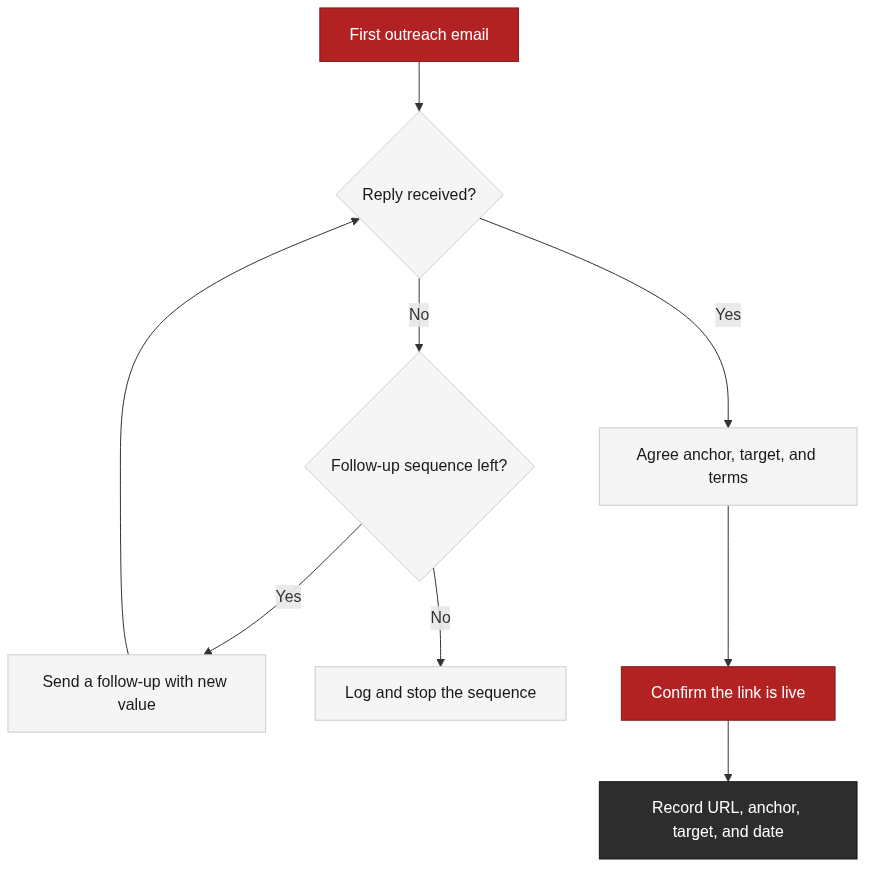
Send in small batches so you can adjust before the whole list is burned. Track opens, replies, and clicks if your tool supports it, but treat replies as the primary signal, because an open without a reply means the pitch rather than the send needs work [3]. Follow up once or twice with new information instead of a bare nudge, and treat the third follow-up as the exception rather than the default.
Handle every reply as a negotiation rather than a yes or no. A positive reply may need a different anchor, a different landing page, or a contribution before the editor agrees, and that negotiation is where the placement is actually earned [1]. A clear no is valuable too: log it, stop the sequence, and move on instead of cycling the same prospect through new angles.
Earning the Link After the Reply
The placement only exists when the link is live and points where you said it would. After the editor agrees, send exactly what was promised, confirm the target URL and anchor, and check the published page once it goes live [4]. A link that disappears or points to the wrong page is not a placement, whatever the original promise said.
Record every accepted placement in the same place you track prospects: URL, anchor, target page, date, and the outcome of the negotiation. That log makes the next campaign faster, because the methods that worked become the template for the next list [3]. The broken link building guide, link reclamation guide, and guest posting guide each describe a specific way to reach this point.
Measuring Outreach Results
Measure the campaign on placement quality and the response funnel rather than on email volume. Watch reply rate, positive reply rate, and the ratio of live placements to sent emails, and compare them across batches so a change in copy or list quality shows up early [3]. A low reply rate points at the list or the first line; a high reply rate with few placements points at the negotiation or the target page.
Check the placements themselves on the same cadence. Links disappear, pages get redesigned, and anchors get rewritten, so a monthly review of live status matters more than the week-one count [2]. When results lag, fix the asset or the qualification step before sending more volume, because more emails to the same kind of prospect will not change the outcome [1].
FAQ
References
Google, “SEO Starter Guide,” developers.google.com. Official documentation describing links among the signals that help pages gain visibility and why page quality determines link value.
Moz, “Backlinks,” moz.com. Public glossary explaining what backlinks are and why relevance and placement determine their worth.
Ahrefs, “Link Building for SEO: The Definitive Guide,” ahrefs.com. Public industry guide covering outreach, prospect research, and link-worthy content as the core of link building.
Search Engine Journal, “Link Building,” searchenginejournal.com. Public industry article covering outreach emails, digital PR, and the risks of low-quality placements.
Google Search Central, “Spam policies for Google web search,” developers.google.com. Official documentation describing link schemes and practices that Google treats as policy violations.
Next Steps
Start with the pipeline rather than the volume: qualify twenty to thirty prospects, send a tailored first email, follow up once or twice, and log every placement. Measure the reply and placement rates on a monthly cadence, fix the asset or the qualification step before scaling, and let the record of what worked shape the next list. The pillar guide to link building strategies places outreach inside the full method set, and the method guides linked above cover the specific tactics.
If you would rather focus on the strategy while a specialist handles the execution, TraffiClimb builds premium link building programs for ambitious brands. Visit the TraffiClimb website to see how the approach works.