
Link Bait: What It Is and How to Create Content That Attracts Backlinks
 Written by Sanja Gajic

You publish a genuinely useful blog post. Then nothing happens. No mentions. No citations. No links. This is not bad luck. Public research on link distribution consistently shows that the overwhelming majority of web pages never earn a single external link, while a very small fraction of pages attract most of the links that exist. The uncomfortable conclusion: link bait is not something you stumble into. It is something you design.
The goal of this guide is to help you understand why certain content earns references and backlinks, and how to deliberately design the type of content that is worth linking to — without resorting to clickbait. We will define what link bait is (and what it is not), explain the six triggers that make people link, walk through common link bait types with public examples, and give you a scoring checklist you can run before you build anything.
Why Most Content Never Gets Linked
Before we talk about how to create link bait, it is worth sitting with the reality of how links actually distribute across the web. The data is not flattering, and it explains why “publish and hope” is not a strategy.
The uncomfortable data: most pages earn zero external links
Widely cited research from the SEO industry paints a consistent picture. Studies published by Backlinko and Ahrefs — two of the most referenced sources in link building — both show that external links are extremely concentrated. Backlinko’s long-running research is often summarized with a striking ratio: roughly 5% of pages earn about 75% of the links [1]. Ahrefs’ analysis of page-level data reached a similar conclusion, finding that the vast majority of pages — in the range of 90% or more — never gain a single external link after publication [2].
The precise numbers shift depending on the dataset. The pattern does not. If you publish content and wait for links to arrive, you are betting against the most likely outcome.
Links are designed, not requested — the core shift in mindset
Here is the mindset shift that separates effective link building from passive publishing: people do not “give” links to you. They create a link because your content genuinely earns a reference. When an editor cites your data, or a blogger links to your tool, they are making a decision that your page adds value to their readers. That decision is influenced by how you designed the content.
This is the essence of link bait. You are not asking for a link. You are building something that makes the link an obvious, natural choice. As Brian Dean’s methodology has long argued, the real work is in creating things that are worth linking to, rather than chasing links directly [1]. That single reframe changes how you allocate your effort.
What this guide will cover (and what it deliberately won’t)
This is a focused guide. We will cover what link bait is, how it differs from related concepts, the six reasons people link, common types with examples, and a step-by-step creation workflow with an evaluation checklist.
We will deliberately not teach the full linkable assets framework, the complete Skyscraper technique, the entire infographic link building playbook, or a full outreach workflow. Those are separate topics. Where they connect to link bait, we will point you to dedicated guides so you can go deeper without this article ballooning into a content marketing encyclopedia.
What Is Link Bait? (And What It Isn’t)
If you are going to build content that earns links, you need a precise definition. “Link bait” gets thrown around loosely, and that looseness is exactly how clickbait sneaks in through the back door.
A working definition of link bait
Link bait is content deliberately designed to attract natural, inbound backlinks and citations. The emphasis is on the word *deliberately*. Unlike a standard blog post that hopes to be useful, link bait is engineered around a specific trigger — original data, a reusable tool, a complete reference, a striking visual, or a surprising argument — with the explicit goal of making other creators link to it.
The key test is whether the content is worth citing on its own merits. If someone links to it because it genuinely helps them, it is link bait. If someone clicks because the headline tricks them, you have built something else entirely.
Link Bait vs Linkable Assets — the “action vs asset” distinction
These two terms are often used interchangeably, but they describe different layers of the same system. A linkable asset is the reusable, long-lived resource — a free tool, a data page, a comprehensive guide — that continues to earn references over time. Link bait is the content or mechanism that makes that asset get linked in the first place.
Think of it this way: link bait is the action that draws attention; the linkable asset is the durable vessel that people keep coming back to. A viral opinion piece is link bait. The evergreen calculator you built is a linkable asset. You need both — and the asset is usually what turns a one-time spike into a sustainable stream of links. If you want the complete framework for building those durable resources, our guide to linkable assets walks through it in depth.
Link Bait vs Clickbait — value-driven vs headline-driven
This is the distinction that matters most, and it is where many teams go wrong. Link bait and clickbait both try to attract attention, but they work on completely different mechanisms:
- Link bait earns links because it is useful. The value lives in the content. People cite it, reference it, and build on it.
- Clickbait steals clicks because it is irresistible. The value lives in the headline. The content underneath is hollow, and readers leave disappointed.
One sentence captures it: *Link bait earns links because it is useful; clickbait steals clicks because it is irresistible.* The first builds trust and authority. The second erodes both — and it produces almost no natural citations, because nobody wants to reference a page that did not deliver on its promise.
Why People Link to Content: The 6 Link Triggers
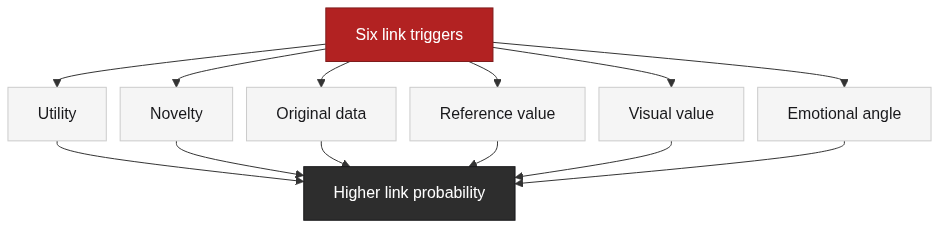
Now that we have defined link bait, the practical question is: what actually makes someone link? In our experience, nearly every earned link can be traced back to one of six triggers. Each trigger is a design dimension you can deliberately build into your content. Treat them as levers that raise the probability of being linked — not as guarantees.
Utility and Novelty — solving problems and being first
Utility is the simplest trigger. People link to content that saves them time or solves a real problem. Interactive tools, calculators, generators, and step-by-step walkthroughs fall into this category. If an editor can point their readers to your tool and say “this does the job,” they will link to it — because it makes their own content more useful.
Novelty is about being first. When you publish an exclusive finding, a new concept, or a first-of-its-kind dataset, you occupy a position nobody else can claim. Journalists and bloggers need a primary source for “the first time X happened,” and if that source is you, you become the default citation. Novelty is time-sensitive — you have to move fast — but the payoff is a link that competitors cannot easily replicate.
Original data and Reference value — becoming the default citation
Original data is one of the most reliable link triggers. When you survey your audience, analyze a proprietary dataset, or run a study that nobody else has run, you create something that cannot be found anywhere else. Other creators who write about the same topic have to cite you, because you are the only source for that number. This is the model behind the industry data reports that brands like HubSpot publish year after year — they become the numbers everyone else quotes [3].
Reference value is closely related but distinct. Reference content — comprehensive lists, templates, glossaries, resource directories — earns links because it becomes the default bookmark. Years after publication, people still link to it as “the definitive resource.” A well-structured ultimate list can keep earning references long after a trend piece has gone cold.
Visual value and Emotional / surprising angles
Visual value covers infographics, charts, and data visualizations. Visual content is easy to embed, easy to share, and easy to cite. When a chart clearly communicates a finding, another site can embed it with a link back to you. This is the mechanism behind infographic link building — the visual is the bait, and the link is the return.
Emotional / surprising angles are the strongest triggers for immediate attention. A strong opinion, a counterintuitive finding, or a claim that challenges conventional wisdom sparks discussion and debate. When people disagree, they argue — and when they argue, they link. The critical caveat is that the argument must be backed by substance. A surprising claim with no evidence is clickbait; a surprising claim with data behind it is link bait.
Why these triggers raise probability — but never guarantee links
This is the most important honesty check in this entire guide. No psychological trigger, no content format, and no checklist can guarantee backlinks. These six triggers are design dimensions that raise the *probability* of being linked. They shift the odds in your favor. They do not remove the risk.
Link earning is a combination of content quality, timing, audience fit, and promotion. A well-designed piece in the wrong niche, published at the wrong moment, with no promotion, can still earn nothing. Build the triggers in deliberately, but keep your expectations calibrated: you are improving your chances, not buying certainty.
Common Link Bait Types (With Public Examples)
The six triggers map onto a set of recognizable content types. Each type works best in certain niches, so it helps to know what exists before you decide what to build.
Data reports and original research
Original research is the heavyweight of link bait. Brands like HubSpot publish annual state-of-the-industry reports built on proprietary survey data, and those reports become the citation source for writers across the web [3]. Brian Dean’s studies at Backlinko follow the same model — original analysis that other SEO professionals cite when they need an authoritative number [1].
This type scores on two triggers at once: original data *and* reference value. Because the data is proprietary, you have a moat that list-style content cannot match. It is expensive to produce, but the links can compound for years.
Interactive tools, ultimate lists, and templates
Interactive tools are the purest expression of utility. A calculator, a generator, or a checker that does real work for the user earns links because it is genuinely useful — editors reference it as a resource, not as a citation. This is a strong fit for niches where users repeatedly need the same calculation or check.
Ultimate lists and templates lean on reference value. A comprehensive, well-organized list becomes the default bookmark for its topic. Templates give readers a reusable starting point, which makes them link-worthy in their own right. The trade-off is that list content is easy to replicate, so your version has to be meaningfully more complete or better organized than the competition — the same logic that powers the Skyscraper technique.
Infographics and strong-opinion pieces
Infographics combine visual value with easy embeddability. When a visual clearly tells a story, other sites embed it with a link back to you. This is the foundation of infographic link building — the visual is the bait, and the citation is the return.
Strong-opinion pieces tap the emotional and surprising trigger. A well-argued contrarian take generates discussion, and discussion generates links. The rule is simple: the opinion must be defensible. If the argument is backed by data and logic, it is link bait. If it is just noise designed to provoke, it is clickbait wearing a costume.
Matching the right type to your industry and audience
Not every type works in every niche. B2B SaaS audiences respond to data reports and interactive tools. Creative and design audiences respond to visual content. Legal and finance audiences respond to reference guides and templates. The right question is not “what type is popular?” but “what type does my audience actually cite?”
Map your audience’s citation habits before you choose a format. Look at what your competitors and peers link to, and build the type that fills the gap. A data report only works if your niche actually cites data. A strong-opinion piece only works if your niche is willing to argue.
How to Create Link Bait: From Idea to Execution
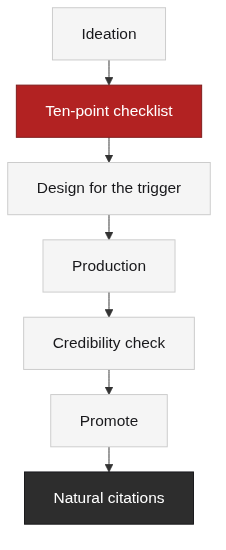
Ideas are plentiful. The value is in evaluating them honestly and executing them well. This section gives you a scoring checklist to run before you build, a practical workflow to follow, and the quality bar that makes content citable in the first place.
The Link Bait Idea Evaluation Checklist (score before you build)
Before you invest weeks in production, run every idea through this ten-point checklist. Score the trigger dimensions (items 1–5) on a scale of 1 to 5, and treat items 6 and 9 as hard red lines. Only move an idea to production if it scores at least 4 out of 6 on the trigger dimensions and passes both red lines.
| # | Question | Trigger | Role |
|---|---|---|---|
| 1 | Does it solve a real problem? | Utility | Score 1–5 |
| 2 | Does it have something nobody else has? | Novelty / Original data | Score 1–5 |
| 3 | Will people still cite it years from now? | Reference value | Score 1–5 |
| 4 | Is it easy to embed or visualize? | Visual value | Score 1–5 |
| 5 | Does it carry an emotional or surprising angle? | Emotional / surprising | Score 1–5 |
| 6 | Is the credibility bar met (traceable data, accurate citations, transparent method)? | Quality / credibility | Red line |
| 7 | Does the type fit your industry and audience? | Type-fit | Yes / No |
| 8 | Is there a clear promotion hook and target audience? | Promotion | Yes / No |
| 9 | Is it clickbait in disguise? | Red line | Red line |
| 10 | Is it worth long-term investment as an asset? | Asset mindset | Yes / No |
Two red lines are non-negotiable. If item 6 fails — the data is unverifiable or the method is opaque — the content cannot be cited, so the link bait fails by definition. If item 9 fails — the headline overpromises what the content delivers — it is clickbait, and you should discard it immediately. Remember: this checklist raises your probability of earning links. It does not guarantee them.
A practical creation workflow: ideation → evaluation → design → production
Once an idea passes the checklist, follow a repeatable workflow so you do not skip the steps that make link bait work.
- Ideation. Generate candidate topics from your niche’s citation gaps, your proprietary data, and the questions your audience keeps asking.
- Evaluation. Run each idea through the checklist above. Score the triggers honestly, and drop anything that fails a red line.
- Design for the trigger. Before you write a word, decide which trigger you are building around and design the content to fire it. If it is original data, plan the survey or analysis first. If it is utility, design the tool experience first.
- Production. Build the asset with the quality bar described below. This is where most of the effort goes, and it is not the place to cut corners.
- Credibility check. Verify every number, every citation, and every claim. A single unverifiable figure can sink the credibility of the entire piece.
- Promote. Link bait does not promote itself. A well-designed piece with no reach earns nothing. This is where link bait meets outreach — and we cover that handoff in the next section.
Quality and credibility as the precondition for being cited
The link triggers all assume one thing: the content is credible enough to cite. This is where Google’s E-E-A-T thinking aligns with plain common sense. Editors and bloggers will not risk their own trust on a page with unverifiable numbers, anonymous authorship, or a shaky method.
Concretely, that means: traceable data with a clear source, accurate citations that actually support your claims, a transparent methodology on how you collected the data, and visible authorship or ownership. If you are publishing original research, describe your sample and method. If you are quoting a number, link to where it came from. Credibility is not a nice-to-have on top of link bait — it is the precondition that makes every other trigger possible.
Practical Application and Action Guide
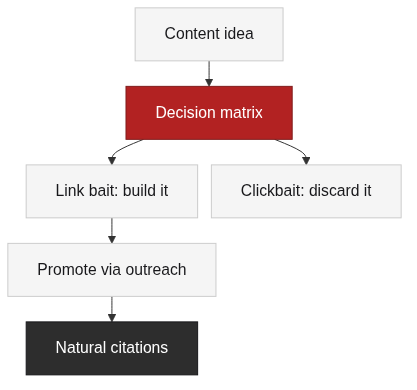
This section turns the concepts into decisions you can make today. We will give you a quick matrix to tell link bait from clickbait, a promotion overview that connects to outreach without rewriting it, and the common mistakes to catch in your own pipeline.
Link Bait vs Clickbait decision matrix
Run any piece of content through this matrix to see which category it actually belongs to.
| Dimension | Link Bait (build this) | Clickbait (avoid this) |
|---|---|---|
| Core driver | Content value (utility, data, reference) | Headline curiosity or misdirection |
| Goal | Natural citation and backlinks (long-term asset) | Stolen clicks and short-term traffic |
| Reader payoff | Real problem solved | Disappointment, lost trust |
| Links / citations | Editors and bloggers cite it voluntarily | Almost no natural citations, or low-value links |
| Brand impact | Builds authority (positive E-E-A-T) | Damages credibility (negative E-E-A-T) |
| Sustainability | Reusable, long-lived asset | One-time, quickly obsolete |
| Fit with this brand | Matches premium, compliant positioning | Violates integrity-first principles |
If your content sits in the right-hand column, stop. Redesign the value before you publish, or drop the piece entirely.
Promotion overview — where link bait meets outreach
Link bait is the content; promotion is the distribution. The two are inseparable in practice. A link bait asset with no promotion is like a great product with no storefront.
The handoff works like this: once your link bait is live, you identify the editors, bloggers, and sites that would genuinely benefit from referencing it, and you reach out with a clear, value-first pitch. The asset does the heavy lifting — your outreach is simply pointing the right people at something that helps their readers. We will not rewrite the full outreach workflow here; our guide to link building outreach covers the complete process. The key point for this article is that promotion is not optional, and it is most effective when the asset is genuinely link-worthy.
Common mistakes to avoid (and how to spot them in your own pipeline)
The most common failure is confusing clickbait with link bait — building a headline that overpromises and a body that underdelivers. You can catch this by running item 9 of the checklist on everything you publish.
The second mistake is chasing the *appearance* of link bait without the substance. A “study” with no clear methodology, or a “tool” that does not actually work, earns nothing and damages trust. The third is skipping the credibility check — one unverifiable number can sink the whole piece. The fourth is treating link bait as set-and-forget: publishing without a promotion plan and expecting links to arrive on their own. The fifth is expecting immediate results. Link earning compounds over months, and an asset that earns nothing in week one is not necessarily a failure — it may simply need time and continued promotion.
Core Takeaways and Your Next Step
You now have the definition, the triggers, the types, and the workflow. Here is how to distill it into action.
The one-sentence summary: design link-worthy content, don’t chase clicks
The entire argument of this guide fits in one sentence: link bait earns links because the content is worth linking to — so design for value, and let the links follow. The moment you stop trying to trick people into clicking and start building things worth citing, you move from clickbait to link bait.
Your immediate action plan for a link bait pilot
Do not try to build everything at once. Run a small pilot with one asset.
- Pull three candidate ideas from your niche’s citation gaps.
- Run each through the ten-point checklist. Keep the highest-scoring idea that passes both red lines.
- Design around one trigger. Pick the single strongest trigger and build the asset to fire it cleanly.
- Produce it with the credibility bar in place. Traceable data, accurate citations, transparent method.
- Plan the promotion before you publish. Identify the editors and bloggers who would benefit from citing it.
- Measure and iterate. Track the links it earns over a few months, learn from what worked, and run the next pilot.
Go deeper — explore the related link building guides
Link bait is one piece of a larger link building system. To build the durable assets that turn spikes into streams, start with our guide to linkable assets. To make existing content dramatically better and earn links that way, explore the Skyscraper technique. For visual content, see infographic link building. And when you are ready to distribute, our link building outreach guide covers the full process.
FAQ
References
Backlinko — Backlinks Guide: Provides the widely cited research on link distribution, including the finding that roughly 5% of pages earn about 75% of links, and Brian Dean’s methodology on creating content worth linking to. https://backlinko.com/hub/seo/backlinks
Ahrefs — Backlinks Guide: Provides page-level analysis showing that the vast majority of pages never earn an external link after publication. https://ahrefs.com/blog/backlinks/
HubSpot — Marketing Statistics and Data: Illustrates the original data report model, where proprietary industry statistics become the citation source for writers across the web. https://www.hubspot.com/marketing-statistics