
Image Link Building: How to Earn Backlinks With Original Images
 Written by Sanja Gajic

Image link building is often mistaken for “make an infographic and hope people embed it.” That narrow view leaves most of the opportunity on the table. If your site publishes only text, you may be missing the easiest high-quality backlinks available — the ones that come from original images. The visual assets you already own, or can create at modest effort, are frequently the ones that earn links most reliably.
Image Link Building Is Bigger Than Infographics
Most SEO teams equate image link building with producing a single large infographic, promoting it once, and moving on. That framing is misleading. The images that consistently earn links in practice are not always grand infographics — they are often original photos, data charts, flow diagrams, product screenshots, and custom maps that other sites genuinely want to embed for their own readers.
The Counterintuitive Opening: Text-Only Sites Miss the Easiest Links
If your website has never published an original image, you are likely leaving backlinks on the table. When a journalist or blogger wants to illustrate a data point, a process, or a product feature, they reach for something visual they can reuse quickly. If your site offers none, they embed someone else’s chart or screenshot — and that someone else gets the attribution link. Image link building is not an add-on; it is a core route to earning references you cannot get with text alone.
The Core Contradiction: Linkable Visuals Are Often Already on Your Site
Here is the tension most teams miss. They assume earning links from images requires commissioning expensive infographics. In practice, the visual assets that earn links are frequently the ones you already produced as part of your normal work — a chart from an internal analysis, a diagram from a documentation page, a screenshot from a product walkthrough. The effort is not in creating something new; it is in recognizing what you have and packaging it for reuse.
Defining Visual Asset Link Earning
We can reframe image link building as visual asset link earning — a broader practice that covers original photos, charts, diagrams, illustrations, screenshots, maps, and visualized data. An infographic is one member of this family, not the whole family. Treating the entire visual catalog as potentially linkable changes which assets you prioritize and how you promote them.
Redefining Image Link Building as Visual Asset Link Earning
Image link building is the practice of earning backlinks because other sites want to embed or cite a visual asset you created. It is distinct from the narrower infographic link building tactic because it treats every original visual as a candidate, not just the one big designed piece.
The Full Spectrum of Linkable Visual Assets
Before you commission anything, inventory the visual assets you can already produce:
| Asset type | What it carries | Typical earning path |
|---|---|---|
| Original photography | Visual proof, atmosphere, credibility | Licensing, attribution, editorial use |
| Data chart / visualized data | Numbers made readable | Embed + attribution link in articles |
| Flow diagram | Processes, logic, architecture | Embed in tutorials and how-tos |
| Product / UI screenshot | Real functionality, evidence | Reviews and comparisons citing your tool |
| Custom map | Geographic distribution, coverage | Embed in industry or regional content |
| Illustration | Concepts that photos cannot show | Editorial use with credit |
Why Original Visualized Data Gets Embedded
There is a consistent pattern: original data visualizations are among the most frequently embedded and cited assets in digital PR. When you publish a chart built on your own dataset, you give other writers something they can reuse with confidence — and you become the source they credit. The mechanism is simple: embeddability drives citation, and citation is what turns into a backlink. The more original the data and the clearer the chart, the more likely another site treats it as a reference worth linking to. Industry research on content marketing consistently points to visual and data-driven formats as strong drivers of sharing and citation, which is why visual assets remain a reliable route to earned media [3][4].
Linkable Assets: What Is Worth Linking
Not every image is linkable. The ones that earn links share a trait with other linkable content: they solve a problem the reader came with. A chart that answers a question, a diagram that clarifies a process, or a screenshot that proves a claim has inherent value. If you want a sense of what qualifies, our guide to linkable assets explains how to identify content worth earning links for — and the same logic applies to images.
Why Embeddability Equals Linkability
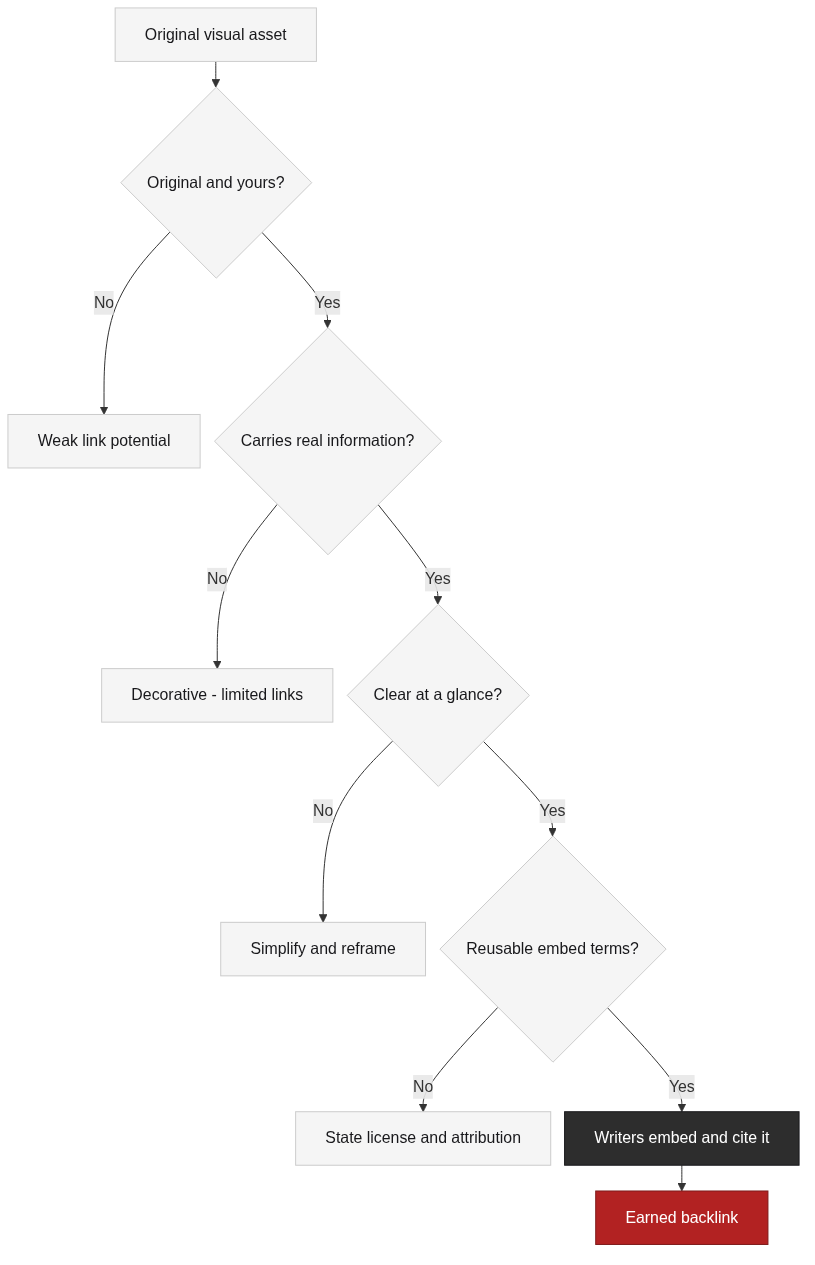
An image earns a link because it is worth embedding. The decision to embed is not random; it is a judgment other writers make in seconds. Understanding that judgment tells you which assets to invest in.
What Makes an Image Worth Embedding
Four traits drive embeddability:
- 1. Originality — A unique chart, photo, or diagram cannot be found elsewhere, so it is the only source a writer can cite.
- 2. Information density — The image carries meaning that would take many paragraphs to reproduce in text.
- 3. Clarity — A reader can grasp the takeaway at a glance; a confusing image gets skipped.
- 4. Reusable licensing — Clear embed and attribution terms make reuse easy and safe for the writer.
Original Chart vs Stock Photo vs Screenshot
Not all images have equal link potential. The difference comes down to how much unique value each type provides:
| Asset type | Originality | Link potential | Why |
|---|---|---|---|
| Original data chart | High | High | Unique data no one else can cite |
| Stock photo | Low | Very low | Available everywhere, no reason to credit you |
| Plain screenshot | Medium | Medium | Useful but easy to reproduce; needs added context |
The pattern is clear: link potential tracks originality. Stock images are the weakest because they offer no reason for anyone to attribute a link to you. Original charts and diagrams offer the strongest reason because they are the only source of that specific visual.
Relevant Backlinks: Relevance Is What Makes a Link Valuable
An embedded image only helps if the linking page is relevant to your content. A chart about your industry embedded on an unrelated site may drive traffic but carries little relevance signal. Relevant backlinks matter more than raw volume — which is why the relevance of the target site should shape both your outreach and your reclamation decisions.
Proactive Acquisition — Using Original Visuals in Outreach
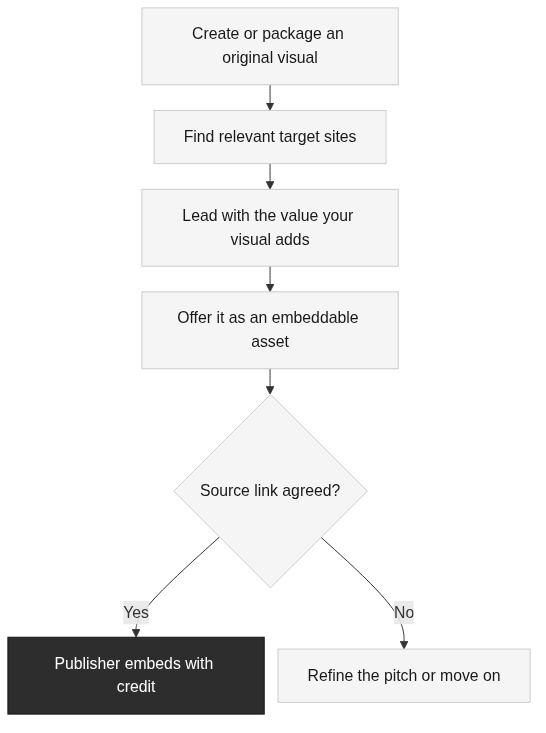
The active route to image link building is to present your original visuals as embeddable assets to sites that would genuinely benefit from them. Instead of asking for a link, you offer something the writer can use.
Offering Visuals as Embeddable Assets
The core tactic is simple: package an original chart, map, or visualized dataset as a ready-to-embed asset, then introduce it to writers who cover the topic. You provide the embed code or a clean image file plus clear usage terms, and in exchange the writer embeds it with a source link back to you. The value exchange is mutual — they get content for their readers, you get attribution.
Image Quality and Relevance: The Two Non-Negotiables
Outreach fails when the asset is irrelevant to the target site. A beautifully designed chart about the wrong topic will not earn a link, because the writer cannot justify embedding it. Before you send anything, verify two things: the asset is high quality enough to reflect well on the receiving site, and it directly serves the topic that site covers. Relevance is the filter that decides whether outreach converts.
Outreach Language: Lead With the Value to Them
The framing of your pitch matters more than the asset itself. Open with what the visual does for the writer’s readers — the question it answers or the clarity it adds — not with a request for a link. If the asset is genuinely useful, the link follows naturally. For the mechanics of running this kind of campaign, our guide to link building outreach walks through the full process, and the broader content-led link earning approach explains how to build campaigns around assets rather than link requests.
Passive Recovery — Image Reclamation for Uncredited Uses
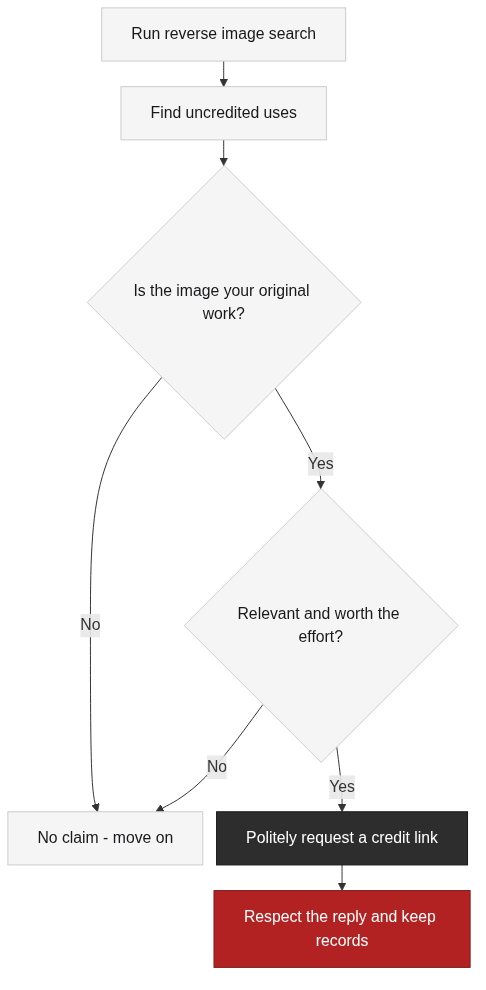
There is a second, lower-effort route: find sites that are already using your images without crediting you, and ask them to add a link. Because the usage already exists, the only missing piece is the attribution.
Finding Uncredited Uses With Reverse Image Search
Reverse image search lets you find every public copy of an image. Upload your original photo, chart, or screenshot to a reverse image search tool such as Google Lens or Google’s reverse image search [1] or the dedicated service TinEye [2], and the results show where the image appears online. Scanning these results reveals pages using your asset without a source link — the starting point for reclamation.
Two Paths After You Find an Uncredited Use
Once you identify an uncredited use, you have two reasonable paths:
- 1. Request a credit link — Contact the site politely, explain that you created the image, and ask them to add a source link. Because the usage already exists, this is a low-friction request.
- 2. Respect the boundary — If the site declines, evaluate whether to pursue it further. Compliance and courtesy come first; you should not pressure or threaten the site owner.
Copyright and Attribution: Keep It Careful
Image rights and attribution are sensitive areas, and the specifics depend on your situation, your licensing terms, and the laws that apply in your jurisdiction. This article does not provide legal conclusions. As a general practice, it is usually wise to keep requests polite, preserve records of your communication, and — if a genuine dispute arises — consider consulting a qualified professional before taking further steps. When you publish your own images, making your embed and attribution terms explicit reduces ambiguity for everyone who might reuse them.
Link Reclamation: Recovering Existing Value
Reclamation is often described as “picking up what is already yours” rather than competing for something new. The reference already exists; you are simply asking for the missing link. Because the hard part — getting your image used — has already happened, reclamation tends to have a lower barrier than cold outreach. If you want the full framework, our guide to link reclamation covers how to systematize the discovery and request workflow.
A Practical Playbook — Choosing and Executing Visual Asset Link Earning
Deciding between proactive outreach and passive reclamation depends on what your team already has. The right starting point is rarely “build a big new infographic”; it is “use the assets you already produce.”
Proactive vs Passive: Which Fits Your Situation
| Dimension | Proactive acquisition | Passive reclamation |
|---|---|---|
| Starting point | You create or package a visual asset | Someone is already using your image |
| Effort | Higher (requires outreach and conversion) | Lower (usage already exists) |
| Success driver | Asset value and relevance | Contact quality and communication |
| Compliance focus | Clear licensing and attribution terms | Careful copyright handling, no pressure |
| Best fit | Teams with original data or chart skills | Teams with widely republished images |
The Pre-Send Self-Check Checklist
Before you invest in promoting or reclaiming an image, run it through a quick six-point check:
- 1. Originality — Did you create it, and do you hold the rights to publish and license it? (Not a stock image you copied.)
- 2. Information value — Does it carry meaning text cannot easily express — data, a process, a structure? Or is it purely decorative?
- 3. Embeddability — Would another writer realistically want to embed it, given its size, clarity, and format?
- 4. Relevance — Is it highly relevant to the target site’s topic? This determines the link’s value.
- 5. Clear licensing — Have you defined the embed, use, and attribution terms to avoid disputes?
- 6. Traceable data — If it visualizes data, is the source real and traceable? This decides whether others trust it enough to cite.
A Decision Checklist for Handling Uncredited Uses
When reverse image search surfaces an uncredited copy, work through these steps:
- – [ ] Confirm the image is genuinely your original work
- – [ ] Assess whether the site is relevant and authoritative enough to be worth the effort
- – [ ] Contact the site politely and request a credit link (not a complaint)
- – [ ] If they decline, decide whether to pursue further — compliance first, no pressure or threats
- – [ ] Keep records of all communication, and for any genuine copyright dispute, consider consulting a qualified professional
Choosing a Path by Team Situation
| Your situation | Recommended route |
|---|---|
| Team with original data or research | Lead with charts and visualized data in proactive outreach |
| Team with a product or tool | Lead with product screenshots and flow diagrams for reviews and tutorials |
| Team with widely republished images | Prioritize image reclamation to recover existing value |
| Small site with limited resources | Start with simple diagrams and low-cost data charts |
Core Takeaways and Your Next Step
Image link building is best understood as visual asset link earning: it covers charts, diagrams, screenshots, maps, photos, and visualized data, not just infographics. Embeddability is what makes an image linkable, and you pursue it through two complementary routes — proactive outreach and passive reclamation.
The Three Ideas to Hold On To
- 1. Image link building is broad — Treat every original visual as a potential link asset, not just infographics.
- 2. Embeddability equals linkability — Originality, information density, clarity, and clear licensing decide whether an image gets embedded and credited.
- 3. Two routes, one goal — Proactive outreach earns new links; passive reclamation recovers links that should already exist.
Your Next Step
Start by auditing the original images you already produce — your charts, diagrams, screenshots, and maps. Run each through the six-point self-check, and pick the lowest-cost asset you can package for reuse. For most teams, a clean diagram or a simple data chart is the fastest way to begin earning visual-asset links.
Go Deeper With Linkable Assets
If you want to build a repeatable pipeline, start with linkable assets to identify what deserves links, then apply the content-led link earning framework to turn your original visuals into a steady source of relevant backlinks.
FAQ
References
Google — How to reverse image search — describes how reverse image search works for finding where an image appears online
TinEye — Reverse Image Search — a dedicated reverse image search service used to discover uncredited uses of your images
Content Marketing Institute — Visual Content Marketing Research — provides industry perspective on how visual content supports content marketing and earned media
BuzzSumo — Visual Content Research — research resource on how visual and data-driven content performs in sharing and citation