
Healthcare Link Building: How to Earn Trustworthy, Topically Relevant Backlinks
 Written by Warren Reed

A health website lands a backlink from a generic DR 80+ commercial site. The domain rating climbs. Yet the medical keywords that actually matter stay frozen, and the link does nothing to signal that the page behind it knows anything about medicine. This is the DR trap, and it is the most common mistake in healthcare link building.
The reason is structural. Health content sits in Google’s high-sensitivity YMYL (Your Money or Your Life) tier, where the bar for trust, source quality, and professional relevance sits far above ordinary commercial content [1]. In this context, the value of a backlink does not come from a score. It comes from credibility plus topical relevance. A link is only worth what it can vouch for, and a generic commercial link cannot vouch for medical expertise.
This guide walks through the special challenges of healthcare link building, why a high DR site is not enough, the four source types that actually earn trustworthy health backlinks, how to acquire each one, and a risk-screening framework you can apply before you approve any placement.
Why “High DR” Falls Short in Healthcare Link Building
In healthcare link building, the first question is whether the source can vouch for medical expertise.
DR (Domain Rating) and DA (Domain Authority) measure a site’s overall link weight. They tell you how many links point at a domain, and roughly how strong that profile looks. They tell you almost nothing about whether that domain is credible on health topics.
The DR trap: a high-DR generic link that lifts the score but leaves medical keywords untouched
Imagine a health site that buys a placement on a high-DR lifestyle portal with a strong overall profile but no medical coverage. The placement raises the domain’s aggregate score. But the page receiving the link is not a medical page, the surrounding content is not medical, and the anchor context says nothing about the health topic you care about. Search engines see a link from an off-topic page and derive no topical relevance signal from it.
The result is a metric that moves and a ranking that does not. For a health site, that gap is the whole problem in miniature: link value and DR are not the same thing.
The core contrast: in health content, link value comes from credibility + topical relevance, not from a metric
In a commercial niche, a strong generic link can still move rankings because the algorithm weighs authority broadly. Health content does not work that way. Google’s quality rater guidelines treat health pages as YMYL, where Expertise, Authoritativeness, and Trustworthiness (E-E-A-T) are the core quality signals, and Trust sits at the center [1].
That means a backlink earns value by doing three things at once: it comes from a source with demonstrable authority, it sits on a page relevant to the health topic, and it is placed under editorial control rather than as a paid or exchanged insertion. A high DR score satisfies none of these by itself. Relevance and credibility are the currencies that matter, and a metric cannot substitute for either.
Why health pages sit in Google’s YMYL high-sensitivity tier, raising the bar for trust and source quality
Google classifies pages that could affect a person’s health, finances, safety, or happiness as YMYL. Health and medical content is the most sensitive subset of this tier because the consequences of wrong or misleading information can be direct and serious [1].
The practical implication for link building is that the algorithm applies a much higher standard to health pages. It looks for content created by people with genuine expertise, backed by authoritative sources, and presented transparently. A backlink from a random high-DR site does not contribute to any of those signals. Worse, if the placement looks like a paid or scaled exchange, it can act as a negative signal precisely because it sits on a YMYL page where the stakes are highest.
The Special Challenges of Healthcare Link Building
Healthcare link building is harder than link building in most other niches, and the difficulty is not just about competition. It comes from a mismatch between what the algorithm rewards and what the market usually sells.
Trust and expertise are amplified by the algorithm: E-E-A-T with Trust at the center
In the E-E-A-T framework, Trust is the element that all the others feed into. Experience, Expertise, and Authoritativeness exist to build trust, and for health content the trust bar is set by the medical stakes [1].
A backlink contributes to trust only when the source itself is trustworthy on health. A link from a peer-reviewed medical journal carries a different weight than a link from a general news portal, even if their DR scores are similar. The algorithm does not reward the score; it rewards the credibility signal the source carries. This is why healthcare link building has to be evaluated source by source rather than score by score.
The supply-quality mismatch: high-score sources may lack medical authority, authoritative sources may be hard to earn
Here is the core difficulty: the sources that score highest on DR/DA are often general commercial or news sites with no medical authority, while the sources with genuine medical authority, such as peer-reviewed journals, institutional medical sites, and professional associations, are difficult to earn links from and rarely sell placements.
The market is full of high-DR sites that will accept a paid or exchanged link. It is nearly empty of authoritative medical sources that will do the same. This supply-quality mismatch means that if you optimize purely for DR, you will systematically end up with the wrong links. The challenge of healthcare link building is to resist that pull and pursue sources that are harder to get but actually move the needle.
Why a generic commercial link cannot vouch for medical expertise (YMYL implications)
A backlink is, in effect, a third-party endorsement. It tells the algorithm and the reader that another site considers your content worth referencing. For that endorsement to matter on a YMYL health page, the endorsing site has to be capable of vouching for medical expertise.
A generic commercial portal is not. It has no clinical authority, no editorial standard for health claims, and no reason a reader would trust its judgment on a medical topic. A link from such a site adds nothing to the Expertise or Trust signals the algorithm looks for. It can even raise a red flag if the placement looks transactional, because scaled or paid links on YMYL pages are exactly the pattern the guidelines warn against [2].
Why a High DR Site Is Not Enough: Moving to a Three-Dimension Evaluation
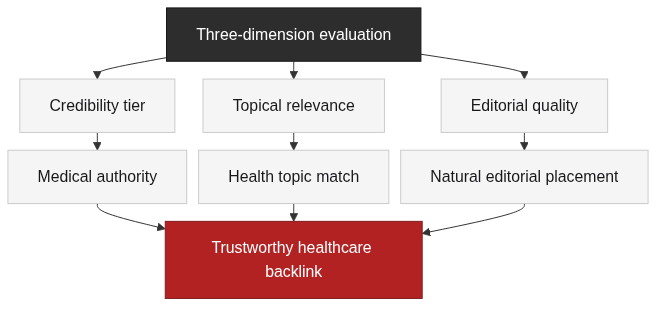
The practical takeaway is that healthcare link building needs a different evaluation lens. Instead of asking “what is the DR score?”, ask three questions: is the source credible on health, is it topically relevant, and is the placement editorially sound?
DR/DA reflects overall link weight, not topical relevance, content credibility, or medical expertise
DR and DA are aggregate metrics. They measure the quantity and weight of links pointing at a domain, not the domain’s competence on any specific topic. A site can have a very high DR built entirely on unrelated content, and its medical pages, if any, can be thin and unverified.
When you evaluate a link for a health site, the relevant question is not “how strong is this domain overall?” but “what authority does this specific page and this specific domain have on this specific health topic?” DR cannot answer that question. It is a proxy for scale, not for expertise.
The risks of off-topic high-DR links: no relevance signal, possible link-scheme detection, no E-E-A-T lift
An off-topic high-DR link carries three risks. First, it delivers no topical relevance signal, so it does nothing for medical keywords. Second, if the placement was paid or exchanged, it can be flagged as part of a link scheme, and Google’s guidelines explicitly describe scaled guest posting and paid links as patterns to avoid [2]. Third, it provides no E-E-A-T lift, because the source has no health credibility to lend.
In the best case, such a link is neutral noise. In the worst case, it is a negative signal on a YMYL page. Neither outcome justifies the cost or the risk.
The shift from “DR-first” to “credibility tier + topical relevance + editorial quality”
The evaluation model that works for healthcare link building combines three dimensions:
| Dimension | What it asks | Why it matters for health |
|---|---|---|
| Credibility tier | Where does this source sit in the medical credibility hierarchy? | Peer-reviewed journals and institutional medical sites carry real authority; commercial blogs carry almost none |
| Topical relevance | Does this source consistently publish on medical and health topics aligned with your specialty? | Relevance is the signal that connects the link to your medical keywords |
| Editorial quality | Is the placement a natural editorial reference, or a paid, exchanged, or scaled insertion? | Natural placements build trust; transactional ones risk link-scheme detection |
This three-dimension model is the lens through which the rest of this guide evaluates sources. DR is not ignored, it is demoted from the primary metric to a secondary consideration.
The Four Source Types That Earn Trustworthy Healthcare Backlinks
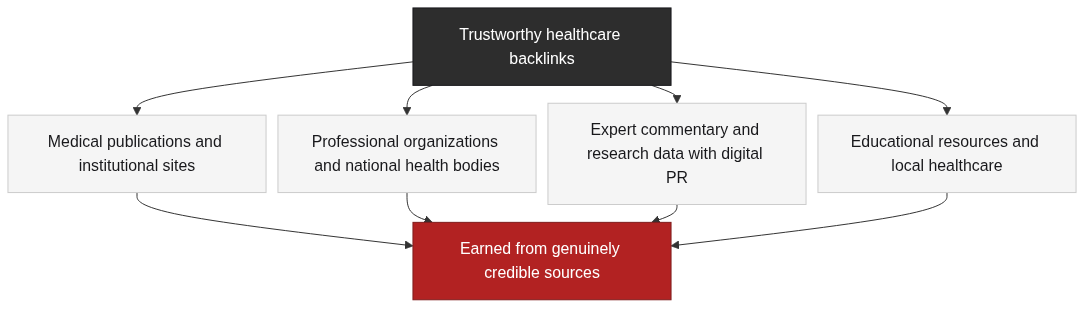
Not all sources are equal, and the ones that actually help a health site are the ones with genuine medical credibility. Four source types consistently earn trustworthy healthcare backlinks.
Medical publications and institutional sites (peer-reviewed journals, hospital medical sites)
At the top of the medical credibility hierarchy sit peer-reviewed journals and institutional medical sites. Journals such as those in the NEJM, Lancet, and JAMA family, along with hospital medical pages from institutions like Mayo Clinic or Cleveland Clinic, carry the strongest possible health authority [3].
Links from these sources are rare and hard to earn, which is exactly why they are valuable. They require genuine expertise, original work, or a legitimate reason to be referenced. A citation from a peer-reviewed outlet is the strongest trust signal a health site can receive, because it places your content in the same credibility tier as the medical literature itself.
Professional organizations, associations, and national health bodies (AMA, AHA, CDC, NIH)
Professional organizations and national health bodies are the natural link sources for a health site. Associations such as the American Medical Association and the American Heart Association, and agencies such as the CDC and NIH, sit in the highest credibility tier and publish constantly on health topics [3].
These organizations are also more approachable than peer-reviewed journals. Many maintain media, expert, and resource directories, and they regularly link to credible external resources that serve their audiences. A link from a professional association signals to the algorithm that recognized medical bodies consider your content authoritative, which is precisely the Expertise and Authoritativeness signal health pages need.
Expert commentary, original research, and data assets paired with Digital PR
Original research and expert commentary are the most sustainable way to earn health backlinks. When you publish original data, a patient survey, a clinical insight, or a data visualization, you create something other sites want to cite [4].
This is where digital PR comes in. Research and data assets only earn links if they reach the right audiences, which means pitching journalists, health writers, and relevant publishers with a clear, newsworthy story. A well-designed data asset paired with targeted outreach is the single most reliable path to natural, editorially placed backlinks in healthcare.
Educational resources and local healthcare opportunities (guides, patient education, community content)
Educational resources and local healthcare content round out the source mix. Patient education guides, explainer content, and community health resources are citable because they serve a real audience need. Local opportunities include partnerships with regional clinics, community organizations, and local media covering health topics.
These sources may not carry the prestige of a national association, but they deliver strong topical relevance and are often easier to earn than institutional links. A well-crafted educational resource that genuinely helps patients is the kind of content that earns natural references over time.
How to Acquire Each Source Type Effectively
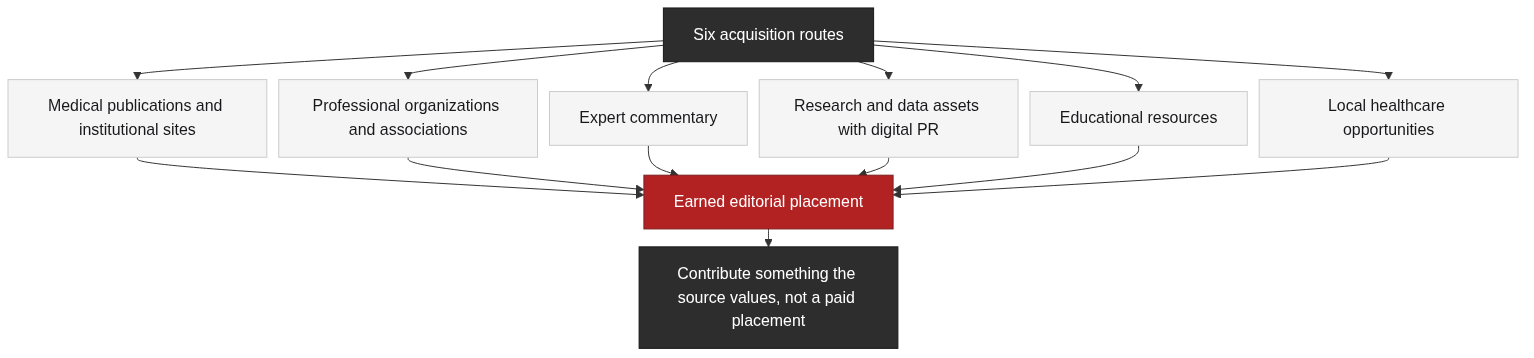
Each source type requires a different acquisition path. The common thread is that healthcare link building rewards asset-first, relationship-driven approaches over transactional ones.
Acquisition paths by source type: expert quotes, original research citations, media outreach
| Source type | Primary acquisition path | What you need to succeed |
|---|---|---|
| Medical publications / institutional sites | Expert quotes, original research citations | Real expertise, original data, a legitimate reason to be referenced |
| Professional organizations / associations | Member resources, media/expert directories, expert databases | Credible credentials, education content, alignment with association priorities |
| Expert commentary (KOLs) | Direct invitations, co-created content | Signed expert articles, interviews, genuine subject-matter authority |
| Research / data assets + Digital PR | Original data + media outreach | A newsworthy dataset, clear narrative, targeted journalist pitching |
| Educational resources | Co-built guides, patient education | Citable, genuinely helpful education content |
| Local healthcare opportunities | Local clinic / institution partnerships, local media | Community health resources, regional relevance |
The pattern across all six routes is the same: you earn the link by contributing something the source values, not by buying a placement.
Building asset-first campaigns: white papers, patient data insights, and data visualization
Asset-first healthcare link building starts with the content, not the link. Build a white paper on a topic your audience cares about, analyze patient data to produce a genuinely new insight, or turn a body of research into a data visualization that journalists can use.
The asset does the linking work. If it is genuinely newsworthy, publishers cite it because it strengthens their own content. This is the difference between a link you buy and a link you earn: the earned link comes with editorial endorsement attached, which is exactly the trust signal health pages need [4].
Local and educational routes: institutional partnerships and citable patient education content
Local and educational routes are lower-barrier complements to the national and institutional paths. Partner with a regional clinic or community organization to co-create health resources. Build patient education content that answers real questions and is structured so other sites can reference it. Reach out to local media covering health topics with a relevant, local story.
These routes trade prestige for accessibility. They are easier to execute, deliver strong topical relevance, and collectively build a natural, diversified link profile that supports rather than endangers the site.
Evaluating Providers and Publishers: A Risk-Screening Framework
Before you approve any placement, run it through a risk-screening framework. This is where healthcare link building separates disciplined teams from the ones that fall into the DR trap.
The eight-point source evaluation checklist (relevance, credibility tier, editorial control, author expertise, backing, risk, reusability, YMYL gain)
Screen every source against eight questions:
- Topical relevance — Does this source consistently publish on medical and health topics aligned with your specialty?
- Credibility tier — Where does the source sit in the hierarchy (peer-reviewed journal > institutional medical site > national health body > medical media > commercial blog)?
- Editorial control — Is the link a natural editorial placement, or a paid, exchanged, or scaled guest-post insertion?
- Author expertise — Does the content’s author have verifiable medical credentials or signature?
- Source backing — Does the source carry HONcode certification, institutional accreditation, or association membership as trust signals [5]?
- Risk screen — Does the source show signs of link farms, content farms, or questionable site characteristics?
- Reusability — Is this a one-time placement or the start of a relationship that can produce more links?
- YMYL gain — Does this link genuinely strengthen reader trust and medical expertise signals, or does it only raise DR?
If any of the first, second, or fourth criteria fails, or if the third indicates a paid or exchanged placement, the link should be rejected regardless of DR.
Scenario comparison: high-DR generic link vs. high-relevance medical link across decision dimensions
| Decision dimension | High-DR generic link | High-relevance medical link (institution / journal / association) |
|---|---|---|
| Topical relevance | Low (unrelated to health) | High (direct medical topic match) |
| YMYL credibility contribution | Almost none (cannot vouch for medical expertise) | Strong (authoritative institution / expert backing) |
| E-E-A-T lift | Only adds Authority “quantity,” no Expertise | Adds Expertise + Authoritativeness + Trust together |
| Link-scheme detection risk | Medium-high (if paid or exchanged) | Low (natural editorial placement) |
| Actual value for medical keywords | Low | High |
| Acquisition cost / difficulty | Low-medium | High (requires content, research, or relationships) |
The table makes the trade-off explicit. The high-relevance medical link costs more and is harder to get, but it is the only one that actually moves medical keywords and strengthens the trust signals YMYL pages need.
Red-flag rules: reject off-topic or paid/exchanged links even when the DR is high
Set firm red-flag rules and apply them without exception. Reject any placement that is off-topic, even at DR 90. Reject any placement that is paid, exchanged, or part of a scaled guest-posting arrangement, because Google’s guidelines classify these as link schemes [2]. Reject any source that shows link-farm or content-farm characteristics.
The discipline matters more than the opportunity. One off-topic or transactional link on a YMYL page can do more harm than the score it adds, which is why the framework exists in the first place.
Applying the framework to competitor backlink research and campaign planning
Use this framework as the lens for competitor backlink research. When you analyze a competing health site’s profile, do not just look at which sites link to it. Ask which of those links pass the eight-point screen, which come from professional organizations, institutional medical sites, or peer-reviewed sources, and which look transactional.
That analysis tells you where the real opportunity is. It shows you which sources your competitors earned through genuine expertise, and which source types are underrepresented in your own profile. Use it to plan a link building campaign that targets the credibility tiers and topical gaps that matter, rather than chasing raw DR.
Core Takeaways and Your Next Steps
Healthcare link building is not about collecting high-DR links. It is about earning placements from sources that have genuine medical credibility, on pages that are topically relevant, under conditions of editorial control.
Recap: credibility tier + topical relevance + editorial quality, not DR alone
The evaluation model for health links is three-dimensional: credibility tier, topical relevance, and editorial quality. DR is a secondary metric, not the goal. A link from a peer-reviewed journal, a professional association, or a national health body is worth more to a health site than a dozen generic high-DR placements, because it is the only kind of link that carries the trust signal YMYL pages need.
A practical checklist to start evaluating your healthcare link sources today
To start applying this today:
- Audit your current profile and classify each link by credibility tier, not DR.
- Remove or disavow off-topic and transactional placements that fail the risk screen.
- Build one asset-first campaign around original data or a white paper.
- Target professional organizations and associations with media and resource directories.
- Run every new placement through the eight-point checklist before approval.
- Use competitor backlink analysis to find the source types you are missing.
Where to go deeper: explore link building strategies and talk to a strategist
If you are building your own campaigns, start with the fundamentals of link building strategies and understand what makes a high-quality backlink versus a relevant backlink. Learn how digital PR turns data assets into earned links, and how to recognize unnatural links before they hurt a YMYL page. Use competitor backlink analysis and structured link building campaign planning to keep your approach disciplined.
Because healthcare link building demands source-by-source judgment rather than score-chasing, it helps to work with a strategist who evaluates every placement against credibility, relevance, and editorial quality. If you want to think through how this framework applies to your health site, talk to a TraffiClimb strategist and build a plan around sources that actually earn trust.
FAQ
References
Google Search Central — Search Quality Evaluator Guidelines (E-E-A-T and YMYL) — This source defines the E-E-A-T framework with Trust at the center and explains that health content is treated as high-sensitivity YMYL, raising the bar for source quality and expertise.
Google Search Central — Link Spam Policies — This source documents the patterns classified as link schemes, including scaled guest posting and paid links, which supports the risk-screening rules for YMYL pages.
Health on the Net — HONcode Certification — This source describes HONcode certification as a transparency and source-traceability standard for health websites, used here as a reference signal in source evaluation.
National Library of Medicine — PubMed — This source represents the peer-reviewed medical literature tier referenced in the credibility hierarchy, illustrating the strongest medical authority a backlink source can carry.