
Guest Posting Sites & Opportunities: How to Find Guest Posts Worth Pursuing
 Written by Alistair MacLeod

Scanning for guest posting sites is a trap most SEOs fall into at least once. You find a “100 Best Guest Post Sites” list, pitch twenty of them, publish a handful of articles, and your rankings barely move — or worse, you end up with links that look transactional and put your site at risk. The problem is rarely that you can’t find guest posting sites. It’s that you don’t know how to qualify which guest post opportunities are actually worth pursuing. This guide gives you a repeatable framework: discover candidates, verify they still accept posts, and qualify them against a scoring checklist before you ever pitch.
Why a “100 Guest Post Sites” List Won’t Move Your Rankings
Ready-made lists of guest posting sites & opportunities are seductive because they remove the effort of discovery. But they fail on three grounds: the sites are usually stale, the relevance is generic, and the list itself can’t tell you whether a given site still accepts guest posts today. By the time a list circulates widely, the best opportunities on it are often closed.
The tempting-but-futile scenario: chasing volume over relevance
The correlation between backlinks and rankings is real. Studies of large-scale search data consistently show that pages ranking on page one tend to have far more referring domains than pages ranking further down [1]. That fact makes quantity feel like the answer. It isn’t. The same research is careful to call this a correlation, not a causation — and a link that is off-topic or placed on a page nobody reads contributes almost nothing to that outcome.
The real problem: finding sites is easy, qualifying them is hard
Anyone can run a Google search and surface hundreds of pages that mention “write for us.” The hard part is the work that comes after: confirming the submission channel is still open, checking whether the site has real organic traffic, judging its editorial standards, and spotting transactional link requests that violate search engine guidelines. That verification and qualification work is where the value lives — and it’s exactly what a static list cannot give you.
Promise of the article: a discover, verify, and qualify framework
Instead of handing you a list that will be out of date in weeks, this article teaches you to build your own pipeline. You’ll learn three ways to discover candidate guest posting sites, four signals to confirm a site still accepts submissions, and a scored checklist that tells you whether a candidate is worth pursuing or should be skipped. Every method here is designed to be re-run on demand, so your list stays current.
What Makes a Guest Post Opportunity Worth Pursuing
A guest posting opportunity is worth pursuing when the site is relevant to your audience, has genuine traffic and editorial quality, accepts posts through a legitimate editorial channel, and does not ask for payment in exchange for placement. Any site that accepts posts but fails these tests is a candidate you should skip — regardless of how authoritative it looks.
Defining a “worthwhile” guest posting opportunity vs. any site that accepts posts
Not every site that accepts guest posts is a worthwhile target. A site that publishes anything, with no review process, is usually building a collection of low-editorial-standard pages that search engines treat with caution. A worthwhile opportunity is one where your placement is earned on merit: the editor reviews it, the topic fits the site’s existing coverage, and the link is added because it genuinely helps readers. That distinction is the entire game.
The four evaluation dimensions: relevance, traffic signals, editorial quality, submission requirements
You can evaluate any candidate against four dimensions:
- Relevance — does the site cover your industry or serve your target audience?
- Traffic and quality signals — does the site have real organic traffic, current content, and reader engagement?
- Editorial quality — does it have clear guidelines, a review process, and a history of publishing guest authors?
- Submission requirements — are the word count, topic, and format demands within your reach, and is the entry point still open?
Why a high authority score alone is not a green light
Domain authority and domain rating are useful shorthand, but they are third-party metrics that Google does not use as ranking factors [2]. A high score tells you a site has a strong link profile; it tells you nothing about whether the site is relevant to your niche, whether its traffic is real, or whether it accepts guest posts on legitimate terms. Treat authority as one input in a broader evaluation, never as a pass on its own.
How to Find Guest Posting Sites: Three Discovery Pipelines
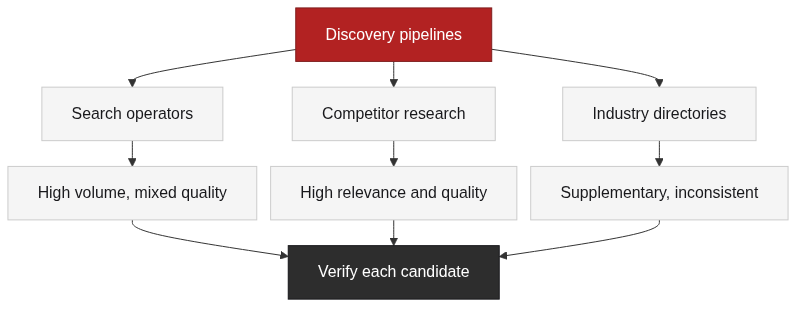
You can build a steady stream of candidate guest posting sites through three pipelines: Google search operators, competitor research, and industry directories. Each pipeline produces candidates with different relevance and quality profiles, so the smart approach is to run more than one.
Google search operators: “write for us”, “guest post”, intitle, site: queries
Search operators are the fastest way to surface sites that explicitly invite contributions. Try combinations like these:
"write for us" + [your keyword]"guest post" + [your niche]intitle:"write for us" + [industry]site:[domain] "write for us"— to check whether a specific site you already trust accepts posts"guest post guidelines" + [niche]
These queries return a high volume of candidates, but relevance and quality vary widely. Treat every result as a lead to verify, not as a confirmed opportunity.
Competitor research: mining Referring Domains for open guest post sites
Your competitors have already done part of the discovery work. Open your SEO tool of choice, pull the referring domains that link to your top competitors, and filter for sites in your niche that look like blogs or industry publications. Those are plausible guest posting targets. Then check each one for a submission entry point. This pipeline produces fewer candidates but tends to surface higher-relevance, higher-quality sites because the links already point at your space [3].
Industry directories, resource pages, and blogrolls as a supplementary pipeline
Niche directories, curated resource lists, and the blogrolls of respected sites in your industry can surface targets you would not find through search operators. These are useful as a supplementary channel, but they can be inconsistent — some entries are outdated, and some resource pages are not actively maintained. Verify each one before investing time in a pitch.
Discovery channel comparison matrix
| Discovery channel | Example method | Candidate volume | Typical relevance | Typical quality | Verification effort |
|---|---|---|---|---|---|
| Google search operators | "write for us" + niche |
High | Medium | Medium | High (verify each site) |
| Competitor research | Referring Domains reverse filter | Medium | High | High | Medium |
| Industry directories / resource pages | Niche resource list / blogroll | Medium | Medium-high | Medium | Medium |
| Paid / transactional link platforms | Buying placements | High | Low | Low | Low (but violates guidelines — avoid) |
The takeaway from this matrix is that there is no single channel that is fast, relevant, and compliant at once. The combination worth investing in is competitor research plus per-site verification, because it trades a little volume for much higher relevance and compliance.
How to Verify a Site Still Accepts Guest Posts
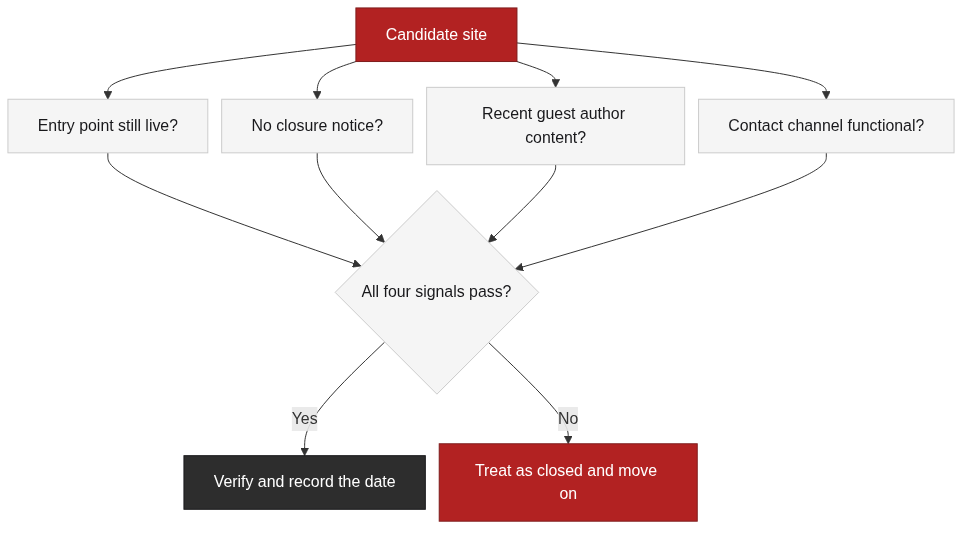
Many sites that once accepted guest posts have closed their doors, and many “write for us” pages are abandoned. Before you write a single pitch, confirm the channel is actually open. Four signals tell you whether a site still accepts submissions.
The four signals that a submission channel is still open
- The submission entry point still exists — a “write for us,” “contribute,” or “guest post guidelines” page is live and reachable.
- There is no “not accepting submissions” notice — many sites post a temporary or permanent closure notice on their guidelines page.
- Recent guest author articles exist — if the site published a guest post in the last few weeks or months, the channel is likely active.
- The contact form or email address is functional — a dead form or bouncing address is a clear sign to move on.
Distinguishing an open editorial channel from a “post anything” link farm
An open editorial channel reviews submissions, asks for original content, and has standards. A “post anything” operation publishes whatever you send, charges for placement, or accepts content with no review. The distinction matters because the latter produces transactional links of the sort that search engine guidelines treat as a violation [4]. If a site will publish anything you pay for, it fails the compliance test regardless of how the page looks.
Recording verification date and submission-entry details for every candidate
Verification is only useful if you can reproduce it. For every candidate, record the date you checked, the exact URL of the submission entry point, whether the site is still accepting posts, and a short summary of the submission requirements. When you return to a candidate weeks later, this record lets you confirm nothing has changed — and it prevents you from pitching stale targets.
How to Qualify a Guest Post Site Before You Pitch
Discovery and verification tell you a site is open. Qualification tells you whether it is worth your time. This is where you weigh relevance against authority, inspect real traffic signals, judge editorial quality, and flag transactional link requests.
Relevance vs. authority: why topical fit wins over a high DR
A site with a high domain rating but no connection to your industry delivers a link that neither readers nor search engines find contextually useful. A lower-authority site that is squarely in your niche puts your content in front of the right people and creates a natural-looking link. When the two conflict, relevance wins. Aim for sites that are both relevant and authoritative, but never sacrifice topical fit for a big authority number.
Traffic and quality signals: organic traffic, update cadence, reader engagement
Look past the authority score and check the site’s actual health. Use an SEO tool to estimate organic traffic, check how recently the site publishes new content, and look for signs of reader engagement such as comments, shares, or brand mentions elsewhere. A site with steady traffic and a consistent publishing cadence is a much better home for your content than one that is technically authoritative but effectively dormant.
Editorial quality and submission requirements: guidelines, review, word count
Read the guidelines before you pitch. A worthwhile site has a real review process, states its word count and topic preferences, and requires original, useful content. If a site has no guidelines, no review, and no standards, treat it as a low-editorial-standard target and skip it. The submission requirements also need to fit your capacity — if the site demands a 3,000-word deep dive and you cannot deliver that quality, it is not the right opportunity for you right now.
Recognizing paid / transactional link requests that violate guidelines
The clearest disqualifier is a request for money in exchange for placement. A site that charges for guest posts, sells links by the anchor text, or lets you publish anything for a fee is operating a transactional link scheme. Search engine guidelines are explicit that buying or exchanging links to manipulate rankings violates their policies [4]. One red flag here — a price list, a “sponsored” placement that is really a paid link, or an editor who quotes a fee — and the site is out, no matter how strong its metrics look.
Your Guest Post Site Qualification Checklist
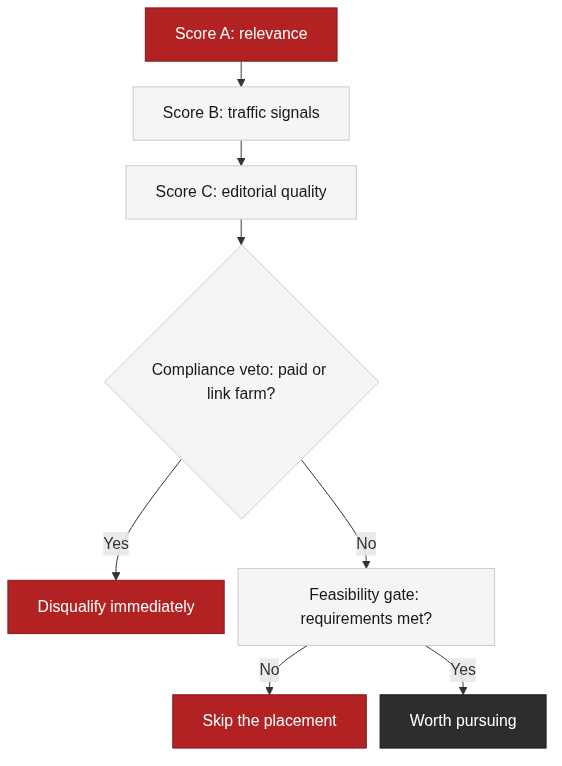
This is the tool you apply to every candidate after verification. Score the first three sections at one point each, treat the compliance section as a veto, and use the feasibility gate as your final go/no-go check.
Scoring the relevance, traffic, and editorial quality dimensions (A + B + C)
A. Relevance
- [ ] Does the site cover my industry or target audience?
- [ ] Is the site’s existing content consistent with my topic area?
- [ ] Would my link on this page feel natural and useful to readers?
B. Traffic and quality signals
- [ ] Does an SEO tool show real, meaningful organic traffic?
- [ ] Does the site publish new content on a normal cadence?
- [ ] Is there evidence of genuine reader engagement — comments, shares, or brand mentions?
C. Editorial quality
- [ ] Does the site provide clear guest post guidelines?
- [ ] Is there a real editorial review process rather than instant auto-publishing?
- [ ] Has the site published guest author content recently, proving the channel is open?
The compliance veto: paid links and link farms disqualify instantly
D. Compliance and payment requirements
- [ ] Does the site openly price or sell backlinks? If yes, skip it — this violates search engine link guidelines [4].
- [ ] Does it require payment to publish? Paid guest posts carry transactional-link risk.
- [ ] Does it publish anything without review (a “post anything” operation)? If yes, skip it.
The compliance section is a veto, not a score. If you hit any of these red flags, the candidate is disqualified no matter how high it scores on relevance, traffic, or editorial quality. This aligns with a compliance-first approach to link building: a single risky placement can outweigh many good ones.
Feasibility gate: submission requirements and open entry points
E. Submission requirements match
- [ ] Are the word count, topic, and format requirements within my capacity?
- [ ] Is the submission entry point (form or email) still functional?
The feasibility gate is your final check. A site can score perfectly on relevance and quality but still be a poor fit if you cannot meet its requirements or reach its editor.
Worth pursuing vs. skip decision matrix with candidate examples to verify
| Evaluation dimension | Worth pursuing | Skip |
|---|---|---|
| Relevance | Topic highly relevant to your industry / audience | High DR but topic completely unrelated |
| Traffic / quality signals | Real organic traffic, current content, reader engagement | Questionable traffic, stale content, no updates |
| Editorial quality | Guidelines + editorial review + quality standards | Accepts anything, no review, no standards |
| Payment requirements | Free submission (editor accepts on merit) | Paid placement / transactional link scheme |
| Submission requirements | Clear word count / topic / format you can meet | No requirements (often a low-standard signal) |
Rather than a static list that will go stale, here is how to build your own shortlist of candidates to verify using the framework above. Start with well-known industry SEO and digital marketing blogs — for example Moz Blog, Search Engine Journal, Ahrefs Blog, and Backlinko — but verify each one before you pitch, because several of these have closed or restricted public guest posting at various points. Then add mid-size vertical blogs in your niche that have open “write for us” pages. For every candidate, run the four verification signals, then score it with the A-through-E checklist above. Record the verification date and the submission entry URL for each one. This turns “a list” into a working, current pipeline.
Core Takeaways and Your Next Step
The difference between a wasted afternoon and a productive outreach session is not how many guest posting sites you can find. It is whether you discover candidates, verify that they still accept posts, and qualify them against a consistent standard before you pitch.
Recap: discover, verify, and qualify before you pitch
Run at least two discovery pipelines — search operators for volume and competitor research for relevance. Verify every candidate with the four signals: a live entry point, no closure notice, recent guest author content, and a functional contact channel. Then score each one with the A-through-E checklist, treating the compliance section as an absolute veto. Only then is a guest posting opportunity worth pursuing.
If you prefer not to prospect yourself, outsource link building
Prospecting, verifying, and qualifying is valuable work, but it is also time-intensive. If you would rather spend your effort on content and strategy than on building and maintaining a candidate pipeline, that is exactly what a link building partner is for. A compliance-first link building service handles the discovery and qualification for you, so you only review placements that have already passed the relevance and editorial bar.
Recommended internal resources
To go deeper on the surrounding steps, start with our guides on guest posting to understand the full process, link prospecting to refine your discovery workflow, high-quality backlinks and relevant backlinks to sharpen your qualification criteria, and outreach email templates for the pitch that follows a successful qualification.
When you are ready to stop prospecting and start publishing, explore our link building services and let a team that treats compliance and relevance as non-negotiables build your pipeline for you.
FAQ
References
Ahrefs — Search Traffic Study: We Analyzed 1 Billion Pages: provides the correlation finding that pages ranking on page one tend to have more referring domains than pages ranking lower, used to frame the volume-vs-relevance tension in H2 1. https://ahrefs.com/blog/search-traffic-study/
Ahrefs — Domain Rating: What It Is and Why It Matters: explains that domain rating is a third-party link-profile metric, supporting the point that high authority alone is not a green light in H2 2. https://ahrefs.com/blog/domain-rating/
Ahrefs — Link Building for SEO: The Definitive Guide: describes competitor research via referring domains and the broader link building process, supporting the discovery pipeline in H2 3. https://ahrefs.com/blog/link-building/
Google Search Central — Link Spam Policies: documents that buying or exchanging links to manipulate rankings violates search engine guidelines, supporting the compliance veto in H2 4, H2 5, and the checklist in H2 6. https://developers.google.com/search/docs/essentials/spam-policies/link-spam