
Guest Post Marketplaces: How They Work and What to Check Before You Buy
 Written by Alistair MacLeod

Two buyers spend the same amount on the same guest post marketplace. One walks away with a relevant, compliant editorial link on a real site with genuine traffic. The other gets a placement on a weak directory, a link that disappears three weeks later, or worse, a footprint that drags down the whole campaign. The platform itself never decides which outcome you get. Your screening process does. This guide explains how a guest post marketplace operates end to end, and gives you a pre-purchase check framework you can apply before you spend a dollar.
Why Two Buyers Can Spend the Same Money and Get Different Results
Guest post marketplaces give you scale, not certainty. They let you browse thousands of publishers in an afternoon, but that same scale is exactly what lets weak inventory slip through. The difference between a good placement and a bad one almost never comes down to the platform. It comes down to what you verify before you click buy.
The same marketplace, two very different outcomes — why the platform itself never guarantees results
Marketplaces are curated directories of publishers who have agreed to accept sponsored guest content for a fee. When you buy a placement, you are not buying a guarantee of quality. You are buying access to an inventory that the platform has indexed. Whether any single site in that inventory is worth your money depends on factors the platform surfaces only partially: real traffic, editorial standards, niche relevance, and ownership footprint. Two buyers can pick from the identical catalog and end up with wildly different assets.
Marketplace is a tool, not an answer: the buyer’s screening process is what separates a relevant, compliant link from a weak directory placement
Think of a guest post marketplace the way you would think of a supplier directory in any industry. The directory is useful because it aggregates options and gives you filters. It is not a substitute for your own due diligence. The buyer who treats a high DR number as enough proof of value is the buyer who ends up with a link on a site nobody visits. The buyer who cross-checks metrics, reads the site, and verifies editorial control is the buyer who gets a placement that actually supports rankings.
What this guide delivers: how marketplaces operate end-to-end plus a pre-purchase check framework you can apply today
We will walk through the mechanics of these platforms, compare them with manual outreach and managed services, and then give you a concrete checklist. By the end, you will know exactly what to verify before you buy a placement from any guest post marketplace.
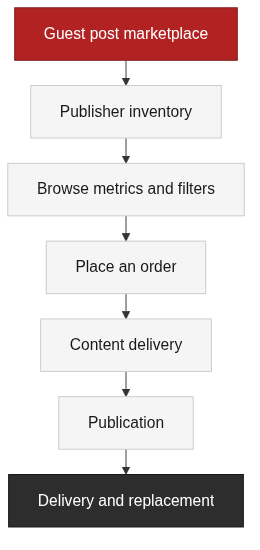
What a Guest Post Marketplace Actually Is: From Publisher Inventory to Delivery Pipeline
At its core, a guest post marketplace is a two-sided platform. Publishers list their sites as available for sponsored posts. Buyers browse that inventory, filter it, and place orders. The platform handles the transaction, the content delivery, and often the reporting in between.
The core asset is the publisher inventory — indexed by DA/DR, traffic, niche, language, country, and editorial rules
The inventory is the product. Platforms typically index each publisher by third-party SEO metrics (Moz DA, Ahrefs DR, SEMrush traffic), plus niche, language, country, and editorial requirements. The most mature platforms integrate data from multiple tools so buyers can cross-reference. For example, MeUp advertises deep integration with Moz, Ahrefs, and SEMrush data, which means a buyer can check a publisher against more than one metric source. That cross-referencing matters, because a single metric on a platform dashboard is not a reliable signal by itself.
The buying flow: browse metrics and filters → place an order → content delivery → publish → delivery and replacement
The typical flow is consistent across platforms. You set your filters (niche, DR range, language, price), browse the matching publishers, and place an order. Depending on the model, you either supply your own content or the platform writes it. The publisher reviews and publishes the post, then the platform confirms delivery and sends reporting. If a link does not go live or gets removed shortly after, the replacement policy kicks in. This pipeline is where the real differences between platforms show up — in how transparent each step is and how the platform handles failures.
The real value of a marketplace is scale plus transparent filtering — not a quality guarantee
This is the key point to internalize. The value proposition of a guest post marketplace is efficiency: you can evaluate and purchase placements at a scale that manual outreach cannot match. BaZoom, for instance, reports a network of more than 80,000 media outlets, and MeUp lists over 150,000 reviewed sites and 80,000+ unique domains. That is an enormous catalog. But a large catalog is not the same as a verified one. Scale gives you options; your screening gives you quality.
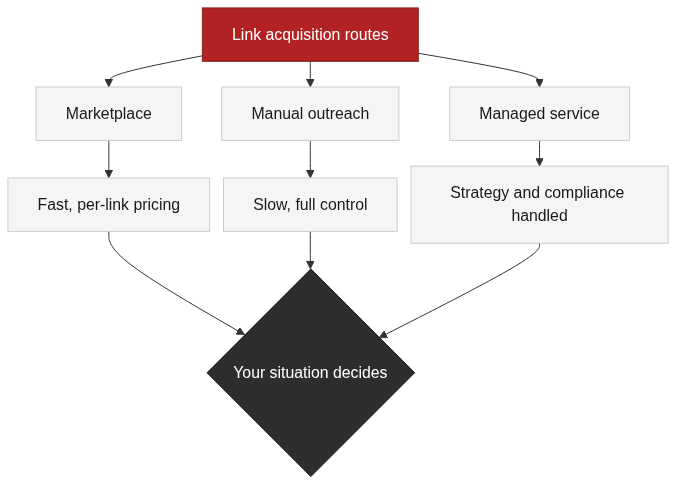
Marketplace vs Manual Outreach vs Managed Service: An Overview Comparison
Before you buy from any guest post marketplace, it helps to see where it fits alongside the two main alternatives. Each route trades off control, cost, speed, and quality assurance differently.
Side-by-side comparison matrix across control, cost structure, speed, quality assurance, inventory scale, content delivery, and compliance risk
| Dimension | Guest Post Marketplace (self-service) | Manual Outreach | Managed Link Building Service |
|---|---|---|---|
| Control | High — you select publishers yourself | High — you lead the outreach | Medium — strategy team takes over |
| Cost structure | Per-link pricing, transparent | High labor cost, negotiated per site | Packaged or monthly, includes strategy, content, and delivery |
| Speed | Fast — browse and order immediately | Slow — site by site outreach | Medium — defined delivery cycles |
| Quality assurance | Platform review plus your own screening | Your own judgment | Service provider’s strategy and replacement commitment |
| Inventory scale | Large (e.g., MeUp 150k+ sites, BaZoom 80k+ outlets) | Limited to your own list | Depends on the provider’s network |
| Content delivery | Often placement-only; content purchased separately | You supply or outsource content | Usually includes content creation |
| Compliance risk | Medium — you must verify sponsored disclosure and footprints | Low — you control it | Low — provider handles compliance |
When each route fits: self-service marketplaces suit experienced SEOs; manual outreach suits constrained resources; managed services suit teams that want strategy and compliance
There is no universally correct route. A self-service guest post marketplace fits an experienced SEO who knows how to verify a publisher and wants to move fast. Manual outreach fits limited resources and a willingness to trade hours for money, because you do the legwork yourself. A managed link building service fits a team that values its time, wants strategy and compliance handled by specialists, and prefers a predictable delivery flow over self-service screening.
Why the comparison points toward managed link building for teams that value time and strategic partnership
The pattern is clear. If you have the expertise and the time, a marketplace gives you maximum control at a transparent per-link cost. But the moment your screening becomes a bottleneck — when you are verifying dozens of publishers across every campaign — the economics shift. A managed partner takes over strategy, content, and compliance, which is exactly why the comparison tends to point toward managed link building for teams that want to stop doing the work themselves. This is where a strategic partner like TraffiClimb operates: not as another marketplace, but as a partner that combines scale with depth.
Metrics Are Not Quality: Publisher Verification Is the Real Gate
The single most important lesson for anyone buying from a guest post marketplace is that platform metrics are not a proxy for quality. DA and DR numbers describe a site’s link profile, not its editorial value. Traffic numbers describe volume, not whether that traffic is real or relevant.
What platform metrics actually show (DA/DR, traffic, niche) — and how they can be gamed
Domain Authority and Domain Rating are calculated from a site’s backlink profile. A site can earn a high DR through a network of weak links rather than genuine authority. Traffic figures on a platform dashboard can be inflated or can come from sources that have nothing to do with organic search. Even a niche tag on a listing is only as accurate as the platform’s classification. None of these metrics tell you whether a human editor will actually review your content, or whether the site will still be live in six months.
The verification dimensions that matter: site ownership and network footprints, relevance, traffic authenticity, and editorial control
Real verification goes beyond the dashboard. Four dimensions matter most. First, site ownership and network footprints: is this a genuinely independent site, or one node in a larger network of sites sharing hosting, analytics, or design? Second, relevance: does the site’s actual content overlap with your niche, or is the topic tag a stretch? Third, traffic authenticity: does the traffic look natural, with stable history, or does it spike and collapse? Fourth, editorial control: will a human editor review your content, or is this a programmatic placement with no real gate?
Why platform review scale (e.g. MeUp’s 150,000+ reviewed sites) confirms review is standard — but depth varies by platform
The fact that a platform like MeUp advertises more than 150,000 reviewed sites tells you something important: publisher review is now a standard feature of the market. Nobody credible ships an unvetted catalog anymore. But scale of review is not the same as depth of review. One platform may verify that a domain exists and resolves; another may check traffic authenticity, ownership, and editorial standards. When you evaluate a guest post marketplace, ask what its review process actually checks — not just how many sites it claims to have reviewed.
Pricing Models and Content Delivery: Are You Buying a Link or an Editorial Opportunity?
The price you see on a guest post marketplace is rarely the full picture. You need to know what the price covers, who owns the content, and what happens when a placement fails.
Placement-only vs content-included pricing — what each actually covers and who owns content quality
There are two common pricing models. Placement-only means you pay for the link and the publication slot, and you supply the content yourself. Content-included means the platform or publisher writes the article as part of the price. BaZoom, for example, prices per link with content and publication included, with an average delivery time of around four days. The distinction matters because content quality affects both editorial acceptance and whether the link looks natural. With placement-only, you own the writing and the risk. With content-included, you are trusting the platform’s writing team, so you need to confirm what quality bar they hold.
Sponsored disclosure as a compliance requirement: rel=”sponsored” and explicit sponsored labeling, consistent with paid links policy
Any paid placement is, by definition, a sponsored link under search engine guidelines. A compliant marketplace ensures the publisher marks the post as sponsored — either with a rel=”sponsored” attribute on the link or with explicit sponsored labeling on the page. This is not optional decoration. It is a compliance requirement that keeps the placement within paid links policy. If a seller refuses to add sponsored disclosure, or is evasive about it, treat that as a hard stop. The same logic applies across all paid link building, which is why our paid links and white hat guidance treat disclosure as non-negotiable.
Turnaround and replacement terms determine your purchase risk — delivery cycles and what happens if a link goes live then gets removed
Your purchase risk lives in two clauses: turnaround and replacement. Turnaround is the promised delivery time — how long from order to live link. BaZoom’s average of four days is a reasonable industry benchmark, but the exact number matters less than whether the platform commits to it. Replacement is what happens if a link never goes live, or goes live and is later removed. A clear replacement policy — how long you have to report a missing link, how many replacements you get, and on what timeline — is what separates a marketplace that stands behind its inventory from one that does not.
Red Flags That Should Stop a Purchase Immediately
Some signals should end your evaluation of a seller on the spot. These are not minor inconveniences; they are vetoes.
Refusal to share site URLs, anonymous high-DR sites, and no sponsored disclosure
If a seller will not show you the actual site URL before purchase, walk away. An anonymous “high-DR site” you cannot inspect is not a legitimate asset. Similarly, if there is no commitment to sponsored disclosure, the placement is a compliance risk from the start. A guest post marketplace that hides inventory or dodges disclosure questions is signaling that it does not want you to look too closely.
Vague or missing replacement policies, obvious network footprints, and metrics that contradict real traffic
A vague replacement policy is a red flag because it means you have no recourse if the link fails. Obvious network footprints — dozens of near-identical sites sharing hosting, templates, and analytics — indicate a network rather than genuine independent publishers. And metrics that contradict what you can verify yourself, such as a high DR site with no visible organic traffic, tell you the data is not trustworthy.
No reporting or delivery proof — and why each red flag is effectively a veto
If a platform offers no reporting or no proof of delivery, you have no way to confirm the placement even happened. Each of these red flags is a veto because each one undermines the core reason you are buying the placement in the first place: a relevant, compliant, verifiable link. When any of them appears, the rational move is to stop and look elsewhere rather than hope for the best.
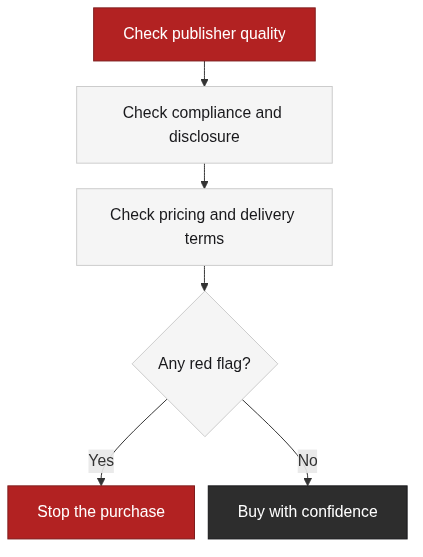
Pre-Purchase Checklist: What to Verify Before You Buy
This checklist turns the discussion above into an actionable gate. Run it against any guest post marketplace and any specific publisher before you commit money.
Publisher quality checks — independent operation, cross-verified metrics, real traffic, niche relevance, and genuine editorial flow
- [ ] Is the site genuinely and independently operated, or is it part of an obvious network footprint?
- [ ] Do the DA/DR figures hold up when cross-checked against third-party tools (Ahrefs, Moz, SEMrush)?
- [ ] Is the traffic real — stable history and natural sources — rather than inflated or purchased?
- [ ] Does the site’s actual content align with your niche, beyond a convenient topic tag?
- [ ] Is there a genuine editorial review process, or is this a programmatic placement with no human gate?
Compliance and disclosure checks — sponsored labeling, alignment with paid links policy, and refusal signals
- [ ] Will the publisher add rel=”sponsored” or otherwise label the post as sponsored content?
- [ ] Does the placement stay within search engine paid links policy? (This is the same standard we apply across paid and white hat link building.)
- [ ] Is the seller transparent about disclosure, or evasive when asked?
Pricing, delivery, and platform trust checks — placement-only vs content, turnaround and replacements, reporting, and third-party reputation
- [ ] Is the quote placement-only or content-included, and who is responsible for content quality?
- [ ] Is the turnaround time clearly stated, and is there a defined replacement policy if a link fails or is removed?
- [ ] Does the platform provide reporting and proof of delivery?
- [ ] Does the platform have third-party reputation signals such as Trustpilot or G2 reviews, a visible team, and accessible support?
Core Takeaways and Your Next Step
You now have both the mechanics and the framework. The bottom line is simple: a guest post marketplace is a tool, and your screening is the protection.
The decisive insight: the marketplace is a tool, and the buyer’s screening framework is what protects the investment
The platform aggregates inventory and gives you filters. It does not guarantee that any single placement is worth buying. Your verification — of ownership, relevance, traffic, editorial control, disclosure, and replacement terms — is what actually protects your investment and your rankings. Two buyers on the same marketplace get different results because one screens and the other does not.
When self-service screening stops being worth your time, a managed link building partner takes over strategy, content, and compliance
There is a point where self-service screening stops being efficient. When you are cross-checking dozens of publishers, writing or reviewing content, and tracking replacements across every campaign, the hours add up. That is the moment a managed partner becomes the better use of your time. A partner like TraffiClimb takes over strategy, content creation, and compliance, so you get the benefit of scale without doing the verification work yourself.
Next step — talk to a strategic partner about compliance-first, content-driven link building instead of screening placements yourself
If you are spending more time vetting placements than growing your site, it may be time to hand the process to a team that does it daily. TraffiClimb builds compliance-first, content-driven link building programs that combine scale with strategy. Compare how a managed link building service handles publisher verification, content, and compliance — and see whether it beats the hours you are spending on self-service screening.
FAQ
References
MeUp — Link Building Platform: Provides verified data on marketplace inventory scale (150,000+ reviewed sites, 80,000+ unique domains) and the dual marketplace + managed model, cited in the marketplace overview and verification sections. https://meup.com
WhitePress — Global Link Building Platform: Provides verified data on a long-established marketplace (founded 2013, 26+ language markets) covering marketplace plus content and PR, cited in the marketplace comparison. https://whitepress.com
BaZoom — Link Building Service Agency: Provides verified data on a people-driven provider (80,000+ media outlets, per-link pricing with content included, average delivery of 4 days), cited in the pricing, turnaround, and comparison sections. https://bazoom.com
Google Search Central — Link Schemes and Sponsored Links: Documents the paid links policy and the requirement to mark sponsored links with rel=”sponsored”, cited in the sponsored disclosure and compliance sections. https://developers.google.com/search/docs/essentials/spam-policies