
Forum Backlinks: Do They Help SEO? Risks, Spam & Safer Approaches
 Written by Alistair MacLeod

Your competitor just packed their forum signature with keyword-rich anchor text, and their rankings look fine. Should you do the same? Before you start registering accounts across a dozen forums, here is the uncomfortable truth about forum backlinks in 2026: their direct link weight is close to zero, and when you scale them, you are not building links — you are building risk. The value of a forum link was never the link itself. It was *why you appeared there*.
This guide helps you draw the line between genuine community participation and manipulative forum submission, then shows you what to do instead.
Why Everyone Is Asking About Forum Backlinks in 2026
The question keeps coming up because the answer keeps shifting. Forum backlinks were once a quick, low-effort way to build a backlink profile. Today, Google’s spam systems have made that approach both low-value and genuinely risky.
The Competitor Dilemma — seeing rivals pack forum signatures and wondering if you should too
You open a forum in your niche, and there it is: a competitor’s signature with an exact-match anchor text pointing at their money page. Their site ranks — so the logic goes — they must be doing something right. This is the trap. What you are seeing is a pattern Google has spent years devaluing, not a strategy that is working *because of* the forum links. Correlation here is not causation, and copying it usually imports the risk without the reward.
The Core Tension — forum link value lies not in the “link” itself but in “why you appear there”
A forum link is a signal, not a ranking asset. When a real person in a relevant community links to you because you answered their question well, that is a citation. When you register an account purely to drop a link, that is a submission. Google treats these two things completely differently — not because of the link’s HTML, but because of the motive and the context around it.
The Stakes — Google’s 2022 Link Spam Update explicitly targets scaled forum link building
In December 2022, Google rolled out a Link Spam Update aimed squarely at sites engaging in link spam at scale, which includes bulk posting in forums and comment sections. The official announcement is explicit that such links can be ignored or trigger manual action [1]. This is not a theory about future enforcement — it is the current operating state of the algorithm.
What Forum Backlinks Actually Are (and Why Weight Is Nearly Zero)
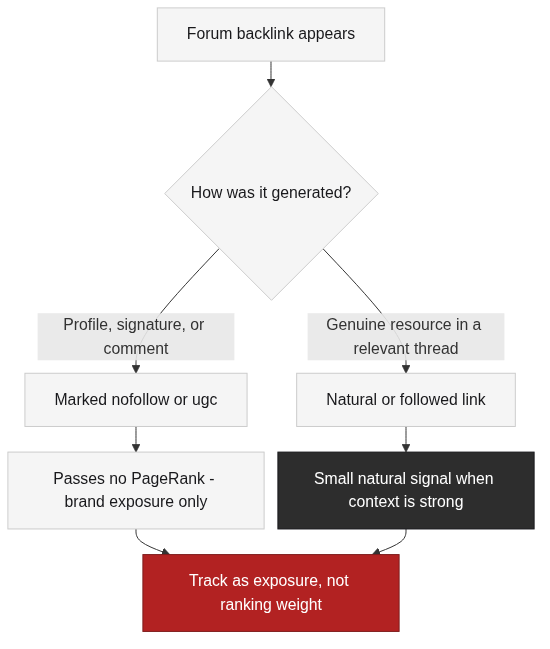
Before you judge whether a forum link helps, you need to understand what it technically is. Most forum links carry attributes that stop them from passing ranking weight in the first place.
The Four Common Forms — profile, signature, comment, and community links, and how each is generated
| Form | How it is generated | Typical attribute |
|---|---|---|
| Profile link | Link placed in a forum profile/account page | rel="nofollow" or rel="ugc" |
| Signature link | Link embedded in a forum signature shown on every post | rel="nofollow" or rel="ugc" |
| Comment link | Link dropped inside a post or reply | rel="ugc" |
| Community link | Link shared as a genuine resource in a relevant discussion | rel="ugc" or naturally followed |
The first three are almost always generated for the purpose of acquiring a link. The fourth is generated because the link is genuinely useful. That difference in generation is what matters more than the HTML.
The Link Attributes Reality — rel=”ugc” and rel=”nofollow” do not pass PageRank, per Google’s official docs
In September 2019, Google introduced rel="ugc" (user-generated content) and rel="sponsored" as new link attribute values [2]. The official documentation is unambiguous: links carrying rel="nofollow" or rel="ugc" do not pass PageRank. Because forum posts, comments, and signatures are user-generated content, they are typically marked with rel="ugc" or rel="nofollow" by default. The practical upshot: the forum links you can actually place are, by design, links that do not pass ranking weight.
The Real Value Shift — brand visibility, direct traffic, and the chance of later natural citation
If forum links do not pass weight, why do they still appear in discussions about SEO? Because a well-placed community link can still deliver brand visibility, direct referral traffic, and — most importantly — the possibility of a later *natural* citation from someone who found you through that community. Google’s own documentation notes that even nofollow and ugc links can act as signals for discovering new pages and evaluating brand mentions [2]. That is the real, defensible value: not the link’s weight, but the exposure and the downstream citations it can seed.
Natural Community Mention vs Manipulative Forum Submission
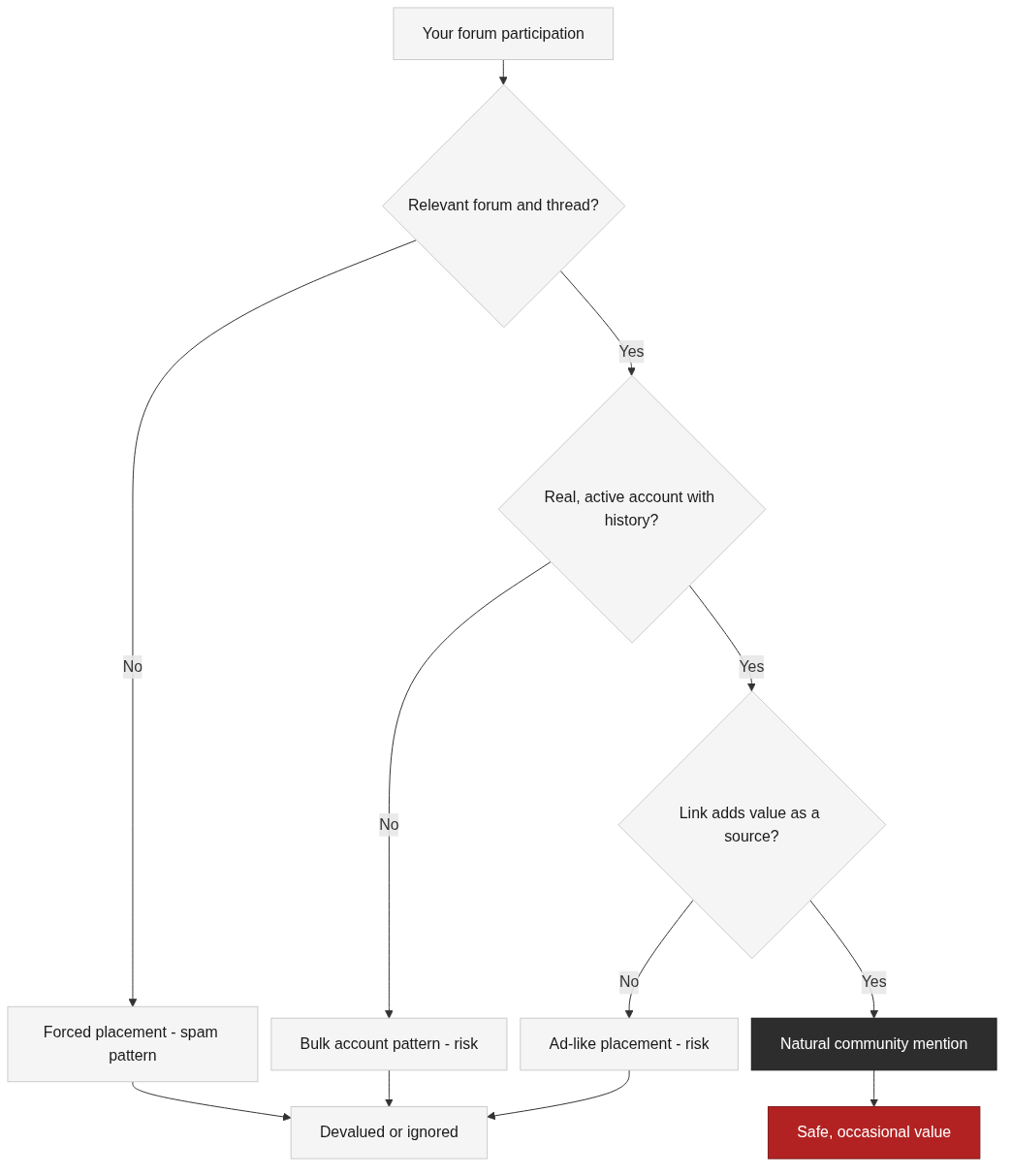
Two forum links can look identical in a backlink report and be polar opposites in Google’s eyes. The difference is not the link — it is the intent and the pattern behind it.
What Separates a Healthy Signal from a Spam Signal — relevance, source credibility, context naturalness, and scale
| Dimension | Healthy signal | Spam signal |
|---|---|---|
| Relevance | Forum and topic directly match your business | Link forced into an unrelated thread |
| Source credibility | Active forum with real, engaged users | Low-trust or disposable forum |
| Context naturalness | Link is the “source” the answer points to | Link reads like an ad slot |
| Scale | Occasional, non-patterned appearances | Bulk, cross-site, repeated identical patterns |
A single relevant citation in a respected community is a healthy signal. Fifty identical signature links across fifty forums is a pattern — and patterns are what spam systems are built to detect.
The Motive & Context Test — a genuine answer in a vertical forum versus bulk account registration
Ask yourself one question for any forum link you are about to place: *would this link still be here if I got nothing from it?* A genuine answer in a vertical forum — say, a developer helping another developer in a framework community — earns a link because the answer is useful. Bulk account registration, by contrast, is a transaction: you register, you drop a link, you move on. The motive is the tell, and Google’s systems are built around evaluating whether a link was placed for real reasons.
What Google’s Spam Policies Define as Link Manipulation — where forum posting crosses the line
Google’s official Spam policies classify link manipulation as creating links that are intended to manipulate rankings, and they explicitly call out bulk posting of links in forum, comment, and signature sections of user-generated content as a form of link spam [3]. This is the line: the moment your forum activity exists primarily to place a link rather than to contribute, you have crossed from participation into manipulation.
The Real Risks of Scaled Forum Posting
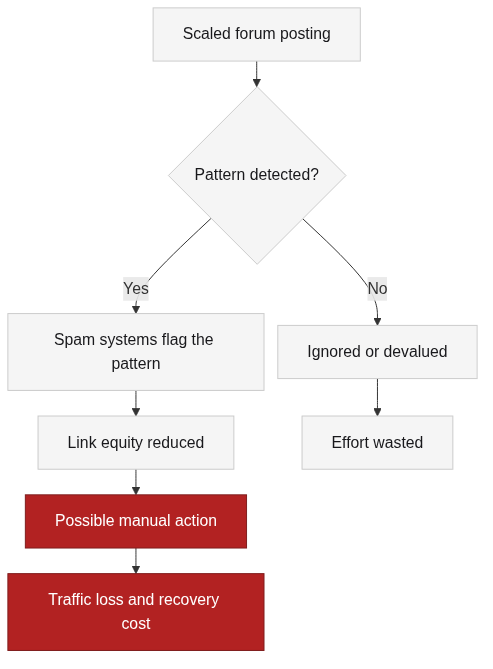
The risk of forum posting is not binary. It escalates in stages, and most sites never notice until the escalation reaches the point where it costs them.
The Risk Hierarchy — from “ignored” (no benefit) to “devalued” and “manually actioned”
| Stage | What happens | Net effect |
|---|---|---|
| Ignored | Low-value forum links are simply not counted | No benefit, no penalty |
| Devalued | Links lose whatever weight they might have had | Effort wasted |
| Pattern-flagged | Spam systems detect a scaled, low-value pattern | Link equity reduced, site trust questioned |
| Manually actioned | Site draws a manual action under spam policies | Traffic loss, recovery effort required |
The danger is that “ignored” and “devalued” feel harmless, so scaled forum posting appears to be a free option. It is not free — it is the entry ramp to the later, costly stages.
Pattern Detection — how SpamBrain and Link Spam Updates recognize scaled, low-value forum patterns
Google’s spam-fighting systems, including SpamBrain, are designed to identify link spam at scale rather than individual links. The 2022 Link Spam Update specifically targeted sites engaging in link spam at scale [1]. What that means in practice: a single forum link is unlikely to trigger anything, but thousands of forum links following the same template — same anchor, same profile structure, same posting pattern — are exactly the kind of fingerprint these systems are built to catch.
The 2021/2022 Update Evidence — sites leaning on forum signatures/comments saw significant traffic loss
The 2021 Link Spam Update was the first iteration aimed at links built through forum signatures, comments, and blog comment sections [4]. The 2022 update built on it [1]. Across the SEO industry, sites whose profiles leaned heavily on forum signature and comment links reported meaningful traffic declines after these rollouts. The pattern is consistent: when your backlink profile is dominated by low-value forum links, you are exposed to the next spam update rather than insulated from it.
Practical Judgment Framework and Safer Alternatives
You do not need to abandon forums. You need to change how you use them — and shift your link building effort toward channels where quality is controllable.
The Pre-Posting Checklist — ask yourself seven questions before leaving any forum link
- 1. Relevance — Is this forum directly relevant to my business and audience? (If not, stop.)
- 2. Context — Does the link belong naturally in the discussion, or is it forced in?
- 3. Motive — Am I posting to help someone, or to place a link?
- 4. Identity — Am I a real, ongoing member, or a one-time registration?
- 5. Anchor — Am I using a natural anchor (brand name or bare URL) or an exact-match keyword?
- 6. Scale — Am I repeating this same action across many sites? (If yes, high-risk signal.)
- 7. Attribute — Will this link be marked
nofolloworugc? (If yes, treat it as brand exposure, not ranking weight.)
If your answer to any of questions 1, 2, or 3 is negative, the link is not worth placing.
The Forum Link Evaluation Matrix — scoring relevance, domain trust, context, account authenticity, anchor, and scale
| Evaluation dimension | Weight | Passing line |
|---|---|---|
| Domain relevance | High | Directly matches your vertical |
| Domain trust | High | Real active users, not a disposable forum |
| Context naturalness | High | Link is a source, not an ad slot |
| Account authenticity | Medium | Long-term participation, not one-time |
| Anchor naturalness | Medium | Not exact-match keyword |
| Scale risk | High | Non-bulk, non-patterned |
If a forum link fails on relevance, context, or account authenticity, its SEO value approaches zero and it may carry risk. It is not worth the cost of manufacturing it at scale.
The Safer Path — expert participation in relevant communities plus content-driven, quality-first link building
The smarter approach is to earn forum visibility rather than manufacture it. Participate genuinely in the few communities where you can add real value, let links appear naturally as sources, and treat any resulting exposure as a brand signal rather than a ranking asset. Then put the bulk of your effort into link building you can actually control — content-driven, quality-first strategies that produce links you can select and track. This is where the ROI lives, and it is the approach that survives algorithm changes instead of fearing them.
Core Conclusion and Next Steps
The Bottom Line — forum backlinks carry near-zero weight and high scaled risk; invest in expert reputation instead
Forum backlinks, in their most common forms, carry close to zero ranking weight because of the nofollow and ugc attributes they almost always carry [2]. Their real value is brand exposure and the chance of later natural citation. The moment you scale forum posting to try to manufacture links, you move into territory that Google’s spam policies explicitly define as link manipulation [3] and that its updates actively target [1][4]. The rational move is to stop treating forums as a link source and start treating them as a reputation channel.
Shift to Sustainable Growth — move from manufacturing links to content-driven, high-quality link building
The trade-off between forum backlinks and quality-first link building is not close. Forum links offer low control, near-zero weight, and high scale risk. Content-driven link building offers high control, links that can pass weight, and a strategy you can sustain. If you want a deeper framework for doing this the right way, our guide to White Hat Link Building and our take on Relevant Backlinks walk through the quality-first principles that replace forum mass-posting. For a wider view of the trade-offs between approaches, our Link Building Strategies overview is a good starting point. And if you want to understand the difference between earning links and manufacturing them, our breakdown of Unnatural Links explains exactly where the line sits.
Your Next Move — explore a compliant, quality-first link building partnership
You do not have to choose between doing nothing and risking scaled forum posting. There is a middle path: a compliant, content-driven link building approach where every placement is selected for relevance and quality rather than volume. That is what we do at TraffiClimb — we build premium backlinks that drive sustainable growth, with transparent reporting and a strategy that treats your long-term ranking health as the goal, not a short-term link count. If you are ready to move from manufacturing links to building an asset, that is the conversation worth having.
FAQ
References
Google Search Central Blog — New ways Google Search is helping more people access the web (Link Spam Update, Dec 2022) — Google’s official announcement that the Link Spam Update targets link spam at scale, including bulk forum and comment posting.
Google Search Central Blog — Evolving “nofollow” – new ways to identify links (2019) — Google’s official documentation that rel=”nofollow”, rel=”ugc”, and rel=”sponsored” links do not pass PageRank.
Google Search Central — Spam policies — Google’s official definition of link manipulation, including bulk posting in forum, comment, and signature sections.
Google Search Central Blog — New link spam fighting measures (Jul 2021) — Google’s first Link Spam Update aimed at links built through forum signatures, comments, and blog comments.