
Fintech Link Building: Strategies for Financial Technology Companies
 Written by Warren Reed

Fintech link building is one of the most demanding link acquisition challenges in SEO because financial technology sits at the intersection of two very different editorial worlds. On one side, finance media demand trust, compliance, and authority. On the other, technology and startup media reward product innovation, growth, and founder stories. Most fintech teams execute only one side well, leaving their link profile “half-built.” This guide gives you a dual-attribute strategy framework for fintech link building—covering content layering, data-led assets, Digital PR, and founder commentary—so you can earn high-quality backlinks without crossing compliance lines.
Why Fintech Link Building Can’t Copy SaaS or Finance Playbooks
A generic SaaS link building playbook assumes you can scale volume through product pages and tech roundups. A generic finance playbook assumes trust and regulation dominate every decision. Fintech needs both, and neither template alone is enough. The reason is structural: your brand is being evaluated by two audiences with opposing expectations.
The “split personality” of fintech—caught between trust-driven finance media and growth-driven tech/startup media
Finance publications want evidence: data, methodology, regulatory context, and defensible claims. Technology and startup outlets want momentum: product launches, funding, API updates, and team stories. A single asset rarely satisfies both unless it is deliberately engineered to carry two narratives. This is the core of what we call the “split personality” of fintech link building—you are running two outreach tracks in parallel, not one.
Why doing one side well isn’t enough, and why the real barrier is balancing both without crossing compliance lines
You can earn strong links from tech media on product launches alone. But if your domain lacks the trust signals finance editors look for, you will consistently miss the citation-driven opportunities that carry the most weight. Conversely, a compliance-heavy finance profile without any product-led coverage leaves you invisible to the buyers evaluating you as software. The real barrier is not doing either side—it is balancing both while keeping every placement inside the compliance boundaries that govern financial communications.
What this guide delivers—a dual-attribute strategy framework for fintech link building
This guide walks through the competitive environment, content asset layering, data-led assets, Digital PR, and founder commentary, then gives you a practical decision framework. By the end, you will be able to evaluate any link opportunity against the dual relevance and compliance criteria that fintech demands.
The Fintech Competitive Environment Puts Quality and Risk First
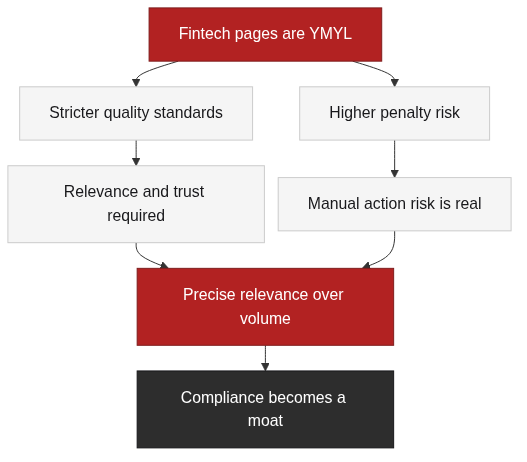
The link building market overall is in a transition from volume to precision. Low-value links are losing worth, while premium, content-native placements are gaining it [1]. In financial verticals, this shift is amplified because the penalty risk is structurally higher.
Why low-value, irrelevant, or spammy backlinks carry a higher penalty risk in financial verticals
Search engines treat pages that can affect money, health, or safety with stricter quality standards—commonly described as “your money or your life” (YMYL) content [2]. Financial technology pages fall squarely into this category. When a fintech domain accumulates irrelevant or low-value links, the damage is not just a ranking dip; it risks a manual action under link spam policies that is far harder to recover from than in a lower-stakes vertical [3]. The consequence is that “scale and volume” is not just ineffective for fintech link building—it is actively dangerous.
Compliance as a moat—how regulated markets turn “compliant” into a defensible advantage
In strictly regulated environments such as the European market, compliance is itself a defensible moat. Competitors who cut corners on link quality and disclosure thin themselves out over time. A fintech brand that treats compliance as a feature—rather than a constraint—can build a link profile that is both safe and scarce. This is the opposite of the race-to-the-bottom dynamic that dominates lower-tier link building.
Shifting from “scale and volume” to “precise relevance” for fintech link building
The practical consequence is that your primary metric should not be link count. It should be precise relevance: does this placement strengthen the perception of your brand as both a credible financial player and a credible technology product? Every link you pursue should be checked against both attributes. If a placement only serves one side and does nothing for the other, it should be deprioritized in favor of opportunities that bridge the two.
Layer Your Content Assets: Product and Commercial Pages vs. Authority Pages
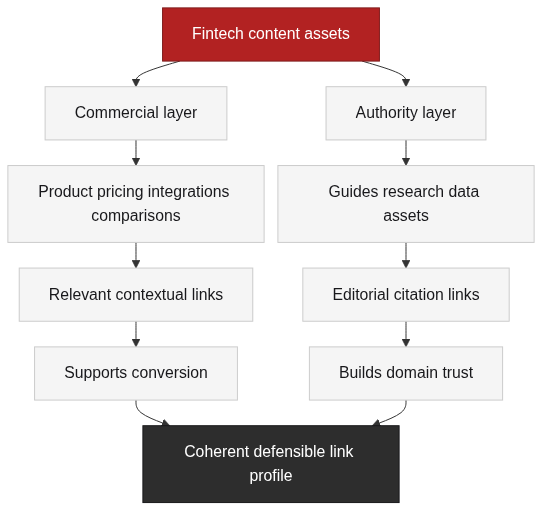
Fintech websites contain different types of pages, and each type needs a different link strategy. Treating all pages the same dilutes relevance and raises risk. The first step in any fintech link building plan is to separate your assets by the job each page is meant to do.
Product and commercial pages (pricing, integrations, comparisons) need relevant, contextual, conversion-supporting links
Product pages, pricing pages, integration pages, and comparison pages are commercial assets. They need links that are relevant and contextual, placed where a reader is actively evaluating a solution. A contextual link from a trusted technology review or an integration directory supports conversion because it arrives at the right moment in the buying journey. These links are commercial in nature, and they should be earned deliberately rather than sprayed across unrelated pages.
Educational and authority pages (guides, research, data assets) need editorial links that build domain trust
Guides, research, and data assets are authority pages. They need editorial, citation-style links that tell search engines and readers that your domain is a credible source of information. These links build the domain-level trust that makes every other link on your site more valuable. For fintech, the authority layer is what bridges you into finance media, because finance editors link to sources they can cite—not to pages that merely sell.
Why mixing the two dilutes relevance and raises risk
The mistake is mixing the two. Pointing editorial, citation-driven links at a pricing page, or pointing commercial links at a research hub, dilutes the relevance signal and raises the risk profile of the campaign. Matching asset type to link intent keeps your link profile coherent and defensible. This is a core discipline of fintech link building: separate your commercial and authority layers, and pursue each with the right link type.
Data-Led Assets and Research Are the Language of Financial Credibility
Finance is a discipline built on evidence. In fintech link building, original data is the fastest way to earn the trust of finance editors because it gives them something concrete to cite. Data is the language financial content speaks, and it doubles as a powerful linkable asset.
Why original research, industry indexes, fee comparisons, and regulatory and payments trend data earn citations
Original research, industry indexes, fee comparison studies, and payments or regulatory trend data are inherently citable. Journalists and analysts link to data because it strengthens their own reporting. For a fintech brand, this is a rare opportunity to earn links from both sides of the split personality at once: finance media cite the data for its authority, while technology media cite it for the product insight it reveals.
How data assets double as Linkable Assets and Digital PR ammunition across both finance and tech media
A well-built data asset is not just a page; it is a Linkable Asset that fuels Digital PR. The same study can be pitched to finance outlets as a market analysis and to tech outlets as a product-behavior insight. This lets one piece of research unlock coverage in two verticals, which is exactly the dual-attribute outcome fintech link building should produce.
The criteria for a citable asset—original data, clear methodology, and direct quotability
Not every dataset is a linkable asset. To be citable, an asset needs three things: original data that no one else has, a clear and transparent methodology, and a format that journalists can quote directly. If a dataset is derivative, opaque, or hard to quote, it will not earn editorial links. Applying this test before you build prevents wasted effort and keeps your authority layer genuinely defensible.
Digital PR and Founder and Expert Commentary Carry the Product and Opinion Hooks
Data earns citations, but product and opinion hooks earn coverage. Fintech link building needs both. Product launches, funding news, and API updates are natural news hooks that can trigger coverage in technology and finance media at the same time.
Product launches, funding news, and API updates as natural news hooks triggering tech and finance coverage
A product launch, a funding announcement, or a meaningful API update is a legitimate news event. These are the moments when editors are most receptive to covering your brand. Because fintech products sit at the intersection of finance and software, a single announcement can be framed for a finance audience (what it means for the market) and a technology audience (what it does technically). This doubles the coverage potential of every launch.
Founder and expert commentary as a route into finance and tech media expert networks
Founder and expert commentary is a lower-cost route into the expert networks that finance and technology journalists rely on. When your founder or a senior expert offers a sharp, defensible opinion on a trend, editors begin treating your team as a source. Over time, this builds a relationship that produces editorial, citation-style links without a hard sell. It is one of the most sustainable sources of authority in fintech link building.
Combining commentary with Backlink Gap Analysis to find editorial link opportunities competitors hold
Commentary becomes far more powerful when paired with a Backlink Gap Analysis. By identifying the editorial links competitors already hold but you lack, you can target the same outlets with a differentiated angle. This turns Digital PR from a scattergun activity into a precise campaign aimed at the highest-value gaps in your profile. It is the difference between guessing where links might come from and knowing exactly which opportunities are available.
A Practical Framework for Fintech Link Building Decisions
Theory is only useful if it changes decisions. This section gives you the decision tools: a scenario matrix, an asset-to-page matching guide, a six-point evaluation checklist, and a playbook by business stage.
Scenario matrix—finance-media route vs. tech/startup media route
| Dimension | Finance media route | Tech/startup media route | Decision point |
|---|---|---|---|
| Target media | Financial verticals (trust, compliance, authority) | Technology/startup verticals (product, growth, innovation) | Cover both—one side alone is insufficient |
| Content language | Data, research, regulatory compliance, market trends | Product functionality, API, funding, team story | The same asset often needs two narrative versions |
| Link type | Editorial, citation-driven (data-led) | Product launch, review, expert byline | Keep authority vs. commercial links separate |
| Risk sensitivity | Very high (compliance red lines) | Moderate (spam link penalties) | The finance side is stricter |
| Internal anchor | Digital PR and Linkable Assets | SaaS Link Building and Link Building Campaign | Connect both directions |
Asset-type vs. target-page matching
| Asset type | Target page | Link nature | Risk | Notes |
|---|---|---|---|---|
| Data-led asset / research | Authority/educational page | Editorial, citable | Low | Best bridge across finance and tech |
| Product launch / API update | Product/commercial page | News-driven, commercial-relevant | Medium | Frame for both audiences |
| Founder/expert commentary | Brand/authority page | Expert network, editorial | Low | Builds long-term source relationships |
| Comparison/integration page | Commercial page | Relevant and contextual | Medium-high | Requires precise Relevant Backlinks placement |
A six-point evaluation checklist
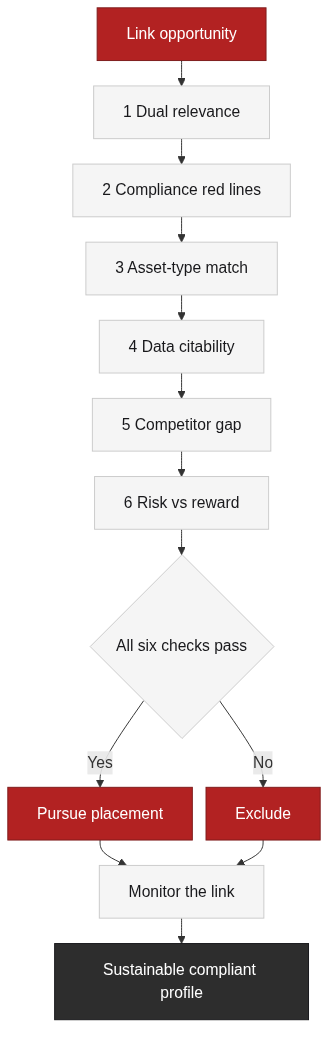
Run every fintech link building opportunity through these six checks before committing:
- Dual relevance—Does the target media satisfy at least one of “financial vertical” or “technology vertical,” and is it strongly relevant to your content? Weak single-sided relevance means downgrade or drop.
- Compliance red lines—Could this link or content touch financial regulation, user data, or investment advice boundaries? If yes, stop immediately. Do not attempt gray-area work.
- Asset-type match—Is the page being promoted a product/commercial page or an educational/authority page? Choose the link nature (commercial vs. editorial) accordingly.
- Data citability—If it is a data-led asset, is the data original, is the methodology clear, and can media quote it directly? If not, it is not a valid linkable asset.
- Competitor gap—Through Backlink Gap Analysis, is this opportunity already saturated by competitors while you lack it? If saturated, change direction.
- Risk vs. reward—Does the link’s quality and risk profile match the high sensitivity of the financial vertical? Any hint of a low-value signal means exclusion.
Recommended playbook by business stage
- Early SaaS/startup: Lead with founder and expert commentary plus product launch hooks. This is the lowest-cost way to build authority, and it lets you establish a foothold in technology media first.
- Growth stage: Invest in data-led assets and original research. This is when you can open the finance media route and build the dual-attribute profile that separates you from single-vertical competitors.
- Mature B2B: Use Backlink Gap Analysis to systematically close competitor gaps, paired with Digital PR to scale editorial links. At this stage, the goal is defense of your authority layer and consistent, sustainable growth.
Core Takeaways and Your Next Step
The fintech link building principle—precise relevance and compliance over volume
The single principle that governs everything in this guide is this: for fintech, precise relevance and compliance beat volume every time. The financial vertical punishes carelessness harder than any other, so the brands that win are the ones that treat every link as a strategic, compliant decision.
Recap of the dual-attribute strategy across content, PR, and industry resources
Across content, PR, and industry resources, the dual-attribute strategy is consistent: separate your commercial and authority layers, build original data that finance editors can cite, use product launches and founder commentary to reach technology media, and close competitor gaps through Backlink Gap Analysis. When all four work together, your link profile becomes both defensible and sustainable.
From a complex industry environment to a tailored Link Building Services consultation
Fintech link building is complex because it demands precision, compliance, and dual-vertical fluency all at once. That complexity is exactly why a tailored strategy matters. If you want to translate these principles into a plan for your specific product, the next step is a Link Building Services consultation where we map your assets, your competitor gaps, and your compliance boundaries into a campaign built for sustainable growth.
FAQ
References
Ahrefs Blog: Digital PR and Linkable Assets: a stable industry source describing how data-led content and Digital PR earn premium, editorial, citation-style backlinks, supporting the shift from low-value volume to content-native placements. https://ahrefs.com/blog/
Google Search Quality Rater Guidelines: provides the “Your Money or Your Life” (YMYL) framework explaining why financial and health content receives stricter quality and trust evaluation. https://static.googleusercontent.com/media/guidelines.raterhub.com/en//searchqualityevaluatorguidelines.pdf
Google Search Central: Link Spam Policies: documents Google’s policies on link spam and low-value links, supporting the higher penalty risk when a site accumulates irrelevant or low-value backlinks. https://developers.google.com/search/docs/essentials/spam-policies