
Finance Link Building: 7 Trust-First Strategies for Financial Sites
 Written by Warren Reed

The same backlink that is harmless on a general e-commerce site can quietly damage a financial website’s standing. That is the core reality of finance link building: money, loans, investments, insurance, and identity are at stake, so the tolerance for a careless placement is far lower than almost any other vertical. Before you buy links, pitch publications, or replicate a generic outreach playbook, the strategies below explain why finance demands a trust-first, quality-first approach — and how to execute it safely.
Why Finance Link Building Can’t Follow Generic Tactics
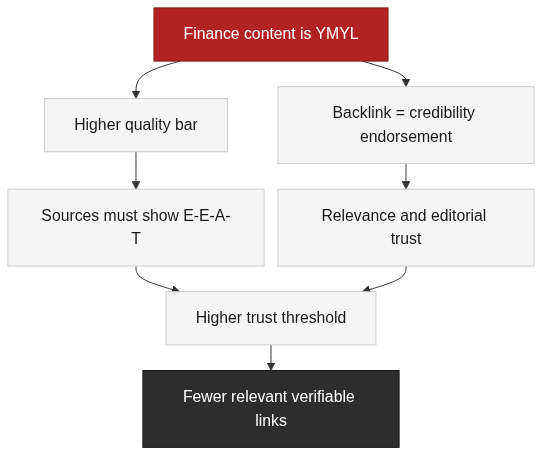
Finance link building is not a variation of general link building; it is a different discipline with a different objective. On a general site, a link is mostly a ranking signal. On a financial site, the same link is a credibility endorsement that reflects on the entire domain.
The same link carries very different weight on a finance site than on a general site
When a visitor lands on a page about loans, investments, insurance, or retirement, they are making decisions that affect their money and their future. A general content site that links to an unreviewed source may lose some trust; a financial site that does the same risks being read as careless or misleading. That asymmetry is why a one-off guest post that works for a lifestyle blog is rarely an acceptable building block for a bank, a wealth manager, or a financial analysis platform.
Finance pages are classic YMYL: an unreliable source or a low-relevance link can hurt domain trust far beyond what a generic site would experience
Google applies stricter quality expectations to pages that could affect a user’s financial well-being, a category it groups under “Your Money or Your Life” (YMYL) [1]. Because the bar for acceptable content is higher, the bar for acceptable linking sources rises with it. A link from a directory that has no editorial process is a risk signal on a finance domain in a way it simply is not on a niche blog.
Core thesis: finance link building is a trust and reputation exercise, not a link-count exercise
The central idea of this guide is that finance link building is fundamentally about trust and reputation. The goal is not to accumulate the most links; it is to accumulate the fewest, most relevant, most verifiable links that reinforce the domain’s credibility. Everything that follows in this guide flows from that principle.
YMYL Sets the Trust Threshold Higher for Finance
Google classifies finance content as YMYL and applies its highest quality expectations to it. That classification changes what a link means and what it is worth.
Google applies stricter quality standards (E-E-A-T, with Trust as the core signal)
Google’s publicly documented approach to assessing content quality centers on experience, expertise, authoritativeness, and trust — E-E-A-T — with trust treated as the most important signal, especially for YMYL topics [1]. A financial page that links out to sources that lack expertise or authority undermines its own trust. The same logic applies to the links pointing in: a backlink from a source that cannot demonstrate relevance or authority does little to build trust and may actively signal the opposite.
A link is a credibility endorsement, not just a ranking signal
In finance, one editorial link from an authoritative financial publication carries more trust value than dozens of low-relevance directory links. A single contextual mention from a respected finance outlet tells both users and search engines that the domain is worth reading. Volume cannot substitute for that endorsement; it can only dilute it.
Banks and financial institutions must treat link building as reputation building
For banks and financial institutions, every placement reflects on the entire domain’s credibility. A single questionable link in a large link profile is not contained to one page — it raises questions about the whole site’s judgment. Reputation building means the link strategy and the brand strategy are the same plan, not two separate efforts.
Relevance Is the Carrier of Trust in Finance
Relevance is what separates a trust-building link from a neutral or damaging one. On a finance domain, relevance is not a nice-to-have; it is the mechanism by which trust transfers.
Links must be strongly relevant to finance, wealth, investment, and regulation topics
A link from a finance blog, an industry analysis site, or a respected financial publication transfers topical authority because the context matches the content it points to. Google’s documentation on links emphasizes that relevant links from authoritative pages are the type that help a site [2]. When the linking page is about investing, banking, or regulation, the endorsement is legible to both users and search engines.
A high-DA but unrelated site is less valuable than a relevant finance source
Domain authority alone does not make a finance link valuable. A high-authority site about cars or travel linking to a mortgage page reads as out of context and can appear manipulative. A lower-authority but strongly relevant finance source conveys domain authority in a way an unrelated portal cannot. Relevance conveys authority; unrelated links risk being read as manipulation [2].
Relevance-weighted screening changes how you evaluate sources
In a generic campaign, you might rank sources mostly by authority and volume. In finance link building, you rank sources by relevance first and then by authority, because relevant links are the ones Google’s guidance says help a site most [3]. This changes the entire evaluation: a moderately authoritative finance blog can outrank a high-authority unrelated portal, and a directory with no topical focus is rejected outright.
Content Assets Are the Entry Ticket to Authority Links
Authoritative finance sites do not link to thin or promotional pages. They link to content that is accurate, verifiable, and useful to their readers. That is why linkable assets are the prerequisite for finance outreach.
Original data, whitepapers, and expert commentary are the core route to earned media links
Financial publications and industry analysts are selective because their reputation is on the line. They are far more likely to reference original data, a well-structured whitepaper, or a quote from a named expert than a generic blog post. Building these assets before outreach is what makes a finance campaign credible enough to earn placements rather than pay for them.
Digital PR and expert commentary turn linkable assets into earned placements
Digital PR is the outreach engine that connects a linkable asset to the right publications. For a bank or financial brand, a defensible path into financial media runs through expert commentary and proprietary research — the type of material an editor can use to support their own reporting. This is the difference between building a linkable asset and actually earning the links it deserves.
Building linkable assets before outreach separates a scalable campaign from one that stalls
A finance campaign that tries to build links before it has anything worth linking to will stall at low-relevance directories and paid placements. A campaign that invests in original data and expert commentary first has a foundation that scales: each new asset is another opportunity to earn a relevant, authoritative link.
Risk Control Is the Bottom Line for Finance Domains
Finance domains are reputation-sensitive by nature. The downside of a bad link is disproportionate, so risk control is not an afterthought — it is the operating principle.
One risky link can trigger a drop in algorithmic trust
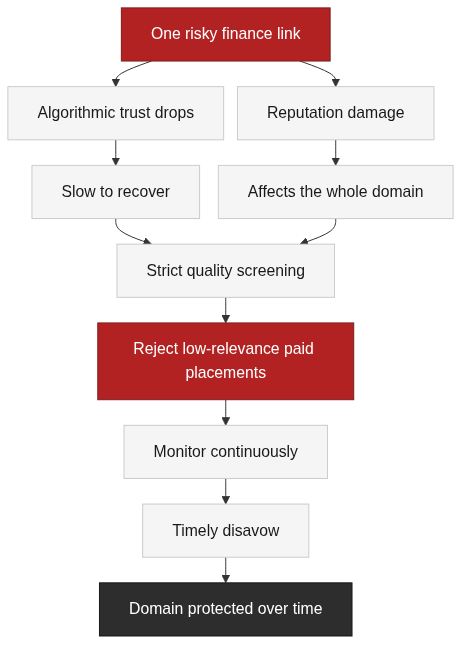
Because finance is YMYL, the cost of a bad placement is high. A link from a site with a history of manipulation, or a link that follows a clear pattern of mass posting, can damage algorithmic trust in a way that is slow to recover. Link building for finance must be treated as risk management, not traffic manipulation.
Strict quality screening rejects low-relevance directories and mass posting
The screening process for finance backlinks is deliberately strict. Low-relevance directories, link farms, and mass-posted placements are rejected because they carry violation signals that outweigh any marginal benefit. When relevance and domain authority conflict, relevance wins — a tradeoff that is decided in favor of the domain’s safety.
Continuous monitoring and timely disavow protect the domain over time
Risk control does not end when a link is placed. Finance domains need ongoing monitoring to catch abnormal links as they appear, and a timely disavow process to neutralize any that slip through. This is what protects the domain across the mature phase of a campaign, when the profile is large enough that a single bad link is easy to miss.
A Trust-First Action Guide for Finance Link Building
The sections above explain the principles. This section turns them into decisions you can make today.
Scenario comparison: finance site versus general site
| Decision dimension | General site (e.g., e-commerce or content) | Finance site (YMYL) |
|---|---|---|
| Core goal | Improve ranking and traffic | Build trust and reputation while earning ranking |
| Relevance weight | Important | Decisive (irrelevant = trust risk) |
| Authority source threshold | Moderate | Very high (financial publications, industry authority) |
| Content asset requirement | Regular content is enough | Original data, expert commentary, or whitepapers |
| Risk tolerance | Relatively high | Extremely low (one risky link can hurt domain trust) |
| Volume vs. quality | Can pursue volume | Quality first, fewer but verifiable links |
| Monitoring frequency | Routine | High-frequency (reputation-sensitive) |
Source-type evaluation for finance scenarios
| Source type | Trust value | Relevance | Acquisition difficulty | Finance fit |
|---|---|---|---|---|
| Authoritative financial media (editorial link) | Very high | Very high | High | First choice, requires Digital PR |
| Finance blogs and analyst sites | High | High | Moderate | Strong supplement |
| Generic high-DA portals and directories | Moderate | Low | Low | Use cautiously; relevance is insufficient |
| Low-relevance directories and mass posting | Very low (harmful) | Low | Very low | Reject; trust risk |
The finance backlink candidate screening checklist
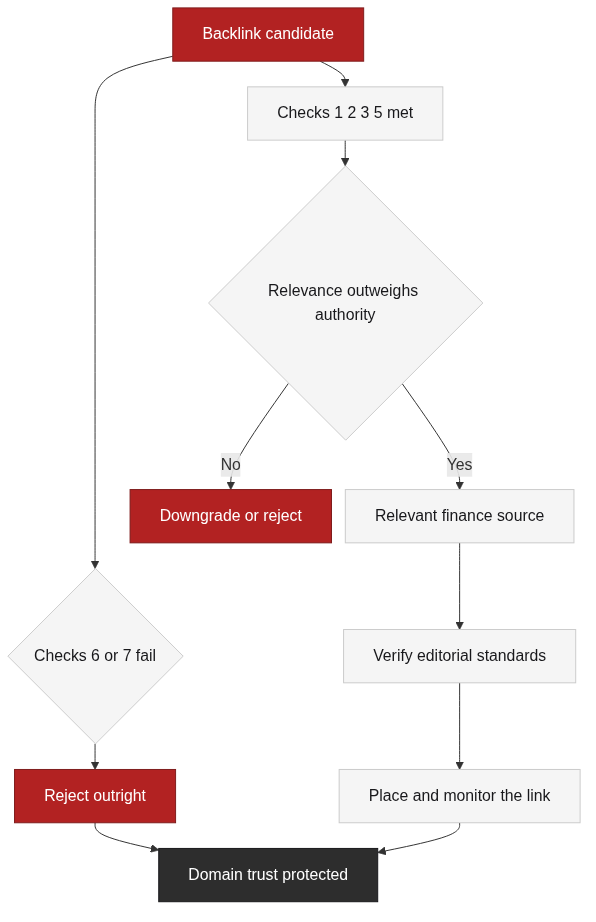
Run every candidate through these eight checks before you place or purchase a link:
If checks 6 or 7 fail, reject the candidate outright. If checks 1, 2, 3, or 5 are not all met, do not use it. For a finance domain, the rule is: when in doubt, leave it out.
- Topical relevance — Is the site or page strongly related to finance, wealth, investment, or regulation?
- Editorial standards — Does the site show clear authorship, sourcing, and a review process?
- Content quality — Is the page original, professional, and verifiable, rather than ad-driven or auto-generated?
- Real audience and reputation — Does the site have a genuine audience and credible reputation, rather than serving as a pure link farm?
- Link context — Is the link naturally embedded in relevant content, rather than an isolated anchor-text stack?
- Violation signals — Does the placement show signs of purchased links, mass posting, or other gray-area patterns?
- Domain history — Has the domain been penalized for manipulative linking in the past?
- Relevance versus authority — Does relevance outweigh domain authority in this decision? A low-relevance high-authority site should be downgraded or rejected.
Strategy selection by business stage
| Business stage | Recommended strategy | Why |
|---|---|---|
| Startup (building authority) | Digital PR + expert commentary + original data | Use content assets to earn authoritative financial media links |
| Growth (expanding coverage) | Finance blogs, analyst sites, whitepaper distribution | Expand credible coverage across relevant domains |
| Mature (defense and maintenance) | Ongoing monitoring + disavow of abnormal links + relationship maintenance | Treat links as a reputation risk to be managed |
Core Takeaways and Your Next Step
Finance link building is quality-first and reputation-first, guided by YMYL, relevance, linkable assets, and risk control. The decisive principle for a high-trust industry is simple: fewer, relevant, verifiable links outperform volume every time.
Recap: finance link building is a trust and reputation exercise
The four pillars of this guide work together. YMYL sets the trust threshold higher, relevance carries the trust, content assets earn the authority links, and risk control protects the domain. Ignore any one of them and the campaign becomes a liability rather than an asset.
The decisive principle: high-trust industries demand quality-first execution
For banks, financial institutions, and financial analysis platforms, the cost of a bad link is too high to justify chasing volume. A strategy that prioritizes a small number of relevant, verifiable, editorially earned links will outperform a strategy that pursues quantity. That is not a compromise; it is the only sustainable path.
Your next step: a compliance-first, content-driven finance link building strategy
High-trust industries need execution that treats domain reputation as the priority. If you are planning a finance link building program, work with a partner that builds linkable assets first, screens every source for relevance and editorial quality, and monitors the profile continuously. A quality-first approach like this is what separates a finance link building program that protects your reputation from one that puts it at risk. Request a consultation on a compliance-first, content-driven finance link building strategy that protects your reputation while it builds your rankings.
FAQ
Conclusion
Finance link building cannot be treated as a volume game. Because finance is a YMYL category, the trust threshold is higher, relevance is the carrier of trust, content assets are the entry ticket to authority links, and risk control is non-negotiable. For banks, financial institutions, and financial analysis platforms, the winning approach is quality-first: fewer, relevant, verifiable links that protect reputation while building rankings. High-trust industries demand exactly this compliance-first, content-driven execution that treats every placement as a reflection of the entire domain. The trust threshold never resets: every new placement is judged against the same YMYL standard. When relevance screening, linkable content, and risk control are part of every decision, quality-first execution protects both reputation and rankings over time.
References
Google Search Quality Rater Guidelines: provides the YMYL definition and the E-E-A-T framework (experience, expertise, authoritativeness, trust) used to assess finance content quality. https://static.googleusercontent.com/media/guidelines.raterhub.com/en//searchqualityevaluatorguidelines.pdf
Google Search Central: Link spam policies: documents the link schemes Google considers manipulative, the basis for rejecting low-relevance directories and mass posting in finance link building. https://developers.google.com/search/docs/essentials/spam-policies
Google Search Central: About links: explains how relevant, authoritative links help pages, the framework behind relevance-weighted screening. https://developers.google.com/search/docs/fundamentals/creating-helpful-content