
Domain Rating vs Domain Authority: What’s the Difference and Which Should You Use?
 Written by Alistair MacLeod

When you’re evaluating a backlink opportunity, it’s tempting to open your favorite SEO tool and ask one question: what’s this site’s DR or DA? That single number feels like a shortcut. But here’s the catch — Domain Rating and Domain Authority both claim to score a site on a 0–100 scale, yet they measure fundamentally different things, and neither one is a score that Google assigns. If you treat either as a ranking guarantee, you’ll make decisions on a metric that was never designed to carry that weight.
This guide breaks down domain rating vs domain authority so you can read both metrics correctly, understand why they diverge, and stop using a single number as a proxy for link quality. The goal is simple: equip you to evaluate a backlink opportunity with multiple signals instead of one headline score.
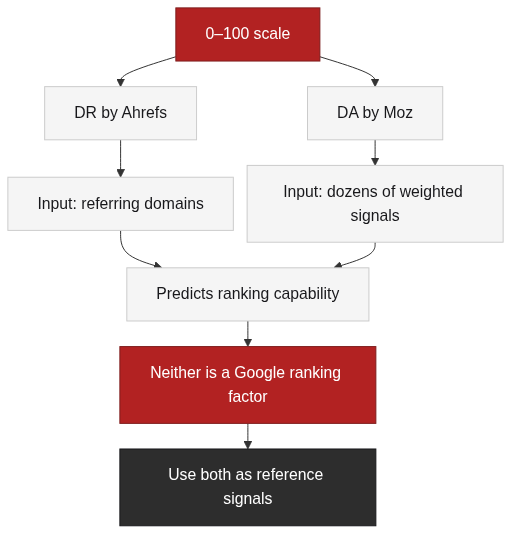
DR vs DA: Two 0–100 Scores That Measure Different Things
The Misconception That Starts Most Evaluations
In practice, when comparing Domain Rating vs Domain Authority, many SEO professionals size up a potential placement by glancing at a score and mentally filing it as “good link” or “skip.” It’s a fast heuristic, and tools encourage it by surfacing DR and DA in every interface. But a high score is not a certificate of quality. It’s an estimate produced by one vendor’s data, computed with one vendor’s assumptions.
The Pain Point in One Sentence
Domain Rating and Domain Authority both use a 0–100 scale, but they measure different things, and neither is a Google-assigned score. DR is Ahrefs’ estimate of the strength of a site’s overall backlink profile, while DA is Moz’s machine-learning prediction of how a site is likely to rank in search results.
What This Guide Covers
Over the next sections, we’ll pull both metrics apart: what each one officially claims to measure, how each is calculated at a high level, why the numbers can’t be compared across tools, and why neither is a Google ranking factor. That foundation leads to a practical framework for judging a backlink opportunity on relevance, traffic, referring domains, and compliance — not on a single scoreboard number.
What Is Ahrefs Domain Rating (DR)?
The Official Definition
Domain Rating (DR) is Ahrefs’ proprietary third-party metric for measuring the strength of a website’s overall backlink profile, expressed on a 0–100 logarithmic scale [1]. It reflects the quantity and quality of links pointing at a site — not its organic traffic, site size, or brand awareness [1]. In Ahrefs’ own metric system, DR is meant to answer a narrow question: how strong is this domain’s backlink profile compared with others in the same dataset [2].
How DR Is Calculated (High Level)
DR is computed from all the backlinks Ahrefs has in its index that point to the target site, using a logarithmic scale [1]. The core inputs are the number and quality of referring domains — how many distinct domains link to the site, and how authoritative those domains are [1][2]. More high-quality referring domains push DR higher, but because the scale is logarithmic, the marginal benefit of each additional link diminishes. That means the jump from 20 to 30 requires far less link equity than the jump from 80 to 90.
The Boundaries of DR
DR is a site-level metric; it doesn’t distinguish between individual pages [1]. It also says nothing about relevance, content quality, or how much real traffic a domain receives [1]. A domain can carry a high DR while being entirely off-topic or while most of its links come from unrelated sources. That’s why Ahrefs treats DR and referring domains as two complementary signals rather than interchangeable ones [2].
What Is Moz Domain Authority (DA)?
The Official Definition
Domain Authority (DA) is Moz’s search engine ranking prediction score, designed to forecast how well a website is likely to rank in search engine results pages (SERPs), also expressed on a 0–100 logarithmic scale [3]. It is not a measure of a site’s actual current rankings; it’s a prediction of ranking capability based on the signals Moz can observe [3].
How DA Is Calculated (High Level)
DA is computed by a machine learning model that Moz trains on multiple real search ranking datasets [4]. The model weighs dozens of link-related signals — among them referring domain counts, MozRank, MozTrust, and the ratio of low-value links — to produce a single composite score [4]. Because it’s a predictive model trained on real-world rankings, DA is best understood as a weighted estimate rather than a direct count of anything.
The Relative and Predictive Nature of DA
Moz is explicit that DA is designed for relative comparison — comparing sites within the same tool, ideally within the same industry or site type — rather than as an absolute quality judgment [4]. Because the underlying link index changes as Moz updates its data, DA can fluctuate as the competitive environment shifts [4]. It also depends entirely on Moz’s own link index, which is another reason the number is only meaningful inside Moz’s ecosystem [4].
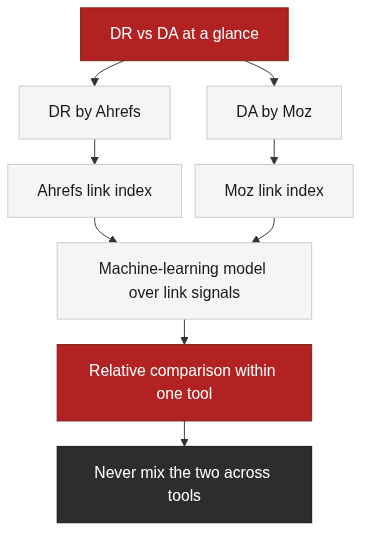
DR vs DA: A Side-by-Side Comparison
Domain Rating vs Domain Authority: Overview Comparison Table
| Comparison Dimension | Ahrefs DR | Moz DA |
|---|---|---|
| Owning tool | Ahrefs | Moz |
| Data source | Ahrefs link index | Moz link index |
| Core inputs | Referring domain count and quality | Machine-learning model over dozens of link signals |
| What it measures | Strength of the backlink profile | Predicted SERP ranking capability |
| Scale | 0–100 logarithmic | 0–100 logarithmic |
| Is it a Google ranking factor? | No (Ahrefs proprietary metric) | No (Moz predictive metric) |
| Best used for | Relative comparison within Ahrefs | Relative comparison within Moz |
| Cross-tool comparison | Not directly comparable | Not directly comparable |
Why You Can’t Compare the Two Across Tools
DR and DA are built by two different companies, on two independent link indexes, with two different algorithms [1][3]. DR is largely driven by referring domain count and quality, while DA is a machine-learning prediction over many weighted signals [1][4]. There is no conversion formula between them. A site with DR 60 won’t necessarily show DA 60 — it could show DA 40 or DA 75, and neither reading is “wrong.” They’re answers to different questions, which is why you should never use one to infer the other.
What the Logarithmic Scale Really Means
Both metrics use a logarithmic scale, and that has a practical consequence: the effort required to move up changes dramatically as you climb [1][3]. Going from 20 to 30 takes far less link equity than going from 80 to 90. The higher a domain climbs, the harder each additional point becomes, and the smaller the marginal return of another link. Reading a score without this context can make a modest domain look weak and an elite domain look ordinary.
The Key Truth: Neither DR Nor DA Is a Google Ranking Factor
The Official Statements
Both vendors are unambiguous on this point. Ahrefs states that DR is its own proprietary metric and is not a ranking factor used by Google — it’s an estimate of backlink profile strength [1]. Moz states that DA is not a metric used by Google or any other search engine; it’s Moz’s own prediction of ranking capability and does not directly determine Google rankings [3]. In other words, the people who made these scores are telling you the scores are estimates, not inputs into Google’s algorithm.
Treat DR and DA as Reference Signals, Not Ranking Guarantees
Once you accept that neither metric feeds Google’s algorithm, the mechanical “DR 50 or above equals a good link” mindset loses its footing. A third-party estimate can be a useful reference signal for relative screening, but it cannot promise ranking outcomes. No single threshold tells you whether a link is worth pursuing, because the value of a link depends on relevance, context, and quality — not on where a domain sits on one vendor’s scale.
Watch for Manipulation and Metric Inflation
Because DR and DA are observable and widely cited, they can become targets. Artificial link acquisition and metric inflation can push a score upward without adding genuine value [1][4]. A domain can look strong on paper while its links come from low-value or unrelated sources. A high score is therefore not proof of a healthy profile — it’s a reason to look closer, not a reason to approve a placement.
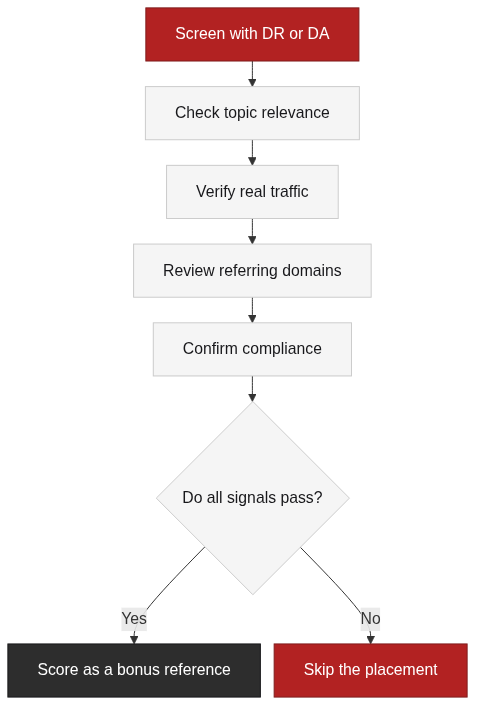
How to Use DR and DA to Evaluate a Backlink Opportunity
Single Metric vs. Multi-Signal Judgment
When you weigh domain rating vs domain authority, the temptation is to let one number decide for you. Relying on DR or DA alone is a single-signal judgment: “high score equals good link.” It’s fast, but it’s also how you end up acquiring links from high-score domains that are irrelevant, low-value, or inflated. A multi-signal approach treats DR or DA as the first-layer screen, then layers on relevance, real traffic, referring domain quality, and compliance before you commit. That’s the difference between treating a third-party estimate as a reference and treating it as a ranking guarantee.
A Multi-Dimensional Backlink Evaluation Checklist
Use this checklist after you’ve screened a domain with DR or DA (using whichever tool you work in — never mixing the two):
- First-layer screen (DR or DA, within one tool). Does the domain fall in the reference range of your industry or competitors? Compare within the same tool and against similar sites — not across tools.
- Relevance (highest weight). Is the site’s topic genuinely related to your content or business? Does the page’s context fit your brand naturally?
- Real traffic. Does the site have verifiable organic traffic? Check the traffic data rather than trusting the score alone, and confirm the audience overlaps with yours.
- Referring domain quality. How many distinct referring domains does the site have, and are they healthy and topical? A profile built on unrelated or low-value domains is a red flag.
- Compliance. Does the placement follow search engine quality guidelines? Content-native placements are preferable to paid directory or link-exchange patterns.
- Decision. If relevance, traffic, referring domain quality, and compliance all pass, treat the DR or DA value as a bonus reference — not a gate. If relevance or traffic is clearly weak, skip the placement even if the score is high.
Scenario Decisions
A single high-quality, relevant link almost always beats a pile of high-DR or high-DA links that have nothing to do with your topic. Reference DR or DA when you need a quick relative screen — “which of these competitors has the stronger backlink profile?” — and drop them when relevance or real traffic fails. When a domain is relevant, has genuine traffic, and a healthy referring domain profile, the score becomes supporting context rather than the deciding factor.
Conclusion: Stop Treating DR and DA as a Scoreboard
The Core Takeaway
Once you understand domain rating vs domain authority, you can see both for what they are: useful first-layer screening signals for relative comparison within their own tools — but they are not Google’s official scores, and they are not the only basis for a decision [1][3]. They estimate backlink strength and ranking capability, respectively, and both are subject to change, fluctuation, and inflation. Reading them correctly means keeping them in their lane: as reference signals, not gates.
What to Do Next
Evaluate every backlink opportunity with multiple standards. Start with DR or DA as a coarse screen in a single tool, then weigh relevance, real traffic, referring domains, and compliance before you commit. When those signals align, a score is a useful confirmation; when they don’t, a high score is not enough to justify a placement.
Put This Framework to Work
If you’re ready to stop evaluating links by a single number and start applying a multi-dimensional standard to every backlink opportunity, we can help you build a compliant, relevance-first link profile. Explore how TraffiClimb evaluates and builds premium backlinks and see how quality, relevance, and sustainable growth come before any single metric.
FAQ
References
Ahrefs Blog · Domain Rating: Official definition of DR, its logarithmic 0–100 scale, referring-domain-based calculation, and the statement that DR is not a Google ranking factor. https://ahrefs.com/blog/domain-rating/
Ahrefs Blog · SEO Metrics: How DR relates to referring domains as complementary metrics and the boundaries of DR as a site-level signal. https://ahrefs.com/blog/seo-metrics/
Moz Learn SEO · Domain Authority: Official definition of DA as a ranking prediction score on a 0–100 logarithmic scale and the statement that it is not a Google metric. https://moz.com/learn/seo/domain-authority
Moz Help · Domain Authority: Details on DA’s machine-learning model, the dozens of weighted link signals, Moz’s own link index, and its relative-comparison nature. https://moz.com/help/guides/moz-pro/domain-authority