
Dofollow vs Nofollow Backlinks: What They Mean for SEO
 Written by Alistair MacLeod

If you have ever run a link audit and seen a row of rel="nofollow" attributes, you have probably had a moment of doubt. Many website owners and SEO newcomers divide backlinks into two simple buckets: “good links” (dofollow) and “useless links” (nofollow). Some even treat a batch of nofollow links as a failed campaign. But this dofollow vs nofollow backlinks framing misses how search engines actually work today.
Take a concrete scenario: an e-commerce site owner just earned 20 backlinks from authoritative news publishers, only to discover every one of them is nofollow. Should they write the links off? The evidence-driven answer is no. Since 2019, Google has treated nofollow, sponsored, and UGC attributes the same way, and since March 2020 it no longer uses nofollow to exclude pages from crawling [1]. In this guide, we break down what the rel attribute really does, how Google processes these attributes, and why a healthy link profile is usually a mix of both.
Why “Dofollow Is Good, Nofollow Is Worthless” Is the Wrong Way to Think
When you evaluate dofollow vs nofollow backlinks, the “dofollow good, nofollow worthless” mindset treats every link as a ranking vote. In practice, a link does several jobs at once: it can drive referral traffic, build brand exposure, get your page discovered and cited, and shape how natural your overall profile looks. A nofollow link from a high-authority news site can deliver far more of those outcomes than a dofollow link from an obscure, unrelated page.
The Counter-Intuitive Hook
Imagine you are the e-commerce site owner above. You spent months earning placements in respected publications. Then your link tool tells you they are all nofollow, and your first instinct is to stop the outreach. That instinct rests on an outdated assumption: that a link is only valuable if it transfers link equity. The reality is more nuanced, and the official documentation has changed the picture.
The Official Evidence Anchor
Google’s stance has shifted in two meaningful ways. First, in September 2019 it introduced rel="sponsored" for paid and affiliate links and rel="ugc" for user-generated content, placing them alongside rel="nofollow" [2]. Second, Google now states it treats all of these attributes the same way and considers them hints about which links to consider or exclude, rather than hard directives [1].
What This Guide Covers
Our goal here is an evidence-driven answer that clears up the real difference between dofollow and nofollow. You will learn what the rel attribute actually does, how Google processes these attributes, how to correctly understand “passing link equity,” and why nofollow backlinks still have real value. Along the way, we will avoid the trap of labeling either type simply “good” or “bad” and instead look at the role each plays.
Dofollow vs Nofollow: What the rel Attribute Actually Does
The entire distinction between dofollow and nofollow lives in a single HTML attribute: rel. Understanding what this attribute does, and what “dofollow” really means, is the foundation for everything else about link building.
Definitions and the HTML Truth
Here is the first thing most guides get subtly wrong: dofollow is not a real HTML attribute. When people say “dofollow link,” they mean a link that has no rel attribute, or whose rel value does not contain nofollow. In other words, dofollow is simply the default state of any link. There is no such thing as rel="dofollow".
| Link type | HTML example | What it signals |
|---|---|---|
| Default (commonly called “dofollow”) | <a href=""> |
No rel value; the default state Example |
| Nofollow | <a href="" rel="nofollow">Example</a> |
Tells Google not to pass link equity |
| Sponsored | <a href="" rel="sponsored">Example</a> |
Paid or affiliate link |
| UGC | <a href="" rel="ugc">Example</a> |
User-generated content |
| Combined | <a href="" rel="nofollow sponsored">Example</a> |
Multiple values, space-separated |
What rel=”nofollow” Officially Means
Google’s documentation defines rel="nofollow" as a way to tell Google not to pass on the link equity that the link would otherwise generate. It is recommended for paid links, content you do not trust, and user-generated content [1]. In plain terms, you are telling Google, “I am linking to this page, but I am not vouching for it with my own authority.”
Where This Fits in Link Building
The rel attribute is one piece of a broader link attribute system. To see how sponsored and UGC attributes work in practice, and how link types fit together, you can explore our guide to Sponsored & UGC links and our overview of the types of backlinks as a follow-up.
How Google Actually Treats These Attributes
Knowing the HTML is one thing; knowing how Google processes it is another. The mechanics matter because they determine what a nofollow link can and cannot do for you.
Hints, Not Directives
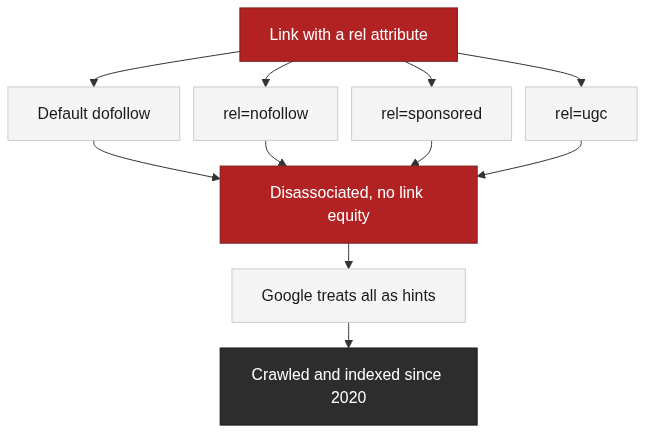
Google’s documentation describes these attributes as “hints about which links to consider or exclude within our search results” [1]. This wording is deliberate. A hint is something Google can weigh and, in some cases, choose to ignore. A directive would be an absolute instruction. Because these are hints, a nofollow link is not a hard veto on your page being considered.
All Three Are Treated the Same Way
Google has explicitly stated that it treats nofollow, sponsored, and UGC the same way [1]. This is a meaningful correction to the old assumption that nofollow is somehow “worse” than the other attributes. In Google’s processing, a sponsored link and a nofollow link are handled equivalently, and UGC is too.
Crawl Behavior Changed in 2020
Before March 2020, Google used nofollow as a signal to exclude pages from crawling. Since March 2020, Google no longer uses nofollow to exclude pages from crawling, which means a page linked to with a nofollow attribute can still be crawled and indexed [1]. This change is why a nofollow link can still help a page get discovered.
Does a Nofollow Link “Pass Link Equity”? The Correct Understanding
The phrase “passes link equity” causes a lot of confusion. The correct way to think about nofollow is not that it “cuts off all value,” but that it disassociates you from the link.
Disassociation, Not Destruction of Value
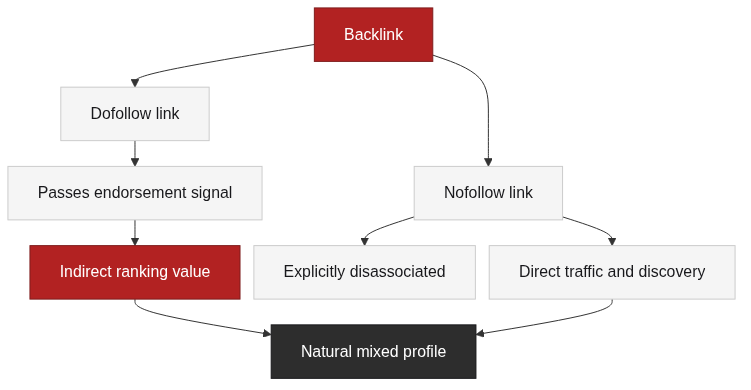
The core function of nofollow is to disassociate the linking page from the linked page. You are saying, “This link should not be treated as my endorsement.” That is very different from saying “this link has no value.” A nofollow link can still send traffic, build visibility, and get your page cited.
The Official Compliance Requirement
Google’s guidelines are clear about when to use nofollow (or sponsored): for paid links, ads, or content you do not trust or cannot vouch for [1]. This is not optional. If you accept payment for a link, or place an affiliate link, you should mark it with the appropriate attribute. Doing so keeps your site aligned with search engine guidelines.
The Right Way to Understand “Passing Link Equity”
When a nofollow link does not pass link equity, it means Google will not treat that link as a signal of your endorsement. It does not mean the page is invisible, worthless, or disconnected from the web. The link can still reach users, and the target page can still be crawled and indexed. Keeping these two ideas separate is the key to a correct mental model.
Dofollow vs Nofollow Backlinks: A Side-by-Side Comparison
To see the practical differences in the dofollow vs nofollow backlinks debate, it helps to put both link types side by side across the dimensions that actually matter.
| Comparison dimension | Dofollow link | Nofollow link (including sponsored/UGC) |
|---|---|---|
| HTML state | Default (no rel, or rel without nofollow) | Explicit rel="nofollow" (or sponsored/UGC) |
| Passes endorsement signal | Yes (Google can use it as a ranking signal) | No (explicitly disassociated) |
| Target page crawled and indexed | Yes | Yes (since March 2020, not excluded from crawling) |
| Google processing | Treated as a signal | Treated as a hint that may be ignored |
| Contribution to organic traffic | Indirect (through rankings) | Direct (clicks) plus indirect |
| Brand exposure / discovery value | Yes | Yes (high-authority nofollow exposure can be higher) |
| Profile naturalness | An all-dofollow profile looks unnatural | A mixed profile matches real ecosystems |
| Typical sources | Natural editorial links, guest posts, resource pages | Comments, forums, social media, paid/affiliate, news articles |
The Conclusion This Comparison Points To
The table makes the point: dofollow and nofollow are not a “good versus bad” relationship. They are different roles. A healthy backlink profile is usually a mix of both, because that is what real websites look like. For a deeper look at how to evaluate your whole profile rather than individual links, see our guide to backlink profiles.
Why a Mixed Profile Is More Natural
Think about any authoritative site you visit. Its outbound links include some it endorses (dofollow), some to paid or sponsored content (sponsored), and some inside comments or forums (UGC or nofollow). A site whose every link is dofollow looks engineered, not natural. A mix signals that links were earned through real editorial decisions.
Why Nofollow Backlinks Still Have Real Value
If nofollow links do not pass link equity, why should you care about them? The answer is that links do more than pass equity, and the other roles are often more valuable.
Traffic and Brand Exposure
A nofollow link on a high-authority site can drive substantial referral traffic and meaningful brand exposure. In many cases, a nofollow link from a leading publication outperforms a dofollow link from a low-authority, irrelevant page in terms of the audience it reaches and the trust it builds.
Discovery and Citation Opportunities
Nofollow links still create opportunities to be discovered and cited. Because Google no longer uses nofollow to exclude pages from crawling, a nofollow link can bring your page to Google’s attention and to the attention of journalists, researchers, and other publishers who may later link to you with a dofollow or editorial link.
A Natural Profile Supports Quality
An all-dofollow profile can look unnatural, and unnatural patterns are exactly what search engine guidelines warn against. A mix of dofollow and nofollow attributes makes your profile look real, which supports the perception that your links were earned organically. This is one reason we emphasize high-quality backlinks as a category rather than a single attribute.
How to Evaluate a Backlink’s rel Attribute in Practice
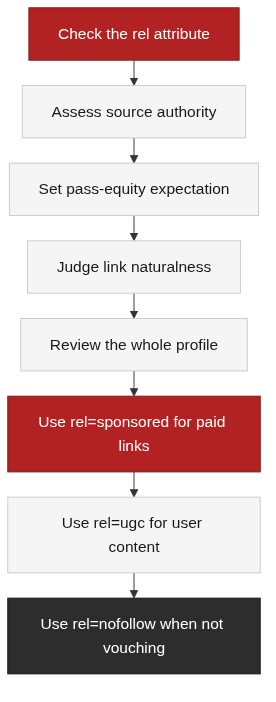
When you receive a backlink, the rel attribute is only the first thing to look at. Here is a practical checklist for deciding what a link means for you.
The Attribute Decision Checklist
- Check the attribute first. Use your browser’s developer tools or an SEO tool such as Ahrefs, SEMrush, or Moz to see the
relvalue (dofollow, nofollow, sponsored, or UGC). - Assess source authority. Is the site relevant to your industry, and does it have real audience and traffic? A high-authority nofollow link can be worth more for exposure than a low-authority dofollow link.
- Set your “pass equity” expectation. If you want a ranking signal, prioritize dofollow. If you want traffic, exposure, or brand, nofollow has value too.
- Judge link naturalness. Was this link earned naturally, or is it paid or user-generated? Paid links must use
rel="sponsored", user-generated content should userel="ugc", and links you do not trust should userel="nofollow"[1]. - Look at the whole profile. Do not evaluate a single link in isolation. Place it in your overall backlink profile to see whether the mix is natural, diverse, and relevant.
The Placement Self-Check for Website Owners
When you are placing or sending outbound links, run this quick checklist:
- [ ] Is this link paid or an ad? → If yes, add
rel="sponsored". - [ ] Is this link from user-generated content (comments, forums)? → If yes, add
rel="ugc". - [ ] Do you trust and vouch for the page it points to? → If not, add
rel="nofollow". - [ ] Do you need more than one attribute? → Combine values with spaces, for example
rel="nofollow sponsored".
When to Prefer Dofollow vs When Nofollow Works Too
If your goal is a ranking signal, dofollow is the attribute you want, because Google can use it as an endorsement. If your goal is traffic, exposure, or brand visibility, nofollow works just as well, and it is often the only option on high-authority platforms. The right choice depends on what the link is meant to do, not on a blanket preference.
Dofollow vs Nofollow: The Bottom Line and What to Do Next
The takeaway is simple: dofollow and nofollow are not a “good versus bad” split. They are different roles in a healthy link ecosystem. A strong backlink profile is usually a mix of both, because that is what real, authoritative websites look like. The attribute tells you about endorsement; it does not tell you everything about a link’s value.
The Core Takeaway
Dofollow links can pass an endorsement signal, which makes them useful for ranking goals. Nofollow links do not pass that signal, but they still deliver traffic, brand exposure, discovery, and citation opportunities. Neither is inherently better. The best strategy is to pursue high-quality links from relevant sources and let the natural mix of attributes follow from real editorial relationships.
What to Do Next
If you want to go deeper, the natural next step is to understand the full link attribute system and how to judge overall link quality. Start with our guide to Sponsored & UGC links to learn when each attribute applies, then move on to high-quality backlinks and backlink profiles to see how individual links fit into the bigger picture. Building a healthy, compliant profile takes strategy and consistency, and that is exactly where a thoughtful link building partner adds the most value.
FAQ
References
Google Search Central — Qualify outbound links to your site: — Official documentation defining rel="nofollow", the hint (not directive) treatment, equal handling of nofollow/sponsored/UGC, and the March 2020 crawl change. https://developers.google.com/search/docs/crawling-indexing/qualify-outbound-links
Google Search Central Blog — Evolving “nofollow” — new ways to identify links: — Official announcement introducing rel="sponsored" and rel="ugc" alongside nofollow in September 2019. https://developers.google.com/search/blog/2019/09/evolving-nofollow-new-ways-to-identify
Google Search Central — Link spam policies: — Official Google guidance on link spam policies, used to distinguish manipulative link patterns from legitimate editorial placement. https://developers.google.com/search/docs/essentials/spam-policies