
Digital PR Tools: How to Build Your Stack for Research, Pitching, Monitoring, and Reporting
 Written by Sanja Gajic

Searching for “digital pr tools” returns dozens of options, from free topic finders to enterprise-grade media monitoring suites that run into five figures a year. Most people’s first instinct is to ask, “Which is the most popular one should I buy?” That is the wrong question to start with. Digital PR is not a one-tool problem. It is a chain of discrete workflow steps, and each step needs a different type of tool. The right way to choose is to break down your workflow first, then pick a “good enough and matched” tool for each step — not to buy the most expensive suite and hunt for a use for it later.
Why “Digital PR Tools” Is the Wrong Question to Start With
The tool-anxiety trap
The market for digital PR tools is crowded. On one end you have free topic finders you can set up in ten minutes; on the other you have global media monitoring platforms with enterprise contracts that stretch into five figures a year. In between sit dozens of journalist databases, outreach sequences, and coverage trackers. When the choice set is that wide, the natural reflex is to default to “the most popular one” or “the biggest suite” — the assumption being that a bigger, more expensive tool must cover more ground.
That assumption usually fails. A single suite tends to be excellent at two or three steps and mediocre at the rest. Buy it for the monitoring engine and you may still be manually building media lists, or exporting coverage into a spreadsheet because the reporting module does not fit how you report to stakeholders.
The real problem: Digital PR is not one tool but nine discrete workflow steps
Digital PR can be broken into nine distinct steps, and each one has its own tool category:
- Topic and news discovery — finding stories worth pitching
- Journalist and media databases — knowing who covers your beat
- Journalist request platforms — where journalists ask for sources
- Data and research sources — building citable data hooks
- Contact discovery — finding and verifying email addresses
- Pitch and outreach — sending and sequencing personalized pitches
- Monitoring — tracking brand mentions and news in real time
- Coverage tracking — collecting and organizing earned coverage
- Reporting — turning coverage into traffic, ranking, and conversion evidence
If you treat these as one market, you will overpay for what you do not use and under-invest in the steps that actually drive results. A team that is stuck at “finding journalists who cover our niche” does not need a new monitoring suite; it needs a better journalist database.
The core claim: selection-first, tool-second
The practical principle this guide is built on: choose tools by first mapping your workflow, then matching a tool to the step where you are stuck. Do not buy a tool because it is famous and then invent a use for it. This selection-first logic is what separates a functional stack from a collection of expensive subscriptions. When you evaluate any digital pr tool, the first question is not “what does it do” but “which of my nine steps is broken right now.”
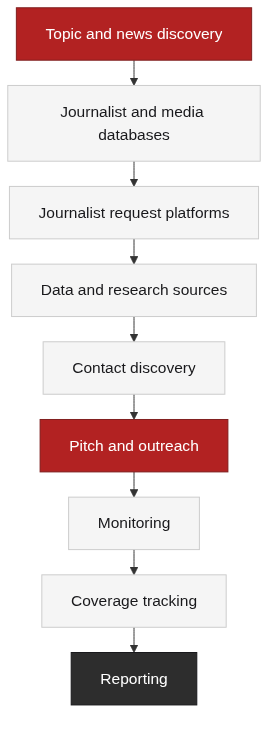
The 9 Workflow Steps of Digital PR — and the Tool Category Each Needs
Map the pipeline first
A healthy digital PR operation runs through the full pipeline: topic and news discovery → journalist databases → journalist request platforms → data and research → contact discovery → pitch and outreach → monitoring → coverage tracking → reporting. Each link feeds the next. A story idea without a journalist database is just a headline; a journalist list without a data hook is a cold email with no reason to be opened.
Why the “one market” view fails
The “digital PR tools” search result treats all of this as a single category, which is why so many buyers end up with one big platform that does a little of everything and a lot of nothing. When you buy a suite for its coverage tracking, you are implicitly accepting that its topic discovery, journalist database, and reporting modules are good enough for your workflow. For many teams that is a false assumption. The result is a stack where the expensive tool is under-used while the step that actually blocks progress has no tool at all.
How to locate yourself
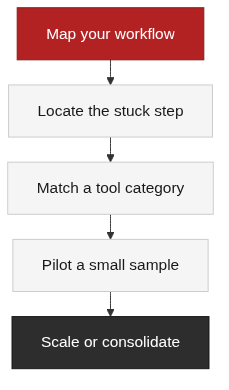
Before you buy anything, identify the step where you are stuck. Ask: Am I struggling to find story angles? To reach the right journalist? To get coverage in the first place? To prove the coverage mattered? The answer tells you which category to evaluate, and that keeps your spending focused. Selection-first, tool-second — this ordering is the single most useful habit you can build when evaluating any digital PR tool.
Tool Categories at a Glance — What Each Does and Who It Serves
Topic and news discovery tools
Topic and news discovery tools help with ideation, newsjacking, and content-gap analysis. Google Trends surfaces search-interest patterns and can reveal rising queries before they go mainstream [1]. AnswerThePublic turns seed keywords into question-based content ideas by grouping search queries around common question stems [2]. Feedly aggregates news feeds so you can spot stories in your niche as they break [3]. Google Alerts is a lightweight, free way to monitor keywords and brand mentions by email [4]. Ahrefs Content Explorer lets you search for content that has already earned backlinks, which is useful for validating a data hook before you pitch it [5]. BuzzSumo surfaces content that has already earned shares and engagement, giving you a signal for what resonates in your niche [6]. NewsWhip helps you gauge which stories are gaining traction fast, which is valuable for reactive PR and newsjacking [7].
What these tools have in common: they are relatively low-cost or free, easy to learn, and they serve the front of the pipeline. If your problem is “I never have a story worth pitching,” this is the category to evaluate first.
Journalist and media databases
Journalist and media databases are where you research who covers your beat, what they have written recently, and how to reach them. Muck Rack is known for journalist-verified profiles that include recent articles and social activity [8]. CisionOne and Meltwater are broader platforms that combine journalist databases with monitoring and outreach [9][10]. Gorkana, Roxhill, and Agility PR are additional options, with coverage strengths that vary by region and industry.
If your problem is “I cannot find the right journalist,” a database is the category that matters most. The trade-off here is usually cost versus coverage: larger databases with global reach and rich profile data tend to sit at the higher end of the cost range.
Journalist request platforms
Journalist request platforms work in reverse: journalists post the questions and source requests they are working on, and you respond with a relevant expert or data point. Qwoted and Featured are among the platforms in this space, and SourceBottle and Terkel offer additional routes into expert roundups and source requests [11][12].
This category has been through a shake-up. The platform once known as HARO was rebranded and then shut down by its parent company, which pushed many teams toward alternatives like Qwoted and Featured. The exact timeline and replacement landscape shift quickly, so the durable lesson is not the specific dates but the pattern: a mainstream digital PR tool can disappear faster than you expect. A request platform is a useful supplement to a journalist database, not a replacement for active pitching.
Data and research sources
Data and research sources provide the citable data hooks that make a digital PR story worth covering. Statista aggregates market data and statistics across many industries [13]. Google Public Data and official government statistics offer free, authoritative datasets. Academic databases and industry reports provide depth for niche topics. Owned data — survey or product data you collect yourself — is often the most differentiated hook, because it cannot be found anywhere else.
The credibility rule for this category: a journalist should be able to trace your number back to an authoritative institution. If a data point cannot be verified, it weakens the pitch rather than strengthening it.
Contact discovery, pitch and outreach, monitoring, and coverage tracking
- Contact discovery — Hunter.io, Apollo, Snov.io, and RocketReach help you find and verify email addresses when a journalist database does not cover the person you need [14]. These tools are useful for filling gaps in your outreach list.
- Pitch and outreach — Pitchbox, BuzzStream, GMass, Mailshake, and JustReachOut handle sending, follow-up sequencing, and workflow management [15]. The important distinction: an outreach tool executes your pitch, but it does not write it. Pitch craft is separate from pitch delivery.
- Monitoring — Meltwater, CisionOne, Muck Rack, Brandwatch, Talkwalker, and Mention track brand mentions and news in real time [10]. If your problem is “I never know when we are mentioned,” this is the category to evaluate.
- Coverage tracking — CoverageBook and Muck Rack help you organize earned coverage into a visual report with screenshots, links, and traffic data [16]. This is the bridge between “we got coverage” and “here is what it was worth.”
- Reporting — Google Analytics 4, Looker Studio, CoverageBook, and BuzzStream reporting modules turn coverage into traffic, ranking, and conversion evidence for stakeholders [16].
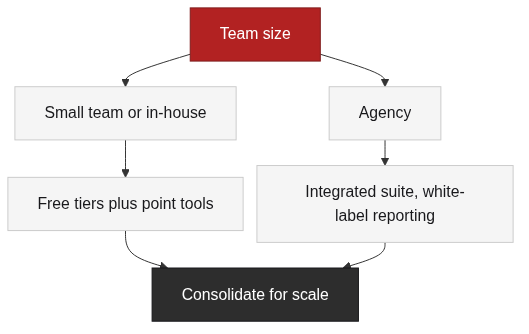
Small Team vs Agency — Two Very Different Ways to Build a Stack
The right stack depends heavily on team size and delivery model. A solo operator and a scaled agency face different constraints, and the comparison matrix below shows why they should not buy the same things.
| Comparison dimension | Small team / In-house (1–3 people) | Agency (scaled delivery) |
|---|---|---|
| Team size and role split | One person wears many hats; tools need a low learning curve and minimal maintenance | Multiple roles; tools need collaboration, permissions, and role-based access |
| Spending capacity | Limited; favors free tiers plus point tools bought as needed | Can absorb an integrated suite; ROI and margin matter more than sticker price |
| Journalist database | Free or entry-level database plus a request platform may be enough | Full-scale database with bulk media-list delivery |
| Monitoring and coverage tracking | Free monitoring plus manual or lightweight reporting | Real-time monitoring plus white-label visual coverage reports |
| Reporting handoff | Simple traffic and coverage-screenshot summaries | Client-facing, multi-dimensional ROI reports (traffic + ranking + conversion) |
| Outreach scale | Low volume, high personalization, manual or light outreach tools | Bulk outreach with sequences and compliance management |
| Selection bias | Point tools stacked as needed | Integrated suite with white-label and scaling capability |
Small team / in-house
If you are a one-to-three-person team, your priorities are a low learning curve, minimal maintenance, and free tiers that cover real workload. You are better off stacking a small number of point tools — a free topic finder, an entry-level journalist database or a request platform, a lightweight outreach tool, and free monitoring — than committing to an enterprise suite you will not fully use. Add tools one at a time, only when a specific step starts to block progress.
Agency
If you deliver digital PR at scale, you need an integrated suite with white-label capability, collaboration and permissions, and client-facing reporting. Your clients expect you to show ROI across traffic, ranking, and conversion, not just a list of links. A suite that consolidates journalist database, monitoring, coverage tracking, and reporting into one workflow saves your team hours per campaign and makes the reporting handoff clean. The trade-off is cost and learning time, which scale teams can absorb.
The Shifting Tool Market — Why Platform Stability Matters
The request-platform shutdown as a case study
The journalist request platform that many teams relied on for years was rebranded and then shut down by its parent company, disrupting outreach workflows across the industry. The exact timeline and the replacement landscape shift quickly, so the durable takeaway is not the specific dates but the pattern: a mainstream digital PR tool can disappear faster than you expect. That is why platform stability has become a first-class selection criterion rather than a footnote.
Selection implications
This should change how you evaluate tools. When you compare options in any category, look at platform stability and alternatives rather than betting the whole strategy on a single tool. Check whether the product is still actively maintained, whether the pricing page is current, and whether there is an obvious successor if the platform were to close. Diversify where the risk is highest — especially in journalist request platforms, where the market has already proven volatile.
The tools ≠ strategy principle
The most expensive suite cannot replace ideation, data hooks, journalist relationships, and pitch craft. A tool executes a workflow; it does not create the story, the data, or the relationship. If you have no citable data hook and no understanding of the journalist’s beat, no outreach platform will save the pitch. Keep this in mind whenever you are tempted to solve a strategy problem by buying another subscription.
A Practical Checklist to Choose Your Digital PR Tool Stack
The 8-step pre-purchase checklist
Work through these steps before you commit to any digital PR tool:
- Break down your workflow — split your current project into the nine steps and mark where you are stuck (topic? finding journalists? reverse requests? outreach? monitoring? reporting?).
- Define the gap — decide whether that step has no tool at all (then buy) or a tool that is not working (then switch). Do not buy a new tool when the problem is how you use the existing one.
- Set spending and scale — identify whether you are a small team or an agency, then use the comparison matrix above to set a realistic cost ceiling and scaling requirement.
- Verify tool survivability — check the vendor’s site to confirm the product is still operating, the pricing page is accessible, and there has been recent activity or announcements. Avoid betting on a platform that looks dormant.
- Check the free tier against real workload — confirm the free tier actually covers the volume you need, so you do not fall into a “free trial then sudden charge” situation.
- Validate data credibility — for data and research tools, confirm the source can be traced to an authoritative institution and that a journalist can cite it directly.
- Run a compliance check — for outreach tools, confirm the sending practices align with the expectations set by regulations such as CAN-SPAM and GDPR. The specific rules change by jurisdiction, so verify against the current requirements where you operate.
- Pilot a small sample — run a small test through the full “tool → coverage → report” loop before you scale up or upgrade the plan.
Recommended starter stacks
For a small team, a lean starter stack might look like: a free topic finder (Google Trends or Feedly) for ideation [1][3], a journalist request platform plus an entry-level database for reaching journalists [11][8], a lightweight outreach tool for sending [15], free monitoring, and a simple reporting setup with GA4 and Looker Studio or a coverage screenshot tool [16].
For an agency, the priority shifts to consolidation: an integrated platform that combines journalist database, monitoring, and coverage tracking, plus white-label reporting, and bulk outreach with sequence and compliance management. The goal is fewer tools doing more, with clean client-facing reporting.
When to stop adding tools — and when a strategic partner beats another subscription
There is a point of diminishing returns where every additional tool adds more maintenance than value. If you find yourself managing five tools that all do the same thing, or paying for a suite you barely open, stop adding and start consolidating. And when the bottleneck is not tooling but strategy — no data hook, no journalist relationships, no pitch craft — another subscription will not fix it. That is the moment to consider an external strategic partner who can handle the execution and strategy together, rather than another line item in your cost plan.
Core Takeaway and Your Next Step
Recap
Choose digital PR tools by workflow step, not by a “best tools” list. Match the stack to your team size — lean and point-based for small teams, integrated and white-label for agencies. And treat tools as execution, not strategy: the tool runs the process, but the story, the data, and the journalist relationship are what win coverage.
A reusable decision checklist
Keep the 8-step checklist above as a reference you return to whenever you evaluate any future digital PR tool. Break down the workflow, define the gap, set spending and scale, verify survivability, check the free tier, validate data credibility, run a compliance check, and pilot a small sample. It works for a monitoring suite just as well as it works for a journalist database.
Your next step
A well-chosen tool stack makes execution faster, but it does not replace the strategy that turns coverage into sustainable, measurable growth. If you want to align your tool choices with a strategy built around compliant, content-driven, high-quality placements, book a consultation to talk through your workflow. We can help you identify the step that is actually holding you back — and build a plan that makes every tool in your stack earn its place. You can also read our Digital PR pillar and media pitch examples to see how the strategy side connects to the tools you choose.
FAQ
References
Google Trends: provides free search-interest and rising-query data used for topic discovery and newsjacking https://trends.google.com
AnswerThePublic: groups search queries around question stems to generate content ideas https://answerthepublic.com
Feedly: aggregates news feeds so teams can spot niche stories as they break https://feedly.com
Google Alerts: provides lightweight, free keyword and brand-mention monitoring by email https://www.google.com/alerts
Ahrefs Content Explorer: searches for content that has already earned backlinks to validate data hooks https://ahrefs.com/content-explorer
BuzzSumo: surfaces content with high shares and engagement for content-gap analysis https://buzzsumo.com
NewsWhip: tracks which stories are gaining traction fast for reactive PR and newsjacking https://www.newswhip.com
Muck Rack: provides journalist-verified profiles, recent articles, and media list building https://muckrack.com
CisionOne: combines journalist database, monitoring, and outreach in one platform https://www.cisionone.com
Meltwater: provides media monitoring and journalist database functionality https://www.meltwater.com
Qwoted: a journalist request platform for reverse pitching and source requests https://qwoted.com
Featured: a journalist request platform for expert roundups and source requests https://www.featured.com
Statista: aggregates market data and statistics across industries for citable data hooks https://www.statista.com
Hunter.io: finds and verifies email addresses for contact discovery https://hunter.io
BuzzStream: provides outreach workflow, sequencing, and reporting https://www.buzzstream.com
CoverageBook: turns earned coverage into visual reports with screenshots, links, and traffic data https://coveragebook.com