
Crypto Link Building: Strategies, Challenges, and Safer Approaches for Crypto Websites
 Written by Warren Reed

Crypto link building is harder than it looks — and the difficulty is not technical. On most sites, more links means more upside. On crypto and blockchain sites, more links can mean more asymmetric downside, because every new link is a new association that a quality rater, an algorithm, or a cautious reader can evaluate. This guide is written for crypto website owners, in-house SEO teams, and agencies who already understand the basics of backlinks and now need to judge which opportunities are worth pursuing and which ones carry hidden risk.
This is a risk-aware industry guide, not a “where to buy crypto backlinks” page. It does not list vendors, it does not promise rankings, and it does not sell placements. What it does is give you a framework for deciding whether a crypto backlink opportunity deserves your brand’s name next to it.
Why Crypto Link Building Is Harder Than It Looks
The counterintuitive reality of crypto link building is that the usual playbook — acquire more links, faster — is exactly the playbook that carries the most risk in this niche. Crypto sites sit in a category where Google applies above-average scrutiny, where paid advertising is often restricted, and where a single bad association can undo months of careful work.
The counterintuitive reality: more links, more asymmetric risk
In a typical industry, a low-quality link is mostly a wasted opportunity. In crypto, it can be a liability. The reason is that crypto content is evaluated against trust standards that assume the reader may be making a financial decision based on what they read. When you attach your domain to a network of low-quality sites, you are not just failing to gain authority — you are actively diluting the trust signals you have spent time building.
The asymmetry shows up in the numbers as well as the rankings. The crypto sector’s public trust baseline is shaped by recurring, high-profile security failures, which raises the bar for every brand operating in it. Any link strategy that ignores this context is optimizing for the wrong metric.
YMYL, restricted paid ads, and a SERP dominated by exchanges and top media
Crypto content falls into Google’s YMYL (“Your Money or Your Life”) category, which covers topics that can affect a reader’s financial well-being. Google’s Search Quality Rater Guidelines treat financial topics as requiring a higher level of demonstrable expertise and trustworthiness than most other verticals [3]. That single classification changes the calculus for link building: trust and relevance carry more weight than volume.
At the same time, crypto advertisers often face restrictions on paid channels, which means organic visibility frequently has to carry more of the load than it would for a mainstream brand [4]. And the SERPs themselves are crowded — established exchanges, large media outlets, and long-running information sites occupy the top positions and rarely give them up easily [7].
What this guide is (and is not)
This guide is a decision-making framework. It is built around three questions you should be able to answer for every link opportunity:
- Does this placement genuinely relate to crypto, blockchain, or an adjacent finance topic?
- Is the publisher editorially independent, or is it a paid network wearing an editorial costume?
- If a human reviewer looked at this link, could you explain why it exists?
It is not a tutorial on crypto SEO as a whole, a list of sites to buy links from, or a promise that any specific tactic will move rankings. Link building does not guarantee rankings — correlation is not causation, and reputable research has repeatedly shown that links from higher-traffic domains do not automatically translate into higher positions [5][6].
What Makes Crypto and Blockchain Sites Different
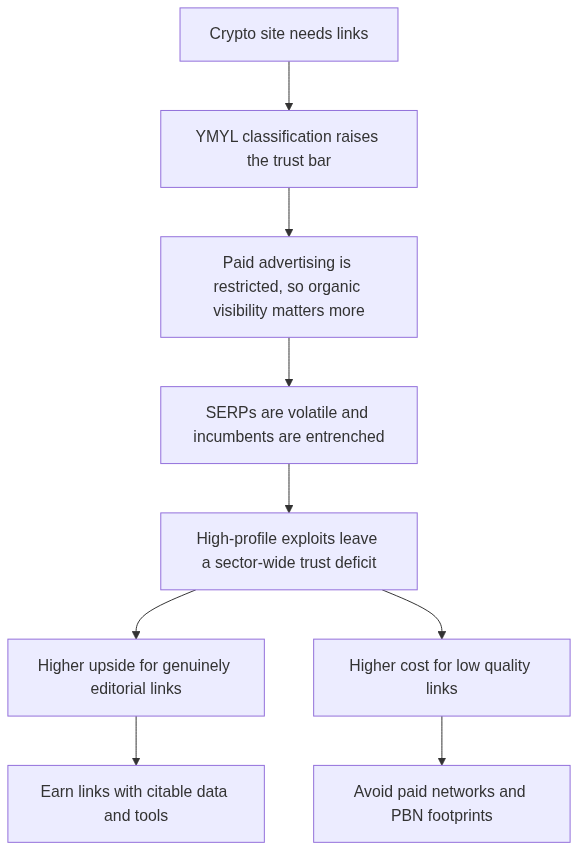
Crypto and blockchain sites operate under a different set of rules than a recipe blog or a gardening site. Four differences matter most for link building: content classification, advertising restrictions, SERP volatility, and a persistent trust deficit.
YMYL classification and why trust signals carry more weight here
Because crypto content can influence financial decisions, Google’s quality framework holds it to a higher standard of expertise, authoritativeness, and trustworthiness [3]. In practice, that means a link from a well-known but irrelevant site is worth less than a link from a smaller but genuinely topical and editorially credible publisher. It also means that the context of a link — the surrounding paragraph, the author, the publication’s track record — matters more than a single authority metric.
Restricted paid advertising and the resulting dependence on organic visibility
Many crypto brands cannot rely on paid search and social the way mainstream brands can, because advertising policies in the category are frequently restricted [4]. When paid channels are constrained, organic search and earned media become the primary growth surfaces. That raises the stakes on every link decision: you cannot simply buy your way back into visibility if organic performance slips.
Volatile SERPs, entrenched incumbents, and the trust deficit after high-profile exploits
Crypto SERPs move quickly. Narratives shift, new projects appear, and rankings that looked stable can reorganize around market sentiment [4]. On top of that volatility, the incumbents — exchanges and major media — hold the head terms, making them expensive and slow to displace [7]. And the sector’s trust deficit is real: repeated, high-profile security incidents keep public and algorithmic scrutiny high, which means the reputational cost of a bad link is higher here than in most industries.
The practical conclusion is that crypto link building should be optimized for trust and relevance, not raw link count.
Industry Trust, Publisher Quality, and Reputation Risk
A high DR number and a “crypto” tag are not evidence of link quality. They are inputs that can be gamed, misread, or simply misunderstood. The useful question is not “how strong is this site’s metric?” but “what does this link actually do for my brand?”
Why high DR and a “crypto” niche tag do not prove link quality
Domain Rating and similar metrics are third-party estimates of a site’s backlink profile strength. They are useful for triage, but they are not a quality guarantee, and they can be inflated by the same manipulative patterns that Google’s spam policies are designed to catch [1]. A “crypto” niche tag is even weaker evidence: it is a categorization, not a statement about editorial independence. A site can carry a crypto label and still be a paid placement network with no editorial standards.
The four jobs of a high-quality backlink
A genuinely valuable backlink does four things at once: it passes some authority, it sends real referral traffic from a real audience, it places your brand in an editorial context that AI systems can learn from, and it builds trust with readers encountering your brand for the first time. When you evaluate an opportunity, ask which of these four jobs it can actually perform. A link that does none of them is not a link — it is a liability with a price tag.
How low-quality associations can dilute YMYL trust signals
In a YMYL space, associations are cumulative. Every low-quality site you appear alongside becomes part of the pattern a reviewer or algorithm can observe. Because crypto already operates under elevated scrutiny [3], the marginal cost of a bad association is higher than it would be for a non-YMYL site. This is why the risk dimension of evaluation matters as much as relevance and authority.
Which Pages and Assets Are Worth Earning Links For
The most durable crypto link building does not start with outreach lists. It starts with assets that people want to reference. If you build something genuinely useful, links follow without a request.
Linkable assets that earn links without outreach
Certain content types attract links naturally because other people need to cite them:
- Original data and research — surveys, on-chain analyses, or market studies that journalists and bloggers can quote.
- Tools and calculators — anything that saves a reader time, such as staking or fee calculators.
- Definitive guides — comprehensive, well-maintained explainers on a specific topic.
- Citable statistics — clean, dated, sourced numbers that others can reference.
- Expert commentary — named, credentialed perspectives that reporters can attribute.
These formats work because they give a publisher a reason to link that has nothing to do with your outreach email.
Content-driven methods: Digital PR, data stories, expert commentary, industry publications, partnerships
For crypto specifically, the methods that tend to hold up over time are content-driven rather than transactional:
- Digital PR built around original research and data stories, which can earn editorial links from relevant outlets [7].
- Expert commentary offered to journalists covering the sector, which builds both links and brand recognition.
- Industry publications that accept genuinely useful contributions on merit rather than payment.
- Partnerships with complementary projects, where the link is a byproduct of a real relationship.
Why these approaches are more sustainable than paid link acquisition in a YMYL space
Paid acquisition is a recurring cost with a recurring risk. Content-driven methods compound: an asset keeps earning links for years, and the relationships behind it keep producing opportunities. In a space where trust is the scarce resource [3][7], building assets and relationships aligns your link profile with the signals that actually matter, instead of renting visibility that can be withdrawn at any time.
Competitor Backlink Research for Crypto Sites
Competitor backlink research is a starting point, not a shopping list. The goal is to understand where your competitors earn links and which of those sources would be legitimate for you — then to filter out everything that would not survive scrutiny.
Using Ahrefs and SEMrush for competitor backlink and content gap analysis
Tools like Ahrefs and SEMrush are the industry standard for this work, offering backlink analysis, referring-domain data, and content gap analysis that shows where competitors rank and you do not [8]. A practical sequence:
- Pull your top three to five organic competitors.
- Export their referring domains and sort by relevance, not just authority.
- Run a content gap analysis to find topics competitors cover that you don’t.
- Cross-reference the two: which competitor topics also attract links?
Filtering out competitors’ paid and low-quality sources before you copy them
This is the step most teams skip. A competitor’s backlink profile is not a quality endorsement — it may contain paid placements, private blog networks, or low-quality crypto sites that the competitor acquired and that you should avoid entirely. Before adding any source to your own list, run it through the same three-dimension filter described below. If you cannot tell whether a competitor’s link was earned or paid, treat it as unverified.
Turning competitor gaps into your own linkable-asset roadmap
The output of good competitor research is not a list of URLs to target. It is a prioritized roadmap of assets to build. If competitors consistently earn links for original data, build original data. If they win citations for a tool, build a better tool. The research tells you where the demand for linkable content already exists — your job is to supply it.
How to Evaluate a Crypto Backlink Opportunity
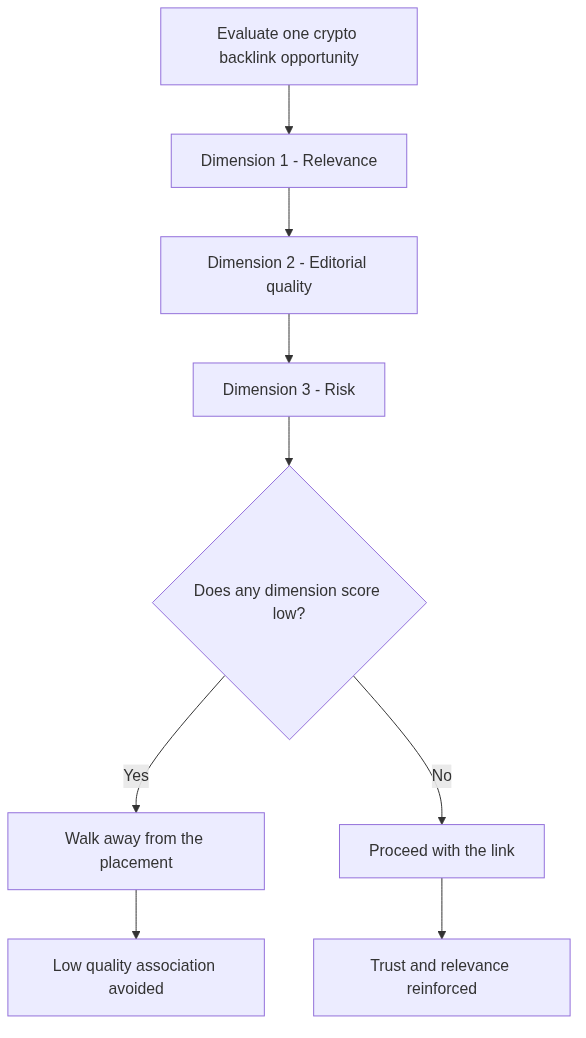
Every crypto backlink opportunity should be scored on three dimensions: relevance, editorial quality, and risk. A single “low” in any dimension is a reason to walk away, regardless of how attractive the other two look.
The three-dimension model: Relevance, Editorial Quality, Risk
| Dimension | What to check | Strong signal | Weak signal |
|---|---|---|---|
| Relevance | Does the site/page genuinely cover crypto, blockchain, or adjacent finance? Is the link in a natural sentence? Does the page already have organic traffic and real readers? | Topical site, contextual link, existing traffic | Unrelated site, forced anchor, no organic visibility |
| Editorial Quality | Is the publisher editorially independent (not a paid network)? Are pieces authored and reviewed? Will they accept an editorial “no”? | Named authors, review process, editorial independence | Anonymous posts, no review, pay-to-publish only |
| Risk | Any undisclosed paid placement, link farm, or PBN footprint? Any association with known spam or penalized sites? Could you justify the link under review? | Clean, explainable, earned | Hidden payment, network patterns, unexplainable |
This model maps closely to how experienced practitioners evaluate links generally — publisher legitimacy, topical relevance, link context, disclosure, and acquisition risk [9].
Common risk sources: paid placements, private blog networks, low-quality crypto sites, link farms
The recurring risk sources in this niche are well documented:
- Undisclosed paid placements — links bought without disclosure, which can fall under Google’s link spam policies [1].
- Private blog networks (PBNs) — networks of controlled sites built to pass ranking signals.
- Low-quality crypto sites — sites that exist mainly to host sponsored posts, with no real audience.
- Link farms and irrelevant directories — bulk, template-driven link sources.
Google’s spam policies explicitly target link schemes and the broader manipulation patterns that surround them, and the March 2024 update added scaled content abuse and site reputation abuse to the list of practices that can trigger action [1][2]. These are not theoretical risks.
The decision rule: any single “low” means walk away
The discipline that separates a durable crypto link profile from a fragile one is a simple rule: if any of the three dimensions scores low, decline the opportunity. A high-authority site with a hidden payment is still a high-risk link. A perfectly clean site with no topical relevance will not move the needle. And a relevant, clean-looking site with a PBN footprint is a liability waiting to be discovered. No single metric — not DR, not a niche tag, not a competitor’s example — overrides this rule.
Practice Guide: Scene Comparison and Pre-Placement Checklist
This section turns the framework into something you can use in the next ten minutes. It compares three common crypto link opportunities and gives you a checklist to run before accepting or sending any link.
Comparing three typical crypto link opportunities
| Dimension | Editorial Digital PR link | Paid guest post / placement | PBN / low-quality crypto site |
|---|---|---|---|
| Source nature | Real, editorially independent publication | Paid network, weak editorial independence | Controlled private network or spam site |
| Policy compliance | Compliant (naturally earned editorial link) | High risk, may constitute a link scheme | Clearly violates link spam policy |
| Relevance / context | High (contextual, in-sentence) | Medium (often forced context) | Low (bulk, templated) |
| Reputation / trust impact | Positive (strengthens YMYL trust) | Neutral to negative | Negative (can invite demotion) |
| Sustainability | High (long-term compounding) | Low (depends on continued payment) | Very low (can be wiped out at any time) |
| Suitable stage | Any stage | Cautious, case-by-case risk control | Not recommended |
| Primary risk | Slow output, requires real assets | Manual actions / algorithmic demotion | Manual actions, whole-site removal |
Matching your scenario to a recommended path
| Scenario | Recommended path | Avoid |
|---|---|---|
| New crypto project (low trust baseline) | Build linkable assets + genuine expert commentary; earn editorial links gradually | Bulk-buying crypto backlinks for volume |
| Mature project with data or a product | Digital PR data stories + tier-1 industry media | Relying on paid placement networks |
| Exchange / highly competitive niche | Original research + partnerships + brand-mention building | PBNs, low-quality niche sites |
| Agency procuring for clients | Case-by-case three-dimension risk control + editorial independence verification | Delivering “high-DR crypto lists” as a package |
Pre-placement checklist before you accept or send any link
- [ ] Does the opportunity pass the Relevance / Editorial / Risk three-dimension review?
- [ ] Was the link earned editorially, rather than paid and undisclosed?
- [ ] Does the host page already have organic traffic and a real audience?
- [ ] Is the anchor text natural and not over-optimized?
- [ ] Is the site free of any known PBN or spam-network association?
- [ ] If a human reviewer examined this link, could you clearly explain where it came from?
- [ ] Does this link serve long-term trust, rather than a short-term ranking fluctuation?
Building a More Sustainable Link Building Approach
The most resilient crypto link building strategy is not a better list of sites. It is a shift in what you are actually trying to build.
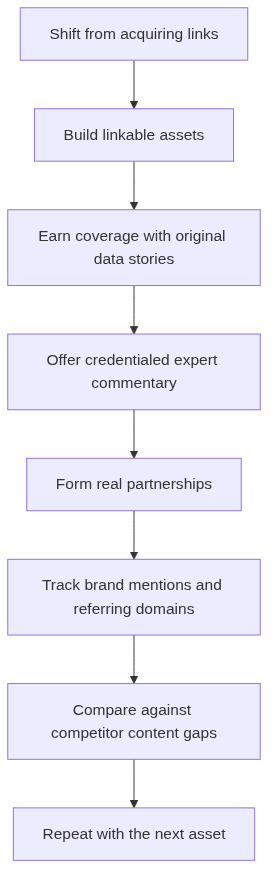
Shifting from “acquiring links” to “building linkable assets + relationships + brand mentions”
Instead of asking “how many links can we get this quarter?”, ask “what would make someone want to link to us without being asked?” That reframing moves your effort toward original research, useful tools, credible expert voices, and real partnerships. It also aligns with how discovery is evolving: as AI systems become another surface for finding brands, brand mentions and citations matter alongside classic backlinks [4][7].
Core takeaways and the questions to ask before your next crypto link decision
- Crypto content is YMYL, so trust and relevance outweigh volume [3].
- High DR and a “crypto” tag are not proof of quality [1][9].
- Judge every opportunity on relevance, editorial quality, and risk — and walk away if any one is low.
- Prefer content-driven methods (Digital PR, data stories, expert commentary, partnerships) over paid acquisition [7].
- Use competitor research to find asset opportunities, not to copy sources blindly [8].
- Remember that links correlate with rankings but do not guarantee them [5][6].
Next step: learn more about compliant, content-driven link building
If you want to go deeper into compliant, content-driven link building — the kind that prioritizes relevance, editorial quality, and long-term trust over volume — you can explore how TraffiClimb approaches premium link building. Every placement follows search engine guidelines, and the emphasis is on sustainable growth rather than short-term spikes. For crypto sites in particular, the safer path is the slower path: build assets worth citing, earn links on merit, and let trust compound.
FAQ
References
Google Search Central — Spam Policies for Google Web Search — Provides Google’s official definition of link spam and the practices that can lead to ranking demotion or removal.
Google Search Central Blog — March 2024 Core Update and New Spam Policies — Documents the introduction of scaled content abuse and site reputation abuse policies.
Google Search Quality Rater Guidelines (PDF) — Defines YMYL topics and the elevated expertise and trustworthiness standards applied to financial content.
Orbink — Crypto SEO: Link Building for DeFi & Web3 — Describes the four crypto-specific SEO hurdles: YMYL classification, advertising restrictions, publisher scarcity, and volatility.
Ahrefs — Do Links From Pages With Traffic Help You Rank Higher? — Shows that links from higher-traffic domains do not automatically translate into higher rankings.
Moz — Links and Brand as Ranking Factors: 2021 Correlation Study — Establishes that links correlate with rankings but do not prove causation.
AInvest — US Crypto Policy Shift Demands High-Authority Link Building — Explains why crypto link building requires high-authority, relevant sites and content-driven methods such as linkable assets and digital PR.
Meltwater — Best Competitor Analysis Tools for Marketers — Confirms Ahrefs and SEMrush as standard tools for backlink analysis and content gap research.
Editorial Backlinks — How to Evaluate Backlink Quality — Provides an evaluation framework covering publisher legitimacy, topical relevance, link context, disclosure, and acquisition risk.