
Black Hat Link Building: Common Tactics, Risks, and Why They Backfire
 Written by Alistair MacLeod

Every SEO professional has faced the same temptation. A keyword you care about is stuck. A vendor promises “100 high-quality links, visible results in two weeks, at a price that’s hard to refuse.” Before you say yes, you need a clear picture of what black hat link building actually is, why some of it appears to work for a while, and why the long-term cost almost always outweighs the short-term gain.
This guide is not a manual. It won’t teach you how to build black hat backlinks. Instead, it helps you recognize these tactics at the behavioral level, measure their real cost, and choose a sustainable alternative that protects both your rankings and your brand.
Why Black Hat Link Building Still Looks Tempting
In black hat link building, the risk profile changes the moment a tactic stops serving readers.
The concrete decision that pulls people in
Imagine this: you’ve been pushing a competitive keyword for months with little movement. A link-building vendor walks in with a polished pitch — a fixed number of “high-authority” links, a fast timeline, and a price that fits easily into your spend. The pitch is designed to sound like a shortcut, and in a moment of frustration, it’s easy to talk yourself into “trying it once.”
That moment is exactly where most risky decisions start. Not because the tactic is obviously bad, but because the alternative — patient, compliant link building — feels slow by comparison.
The core judgment: short-term effect does not equal long-term safety
Here is the central idea to hold onto: short-term effectiveness does not equal long-term safety. Many seemingly clever shortcuts are, in fact, the most expensive trade-offs you can make for your rankings and your brand.
Search engines evaluate links with a probability-based judgment. A newly placed link can influence rankings before it is fully reassessed — that gap creates the illusion of a “working” shortcut. But what works today can be systematically reversed the moment an algorithm update re-evaluates the same signal.
What this article will and won’t do
Let’s be clear about scope. This article will not walk you through how to execute black hat link building strategies. It will help you do three things: recognize manipulative tactics at the behavioral level, weigh their real and lasting cost, and find a sustainable path forward. If you need the operational details of a specific method, that belongs to a different conversation — not this guide.
What Is Black Hat Link Building? The Manipulation Test
A working definition
Black hat link building refers to link acquisition practices that aim to manipulate search engine rankings and that violate a search engine’s link policies. The defining feature is not the technique itself — it is the intent to game the ranking system rather than earn a link through genuine user or editorial value.
The three-part judgment, not a memorized label
Instead of memorizing a list of “forbidden” terms, use a three-part test to evaluate any link strategy:
- Intent: Is the purpose to genuinely help users and readers, or is it purely to inflate rankings?
- Method: Are you deliberately trying to avoid detection — hidden links, disguised anchor text, controlled source fingerprints?
- Editorial reality: Does the link reflect a real user or editor recommendation, or was it manufactured for ranking purposes?
If the answer to all three points toward manipulation, you are looking at black hat behavior — regardless of what the vendor calls it.
White, grey, and black at a glance
The line between these categories is not always crisp, but the intent and risk profile differ meaningfully:
| Dimension | White Hat | Grey Hat | Black Hat |
|---|---|---|---|
| Core intent | Create value for users; earn editorial recommendation | Explore the edge of compliance; intent is ambiguous | Manipulate rankings; work around the rules |
| Typical behavior | Quality content, genuine guest posts, Digital PR | Large but relevant link volume, unlabeled sponsored content | Private blog networks, link farms, automated links, disguised paid links |
| Violates link policy? | No | Grey zone; risk is uncertain | Yes, clearly |
| Long-term risk | Very low | Medium (rises as algorithms tighten) | High — algorithmic, manual, and reputational risk combined |
| Sustainability | High | Medium | Low — it eventually backfires |
9 Common Black Hat Tactics You Should Recognize
These are the tactics you are most likely to encounter. For each one, the goal is recognition, not replication. The operational details of private blog networks, link exchanges, and paid link procurement are covered elsewhere — here we focus on how to spot them and why they count as manipulation.
Private blog networks and link farms
A private blog network (PBN) is a group of sites controlled by one owner, built primarily to pass links to a target site. A link farm is a collection of low-value pages created for the same purpose. Both share a common fingerprint problem: the same IP, the same content management system, the same registration details, or a cluster of sites on a single theme can expose the network.
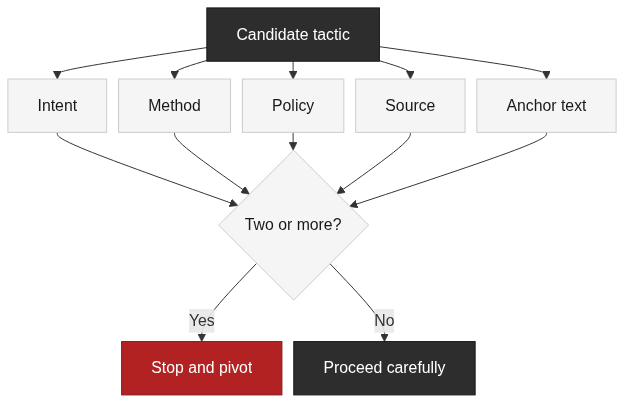
Why it’s manipulation: the links are not editorial recommendations — they are manufactured by the site owner to control ranking signals. Typical risk: if the network is identified, the value of every link in it can be neutralized at once.
Excessive link exchanges and automated links
Link exchanges are not inherently wrong, but they become manipulative at scale. When sites trade links purely to inflate metrics, with little regard for relevance, the pattern looks mechanical. Automated links take this further: software that places links across many sites in bulk, often with the same anchor text and the same footprint.
Why it’s manipulation: the scale and automation remove any editorial judgment. Typical risk: the pattern is easy to spot because of its uniformity.
Spam comments, forum spam, and manipulative guest posting
Comment spam and forum spam are the oldest forms of link manipulation — posting low-value comments or forum replies that carry a link and nothing else. Manipulative guest posting is subtler: content published on another site not because it serves that site’s readers, but because it was commissioned to carry a ranking link.
Why it’s manipulation: the link exists for ranking purposes, not for the audience. Typical risk: low-value placements add little and can drag down the overall profile.
Paid link manipulation and hidden, deceptive practices
Buying or selling links for ranking purposes is a recognized link scheme unless the link is properly labeled as sponsored. When a paid link is disguised to look organic — no rel="sponsored" attribute, no disclosure — it crosses into manipulation. Hidden or deceptive link practices go further: links placed where users cannot see them, or anchor text engineered to force exact-match keywords across a whole profile.
Why it’s manipulation: the intent is to pass PageRank without transparency. Typical risk: disguised paid links and deceptive placements are exactly the kind of signal that algorithmic systems and manual reviewers are built to catch.
Why Short-Term Wins Backfire: Algorithmic, Manual, and Brand Risk
Why some methods appear to work at first
There is a real reason black hat link building can look effective in the short term. Search engines do not instantly re-evaluate every new link. A link can influence rankings in the window between placement and reassessment. On a low-competition long-tail keyword, even a small number of manipulative links can move the needle for a while.
But that is a timing artifact, not a proof of safety. The same link that helped today can be the reason an update rolls back your gains tomorrow.
Three kinds of risk, three recovery paths
The cost of black hat backlinks is not a single penalty — it comes in three distinct forms, each with different triggers and recovery costs:
| Dimension | Algorithmic | Manual Action | Brand / Reputation |
|---|---|---|---|
| How it triggers | Algorithm updates re-evaluate the profile and roll back “fake signals” | A human reviewer flags the site and issues a notice | Public exposure, users and peers recognize the manipulation |
| Is it announced? | Usually silent — rankings just drop | Clear notification in the search console | No official notice; spreads externally |
| Can it be reversed? | Clean up and wait for re-evaluation | File a reconsideration request and wait | Hardest to reverse; trust, once lost, recovers slowly |
| Recovery cost | Medium | High | Very high |
The three risks compound. A silent ranking drop is bad enough; a manual action forces you to prove you have fixed the problem; and reputational damage — being publicly named for manipulative practices — can outlast all of it.
Why a single quality link beats a pile of noise
The industry has long converged on a simple truth that still holds: one relevant, high-quality link has far more long-term value than dozens of low-value ones. This is not just a preference for “quality over quantity.” It reflects how link evaluation works — relevance and trust matter more than raw volume, and a profile built on noise is precisely the kind of thing that gets re-evaluated.
The broader market trend reinforces this. The link-building industry is moving from quantity-driven growth toward precision and relevance. Low-value links are steadily losing value, while premium, content-native placements are becoming more important — especially as AI-driven search rewards content quality and editorial trust.
How to Tell If a Tactic Is Slipping Into Black Hat
The five-question self-check before you commit
Run this checklist before you send money, sign a contract, or place a link. If two or more answers point toward manipulation, stop and pivot to a compliant path.
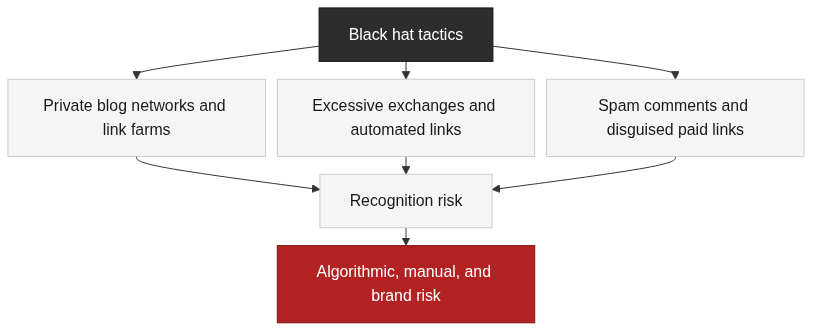
- Intent: Is the purpose to provide value to users and readers, or purely to lift rankings?
- Method: Are we deliberately avoiding detection — hidden links, disguised anchor text, controlled source footprints?
- Policy: Does this link comply with the search engine’s link policies, or does it involve buying, exchanging, automating, or mass-posting?
- Source: Does this link come from a relevant, trustworthy page a user would actually visit, or from a shell site built for links?
- Anchor text: Is the anchor text natural and varied, or heavily concentrated on exact-match keywords?
If you get two or more “manipulation” answers, treat the tactic as black hat link building and walk away.
Choosing a path by business scenario
The right compliant route depends on your situation:
| Scenario | Recommended path |
|---|---|
| Testing a low-competition long-tail keyword quickly | Invest in strong content plus a small number of compliant guest posts; do not “test the waters” with manipulative links |
| Mid-to-large company with an in-house team | Scale compliant links with strategy support and transparent reporting — content-driven and PR-integrated |
| Agency buying links for clients | Choose compliant, auditable, content-native suppliers so you never expose a client to algorithmic or manual risk |
Sustainable alternatives that actually work
You do not need black hat link building strategies to grow. Compliant guest posting, content-native placements, Digital PR, genuine resource pages, and links earned through editorial recommendation all build durable authority. These paths are slower to the first result but compound reliably — and they protect your brand at the same time.
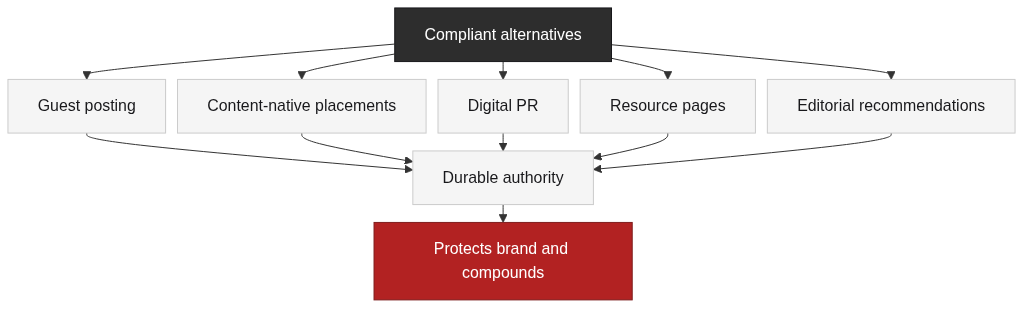
This is exactly the space where a compliant, content-driven approach matters most: premium links earned through real value, with transparency and strategy behind them, rather than volume placed to game the system.
The Bottom Line: Play the Long Game
The core conclusion
Manipulative links eventually backfire. Whether the trigger is an algorithm update, a manual review, or public recognition, the cost of black hat link building almost always exceeds its short-term benefit. Compliance is not a restriction — it is a moat. In a market where low-value links are being steadily washed out, being compliant and content-driven is a genuine competitive advantage.
Where to go from here
If you are ready to move from recognizing risk to choosing a sustainable strategy, the goal is simple: build links that reflect real value, with transparency and strategy behind every placement. That is the approach we build at TraffiClimb — compliant, content-driven link building designed for sustainable growth in both search and AI-driven search. If you want to explore a risk-free alternative to black hat tactics, we can help you map the right path for your site.
FAQ
References
Google Search Central — Link schemes — Official documentation defining link schemes, paid links, and link spam policies referenced throughout the article.
Google Search Central — Spam policies for Google web search — Reference for the distinction between algorithmic and manual handling of spammy link patterns.
Google Search Central — Creating helpful, reliable, people-first content — Reference for Google’s guidance that content earning links naturally by serving readers is the compliant alternative to black hat tactics.