
Backlink Exchange and Reciprocal Links: Are They Safe for SEO?
 Written by Alistair MacLeod

You open your inbox and there it is: “We noticed your site. Let’s add a link to each other—mutual benefit.” Or a colleague forwards you an invite to a link exchange group, promising “a few quick reciprocal placements.” Before you say yes, pause. Reciprocal links are not inherently a problem. The real question is when a backlink exchange crosses the line from natural mutual linking into a manipulative link scheme that Google’s systems treat as spam. This guide gives you a practical framework to judge each request on its merits—not a blanket “yes” or “no.”
The Link Exchange Email in Your Inbox: Should You Say Yes?
That email feels flattering. A real site, real traffic, an offer to link to you. But the same message arrives in thousands of inboxes, and the person sending it may not care about your content at all. They care about a link back.
The Dilemma Behind the Offer
Every link exchange request forces you into a quiet negotiation: accept a potentially useful link now, and risk an uncomfortable one in return later. The temptation is real, especially when your backlink profile is thin and you’re under pressure to build authority fast. That pressure is exactly what makes hasty exchanges dangerous.
The Core Question Nobody Asks
Reciprocal links are not the problem. The problem is when a backlink exchange stops being a natural byproduct of a real relationship and becomes a deliberate, reciprocal-for-reciprocal transaction. Google’s line is not about whether two sites link to each other. It is about why those links exist.
What This Guide Actually Gives You
You will not find a list of exchange partners or a directory of link networks here—that would miss the point and put you at risk. Instead, you get a decision framework: how to judge relevance, editorial intent, scale, pattern, and user value before you accept any reciprocal link request. You decide, with clear signals, instead of guessing.
Backlink Exchange vs Reciprocal Links: What’s Actually the Difference?
The terms get used interchangeably, but they describe different things. Understanding the distinction is the first step to assessing risk.
Definitions: Exchange vs Reciprocal Links
A backlink exchange is an active, deliberate arrangement: you link to me, I link to you. It is a transaction built on mutual benefit rather than on the value of the content itself. Reciprocal links, by contrast, describe the outcome—two sites that link to each other, regardless of how those links came to exist. Every exchange produces reciprocal links, but not every pair of reciprocal links is an exchange. A supplier linking to a client, a trade association listing members, and two research partners citing each other all create reciprocal links without any exchange agreement.
Why Websites Naturally Link to Each Other
The web is built on relationships. Suppliers link to their clients. Industry associations link to their members. Partners cross-reference each other’s resources. Journalists cite the companies they cover. None of these require an agreement, yet they all produce bidirectional links. This is normal network behavior, and Google’s systems are designed to recognize and tolerate it. The presence of reciprocal links alone tells Google almost nothing.
The Dividing Line: Editorial vs Exchange Placement
Google’s concern comes down to intent [1]. A link placed because a page is genuinely useful to readers—an editorial decision—is the natural kind. A link placed only because the other party agreed to link back—an exchange decision—is the manipulative kind. When you receive an exchange request, ask yourself: if the other site never linked to you, would you still place this link? If the honest answer is no, you are looking at an exchange placement, and that is where risk begins.
Where Google Draws the Line: Editorial vs Exchange
Google has published clear guidance on what it considers manipulative link patterns. The boundary is not mysterious, but it is often misread.
What Google’s Spam Policies Explicitly Prohibit
Google’s spam policies single out two patterns that matter here: excessive link exchanges and buying or selling links for ranking purposes [1]. Note the word “excessive.” A single reciprocal link between two related sites is not what Google targets. It is the scaled, systematic version—many sites swapping links in bulk—that trips the systems. Google also defines link spam as creating links that are not editorially placed or vouched for by the site owner on the page itself [1][2]. That definition is the anchor for everything below.
The Signals That Indicate a Link Scheme
When Google evaluates links, it looks for patterns, not single instances. The signals that point toward a scheme include: non-editorial placement (links in footers, sidebars, or dedicated link pages rather than inside relevant content), scale (a sudden burst of reciprocal links), and pattern (identical anchor text, similar placement, or a cluster of domains linking in lockstep) [1]. None of these alone is damning. Together, they form the signature of manipulation.
How to Anchor Your Own Judgment
You do not need to reverse-engineer Google’s algorithm. You need one test: is this link on the page because the content earns it, or because a deal placed it there? If a human editor, unaware of any exchange, would keep the link because it genuinely helps readers, you are on the editorial side. If the link would disappear the moment the reciprocal arrangement ended, you are on the exchange side. Everything else—relevance, scale, pattern—is a refinement of that single test [2].
Why Scale and Pattern Make Link Exchanges More Dangerous
A single reciprocal link is rarely a problem. The danger compounds as exchanges multiply and take on recognizable shapes.
Why One Link Is Different from Fifty
Google’s systems are built to detect patterns across the web, not to judge individual links in isolation. A single mutual link between two relevant sites looks like normal network behavior. Fifty reciprocal links added in the same month, with similar anchor text, from a cluster of domains that all link to each other—that is a pattern a system can recognize [1]. The risk is not linear. It grows quickly as volume and uniformity increase.
How Three-Way Exchanges Try to Hide the Pattern
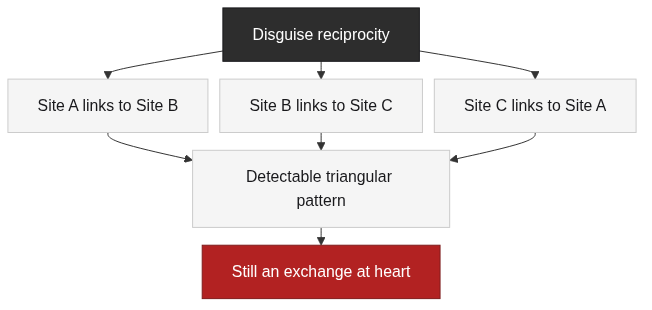
A direct “you link me, I link you” exchange is easy to spot, so some builders use a three-way structure: site A links to site B, site B links to site C, and site C links to site A. The goal is to disguise the reciprocity by routing it through a third party. But the underlying intent is unchanged—it is still an exchange built on a reciprocal agreement, not on editorial merit [2]. And the triangular structure itself creates a detectable signature across the three domains. The disguise rarely holds.
Relevance: The Water Shed Between Natural and Manipulative
Relevance is the single strongest signal separating natural reciprocal links from manipulative ones. A SaaS company and its payment gateway provider linking to each other is natural. A SaaS company and an unrelated casino site linking to each other is not—there is no plausible editorial reason for the connection. When a backlink exchange pairs sites with no topical relationship, the only explanation left is the agreement itself, which is precisely the signal Google treats as manipulative [1]. Relevance is not a nicety; it is the dividing line.
Natural Reciprocal, Questionable Exchange, or Risky Link Network?
Not all reciprocal links carry the same risk. Sorting them into three buckets makes the decision much clearer.
Scenario Comparison: Natural vs Questionable vs Risky
| Dimension | ✔ Natural Reciprocal | ⚠ Questionable Exchange | 🚫 Risky Link Network |
|---|---|---|---|
| Trigger | Real business or content relationship | Explicit “you link me, I link you” agreement | Bulk exchange platform or three-way network |
| Topical relevance | Highly relevant (supplier, association, peer) | Partially relevant | Unrelated or weakly matched |
| Volume & scale | Few, sparse, accumulated over time | Few but reciprocal | Bulk, concentrated, patterned |
| Anchor text | Natural and varied (brand, bare, contextual) | Relatively natural | Identical, optimized anchors clustered |
| Placement | Inside editorial content | Resource or link page | Footer, sidebar, bulk link blocks |
| User value | High (useful to readers) | Medium | Low (pure SEO intent) |
| Google’s read | Natural / normal | Gray area (risk rises with scale) | Clear link scheme, eligible for manual or algorithmic action |
| Recommended action | Keep, no action needed | Evaluate volume and relevance, control scale | Decline, remove, or add nofollow |
Scenario Comparison: Direct Exchange vs Three-Way Exchange
| Dimension | Direct Exchange | Three-Way Exchange |
|---|---|---|
| Structure | A ↔ B direct mutual link | A→B, B→C, C→A triangular pass |
| Purpose | Obtain a reciprocal link | Disguise direct reciprocity, lower detection odds |
| Essence | Reciprocal agreement | Reciprocal agreement (more concealed) |
| Risk | Medium (depends on relevance and scale) | Medium-high (pattern detection can identify it) |
| Judgment logic | Exchange-based link | Exchange-based link, with a more complex pattern |
Reading the Signals: Keep, Evaluate, or Reject
The two tables above give you a practical lens. When a reciprocal link is relevant, editorially placed, natural in anchor text, and genuinely useful to readers, keep it and let it sit naturally. When it is relevant but clearly a direct exchange, treat it as questionable—control the volume and keep it inside your overall link picture. When it is unrelated, bulk, patterned, or routed through a three-way network, decline it or add nofollow. The signal to watch is always the same: does this link exist for the reader, or for the agreement?
A Practical Decision Checklist Before You Accept Any Link Exchange
Decisions under pressure are bad decisions. A checklist removes the guesswork and makes the call consistent.
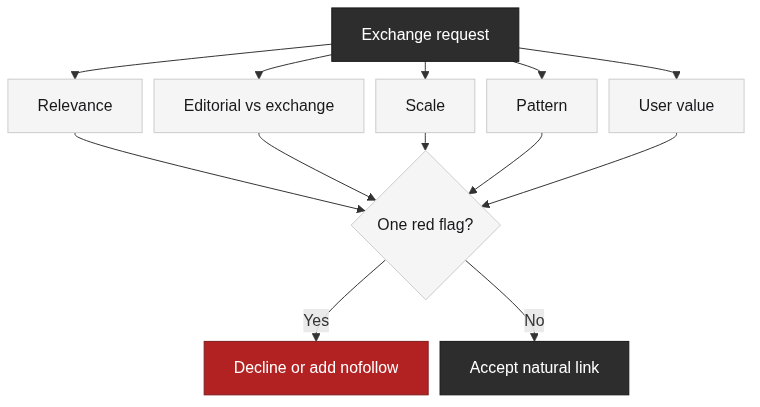
The Five-Question Risk Assessment
Before you accept any exchange request, ask yourself these five questions in order:
- Relevance — Is the other site’s topic genuinely related to mine? Unrelated is a strong risk signal.
- Editorial vs Exchange — Would this link exist if the other site never linked back? Pure agreement is high risk.
- Scale — Is this the third reciprocal link this month? Is there a burst, bulk, or batch of domains? Scale triggers pattern recognition.
- Pattern — Are the anchor text, placement, and domains similar? Does this come from the same network or platform? Pattern equals risk.
- User Value — Does this link actually help a reader? Low value is a manipulation signal.
Scoring and How to Act on It
The treatment is simple: if any single answer lands on the negative side—unrelated, pure agreement, scaled, patterned, or low value—decline the link or add nofollow. If all five answers pass, you are looking at an acceptable natural reciprocal link, and you can keep it without overthinking. The framework is deliberately conservative: one red flag is enough to act, because the downside of a risky link in your profile outweighs the upside of a single referral.
The Pre-Send Checklist
If you decide to move forward, run this list before anything goes live:
- [ ] The other site is topically relevant, has real content, and has genuine traffic and authority
- [ ] The link sits inside editorial content, not on a link page or footer
- [ ] Anchor text is natural and varied, not optimized and repeated
- [ ] Your site’s overall reciprocal ratio stays at a natural level, with no bulk concentration
- [ ] You are not depending on a single exchange network or platform for volume
- [ ] The link provides real value to users, not just a ranking signal
When to Accept, Evaluate, or Decline
Accept reciprocal links from genuine business partners, suppliers, and industry associations—these are natural editorial links that add value. Evaluate cautiously when a direct exchange is relevant and small in number; control the scale and keep it inside your monitored link picture. Decline outright when you face unrelated bulk exchanges, three-way networks, or automated platform submissions. The line between acceptance and rejection is drawn by relevance, editorial intent, and scale—not by a blanket rule.
Should You Say No to Reciprocal Links Completely?
The short answer is no. Cutting off every reciprocal link would mean rejecting the natural connections that make the web work.
The Core Conclusion: Don’t Ban Links, Ban Patterns
Reciprocal links from suppliers, partners, and associations are normal and often valuable. The right approach is not to eliminate them but to keep the natural ones, recognize the manipulative ones, and avoid bulk exchange patterns entirely. A site with zero reciprocal links looks just as unnatural as one drowning in them. The goal is a balanced, editorially earned profile—not an artificial purity.
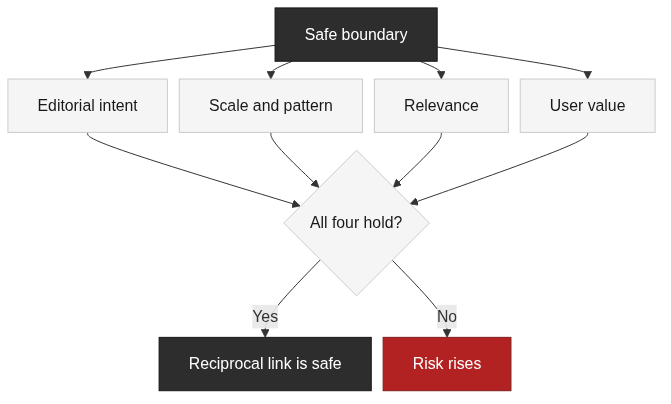
The Four Lines That Define the Safe Boundary
Four principles, applied together, define where the safe boundary sits. First, editorial intent: links exist because of content value, not agreements. Second, scale and pattern: keep volume natural and avoid uniformity. Third, relevance: links between related sites are defensible; links between unrelated ones are not. Fourth, user value: a link that helps a reader is a link worth having. When all four hold, a reciprocal link is safe. When any one fails, the risk rises.
Your Next Step: Monitor, Then Decide
Fold every reciprocal link into your broader link picture and review it as part of your ongoing strategy, not as a one-time decision. If you want a compliant, content-driven link building approach that keeps your profile safe while it grows, a strategic partner can help you build the right links without the exchange-network shortcuts. TraffiClimb builds high-quality, editorially earned backlinks and helps you keep your profile clean and sustainable—book a consultation to review your link strategy.
FAQ
References
Google Search Essentials: Spam policies — Google’s official documentation defining link spam, excessive link exchanges, and buying or selling links for ranking purposes, and the “non-editorial placement” definition of manipulative links.
Google Search Essentials: Link spam — Google’s dedicated link spam guidance, which explains when links are not editorially placed and how link schemes, including scaled reciprocal exchanges, are identified.
Google Search Central — Creating helpful, reliable, people-first content — Google’s guidance that content earning links naturally by serving readers well is the compliant alternative to manipulative exchange patterns.