
Backlink Audit: A Step-by-Step Guide to Auditing Your Backlink Profile
 Written by Alistair MacLeod

What a Backlink Audit Is and How It Differs from Backlink Analysis
A backlink audit is a structured review of a site’s inbound links that ends with documented decisions. It answers more than “what links exist?” The process asks which links deserve attention, what evidence supports each judgment, and what should happen next. That makes it useful for SEO practitioners, in-house teams, and agencies responsible for maintaining a backlink profile.
Backlink analysis is often a snapshot: a report of referring domains, linked pages, anchors, or authority signals. A backlink audit uses that analysis as an input, then adds scope, reconciliation, context, classification, and follow-up. The distinction matters because an isolated metric can describe a link without explaining whether it is relevant, editorially placed, changing, or part of a wider pattern.
A practical audit should define its source coverage and limits before interpretation begins. A well-scoped backlink audit records those limits before a reviewer interprets the findings. Export data can be incomplete, tools can label the same link differently, and a suspicious-looking item may need manual review. Do not turn an incomplete inventory into a claim about a site’s overall health. Instead, preserve the evidence, state what was not available, and make decisions at the level the data can support.
Build a Backlink Inventory Before Judging Link Quality
Start with an inventory that keeps the link, page, and domain views together. Record individual backlinks, referring domains, and the target pages receiving them. Add new and lost links when the source tool provides that history, because a link that recently disappeared can explain a change in traffic or a gap in a campaign without proving a broader problem.
Reconcile exports before scoring anything. During a backlink audit, this reconciliation prevents a missing or duplicated row from becoming a false quality judgment. Normalize protocol and host variants where appropriate, remove duplicate rows, and keep the original source record beside the normalized value. A domain-level row can hide several page-level links; a page-level row can hide that multiple links share the same placement or anchor pattern. Preserve both levels so the audit can move from a broad distribution view to a specific inspection.
The inventory should also record collection date, source tool, target URL, source URL, referring domain, anchor text, link attributes, and any new or lost status. These fields make later comparisons possible. If a small team has only one export, it can begin with a simple sheet and a manual evidence column. Larger teams can merge exports programmatically, but automation should flag conflicts for review rather than silently choosing one value.
Review the Dimensions That Shape Backlink Risk and Value
Source Website and Topical Relevance
Source website context is the first judgment layer. Review the page where the link appears, the site’s subject, the surrounding content, and the likely audience relationship. A relevant editorial mention can be useful even when it does not resemble a commercial directory entry. Conversely, a familiar domain name does not make every page placement relevant.
Relevance should be assessed across the referring domain and the specific page. A site may publish material across several unrelated subjects, so a domain-level label can be too broad. Compare the link’s topic with the destination page, then record whether the connection is direct, adjacent, or unclear. The unclear group is usually a review queue, not an automatic removal list.
Look for distribution rather than isolated wins. A strong backlink audit decision considers whether a pattern repeats across sources, pages, and placements. If many links come from the same narrow type of page, the concentration may matter more than any one source. This is especially important for teams evaluating link-building activity: a single relevant placement can be reasonable while a repeated pattern with little editorial variation deserves closer inspection. For background on the broader strategy context, see TraffiClimb’s link-building strategies guide.
Placement, Anchor Text, and Link Attributes
Placement describes how the link functions in its page context. Note whether it appears in a main editorial passage, a resource section, navigation, a template, a profile, a sponsored area, or a user-generated block. The same anchor can carry different meaning in each location. Record the surrounding sentence or a short evidence note so a later reviewer does not have to infer the placement from a row alone.
Anchor text should be reviewed for meaning and repetition. Descriptive variation can reflect real editorial choices, while an unusually narrow pattern may warrant investigation. Do not judge an anchor from a single instance or treat branded, URL, generic, and topical anchors as a universal formula. The appropriate comparison is the site’s own distribution, the page context, and the way links were acquired.
Link attributes are additional context, not a complete verdict. Capture rel values such as sponsored, user-generated, or nofollow when available, but do not treat one attribute as a substitute for reviewing the page. A team with limited time should prioritize clusters that combine repeated anchors, similar placements, and unclear relevance. When a content asset could earn more contextually relevant mentions, the audit can hand off to TraffiClimb’s guide to creating linkable assets.
Distribution, Velocity, and Suspicious Unnatural Patterns
Examine concentration by referring domain, page type, anchor, target page, and acquisition pattern. A sudden-looking cluster may reflect a campaign, a migration, a tool reclassification, or a reporting artifact. Treat the pattern as a prompt to reconcile dates and sources, not as proof that a penalty or violation exists. Google describes link spam in terms of manipulative practices and recommends evaluating the behavior and intent behind the links, so the context must remain visible in the report [1].
Suspicious patterns become more useful when they are grouped into testable observations. For example, record that many links share a placement type and anchor, then check whether the source pages are relevant and editorially controlled. Separate evidence from interpretation: “same template placement” is an observation, while “manipulative” is a conclusion that needs stronger support.
Velocity is similarly contextual. New links may cluster after a campaign, a news event, a product launch, or a site migration. Without a reliable baseline, do not assign a precise threshold or claim that a change is inherently harmful. Investigate the acquisition source, destination mix, lost-link history, and whether the pattern persists. Manual review is most valuable when several signals point in the same direction; it is a poor use of time when one weak signal is the only concern.
Run a Repeatable Backlink Audit Checklist
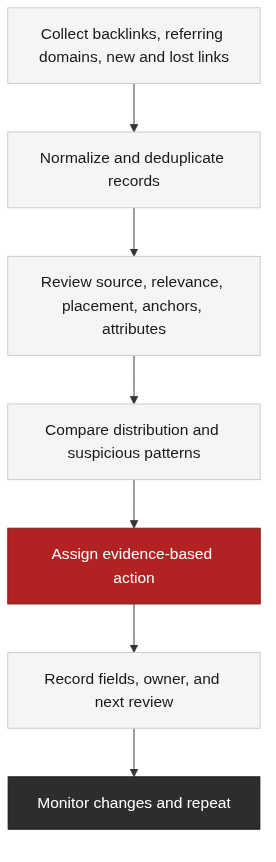
A repeatable backlink audit checklist should turn raw exports into decisions without hiding uncertainty. Use this workflow:
- Define the audit scope and export window, then follow the backlink audit checklist and workflow.
- Merge sources and remove duplicates while preserving raw records.
- Classify domains, pages, anchors, placements, and attributes.
- Investigate outliers and record the evidence behind each conclusion.
- Assign an action category, owner, and review condition.
- Schedule monitoring and document what changed.
The first step is a scope decision. Decide whether the review covers the whole profile, a group of target pages, a recent campaign, or a suspected pattern. A full inventory is appropriate when the team lacks a reliable baseline; a focused review is more efficient when a specific acquisition source or page change is already known. State the choice in the report so a later audit is comparable.
The merge step deserves more care than its administrative appearance suggests. Keep source URLs and referring domains separate, because collapsing them too early can erase page-level evidence. When two tools disagree, record both values and resolve the conflict using the source page or a documented rule. Do not use a spreadsheet formula to convert uncertainty into a false certainty.
Classification and investigation should happen before action. Prioritize clusters with repeated evidence, high business relevance, or a clear owner. A small team can review a representative set from each cluster first; if the pattern is inconsistent, expand the sample rather than applying a broad action. This keeps the workflow proportionate to the evidence and prevents the checklist from becoming an automatic cleanup script.
Turn Findings into Keep, Monitor, Review, Remove, or Disavow Decisions
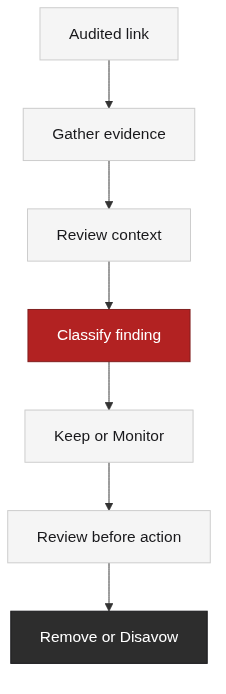
Assign each finding to a Keep, Monitor, Review, Remove, or Disavow classification based on evidence. Keep is appropriate when the link has a credible context and no unresolved issue in the audit record. The decision does not mean the link guarantees rankings or should never be revisited; it means no corrective action is currently justified.
Monitor is useful for uncertain or changing links. Place an item here when relevance is plausible but the context needs a later check, when a domain is changing, or when a new and lost pattern is not yet understood. Review is a stronger queue for items that combine multiple concerns, such as unclear relevance and repeated placement. It requires an evidence note and a next decision condition, not just a red label.
Remove applies when a practical, documented request or source-side correction is appropriate. Record who owns the request, what page is involved, and what outcome would close the item. Removal is not always possible, and a refusal does not by itself prove that a link is harmful. Keep the request history separate from the original observation so the report remains auditable.
Disavow is a specialized option with a high evidence bar. Google explains that the tool is intended for cases involving a considerable number of spammy or artificial links and that incorrect use can harm a site’s performance [2]. It should not be a routine response to low authority, unfamiliar domains, or every link that a reviewer dislikes. Escalate only when the evidence, scope, and decision owner are clear, and preserve the rationale for future review.
These categories are deliberately asymmetric. Within a backlink audit, that asymmetry keeps routine maintenance separate from actions that require stronger evidence. Keep and Monitor are common maintenance outcomes; Review is a holding state; Remove and Disavow require progressively stronger justification and operational ownership. Agencies can connect a verified opportunity to their guest posting link-building guide, but the audit itself should not turn into an instruction to acquire links through a predetermined tactic.
Design a Backlink Audit Report That Supports Follow-Through
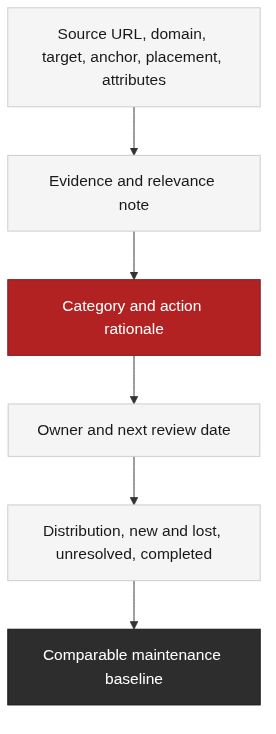
Record the backlink audit report fields: source URL, referring domain, target URL, anchor, placement, attributes, relevance, evidence, category, owner, and next review date. These fields connect the observation to an action and make the report useful after the first reading. Include the collection date and source tool as supporting metadata so a future reviewer can distinguish a new change from a different export.
A useful report has both detail and summary views. The detail view should let a reviewer trace a category back to a page and a reason. The summary view can group referring domains, target pages, new and lost links, unresolved reviews, and completed actions. Avoid presenting a single authority score as the conclusion; a score may help sort work, but it cannot replace page context or ownership.
Keep raw evidence separate from recommendations. Store the source record, screenshot or excerpt when available, and normalization notes apart from the proposed action. This prevents a later edit to the recommendation from erasing what was originally observed. It also helps agencies hand work between analysts, outreach owners, and clients without requiring everyone to interpret the same row from scratch.
The report should make uncertainty visible. Use a status such as pending evidence or needs manual review when a conclusion is not ready. Do not fill every blank with an assumption. For teams planning earned media or digital PR, the TraffiClimb digital PR backlinks playbook is a related resource for execution planning, while the audit report remains the record of what was actually observed.
Maintain the Profile After the Initial Audit
Maintenance turns an audit from a one-time spreadsheet into a feedback loop. A completed backlink audit should therefore define what evidence will trigger the next review. Set a monitoring cadence that matches the site’s acquisition activity and available resources, then watch new and lost links, domain changes, anchor shifts, target-page concentration, and unusual clusters. The cadence should be revisited when the source mix changes; a fixed schedule without a reason can create either unnecessary review work or long blind spots.
Use the first audit as a baseline, not as a permanent definition of normal. Compare later exports using the same normalization rules and document changes in source coverage. If a category grows unexpectedly, first check whether the data provider changed its labels or whether a site migration created duplicate records. Only after those checks should the team infer a change in the underlying profile.
The handoff matters as much as the observation. Link-building strategists can use confirmed patterns to refine content targets and outreach decisions, while content owners can address pages that attract relevant references. TraffiClimb offers link building services and related capabilities, but this article does not present a standalone Backlink Audit service or promise a particular outcome. A sensible next step is to review the evidence, choose the smallest justified action, and then explore a related execution path if the team needs support.
FAQ
References
Google Search Essentials, “Link spam”: https://developers.google.com/search/docs/essentials/spam-policies
Google Search Console Help, “Disavow links to your site”: https://support.google.com/webmasters/answer/2648487
Ahrefs, “Backlink Audit”: https://ahrefs.com/blog/link-audit/
Semrush Knowledge Base, “Backlink Audit”: https://www.semrush.com/kb/859-backlink-audit