
Anchor Text for SEO: Types, Best Practices, and Common Mistakes
 Written by Alistair MacLeod

Anchor text looks like the simplest concept in SEO—a clickable word or phrase inside a link. Yet it is also one of the easiest things to get wrong. Get the distribution right and your link profile reads as natural and earned. Get it wrong and you can trigger the exact kind of manipulation signal Google’s guidelines warn against. This guide walks you through what anchor text for SEO actually means, the six anchor text types, how control differs across internal, external, and inbound links, and how to check your own profile without falling into the trap of chasing a “magic ratio.”
Anchor Text Looks Simple—Until It Isn’t
Anchor text for SEO is where a simple link label turns into a ranking signal, and it is where most profiles go wrong. Picture this: a site has built a steady stream of backlinks over two years, and every single one points to the homepage using the exact same keyword phrase as its anchor. The site ranks well, so no one touches it. Then a core update rolls out, and organic traffic drops by a noticeable margin. When the team audits the backlink profile, the pattern is obvious—an unnatural concentration of identical, keyword-exact anchors aimed at one page.
That scenario is not hypothetical. Excessive exact-match anchor text is one of the patterns Google explicitly calls out in its spam policies as a signal of manipulated link schemes [1]. The uncomfortable truth is that anchor text is not a “use more keywords” lever. It is a relevance signal that has to stay balanced against natural wording and diversity.
The real question this guide answers is straightforward: how do you use anchor text to reinforce relevance without over-optimizing? Below, we cover the definition and mechanism, the six anchor text types and their risk profiles, how anchor text behaves differently in internal, external, and inbound links, and a practical checklist you can run before publishing or auditing. The evidence base is deliberately restricted to reliable sources—Google Search Central’s own link documentation and the explanations published by Moz, Semrush, and Ahrefs—so you can verify every claim yourself.
What Is Anchor Text SEO and Why Does It Matter?
Anchor text is the visible, clickable text in a hyperlink [2]. When one page links to another, the words wrapped inside that link carry meaning. Search engines read that text as one signal among many for understanding what the target page is about and how the two pages relate.
That second part matters more than most people realize. Anchor text is one signal, not the only or decisive factor. Google’s documentation describes links as a signal that a site is worth visiting, and it uses links to understand the relationship between web pages [3]. Anchor text sits inside that broader system. It helps a search engine connect a descriptive phrase to a page, but it does not single-handedly determine rankings. Treating it as a silver bullet is exactly the kind of mythologizing that leads to over-optimization.
The Core Dimension: Relevance
The dimension Google’s documentation keeps returning to is relevance. Anchor text should relate to the topic of the page it points to [3]. If a page about “project management software” is linked with the anchor “crm platforms,” the text and the page are saying two different things. Relevance is what makes anchor text useful to a search engine—and what makes it dangerous when it drifts too far from the target page’s actual topic.
One Signal Among Many
Here is the practical takeaway: anchor text is not a ranking factor you can “max out.” Ahrefs frames it plainly as one of many ranking factors rather than a universal signal [4]. The goal is not to stuff keywords into anchors. It is to write anchors that honestly describe the page they point to, so the overall profile looks like something a human would naturally produce.
The Six Anchor Text Types and When to Use Each
Most reliable SEO references converge on six anchor text types, and Moz’s taxonomy is the one most commonly cited [2]. Each type carries a different relevance signal and a different over-optimization risk, so knowing when to reach for each is the core of good anchor text SEO.
The Six Types Defined
| Anchor type | Example | What it signals |
|---|---|---|
| Exact Match | best crm software |
The anchor is identical to the target page’s main keyword. Strongest relevance signal, highest over-optimization risk. |
| Partial Match | top crm platforms |
Contains a variation of the target keyword. Balances relevance with a more natural feel. |
| Branded | TraffiClimb |
Uses the brand or site name. Most natural, lowest risk, builds brand recognition. |
| Naked URL | trafficlimb.com |
Uses the raw URL as the anchor. Natural and transparent. |
| Generic | click here, learn more, this article |
No keyword signal at all, but reads as very natural. |
| Image anchor | image with alt text | The image is the link, and its alt text acts as the anchor. |
The Relevance-vs-Risk Trade-Off
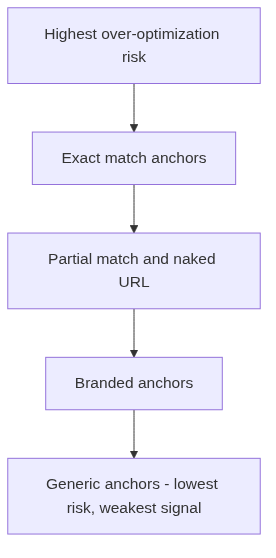
The tension is easy to see once you line the types up. Exact Match gives you the strongest relevance signal, but it is also the type most associated with over-optimization when overused [2][5]. Branded and Generic anchors are the most natural and carry the lowest risk, but they tell a search engine less about the target page’s topic. Partial Match and Naked URL sit in the middle—useful, natural, and relatively low risk.
The mistake is treating any single type as “good” or “bad.” The health of a profile comes from the mix. A profile made entirely of exact-match anchors looks manufactured; a profile with no descriptive anchors at all gives away relevance signals you could be earning.
Anchor Text Differences Across Internal, External, and Backlinks
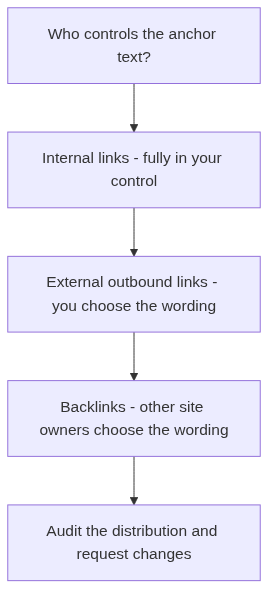
Anchor text behaves differently depending on who controls the link. This is the part of anchor text SEO that most guides gloss over, and it matters because your strategy has to change based on the scenario.
Internal Links: Fully in Your Control
Internal links are the links you place from one page of your site to another. You control every variable, including the anchor text. This is where you can be most precise: use descriptive anchors that accurately name the target page’s topic, because internal anchors reinforce site structure and topical signals [2]. Over-optimization risk here is low because these are your own pages and the anchors should naturally describe your own content.
External (Outbound) Links: Your Choice, Directed Elsewhere
External links point from your site to a third-party site. You decide where they go and what text wraps them. The best practice is honesty: the anchor should accurately describe the content you are referencing, because you are providing context and citing a source [2]. There is no ranking benefit to gaming outbound anchors, and misleading them helps no one.
Backlinks (Inbound): The Part You Cannot Fully Control
Backlinks are the links other sites place pointing to you. Here is the hard truth: you do not fully control them. Other site owners choose the anchor text, and that distribution is what shapes the health of your backlink profile [2][6]. This is the core takeaway of this guide. Internal and external anchors are easy to manage; backlinks accumulate from hundreds of independent decisions, and an unnatural concentration in any one type is a red flag you can only fix by auditing and, where possible, asking for changes.
Over-Optimization and How to Check Your Anchor Text
Over-optimization is what happens when anchor text distribution stops looking natural. It is not about one bad link—it is about a pattern.
What Over-Optimization Looks Like
Three patterns stand out. First, heavy exact-match concentration: a large share of your inbound anchors use the identical keyword phrase. Second, too many anchors pointing to the same page with the same or near-identical text. Third, anchors that are unrelated to the target page’s topic, which suggests the links were placed for manipulation rather than context [2][5].
The Official Signal
This is not speculation. Google’s spam policies explicitly list excessive exact-match anchor text as one of the behaviors it treats as a link scheme [1]. That is the clearest official statement you will find: overuse of exact-match anchors is not just a best-practice concern, it is a documented manipulation signal.
How to Check Your Own Distribution
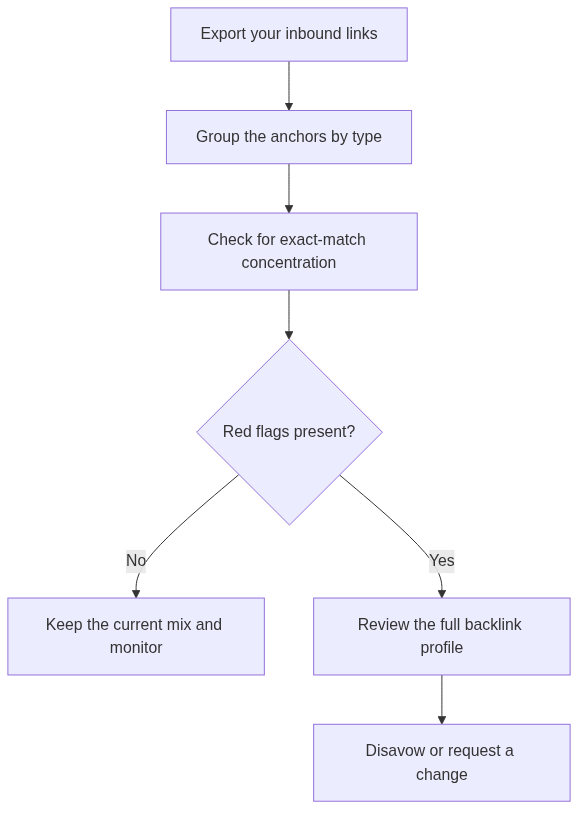
You can check your anchor text distribution with a backlink audit tool. Export the list of your inbound links, group them by anchor type, and review the shares of exact-match, branded, naked-URL, and generic anchors [6]. Look for concentration and for any type that is almost entirely absent. A profile where branded and generic anchors are missing while exact-match dominates is a warning sign worth investigating.
A Practical Framework for Building a Natural Anchor Text Distribution
Rather than chase a fixed percentage for any anchor type, aim for a profile that looks natural, relevant, and diverse. The decision principle is simple: no single type should dominate, and every anchor should make sense in context.
Relevance vs. Risk Across Anchor Types
| Anchor type | Relevance signal | Over-optimization risk | Best-fit use |
|---|---|---|---|
| Exact Match | High | Highest | Sparingly, on precise content pages |
| Partial Match | Medium-high | Medium | Content pages and blog citations |
| Branded | Low (brand signal) | Lowest | Homepage and brand pages |
| Naked URL | Low | Low | Citations and footnotes |
| Generic | None | Low | Navigation and CTAs |
| Image anchor | Depends on alt | Medium | Visual content and infographics |
Controllability and Strategy by Link Scenario
| Dimension | Internal links | External (outbound) | Backlinks (inbound) |
|---|---|---|---|
| Controllability | Fully controllable | Controllable (you choose) | Not fully controllable |
| Main goal | Site navigation, topical signals | Citing sources, providing context | Building authority and relevance |
| Anchor precision | Precise descriptions | Honest descriptions | Naturally diverse |
| Over-optimization risk | Low | Low | Highest (affects your profile) |
| Strategy | Precise + relevant | Honest + relevant | Natural distribution + audit |
An 8-Point Anchor Text Health Checklist
Run this checklist before you publish a new link or before you audit an existing profile:
- Is it relevant? Does the anchor accurately describe the target page’s topic? If not, it is low quality even if it is a brand name.
- Is the wording natural? Does it read like something a person wrote, or like keyword stacking?
- Is it over-concentrated? Is the same page being pointed at by many identical or near-identical anchors?
- Are branded anchors present? A profile with almost no brand anchors may look unnatural.
- Are naked-URL and generic anchors present? Total reliance on keyword anchors with no natural anchors is a classic over-optimization signal.
- Are the sources credible? Do these links come from relevant, trustworthy sites rather than unreliable directories?
- Is the overall distribution balanced? Look at the whole picture, not any single type’s share.
- Is a deeper diagnosis warranted? If several items above are red flags, run a full backlink profile review.
If multiple items light up, the right move is not to guess at a ratio. It is to review the entire backlink profile and decide what, if anything, to disavow or ask to be changed.
Core Takeaways and Your Next Step
Anchor text is one relevance signal, not a magic lever. There are six anchor text types with different risk profiles, and how you use them depends on whether you control the link. Internal and external anchors are yours to manage; backlinks accumulate from decisions other people make, and their distribution determines the health of your backlink profile.
The balanced approach is consistent across every scenario: use natural wording, keep anchors relevant to the target page, and aim for diversity across types. Avoid over-optimization by refusing to chase any single anchor type, and by treating Google’s documented concern with excessive exact-match anchors as a real boundary, not a rumor.
Your next step is to look at the whole picture, not just one anchor. Export your inbound links, group them by type, and assess whether the distribution reads as natural and earned. If you want to go deeper, a full review of your backlink profile is the right place to start—checking anchor text in isolation can only tell you part of the story. Take a look at how your backlink profile is structured overall, then decide whether any adjustments are worth making.
FAQ
References
Google Search Central: Link schemes —— Google’s official spam policies list excessive exact-match anchor text as a link-scheme manipulation signal.
Moz Learn SEO: Anchor Text —— Defines anchor text as “the visible, clickable text in a hyperlink,” outlines the six anchor text types, and notes that over-optimized anchor text is a common cause of Google penalties.
Google Search Central: Links —— Google’s official documentation explains that links are a signal a site is worth visiting and that anchor text should relate to the linked page’s topic.
Ahrefs Blog: Anchor Text —— Frames anchor text as one of many ranking factors rather than a universal signal, and recommends a diverse, natural distribution.
Semrush Blog: Anchor Text —— Recommends using a backlink audit tool to check anchor text distribution and to identify over-optimization risk.