
AI Brand Visibility: How to Improve Your Brand’s Presence in AI Search
 Written by Warren Reed

What AI Brand Visibility Means and Why It Matters
AI brand visibility describes how often and how clearly a brand appears when AI search engines answer questions about its market. Instead of a list of ten blue links, an AI answer often selects a small set of sources, summarizes them, and names the brands behind them. When your brand is not in that set, you do not lose a click on page two; you disappear from the conversation entirely. That is why AI brand visibility matters more than traditional rankings for many teams: it decides whether the brand is part of the answer or part of the background.
What AI brand visibility means in practice depends on where the brand shows up. It can be a direct mention in the answer text, a citation linked to a source, or a consistent description repeated across answers. Each of these needs the same foundation: the brand must exist in the sources an AI system actually reads. Before any framework helps, the brand needs a visible, verifiable footprint that an engine can find, and that footprint must stay free of the manipulative link patterns that search engines treat as spam [1].
How AI Search Engines Find and Describe Brands
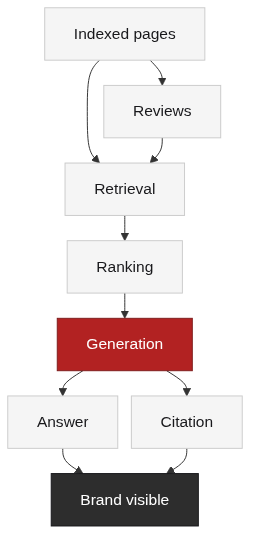
AI search engines combine retrieval, ranking, and language generation to assemble an answer, and that combination is how they find and describe brands. Retrieval finds candidate pages and entities, ranking decides which are most relevant, and generation writes the answer from the shortlist. The practical consequence is that brand presence in AI search is built upstream: if the brand is not clearly described in indexed pages, structured data, reviews, and external references, there is nothing reliable for the system to retrieve or cite.
Describe the brand the way an engine would, not the way a homepage does. The same brand name should point to the same entity across the website, directories, and coverage, with consistent statements about what the company does and who it serves. When sources disagree about a brand’s category or name, the AI system has to pick one version, and it may pick the wrong one. That makes entity clarity a retrieval problem, not a copywriting problem, which is why the description layer comes before the link layer in the framework that follows.
A Brand Visibility Framework for AI Search
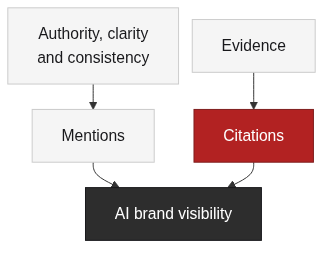
A brand visibility framework for AI search organizes the work into four layers: authority, clarity, consistency, and evidence. Authority signals that the brand is a recognized source in its market, built through coverage, mentions, and links from relevant places. Clarity means the brand name, positioning, and topic association are explicit on every important page. Consistency keeps the name, category, and descriptions aligned across the site and across external references. Evidence gives AI systems verifiable claims and cited sources to attribute, and it includes the risk side: when unwanted links threaten that credibility, search engines document a formal disavow path [2].
The framework works as a filter for priorities. A brand with strong authority but weak consistency gets found and then misdescribed; a brand with clear pages but no external evidence gets described accurately but rarely cited. Teams use the four layers to decide where the next investment goes: fix clarity before chasing more coverage, and fix consistency before adding new mentions. The framework also connects the two signals that matter most in AI search, mentions and citations, into one decision path instead of treating them as separate campaigns.
Mentions and Citations as AI Search Presence Signals
Mentions and citations are the two presence signals that AI search uses to name a brand. A mention is the brand name appearing in an answer or in content an engine reads; a citation is a linked reference that gives the system a source to attribute. A mention without a citation can leave a brand unverifiable, while a citation without a mention can attach the link to the wrong entity. The strongest presence combines both: the brand is named, and the naming is backed by a source the engine can trust.
Link building is the engine that earns and places both signals. A link from a relevant page both mentions the brand and cites a specific source, which is why relevance decides whether the pair is associated with the right topic. TraffiClimb’s guide to relevant backlinks explains how to judge that fit, and the link building strategies guide covers the shift from collecting links to placing the brand where engines sample answers. High-quality backlink evaluation rounds out the set by separating the citations worth pursuing from the ones that add noise.
Build Brand Presence Through Linkable Assets and Digital PR
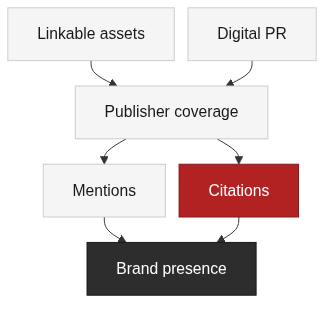
Linkable assets are the practical way to build brand presence in AI search. An original dataset, a working tool, or a reference guide gives publishers a specific reason to cite the brand instead of a generic page. TraffiClimb’s guide to creating linkable assets walks through the formats that earn references, and the principle carries over to AI search: a well-scoped asset is easier for an engine to summarize and attribute than a broad marketing page.
Digital PR is the second half of the build. Where linkable assets create the reason, digital PR places the brand in front of relevant publishers so the reason turns into a mention and a citation. The digital PR backlinks playbook connects coverage to link building, and the same process builds AI brand visibility: the brand is named in context, linked to a verifiable source, and described consistently. Prioritize relevance and quality, because a mention on an off-topic site adds noise that makes the brand harder to describe.
An AI Brand Visibility Presence Checklist
An AI brand visibility presence checklist turns the framework into a repeatable audit. Start by checking what an AI search engine currently says about the brand: which name it uses, which category it assigns, and which sources it cites. Then check name consistency across the website, profiles, and external references, and check whether the most important pages are clearly described and linked. Review where and how often the brand is mentioned, and verify that each mention is backed by a citation an engine can follow.
The checklist also covers gaps, not just errors. If the brand is described correctly but never cited, the gap is evidence and linkable assets. If the brand is cited but misdescribed, the gap is clarity and consistency. If the brand barely appears, the gap is authority and external references. Running the checklist before a campaign shows where the effort should go, and running it after shows whether the effort changed the answer.
Measure and Monitor Brand Visibility in AI Search
Measure brand visibility in AI search the way you would audit any other presence channel: track mentions, citations, and descriptions over time instead of a single screenshot. Semrush documents the backlink and referring domain structures that support this kind of measurement [3], and Ahrefs covers the link audit process for watching which sources mention or cite the brand [4]. The monitoring question is the same as in classic SEO: did the brand’s share of the answer change after the new assets and coverage went live?
Monitor with the same tools that audit, and rerun the checks after publishing new assets or campaigns. The answer text can change without any change on your site, so the baseline and the cadence matter. Watch for two failure modes: the brand disappears from an answer it used to appear in, and the brand gets described incorrectly. Both are signals to correct references, add evidence, or rebuild consistency, and both are easier to fix early. Over a few review cycles, this shows whether your presence in AI answers is improving, staying flat, or slipping back.
FAQ
References
Google Search Essentials, “Link spam”: https://developers.google.com/search/docs/essentials/spam-policies
Google Search Console Help, “Disavow links to your site”: https://support.google.com/webmasters/answer/2648487
Semrush Knowledge Base, “Backlink Audit”: https://www.semrush.com/kb/859-backlink-audit
Ahrefs, “Link Audit”: https://ahrefs.com/blog/link-audit/