
AI Brand Mentions: How Brands Get Mentioned in ChatGPT and AI Search
 Written by Warren Reed
Why AI Search Mentions Some Brands and Not Others
AI search mentions some brands and not others because every answer starts from a short list of retrieved sources. ChatGPT and similar systems do not scan the whole web when they respond; they pull a small set of pages, rank them against the question, and then generate an answer from what those sources say. AI brand mentions therefore depend on appearing in that set, not on ranking well in a traditional sense.
Selection is not random. Indexed pages matter, but so does how clearly those pages describe the brand, how often external references mention it, and how trustworthy those references look. The same factors that make a source useful for a human researcher make it useful for an AI answer.
This framing keeps expectations realistic. No brand controls the retrieval step directly, and no tactic guarantees placement in a specific answer. What teams can control is the pool of sources the engine can choose from.
How Brands Get Mentioned in ChatGPT and AI Search
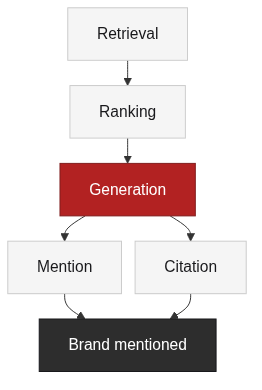
Brands get mentioned in ChatGPT and AI search when their information survives retrieval, ranking, and generation. In the retrieval step, the engine collects candidate pages for the question. In the ranking step, it decides which candidates best match the intent. In the generation step, it turns the top sources into an answer, and the brand appears either as a direct mention in the text or as a citation linked to a source.
Clear brand information makes every step easier. When the brand name, category, and description stay consistent across pages and profiles, the engine has less ambiguity to resolve and can mention the brand correctly instead of describing a confused version of it. The practical order is worth noting: a mention is the first signal most teams can earn, because it only requires the brand name to appear in relevant content, while a citation additionally requires a specific source the answer can attribute.
The boundary matters here as well. AI brand mentions usually start with pages the engine can actually retrieve, so publishing on a site that search engines do not sample does not move the mention count by itself. Focus the effort where the content is crawlable and contextually relevant to the question.
Mentions, Citations, and Backlinks: A Comparison
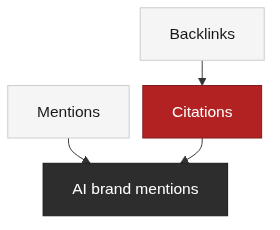
A side-by-side comparison makes the differences concrete.
| Signal | What it is | Where it appears | Main value |
|---|---|---|---|
| Mention | The brand name appearing in an answer or in content an engine reads | Answer text, articles, profiles | Recognition and name association |
| Citation | A linked reference that names a source | Answer text links and reference lists | Attributability and trust |
| Backlink | A link from another site to the brand’s page | Referring pages across the web | Both mention value and citation value |
The comparison shows why the three signals are not interchangeable. A mention without a citation can leave the brand unverifiable, because the engine has no source to attribute. A citation without a mention can attach the link to the wrong entity, because nothing ties it to the brand name. A backlink usually carries both values at once: it mentions the brand and cites a specific page.
For AI brand mentions, the practical order is to fix the mention first, then earn citations, then let backlinks reinforce both. Teams with limited resources should start where the gap is largest rather than treating the three signals as equal campaigns. The relevance of the referring source decides whether the pair gets associated with the right topic, which is why a high-quality link from an off-topic page can do less for the brand than a modest mention on a relevant one.
How to Improve Broader Web Presence for AI Mentions
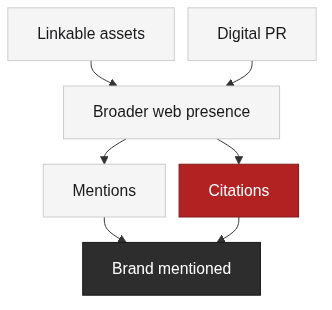
To improve broader web presence for AI mentions, start by becoming visible in the sources AI systems sample, not just ranking your own pages. The brand’s own site is only one layer; coverage, profiles, and references on other sites give the engine more places to find and verify the brand. The goal of AI brand mentions work is to make that external layer consistent, relevant, and verifiable.
Linkable assets are the practical engine behind this. An original dataset, a working tool, or a reference guide gives publishers a specific reason to mention the brand instead of a generic page. TraffiClimb’s guide to creating linkable assets walks through the formats that earn references, and the digital PR playbook shows how coverage outside the brand’s own site turns into mentions and citations. For teams new to this, the 2026 link building strategies guide covers the shift from collecting links to placing the brand where engines sample answers.
Priorities differ by situation. A brand with clear pages but no external coverage should invest in assets and outreach first. A brand with plenty of coverage but inconsistent descriptions should fix consistency before adding more mentions. Otherwise the new coverage keeps describing the wrong version of the brand.
An AI Brand Mentions Checklist
Use this checklist before and after any mention-building effort:
- Audit where the brand currently appears in AI answers. Run the same questions across ChatGPT and AI search, and record which answers mention the brand, which cite it, and which ignore it entirely.
- Check name and category consistency across the website, profiles, and external references. Mismatched names or categories are a common reason answers describe a brand incorrectly.
- Review which sources mention the brand, which cite it, and which only link to it. The mix tells you where the next effort should go.
- Identify linkable assets and digital PR angles that can earn new mentions. The asset list does not need to be long; one strong dataset or guide can out-earn several thin pages.
- Rerun the audit after publishing new assets or campaigns. The baseline only becomes useful when you compare it with the same questions later.
The checklist is deliberately small. Most teams fail on consistency and measurement, not on the number of tactics, so the last two items usually deserve more time than the first two.
Measure and Monitor AI Brand Mentions
Measure AI brand mentions by tracking how often the brand appears in answers and in the content engines read, and then monitor whether that number moves after changes. Semrush documents the backlink and referring domain structures that support this kind of measurement [3], and Ahrefs covers the link audit process for watching which sources mention or cite the brand [4]. The monitoring question is the same as in classic link building: did the brand’s share of the answer change after the new assets and coverage went live?
Use the same tools that audit, and rerun the checks on a fixed cadence. Answers can change without any change on your site, so the baseline and the rhythm matter more than any single snapshot. Watch for two failure modes: the brand disappears from an answer it used to appear in, and the brand gets described incorrectly. Both are signals to correct references or rebuild consistency, and both are easier to fix early.
Relevance filtering belongs in the measurement too. Not all mentions are equal, and a mention on an off-topic site can dilute the association. The guide to relevant backlinks explains how to judge that fit, and the high-quality backlinks evaluation guide separates the citations worth pursuing from the ones that add noise.
What Makes a Mention Trustworthy in AI Answers
What makes a mention trustworthy in AI answers is the source behind it, not the mention itself. An engine can only attribute a brand to a source it can verify, so the credibility of the referring page and the accuracy of its description decide whether the mention survives. A mention that comes from a low-quality or spam-adjacent page can attract the wrong kind of attention to the brand.
The risk side is part of the same model. Google’s link spam guidance defines the manipulative link and content signals that can damage how a brand is perceived [1], and the disavow documentation covers the formal path when unwanted links threaten that credibility [2]. Both belong in the workflow because mentions are only useful while the sources behind them stay defensible.
In practice, this means quality gates belong before outreach, not after. Check the target site’s relevance and trust profile before asking for a mention, and audit the existing reference set on the same criteria. A small set of trustworthy mentions outperforms a large set of noisy ones, and the AI answers will usually reflect that difference over time.
FAQ
References
Google Search Essentials, “Link spam”: https://developers.google.com/search/docs/essentials/spam-policies
Google Search Console Help, “Disavow links to your site”: https://support.google.com/webmasters/answer/2648487
Semrush Knowledge Base, “Backlink Audit”: https://www.semrush.com/kb/859-backlink-audit
Ahrefs, “Link Audit”: https://ahrefs.com/blog/link-audit/