
Affiliate Link Building: 7 Proven Strategies for Affiliate Sites
 Written by Warren Reed

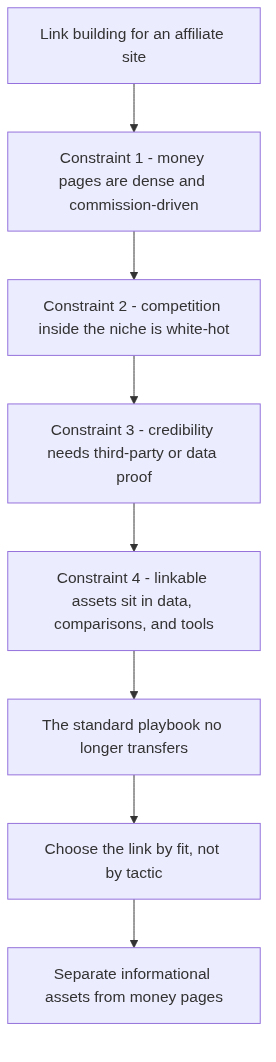
Most affiliate site owners already know that backlinks matter. The problem is not effort—it is that they copy the standard link building playbook and apply it to an affiliate scenario where the rules are different. Link building for affiliate sites fails not because the methods are wrong, but because four structural constraints change every decision: commercialization level, competition intensity, content credibility, and linkable asset shape. This guide gives you an affiliate-specific execution framework, not a rehash of general tactics.
Why Link Building for Affiliate Sites Is Hard
Affiliate link building fails for a structural reason, not for a lack of effort. Affiliate websites do not fail at link building because they work less. They fail because the standard playbook—built for brands, services, and informational publishers—does not fit a site whose primary pages are commission-driven money pages.
The counter-intuitive reality: affiliate site owners fail because they copy standard link building playbooks, not because they lack effort
When a service site earns a link, the linker is connecting readers to a brand, a product, or a resource. When an affiliate site asks for a link, the linker is being asked to endorse a page that exists to earn a commission. That is a different transaction. Editors and webmasters are far more willing to link to content that is verifiable, citable, and useful to their audience than to a page that is primarily promotional [1][2].
The real problem is four structural constraints—commercialization level, competition, content credibility, and linkable asset shape—that change every link decision
Four constraints are unique to affiliate sites, and each one shifts how you should approach link building for affiliate sites:
- Commercialization level — money pages are dense and commission-driven, so linkers naturally steer toward your informational content instead.
- Competition intensity — SEO competition inside a niche turns white-hot, making differentiated assets the only defensible moat.
- Content credibility — affiliate sites need third-party or data proof to be trusted, which makes publishers more selective.
- Linkable asset shape — your assets live in data research, comparison pages, statistics, and tools, not in product or review pages.
Commercial pages naturally earn fewer links because publishers only link to content that is verifiable, citable, and adds value
This is a mechanism, not an opinion. Linkers link to what helps their readers. A product review or a “best X” money page is useful to a reader who already decided to buy, but it does not give a publisher a reason to cite you. Data, original research, and comparison content do. That is why commercial pages sit at the bottom of the link-earning ladder [1][2].
The promise of this guide: an affiliate-specific execution framework, not a rehash of general link building methods
We will not relist generic tactics. Instead, we give you a framework that answers the real question: how do you earn links that last when your most important pages are the ones publishers do not want to link to? The answer is asset separation, channel selection by fit, and compliance discipline.
The Four Structural Constraints That Make Affiliate Link Building Hard
Understanding the four constraints is what turns link building for affiliate sites from a guessing game into a repeatable process.
Commercialization level—money pages are dense and commission-driven, pushing linkers toward informational assets instead
An affiliate site is built around money pages. Those pages carry affiliate links, comparison tables, and conversion-focused copy. That density is exactly what a linker sees and flags as promotional. The practical consequence: your money pages will rarely earn natural links, so you must build a separate layer of informational content that does the earning [1].
Competition intensity—SEO competition within a niche turns white-hot, making differentiated assets the only defensible moat
In a competitive niche, every affiliate site targets the same keywords with similar review and comparison pages. When everyone has the same content, no one earns links. The only moat is an asset nobody else has—original data, a unique tool, or a piece of research that becomes the default citation in your niche.
Content credibility—affiliate sites need third-party or data proof to be trusted, so publishers become more selective
A brand site has its own reputation to lean on. An affiliate site has to prove it. Without original data, expert input, or third-party citations, publishers have little reason to treat your content as authoritative. This raises the bar for every outreach you send.
Linkable asset shape—assets live in data research, comparison pages, statistics, and tools rather than product or review pages
The shape of a linkable asset is different for affiliates. It is not the money page. It is the study, the interactive comparison, the statistics roundup, or the calculator—content that a publisher can cite without endorsing a product. Getting this shape right is the single biggest unlock in affiliate link building.
How these constraints shift every link decision from a “method” problem to a “fit” problem
Because of these constraints, the real question is not “which tactic should I use” but “which tactic fits this asset, this audience, and this level of commercialization.” A guest post that works for a service site may be a risk for an affiliate site with dense money pages. The framework below turns that judgment into a checklist.
Separating Linkable Assets from Commercialization Pages
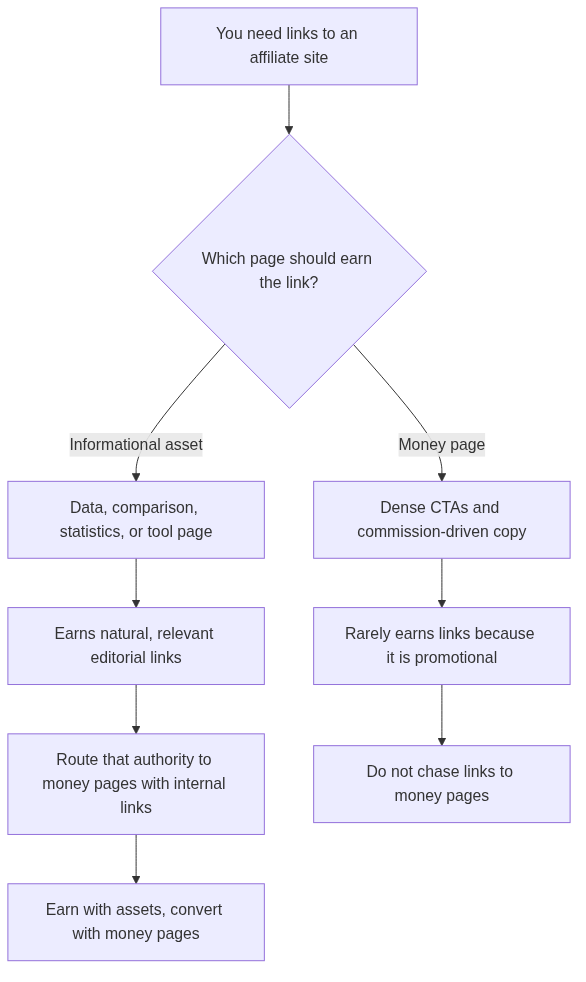
The core affiliate solution is a clean separation: earn links with informational assets, convert with money pages.
The core affiliate solution: earn links with informational assets, convert with money pages
Build a layer of linkable assets that earn authority. Then route that authority through internal links to the money pages that convert. This is the Linkable Assets strategy applied to an affiliate context: the asset earns, the money page converts, and the internal link connects the two.
What makes a strong linkable asset—data research, comparison and statistics content, tools, and guides that publishers want to cite
A strong asset gives a publisher a reason to link. In practice, that means:
- Original data or a study no one else has run
- A comparison or statistics page that rounds up niche facts
- A calculator or interactive tool that solves a recurring problem
- A definitive guide that becomes the default reference
These are the formats publishers cite. They are also the formats that naturally attract relevant backlinks.
Why comparison and data content outperform review pages for earning natural, relevant backlinks
Review pages answer a purchase question for one reader. Comparison and data content answer a question for many publishers: “what does the landscape look like?” That is citable. When a publisher writes about your niche, they link to the resource that summarizes the market, not to the page that sells one product. This is why comparison and data assets earn more natural links than review pages [1].
Mapping asset types to internal link anchors (Linkable Assets and Relevant Backlinks) so earned authority flows to conversion pages
Once an asset earns a link, the authority must flow somewhere useful. Use internal links from the asset to the money page with descriptive, natural anchors. This is how earned authority compounds: the asset pulls the link, the internal link passes relevance to the conversion page, and the site grows without forcing promotional links into outreach.
Affiliate-Specific Link Channel Selection
Not every channel fits an affiliate site. Here is how the major channels map to affiliate scenarios.
A channel-by-channel fit matrix: Digital PR, guest posting, resource links, and competitor backlink analysis in affiliate scenarios
| Channel | What it earns | Risk for affiliate sites | Best stage |
|---|---|---|---|
| Digital PR (data/news) | Authority + natural links | Low, if backed by real data | Mid to late |
| Guest posting | Relevant traffic + contextual links | Medium, guard against over-promotion | All stages |
| Resource links | Authority + batch relevance | Low | Mid to late |
| Competitor backlink analysis | Differentiated opportunities | Low, requires filtering | Early |
Which channels earn relevant traffic versus authority, and which carry higher risk for commercialized sites
Guest posting and resource links tend to earn relevant traffic and contextual relevance. Digital PR leans toward authority and natural links. The higher your commercialization density, the more you should favor authority-building channels (Digital PR, resource links) over channels that place promotional links in editorial contexts.
Relevance and quality as a double constraint—the link must be relevant and the source site’s audience must match your niche
For affiliate sites, relevance and quality are a double constraint. The link must be relevant to your topic, and the source site’s audience must match your niche. A high-authority link from an unrelated audience adds little to your search intent or your conversion path. Both conditions must hold [2].
Using competitor backlink analysis early to surface differentiated opportunities (Competitor Backlink Analysis anchor)
Run competitor backlink analysis early. Look at where your competitors earn links, then find the gaps you can fill with a better asset. If a rival earns links from a weak statistics page, publish a stronger one. Competitor analysis turns the four constraints into a concrete opportunity map rather than a vague strategy.
Positioning Digital PR as one of the few paths that bypass the “commercial page hard-to-link” problem (Digital PR anchor)
Digital PR is one of the few channels that bypasses the commercial-page problem entirely. Because Digital PR is driven by data and news value rather than by a product pitch, it earns links to your informational asset—not to your money page. For a commercialized affiliate site, that is the cleanest way to build authority without triggering promotional flags.
Guarding Against Self-Inflicted Damage: Over-Commercialization and Anchor Risk
The biggest threat to an affiliate site is not a weak tactic—it is self-inflicted damage from over-commercialization and careless anchor text.
How over-commercialized content—CTAs on every page, anchor text stuffing, all internal links pointing to money pages—damages credibility and linker willingness
When every page is packed with CTAs, when anchors are stuffed with keywords, and when every internal link points to a money page, the site reads as promotional. Publishers notice, and they stop linking. Over-commercialization does not just hurt conversions—it dries up the very links you need to rank [2].
Anchor text as an affiliate-specific risk: over-optimized exact-match anchors and uniform “all links to money pages” patterns get flagged
Anchor text is where affiliate sites most often hurt themselves. Exact-match anchors repeated across a link profile, combined with every link pointing to the same money page, create a pattern that search engines recognize as promotional. The fix is diversity: mix branded, URL, and natural descriptive anchors, and point links at assets and supporting pages, not only at money pages [2].
A practical pre-send checklist for controlling commercialization density, anchor diversity, and source quality
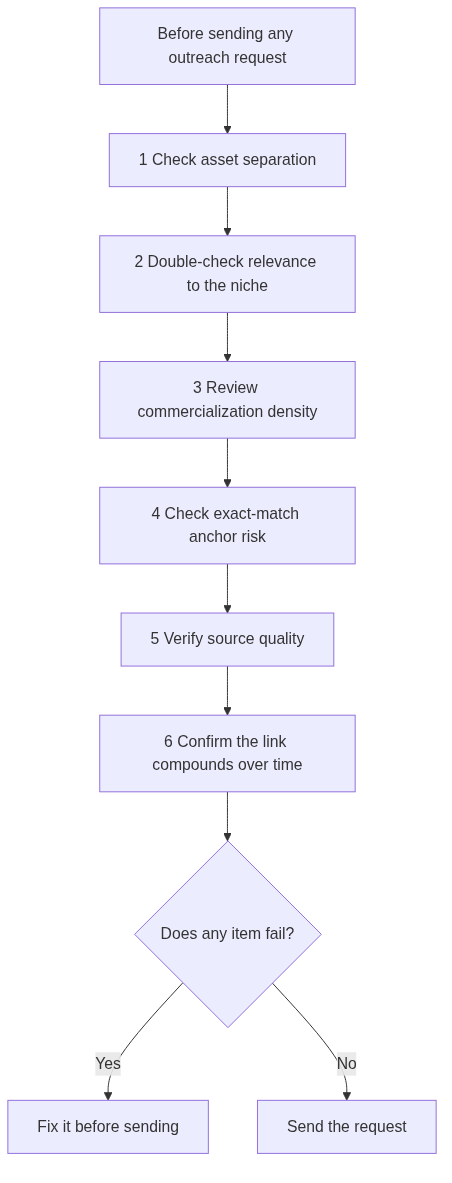
Before you send any outreach, run this checklist:
- Asset separation — does the link point to an informational asset, or a money page? Prefer the asset.
- Relevance double-check — is the source site relevant to your niche, and does its audience match your target conversion audience?
- Commercialization density — is the target page packed with CTAs? If so, reduce density before asking for a link.
- Anchor risk — is the exact-match anchor ratio too high? Are all links pointing to one money page? Diversify.
- Source quality — is the source authoritative, free of commercial contamination, and not part of a reciprocal-link pattern?
- Sustainability — is this a one-time purchase or a link that compounds over time? Prefer asset-type links.
Why compliance protects both the site’s trust and the durability of the links you earn
Compliance is not a constraint—it is protection. A compliant, content-driven approach keeps your site credible in front of publishers and keeps the links you earn durable over time. Following search engine guidelines on link quality and promotional content protects the trust your affiliate site depends on [2].
How to Apply an Affiliate Link Building Framework
Here is how the framework translates into a repeatable process.
Comparing affiliate sites versus standard commercial sites across commercialization, credibility, linkable asset shape, anchor risk, and competition
| Dimension | Standard commercial site | Affiliate site | Impact on link strategy |
|---|---|---|---|
| Commercialization level | Low to medium (brand/service) | High (dense money pages) | Affiliate relies more on informational assets |
| Content credibility | Strong brand backing | Needs third-party or data proof | Linkers are more selective |
| Linkable asset shape | Product, brand, case-study pages | Data, comparison, statistics, tools | Assets must be separated from money pages |
| Anchor risk | Medium | High (over-optimization is easy to spot) | Stricter anchor ratio control |
| Competition intensity | Industry-level | White-hot within the niche | Differentiated assets are the only moat |
A step-by-step decision checklist before any outreach: asset separation, double relevance check, commercialization density, anchor risk, source quality, and sustainability
Run the six-item checklist from the previous section before every outreach. If any item fails, fix it before sending. This turns judgment into a repeatable gate: asset separation first, then relevance, then commercialization density, then anchor risk, then source quality, then sustainability.
Red-light rules—when any checklist item fails, fix it before sending to protect credibility and avoid algorithm risk
Treat the checklist as a set of red-light rules. A link pointing to a money page with no context, a source with a mismatched audience, an over-commercialized target, a repeating exact-match anchor, a contaminated source site, or a one-time purchase—each of these is a red light. Correct the issue before you send. This protects your credibility and reduces algorithm risk.
Prioritizing asset-type links over one-time purchases for long-term, compounding value
One-time link purchases give you a short burst and nothing more. Asset-type links—links to data, tools, and definitive guides—keep earning citations and references over time. For an affiliate site, where every link decision is already constrained, prioritizing asset-type links is the highest-leverage move you can make for long-term, compounding growth.
The Bottom Line and Your Next Step
Affiliate link building succeeds when you separate linkable assets from money pages, choose channels by fit, and keep commercialization compliance in check.
Recap: affiliate link building succeeds when you separate linkable assets from money pages, choose channels by fit, and keep commercialization compliance in check
The framework is simple to state and hard to execute: build informational assets that earn links, keep money pages for conversion, select channels by fit rather than habit, and guard against over-commercialization and anchor risk at every step.
The high execution bar—asset building, channel selection, and compliance—is exactly where a strategic partner adds value
Asset building, channel selection, and compliance each demand time, data, and discipline. That is a high execution bar for a team already running an affiliate site. It is also exactly where a strategic partner with a content-driven, compliance-first approach earns its place.
Next step: evaluate how a premium, content-driven link building service can handle the heavy lifting for your affiliate site
If the execution bar—building linkable assets, selecting the right channels, and staying compliant—is more than your team can sustain in-house, a premium link building service can handle the heavy lifting. The goal is not a pile of links. It is a sustainable, compliant link profile that compounds. That is what a strategic partner for premium link building delivers.
FAQ
References
Ahrefs Blog: Link Building for Affiliate Sites — industry framework explaining why commercial pages naturally attract fewer links and how affiliate sites concentrate their linkable assets in informational content [1]
Google Search Essentials — official documentation explaining that link quality and relevance depend on the source site’s authority, relevance, and contextual naturalness, and that overly promotional or over-commercialized patterns carry recognized risk [2]
Google Search Central: Spam Policies for Google Web Search — official policy text on link spam, covering link schemes and the manipulative patterns that put commercial and affiliate sites at risk [3]