
Authority Backlinks: What Actually Makes a Link Worth Pursuing
 Written by Alistair MacLeod

Your competitor placed one editorial link inside a DA 40 industry blog and outranked the five links you stacked on a DA 90 directory. That scenario is not a fluke, and it is exactly why so many teams keep missing the point. The value of an authority backlink was never a domain score. It lives in whether a link is genuinely earned by an editor, whether it sits in relevant context, and whether real readers ever see it.
This guide is for SEO professionals and in-house teams who are tired of being told to “just find high DA / DR sites.” We will define what an authority backlink actually is, show you why high authority is not the same as high quality, and give you an executable path to earning links that drive sustainable ranking growth—without handing you a fixed DA / DR cutoff that the market keeps proving wrong.
What Is an Authority Backlink—and Why Your DA Obsession Is Misleading You
An authority backlink is not a link on a high-scoring website. It is a link placed editorially on a relevant, trusted page with real readers, in a context that tells search engines what your content is about. Chasing domain scores alone is how teams end up with impressive spreadsheets and disappointing rankings.
The Counterintuitive Scenario: A DA 40 Editorial Link Outranking Five DA 90 Directory Links
Picture two competing pages targeting the same keyword. Site A earns one contextual mention inside a well-read, topically relevant industry blog with a modest Domain Authority of 40. Site B buys five links from a high-DA directory network with scores around 90. In practice, Site A often wins. Why? Because the single editorial link carries relevance, natural placement, and real readership—signals that a directory link, no matter how high-scoring the domain, simply cannot replicate. The directory links sit in low-value context with no topical signal and no engaged audience.
Reframe the Goal: Authority Backlinks Are Earned Through Editorial Recognition, Relevance, and Real Readers—Not Domain Scores
The moment you stop optimizing for a number and start optimizing for “would an editor naturally cite this?”, your link strategy changes shape. Google’s own guidance is unambiguous on this point: the best links are those other sites create because your content is genuinely useful and relevant, not links you pay for, swap, or mass-place [1]. That is the difference between a link that moves rankings and a link that merely looks good in a report.
What This Guide Delivers: A Definition, the Misconceptions, and an Executable Acquisition Path
We will give you four dimensions that actually define an authority backlink, four traps that DA / DR scores hide, a path map for earning links from real authority sites, and a qualification checklist you can apply to every prospect. The goal is not a number. The goal is a repeatable filter for deciding whether a link is worth pursuing at all.
Defining the Authority Backlink: Four Dimensions That Actually Matter
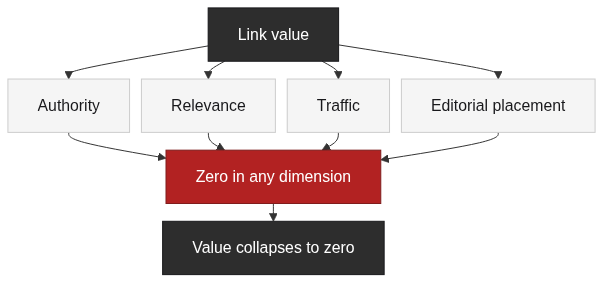
A useful mental model treats the value of an authority backlink as the product of four dimensions: authority, relevance, traffic, and editorial placement. Remove any one of them and the equation breaks.
Authority—Page-Level Trust and Topical Weight, Distinct From a Domain-Wide Score
Search engines evaluate links at the page level, not the domain level. Google’s core link analysis is built around PageRank, which is calculated for individual URLs, not for an entire domain folded into one number [2]. A homepage with a high score does not mean the specific page where your link sits carries the same weight. When you evaluate a candidate, ask about the page, not the domain.
Relevance—The Topic Signal That Tells Search Engines What Your Content Is About
A link from a highly authoritative but unrelated site tells search engines almost nothing about your topic. A link from a smaller, topically relevant site tells them exactly what your content is about. This is why a strong authority backlink is almost always a relevant one—relevance is the signal that connects your page to the right search intent [3].
Traffic and Editorial Placement—Real Readers and Natural In-Content Citation as the Trust Signal
Two things separate a natural editorial link from a manufactured one: real readers and in-content placement. A link in the body of an article, placed because the author found your content worth citing, is a trust signal. A link in a footer, sidebar, or a mass directory is not. Real traffic matters because a link with no readers is hard to treat as earned, and because referral traffic itself is a useful business outcome.
The Value Model: Link Value as the Product of All Four Dimensions, Missing Any One of Them Breaks the Equation
Think of it as link value = authority × relevance × traffic × editorial placement. Because it is a product, a zero in any dimension collapses the whole value to zero. A highly authoritative but completely irrelevant link is worth little. A relevant link with no editorial placement is worth little. This is the lens you should carry into every prospect evaluation, and it is the same lens that exposes why a fixed DA / DR cutoff is a trap.
High Authority Is Not High Quality: Four Traps That DA/DR Scores Hide
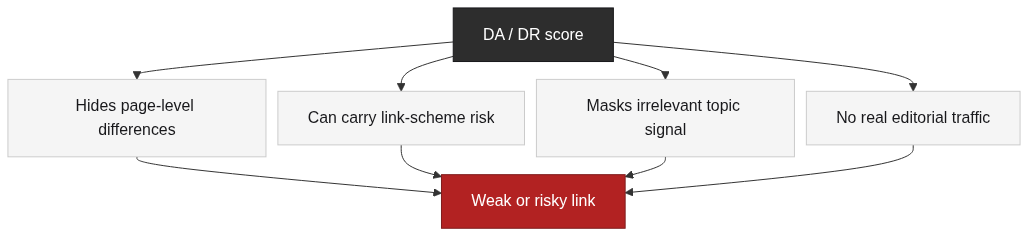
Domain Authority and Domain Rating are third-party estimates, not Google ranking factors. They aggregate an entire domain into a single number, which hides more than it reveals. Here are four traps that live behind a high score.
Trap 1—Domain-Level Aggregation Hides Page-Level Differences (Homepage DA ≠ Target Page Authority)
The homepage of a site might carry a high score while the specific page where your link would sit carries far less weight. When you evaluate a prospect by its domain number alone, you can easily mistake a strong homepage for a strong target page. Always pull the page-level signals for the exact URL before you commit.
Trap 2—High-DA Pages Can Carry Link-Scheme Risk and Paid-Link Footprints
A high-scoring domain is not automatically clean. Some high-DA pages accumulate paid-link footprints and mass directory placements that can be flagged as a link scheme under Google’s guidelines [1]. A link there is not just low-value—it is a compliance risk that can outweigh any theoretical benefit. Screening for this risk is part of qualifying a prospect, not an afterthought.
Trap 3—High DA but Irrelevant: Weak Topic Signal, Limited Ranking Help
A link from a massive but unrelated site delivers almost no topical signal to search engines. It might look impressive on paper, but it does little to tell Google what your page is about. Relevance is the dimension that turns a link into a ranking signal, and no domain score can substitute for it [3].
Trap 4—High DA but Zero Editorial Traffic: No Real Readers, Unlikely to Be Seen as a Natural Editorial Link
A link with no real, relevant readers is hard for search engines to interpret as earned. If the page has no engaged audience and the link sits in a low-value placement, it is unlikely to behave like a natural editorial citation. Real traffic is not just a nice-to-have; it is part of what makes a link read as genuine.
How to Find and Earn Real Authority Sites: The Acquisition Path Map
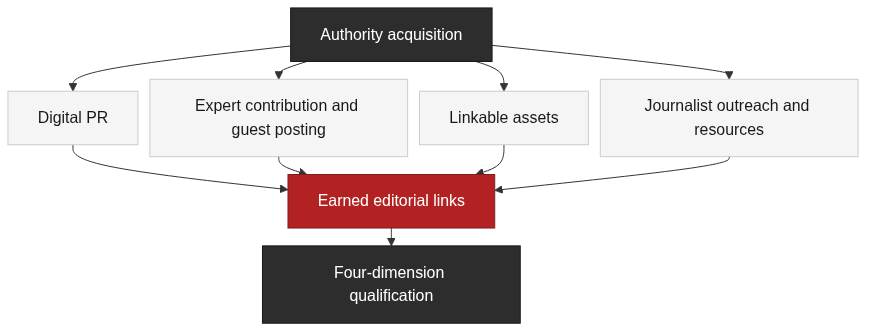
Rather than a full tutorial on each tactic, here is a path map for where authority backlinks actually come from—and which of the four dimensions each path solves. For deeper how-tos, explore our guides on Link Building Strategies, Digital PR, and Guest Posting.
Digital PR—Leverage News and Data to Earn Editorial Links
Digital PR uses a compelling data point, a news angle, or a story to earn coverage in high-authority media. It solves the authority and editorial dimensions at once: the link is placed by a journalist or editor who chose to cite you. If your team has original data or a strong narrative, this is the highest-value path for authority backlinks. It is also the highest cost and longest cycle, so it needs a real story to justify the investment.
Expert Contribution and Guest Posting—Build Relevance and Authority in Related Industry Blogs
Contributing expert commentary or a well-researched guest post to a relevant industry publication solves the relevance and editorial dimensions. Unlike a mass directory placement, a genuine contribution is placed because the publication values your perspective. The key is targeting publications your audience actually reads, not the highest score you can find.
Linkable Assets—Make Others Link to You Through Original Data, Reports, and Free Tools
A linkable asset—original research, a data-driven report, or a genuinely useful free tool—reverses the outreach dynamic. Instead of asking for a link, you create something others want to cite. This path solves the traffic and editorial dimensions by making the link a natural, earned choice. It requires a high initial investment but pays back over a long horizon as others link to it repeatedly.
Journalist Outreach and Resource Opportunities—Earned Placement in High-Authority Media and Curated Resource Lists
Journalist outreach (including HARO-style services) connects you directly to reporters looking for expert sources, often yielding editorial links in high-authority outlets. Resource opportunities work differently: your product or content gets listed on a curated resource page relevant to your niche. Both solve the authority and relevance dimensions, and both reward teams that respond quickly and provide genuinely useful input.
Authority Prospect Qualification: A Checklist to Screen Links Worth Pursuing
Before you send a single outreach email, run every candidate through a qualification filter. This is how you turn the abstract concept of an authority backlink into a repeatable decision.
The Seven-Point Qualification Checklist
Work through each of these for every candidate link:
- Page-level authority: What does the specific target URL look like, not just the domain? Pull page-level signals for the exact page.
- Relevance: Is this page and site topically relevant to your content in a way search engines can understand?
- Editorial context: Is the link placed naturally in the article body because the author cited you, or is it in a footer, sidebar, or link list?
- Real traffic: Does the page have real, relevant readers, and could the link deliver valuable referral traffic?
- Editorial review: Did the publisher actually read and approve your content, or is this a paid placement with no review?
- Compliance risk: Does the placement follow search engine guidelines, or could it read as a link scheme [1]?
- Uniqueness: Is this link something only you can earn, or can anyone buy the same spot (which erodes its distinctiveness)?
The Four-Dimension Scoring Framework
Score each of the four dimensions—authority, relevance, traffic, editorial placement—on a 0-to-5 scale. Add them up:
- Total ≥ 12 / 20: worth pursuing as an authority backlink.
- Total 8–11: decide based on strategic value, such as brand exposure.
- Total < 8: let it go and avoid the high-score, low-value trap.
There is one hard rule: if any single dimension is zero—for example, the page is completely irrelevant, or the placement is purely paid with no editorial context—then the link should not be treated as an authority backlink, no matter how high the other scores are.
Scenario Comparison: High-Score-but-Underperforming vs. Genuinely High-Value Links
| Dimension | High-score trap (DA/DR) | Genuine authority backlink |
|---|---|---|
| Domain score | DA 85 / DR 70+ | Possibly only DA 40, but highly relevant |
| Placement | Footer, sidebar, mass directory | In-content, contextual citation |
| Relevance | Unrelated to your topic | Strongly related to your content |
| Traffic | No real readers (or all crawlers) | Real, relevant audience |
| Editorial | Paid, swapped, or mass-placed | Cited because the content has value |
| Risk | Could be flagged as a link scheme | Follows search engine guidelines |
| Result | Limited or no ranking lift | Transfers topical authority, sustainable |
Common “High-Authority Link” Misconceptions and Your Next Steps
The biggest mistakes in link building are not tactical. They are conceptual, and they all trace back to treating a score as a substitute for quality.
The Most Common Misconceptions
Three misconceptions show up constantly. First, chasing DA / DR alone, which treats a third-party estimate as if it were a Google ranking factor. Second, ignoring relevance, which produces links that are authoritative but useless for your topic. Third, being seduced by high-authority media that publish your link with no editorial context—a placement that looks impressive but behaves like a low-value citation. Each of these is a symptom of optimizing for the number instead of the four dimensions.
The Core Takeaway: Pursue Links That Are Earned, Relevant, and Read—Not Merely High-Scoring
An authority backlink is earned, relevant, and read. It sits in context because an editor found your content worth citing. It tells search engines what your page is about. And it reaches real readers who might become customers. When you evaluate against those three qualities instead of a score, the right opportunities become obvious and the wrong ones stop draining your resources.
Your Next Step: Evaluate Your Current Link Profile and Align With a Strategic Partner
Start by running your existing link profile through the seven-point checklist and the four-dimension scoring framework. Identify the links that read as high-score traps and the ones that genuinely transfer authority. Then, as you plan the next quarter of acquisition, consider whether your team has the resources to run Digital PR, expert contributions, and linkable assets at scale—or whether a strategic partner who handles premium, compliant placements is the more sustainable path.
At TraffiClimb, we approach every campaign as a strategic partner for premium link building, not a marketplace that sells numbers. Every placement follows search engine guidelines and is evaluated against the same four dimensions we outlined here. If you want to audit your current profile or build an acquisition plan around links that are actually worth pursuing, we are ready to help—reach out to discuss your strategy.
FAQ
References
Google Search Central — Link schemes — Google’s official guidance on what constitutes a link scheme and why the best links are earned through unique, relevant content rather than paid, swapped, or mass-placed links.
Moz — Domain Authority — Official description of Domain Authority as a third-party predictive score, distinct from any Google ranking factor.
Ahrefs — Domain Rating — Official explanation of Domain Rating as a domain-wide aggregation metric that hides page-level differences in link profile strength.
Ahrefs — Link Building for SEO — Industry reference on why relevance and editorial context, not domain scores alone, determine link value.