
International Link Building: 7 Steps to Localize Prospecting & Outreach
 Written by Warren Reed

International link building is not a matter of running your home-market playbook in more countries. When you expand into a new language or region, the links that drove your rankings at home lose most of their value, and the ones that would actually move the needle are invisible to a copy-pasted strategy. This guide explains why relevance is country, language, and audience — not DR alone — and walks through a seven-step workflow for localizing prospecting and outreach across markets.
Why Copy-Pasting Your Home-Market Link Strategy Fails Abroad
The copy-paste trap: DR climbs while local rankings stay flat
Picture a team that spent a year perfecting an English-language outreach playbook. They replicate it in German, French, and Japanese markets — same templates, same prospect filters, same pitch. Their domain rating climbs steadily. Yet the local SERPs they care about barely move.
This is not an edge case. It is the predictable outcome of treating link building as a volume game when it is actually a relevance game. A high-authority link from a site that serves readers in the wrong country or language is, for the target market, close to noise. The authority signal is real, but the geographic and linguistic context is mismatched, so Google weighs it far less for that market’s results.
The core reframe: the right links in the right markets
Here is the shift that changes everything: international link building is not about getting more links. It is about getting the right links in the right markets. A mid-authority link from a local publisher that serves your exact audience in their native language will consistently outperform a high-authority global link that points at readers who will never convert on your offer.
That reframe has practical consequences. It means your prospecting cannot be a single filtered list. It means your outreach cannot be one template translated on the fly. It means every market gets its own research, its own prospect qualification, and its own outreach language.
Thesis preview: rebuild around language, market, and audience
The rest of this guide treats international link building as a per-market discipline. You will learn how to judge whether a link is genuinely relevant to a market, how to localize prospecting by language, how to run outreach that respects native-language conventions, and how to manage multiple markets without cross-wiring your prospect lists. By the end, you will have a repeatable workflow you can apply to any country you enter.
What “Relevant” Actually Means in International Link Building
Backlink value is authority × relevance — not DR alone
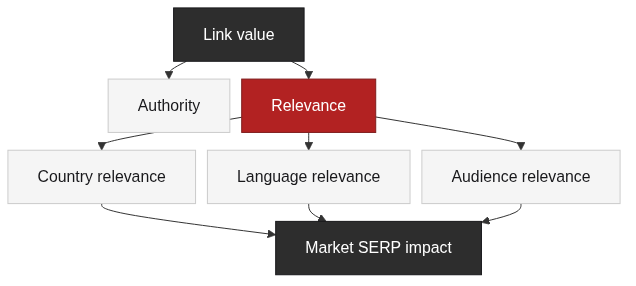
The first mental model to discard is that a link’s value is its domain rating. In international link building, value is better expressed as authority × relevance, where relevance is the product of three dimensions:
- Country relevance — does the publisher’s audience live in the market you are targeting?
- Language relevance — is the content in the language your target audience reads?
- Audience relevance — does the publisher reach the people likely to become your customers?
A link that scores high on authority but low on all three relevance dimensions contributes almost nothing to your local rankings. A link that scores moderate on authority but high on all three relevance dimensions does most of the work. This is why the same link portfolio can look impressive in one market and useless in another.
Global vs country-specific backlinks: how each is weighted
Global and country-specific links serve different purposes, and they are not interchangeable.
| Dimension | Global link | Country-specific link |
|---|---|---|
| Target SERP | Broad multilingual, multi-region weighting | Strong weighting in one country or language |
| Typical source | High-DR English portal, international industry media | ccTLD or local domain, native-language media, local blogs |
| Language signal | Primarily English | Target market’s native language |
| Audience signal | Global general audience | Local audience |
| Best used for | Brand authority, GEO and AI-search visibility | Local rankings, local conversions, local trust |
| Risk | Limited contribution to local rankings | Wasted spend if the market judgment is wrong |
| How to judge | Look at authority and semantic weight | Look at domain type + language + audience geography + traffic source |
The practical takeaway: if your goal is to rank in a specific country or language, you need country-specific links. Global links are a complement, not a substitute. A healthy portfolio includes both, but you should never assume a stack of global links will lift a local market.
The 5-point checklist for judging ccTLD / regional publishers
To decide whether a prospect is genuinely local, run it through this five-point checklist. A link qualifies as locally relevant if it meets at least three of the five criteria.
- Domain type — Is it a country-code TLD (
.de,.fr,.co.jp), or a.comwith a localized subdirectory such as/de/or/fr/? - Content language — Is the page’s primary language the same as your target market’s?
- Author or editor — Is the byline a local author or a local team, or is the piece syndicated from elsewhere?
- Audience geography — Is the traffic source concentrated in the target country?
- Semantic context — Does the content discuss local topics, local data, or local examples?
If a prospect fails three or more of these, treat it as a global link and evaluate it on its own merits — do not count it toward your local-market goal.
Localizing Prospecting by Language and Market
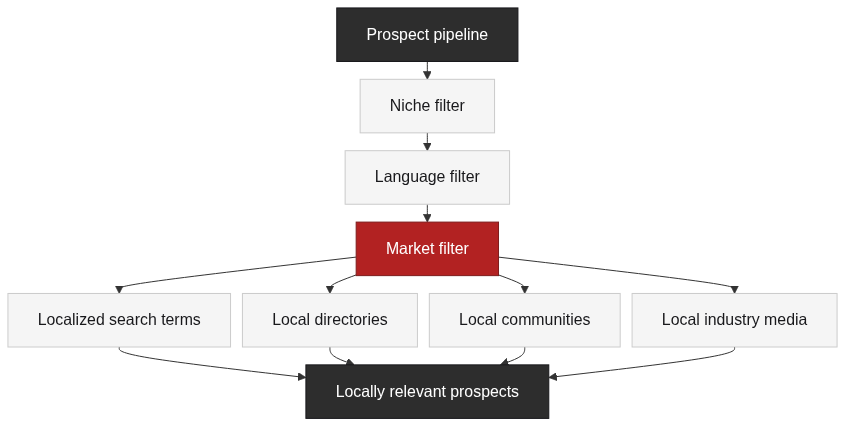
Multilingual prospecting: language + market filters, not just niche
Most prospect lists are built with a single filter: same niche. That approach breaks the moment you go international, because a German SEO site and an English SEO site are both “same niche” but serve completely different markets.
Multilingual prospecting means stacking a language filter and a market filter on top of your niche filter. Concretely, that means:
- Searching with localized search terms in the target language, not English keywords translated in your head.
- Pulling from local directories and industry registries that English-language tools underweight.
- Monitoring local communities — forums, Slack groups, and newsletters where editors and site owners actually gather.
- Following local industry media and their contributor networks rather than only international publications.
When you search in the target language, you surface publishers that simply never appear in an English query. That is where the locally relevant link opportunities live.
Local-market competitor research: separate analysis per market
You cannot reuse your home-market competitor backlink analysis for a new country. The competitors who rank in Germany are often not the competitors who rank in your home market, and the links that put them there are local.
For each target market, run a separate competitor backlink analysis and a backlink gap analysis. The goal is to identify local links that your local competitors hold and you do not. Those gaps are your highest-priority prospects, because they are proven to influence the SERP you are trying to enter.
This is where the discipline of competitor backlink analysis and backlink gap analysis pays off — but applied per market, not once for the whole company.
Applying the ccTLD checklist to qualify prospects
Before a prospect enters your pipeline, qualify it against the five-point checklist from the previous section. This step is easy to skip and expensive to miss. It is the difference between a pipeline full of locally relevant opportunities and a pipeline full of high-DR links that will not move your target market.
For a deeper treatment of how to build and filter prospect lists in the first place, see our guide to link prospecting. The qualification logic here is the international layer on top of that core process.
Localizing Outreach: Native-Language Email and the Translation Trap
Why outreach language must match the editor’s native language
The single most common failure in international outreach is sending a machine-translated English template to an editor who writes in German, French, Japanese, or Spanish. It reads as low-effort, it signals that you do not respect the publication or its audience, and it is far more likely to be ignored or archived.
Outreach language should match the editor’s native language, not your convenience. When you write to an editor in their own language, you demonstrate that you understand their market, their readers, and their publication. That single choice raises your reply rate more than any template tweak.
Translation is cultural context, not word substitution
Localizing outreach is not word-for-word translation. It is cultural adaptation. Consider the conventions that machine translation misses:
- Formality levels — German editors expect formal address (Sie), while a casual tone can read as disrespectful.
- Honorifics and register — Japanese outreach demands levels of politeness and indirectness that English simply does not have.
- Sign-off conventions — a warm, direct English closing can feel abrupt or presumptuous in another culture.
- Idioms and marketing phrases — direct translations of English marketing language often sound unnatural or even meaningless in the target market.
A native speaker or a seasoned local editor should review every outreach email before it goes out. If you do not have that resource in-house, account for it — it is the difference between outreach that lands and outreach that is deleted.
The pre-send localization checklist
Before you send a single email in a new market, run this checklist:
- [ ] The email language matches the editor’s native language, not a machine translation.
- [ ] Formality and honorifics match local conventions (for example, Sie in German, appropriate register in Japanese).
- [ ] The sign-off and sender name are local and credible.
- [ ] Examples and data are local — not your English-market case studies pasted in.
- [ ] A native speaker or local editor has reviewed the message.
- [ ] Direct-translated marketing phrases have been removed and replaced with natural local phrasing.
For the broader mechanics of writing and sequencing outreach campaigns, see our guide to link building outreach. The localization layer here is what makes that process work across borders.
Scaling Across Markets: Managing Prospect Lists and Balancing Quality with Relevance
Multi-country prospect list management: bucket by market
When you run several markets at once, the fastest way to create chaos is to keep one combined prospect list. German editors get pitched as English editors, French opportunities get double-contacted, and you lose track of what has been sent where.
Instead, structure your list with explicit fields and buckets:
- Market bucket — separate lists or clear tagging for each country or language market.
- Language field — the language the outreach must be written in.
- Region field — the geographic focus of the publisher.
- Status field — prospected, qualified, contacted, replied, placed, or rejected.
This structure prevents cross-wiring and makes it easy to hand a market to a local specialist without re-explaining the whole context. It also lets you measure reply and placement rates per market, which is essential for knowing where to invest next.
The decision framework: high-DR-but-wrong-market vs mid-DR-but-locally-relevant
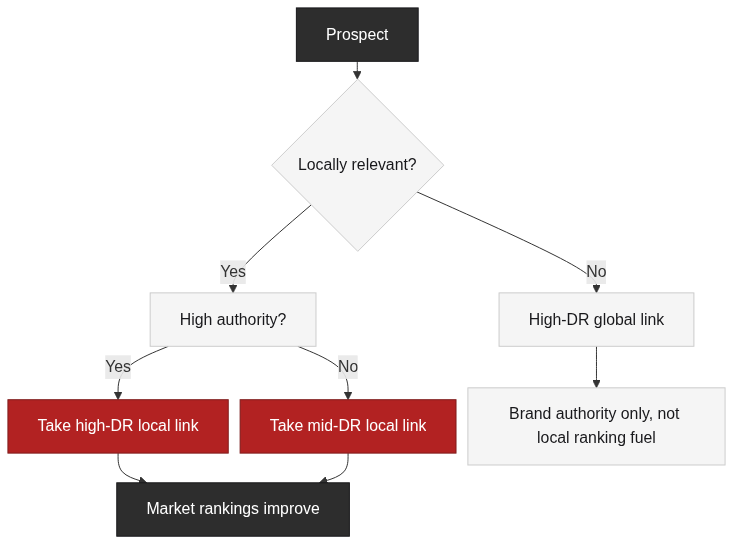
Every international campaign hits the same decision: take the high-DR link in the wrong market, or the mid-DR link that is perfectly local? The answer, in almost every case, is the local link.
Use this decision framework:
| Situation | Choose | Why |
|---|---|---|
| High-DR global link vs mid-DR local link | Mid-DR local | The local link carries the country, language, and audience signals your target SERP needs |
| High-DR local link available | High-DR local | Best of both worlds — take it |
| Only global links available | Global, but don’t count it toward the local goal | Treat it as brand authority, not local ranking fuel |
| Local link but very low authority | Deprioritize unless it’s a trusted niche site | Relevance matters, but so does minimum authority |
The principle: for a specific market goal, relevant backlinks always beat high-authority irrelevant ones. You are building a link building campaign for a market, not a portfolio for a dashboard.
Regional Digital PR: recreate, don’t reuse
A single English press release will not travel well. Regional Digital PR requires recreating your data, your news angles, and your examples for each market, because:
- Local data — journalists want data that reflects their own market, not someone else’s.
- Local holidays and events — a campaign timed to a US holiday is irrelevant in Japan or Germany.
- Local news hooks — what is newsworthy varies by country and by the local media’s editorial priorities.
- Local spokespeople — a local voice lends credibility that a foreign brand name cannot.
This is more work, but it is the difference between press coverage that earns links and a pitch that gets ignored because it is obviously recycled.
Publisher Landscape Differences and How They Shape Your Playbook
Why each market’s publisher ecosystem differs
The media and publishing landscape is not uniform from country to country. Each market has its own mix of:
- Media ecosystem — the density and structure of national, regional, and trade press.
- Blog culture — how active and how influential local blogs are compared to mainstream media.
- Directory and platform activity — how much link value flows through local directories and industry platforms.
- Paid vs editorial acceptance — how willing editors are to accept sponsored or placed links versus editorial ones.
These differences are real industry facts, not abstractions. A strategy that works in one market can fail outright in another simply because the publisher landscape is different.
Scenario matrix: four market archetypes
Different markets fall into recognizable archetypes, and each one demands a different approach.
| Market trait | Typical behavior | Recommended strategy |
|---|---|---|
| Editorial-link-led (for example, German-speaking markets) | Low tolerance for paid or marketplace links, high value on editorial quality | Lead with regional Digital PR and content-driven placements; de-emphasize direct purchase |
| Platform / directory-active (for example, parts of Eastern Europe and Southeast Asia) | Directories, aggregators, and industry platforms are active link sources | Use local platforms selectively, but apply strict quality control |
| English-capable but localized (for example, Nordic markets) | Editors read English, but native-language signals are strong | Bilingual approach: English content plus native-language landing pages and sign-offs |
| Strong language barrier (for example, Japanese, French) | Editors reject English outreach; language is the gate | Native-language outreach only, with local review |
Mapping landscape traits to strategy
Once you identify which archetype a market falls into, the playbook follows:
- Editorial-link-led markets → invest in regional Digital PR and high-quality content that justifies editorial placement.
- Platform-active markets → leverage local directories and platforms, but verify each one against your quality checklist.
- English-capable markets → use a bilingual strategy to keep native-language signals while lowering translation costs.
- Strong-language-barrier markets → commit to native-language outreach with local review, and accept the higher cost per placement.
This mapping is what turns “we build links in many countries” into “we build the right links in each country.”
Your Action Guide: The 7-Step International Campaign Workflow
Step 1: Prioritize markets before you prospect
Rank your target markets by traffic potential, language barrier, competition intensity, and business ROI. Then start with just two or three markets. Spreading thin across ten countries on day one guarantees shallow results everywhere.
Step 2: Run per-market competitor research
For each prioritized market, run a separate competitor backlink analysis and backlink gap analysis. Surface the local links your local competitors hold that you do not. These are your priority prospects.
Step 3: Build multilingual prospect lists
Construct each market’s prospect list using localized search terms, local directories, local communities, and local industry media. Bucket the lists by market and tag every entry with language, region, and status fields.
Step 4: Qualify every prospect against the ccTLD checklist
Before a prospect enters your pipeline, run it through the five-point checklist. Keep locally relevant prospects; move everything else to a separate global-link track.
Step 5: Send localized outreach
Write outreach in the editor’s native language, with local formality, local sign-off, and local examples. Have a native speaker review each message before it goes out.
Step 6: Run regional Digital PR
Recreate your data, news angles, and examples for each market and pitch local media. Treat this as a per-market activity, not a one-time English campaign.
Step 7: Verify quality and iterate continuously
Verify each placed link against your quality and relevance checklist, and review reply rates, placement rates, and local rankings per market each month. Reallocate investment to the markets that are responding and adjust the ones that are not.
Core Takeaways and Next Steps
Recap: relevance is country + language + audience
If you remember one thing from this guide, let it be this: international link building is a relevance game, not a volume game. Value is authority times relevance, and relevance is country, language, and audience. Localize your prospecting and your outreach for each market instead of replicating your home strategy, and the local links that actually move rankings will follow.
Action prompt: audit one of your target markets
Choose one market you are entering or currently underperforming in. Run its prospects through the five-point ccTLD checklist, compare your links against your local competitors with a gap analysis, and check whether your outreach is written in the editor’s native language. You will typically find the fix within days.
Request a consultation on your international link strategy
Localizing link building across markets takes more than templates — it takes a partner who treats each market as its own campaign. If you are expanding into new countries or languages and want a strategy that respects relevance at every step, request a consultation with TraffiClimb and let our strategic-partner approach plan your international link building the right way.
FAQ
References
Google Search Central — Managing multi-regional and multilingual sites — Google’s official guidance on how localized content and regional signals affect search visibility across markets.
Google Search Central — hreflang for language and regional URLs — Google’s documentation on language and regional URL signals that underpin the relevance dimensions discussed here.
Ahrefs Blog — Link building for international SEO — Industry guidance on adapting link building to multiple languages and regions, supporting the per-market approach in this guide.
Moz — International SEO: the complete guide — Foundational explanation of country and language relevance and how regional publishers influence local rankings.
Conclusion
International link building fails when it is treated as a scaled-up version of a home-market campaign. It succeeds when every prospect is qualified for country, language, and audience relevance, every outreach is written in the editor’s native language, and every market gets its own research, its own Digital PR, and its own measurement. Start with two or three markets, apply the five-point ccTLD checklist, and let local relevance — not domain rating — decide which links you pursue.
Before you scale, run the checklist against your current prospect list and set up separate market buckets, language fields, and local-review steps for every outreach email. Track reply and placement rates per market each month, then shift budget toward the markets that respond. International link building is a long-term, per-market discipline: the local links you earn this quarter become the rankings and revenue you measure next.