Local Link Building: 12 Proven Local Backlink Sources for Local SEO
 Written by Warren Reed

Nearly half of all Google searches carry local intent, yet most local businesses stop at Google Business Profile and citations and never touch the signal that often matters most for local rankings: geographically relevant backlinks [1]. This guide explains what local link building is, why geographic relevance carries real value, how to judge whether a local backlink is worth pursuing, and where to find actual local link opportunities in your service area.
If you run a local service business, a brick-and-mortar store, or a regional B2B operation, the difference between ranking in the Local Pack and getting buried on page two is not only about how many links you have. It is about whether those links prove to search engines that your business genuinely belongs to a specific place.
Why Local Businesses Are Missing the Geographic-Relevance Signal
A quantified opening scene
Roughly 46% of Google searches carry local intent, which means a large share of queries are people looking for a service or product near them [1]. For a local business, visibility in those searches directly determines whether you get the call, the walk-in, or the booking. Yet many local businesses treat local SEO as a two-part task: set up Google Business Profile, then build citations. Both matter. But they leave out a third, distinct signal — backlinks that are relevant to your geographic area. For local SEO, local link building is the missing third signal that connects a business to its service area.
The pain point contrast
Consider a local law firm competing with a national chain. The national chain can point to a high-authority link from a global publication with zero regional connection. The local firm, by contrast, earns a single link from the local chamber of commerce or a local news site. That one local link can do more for local rankings than the high-authority link with no regional tie [2]. The reason is simple: the chamber link tells the engine that this firm is a real, recognized part of that community, not just a website that happens to serve people there.
Establish the core thesis
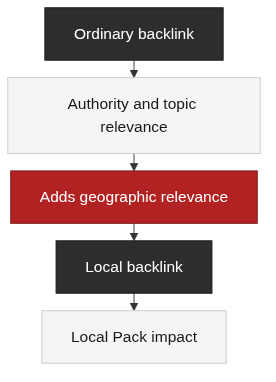
The core idea of this guide is that local links are not ordinary links. An ordinary backlink is judged mainly on authority and topic relevance. A local backlink adds a third dimension: geographic relevance. Throughout this guide, we walk through the evaluation criteria you can use to judge any local link opportunity, aligned with broader link building strategies, and a source map of real local resources where those opportunities live.
What Local Link Building Is — and How It Differs From Ordinary Backlinks
Define local link building
Local link building is the practice of earning backlinks that carry geographic relevance for a business that serves a specific area. It layers “geographic relevance” on top of the two signals ordinary backlinks already carry — authority and topic relevance. A link from a local business directory in your city, a local news story about your business, or a member page on your chamber of commerce website all count as local backlinks because the source is connected to the same region you serve.
A comparison matrix
| Comparison dimension | Ordinary backlink (global / broad-vertical) | Local backlink (geographically relevant) |
|---|---|---|
| Primary goal | Build domain authority and global trust | Strengthen local entity authority and geographic relevance |
| Relevance dimension | Topic relevance | Topic + geographic double relevance |
| Typical sources | Industry blogs, digital PR, aggregator platforms | Local directories, local media, chambers, associations, events |
| Impact on Local Pack | Indirect, weaker | Direct, stronger |
| Risk | Irrelevant or low-value links may be ignored | Low-value reciprocal directories carry similar risk |
| Best fit | National / global businesses | Local services, physical stores, regional markets |
Clarify the boundary in one sentence
To keep the scope clear: citations are structured NAP (name, address, phone) mentions on directories and platforms that mainly reinforce local entity consistency, while backlinks are clickable links from other pages that mainly pass authority and relevance signals — the two work together, but local link building is not citation building, and this article does not cover citation building [3].
Why Geographic Relevance Carries Real Value for Local Rankings
The engine’s entity–location–topic triangle
Search engines do not judge a link by source authority alone. They weigh how well the source aligns with the target page across geography and topic [4]. A link from a site in your city that covers your industry satisfies both dimensions; a link from a high-authority site with no regional or topical connection satisfies neither. That is why geographic relevance is not a nice-to-have — it is a core part of how the engine evaluates whether your business belongs in a local result.
Double relevance
Local links are powerful because they satisfy both “same region” and “same vertical” at once. This double relevance amplifies local entity authority, the same principle that makes relevant backlinks so effective and feeds directly into the Local Pack, the block of local results that captures a significant share of clicks on local-intent searches [5]. When your links come from local sources in your industry, you are telling the engine, repeatedly and consistently, that you are a recognized player in that specific market.
Data support
Link signals have long ranked among the front-line factors in Moz’s Local Search Ranking Factors, sitting just behind Google Business Profile-related signals [5]. And the value of local links is not just mechanical. As the Ahrefs team puts it, “the value of local links is not only in passing authority, but in proving to search engines that your business is genuinely relevant to a specific geographic area” [6]. That is the strategic edge local link building gives you.
How to Judge Whether a Local Backlink Is Worth Pursuing
The evaluation dimensions
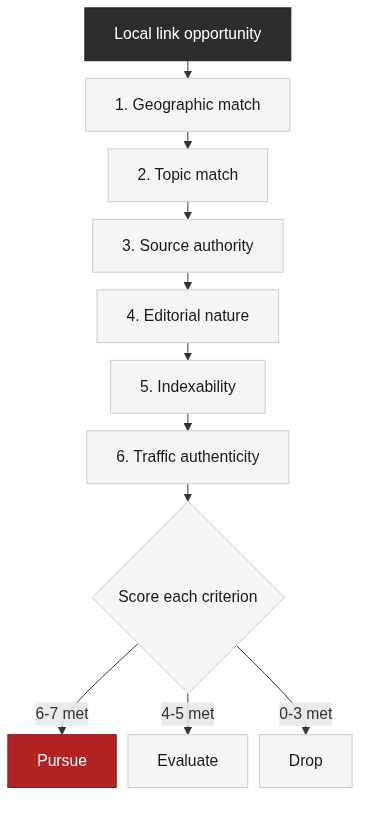
Before you spend time on outreach, run any local link opportunity through six evaluation dimensions: geographic match (does the source align with your service area?), topic match (does the source’s content relate to your vertical?), source authority (does the source have real traffic, editorial review, and consistent updates?), editorial nature (does the link appear naturally in content, rather than as a pure sponsorship or exchange?), indexability (is the page crawlable and free of heavy nofollow use or paywalls?), and traffic authenticity (does the source have real readers, not just SEO tool sites?).
A pre-outreach checklist
| Criterion | Check |
|---|---|
| Geographic match | Source aligns with or is highly related to your service area |
| Topic match | Source content or site topic relates to your vertical |
| Source authority | Real traffic, editorial review, consistent updates |
| Editorial nature | Link appears naturally in content context |
| Indexability | Page is crawlable, no heavy nofollow, no login wall |
| Traffic authenticity | Real readers and visitors, not a pure SEO tool site |
| Compliance | Acquisition follows search engine guidelines |
A simple scoring threshold helps you decide: if a prospect meets six to seven criteria, treat it as high priority and pursue it. If it meets four to five, evaluate it before committing outreach. If it meets three or fewer, drop it. This is the same discipline that separates high-quality backlinks from wasted effort [7].
How to apply the framework
The framework is most useful when it stops you from chasing the wrong link. A high-DA source with zero regional connection may look impressive in a backlink report, but if it fails the geographic-match and topic-match checks, it is not a local backlink and will not move your local rankings the way a smaller, relevant local source will [2]. Apply the checklist before you invest in outreach, and you will spend your effort where it actually compounds.
Where to Discover Real Local Link Opportunities
The local source map
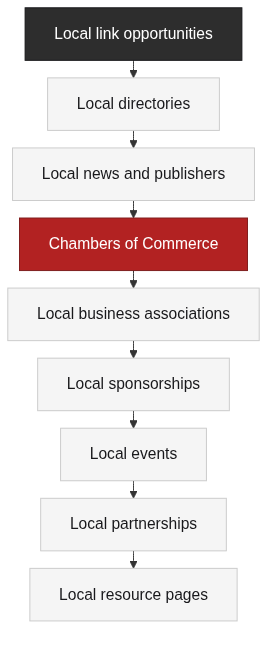
The best local link opportunities come from real, established local resources rather than manufactured link pages. Work through this source map:
- Local directories — city and regional business directories with editorial standards and real users, not mass reciprocal listings.
- Local news and local publishers — local news sites, community blogs, and local vertical media. Editorial links from these sources are hard for algorithms to treat as low-value [8].
- Chambers of Commerce — chamber member directories typically provide indexable member pages with a backlink, making them a classic entry point for local link building [9].
- Local business associations — industry and neighborhood associations that list member businesses.
- Local sponsorships — sponsoring local events, teams, charities, or schools often earns a thank-you page or sponsor page backlink while also giving you brand exposure [6].
- Local events — event websites that list participating businesses and sponsors.
- Local partnerships — collaborations with complementary local businesses that naturally lead to mentions and links.
- Local resource pages — curated pages of local suppliers, service providers, or “best in [city]” lists.
Source prioritization by business type
| Business type | High-value local sources | Medium-value local sources | Low-value / avoid |
|---|---|---|---|
| Local service provider (lawyer, dentist, contractor) | Local news, chamber, industry association | Local directories, sponsored events | Mass reciprocal directories, irrelevant link farms |
| Brick-and-mortar retail / restaurant | Local media, local events, community blogs | Local directories, local partners | Low-value review-site link exchanges |
| B2B / regional service | Local chamber, industry association, local resource pages | Local news, sponsorships | Broad directories, unvetted directories |
Local outreach as the activation layer
Every source in this map becomes useful only when you approach it naturally. Local outreach is the activation layer, and the discipline of link building outreach — reaching out to the chamber, pitching a story to a local news site, or asking a partner to mention you on their resource page. This article keeps the focus on where the opportunities are and how to judge them; the full outreach workflow is a separate discipline [10].
How to Build a Local Prospect List
The operating framework
Building a local prospect list starts with inventorying the local resources in your area, the core of link prospecting, then using search syntax to surface the ones that matter. Useful patterns include "best [service] in [city]", "[city] [industry] association", "[city] business directory", and "sponsor [city] [event]". These queries surface directories, associations, events, and resource pages that are actually active in your service area.
Competitor backlink analysis
One of the fastest ways to build a prospect list is to mine the local links your competitors already earned. Run a competitor backlink analysis on the local businesses that rank above you, and you will find the directories, media, chambers, and resource pages that are already willing to link to businesses like yours. Those become your highest-confidence prospects because they are proven to accept local links [11].
Grading and maintenance
Once you have a list, score each prospect on the three dimensions that matter most — geography, topic, and authority — and rank them by priority. Then re-run the list quarterly. Local resources change: directories close, events move, editors rotate. A prospect list is a living asset, not a one-time export [12].
Practical Application and Action Guide
Scenario comparison
Different business types should sequence their local link efforts differently. A local service provider should start with the chamber and local news, where authority and trust are highest. A retail or restaurant business should prioritize local media and community events, where visibility and foot traffic matter most. A B2B or regional service should lean on the chamber, industry associations, and curated local resource pages, where the audience is more professional and the links more relevant.
A quick evaluation and prioritization checklist
| Step | Action |
|---|---|
| 1 | Run each prospect through the seven-criterion checklist (geographic, topic, authority, editorial, indexable, real traffic, compliant) |
| 2 | Score 6–7 criteria = pursue; 4–5 = evaluate; 3 or fewer = drop |
| 3 | Grade each prospect on geography + topic + authority |
| 4 | Rank priorities and start outreach with the highest-confidence, highest-value sources |
| 5 | Re-run the prospect list quarterly |
Common mistakes and low-value local links to avoid
The most common mistakes in local link building are chasing volume over relevance, and mistaking “local-looking” for “locally relevant.” Avoid mass reciprocal directories that link to everyone, irrelevant link farms that have no real regional connection, and any acquisition method that does not follow search engine guidelines. A directory with no editorial review and no real users is not a local backlink — it is a wasted link that can hurt more than it helps. Prioritize a few strong, relevant local links over many weak ones [7].
Core Takeaways and Next Steps
Recap the core thesis
Local links are a distinct, geographically relevant signal that complements citations and ordinary backlinks. They work because they satisfy both regional and topical relevance at once, and they directly influence the Local Pack. The value is not in the count — it is in the relevance.
The one action to take now
Audit your current local backlinks against the evaluation framework in this guide, then build your first local prospect list using the search syntax and competitor analysis described above. Start with the highest-confidence source — the chamber, local news, or a relevant association — and apply the checklist before you reach out. If you want a strategic partner to handle the compliant, content-driven legwork for your market, TraffiClimb builds high-quality backlinks that drive sustainable growth.
FAQ
References
BrightLocal — Local Consumer Review Survey — provides the data that roughly 46% of Google searches carry local intent.
Moz — Local Search Ranking Factors — documents Local Pack click share and the sustained position of link signals among local ranking factors.
Moz — The Beginner’s Guide to Local SEO — explains the citations vs. backlinks distinction and why a local chamber or media link can beat a high-DA irrelevant link for local rankings.
Whitespark — Local Link Building — provides the mechanism argument for geographic relevance in link evaluation.
Ahrefs Blog — Local Link Building — provides the expert quote on local links proving geographic relevance, and the sponsorship/event backlink example.
Local SEO Guide — explains why editorial links from local news are hard for algorithms to treat as low-value.
SEMrush — Local Link Building — documents chamber member directory backlinks as a classic local link opportunity.