
AI Search Citations: How to Get Your Content Cited by ChatGPT and AI Search
 Written by Warren Reed

You publish a page that ranks first in Google for a high-value query. Then you ask ChatGPT the same question, and the answer pulls from a page you have never heard of — a smaller site with a fraction of your traffic. If that scenario sounds familiar, you are not alone. This is the reality of AI search citations: the signals that make a page rank in a traditional engine are not the same signals that make a page appear as a cited source inside an AI-generated answer.
This guide explains what AI search citations actually are, how they differ from brand mentions and backlinks, why ChatGPT, Google AI and Perplexity cite differently, and — most importantly — what you can actually do to raise your content’s chance of becoming a citable source. Every claim about “what gets cited” is labeled with an evidence level, so you can tell the difference between observed correlation, industry recommendation, official guidance, and reasoned inference. Nothing here promises that a specific format will earn a citation, because no honest source can guarantee that.
Why Ranking Number 1 Doesn’t Mean You Get Cited
Ranking well and getting cited are two different systems, and the gap between them is where most teams get stuck when it comes to AI search citations.
The Ranking-Versus-Citation Gap
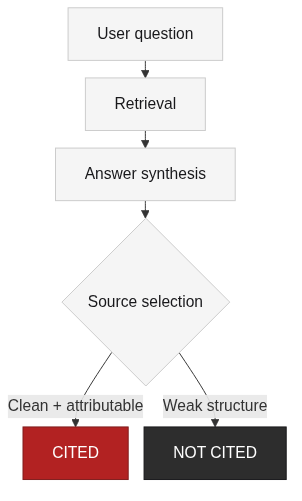
A traditional search engine ranks pages against a query using signals like relevance, authority, and backlinks. An AI search system does something different: it retrieves information, synthesizes an answer, and then decides which pages to surface as sources for that answer. The retrieval step may favor pages that rank well, but the citation step depends on how cleanly a page’s information can be extracted, verified, and attributed.
This is why you can observe pages with modest traffic appearing repeatedly as AI sources while higher-ranking pages are ignored. It is an observed pattern across the AI search ecosystem, not a fixed rule — the specific behavior varies by platform and changes over time. Treat it as a directional signal: citation-worthiness is built differently from rank-worthiness.
The Core Question This Guide Answers
If ranking signals do not drive citations, what does? The answer, based on how AI search systems are designed to work, comes down to one phrase: citable information. A page becomes a useful AI source when it offers a clear, direct answer, supports it with verifiable evidence, attributes its claims, and presents the information in a structure that can be extracted cleanly.
This guide walks through the definition, the platform differences, a framework for assessing citation readiness, and a checklist you can run before publishing. It also covers the common mistakes that waste effort and explains why citation, at the end of the day, cannot be guaranteed.
Setting the Evidence Boundary
Throughout this guide, every claim about what makes content “more citable” is tagged with one of four evidence levels:
- Observed correlation — a pattern noticed in public studies or repeated testing, with sample and date limits acknowledged.
- Industry recommendation — a widely shared practice among SEO and content teams, not a proven guarantee.
- Official guidance — a statement from the platform itself (Google, OpenAI, Perplexity) about how its sources behave.
- Inference — a reasoned conclusion from how these systems are architected, not a tested fact.
This labeling is deliberate. The AI search ecosystem is young, and citation behavior is still evolving. Any claim presented without a level should be treated as a framework assumption, not a proven fact.
What AI Search Citations Actually Are
Before you can improve something, you need a working definition.
Defining the AI Search Citation
An AI search citation occurs when an AI-generated answer references your page as the source of specific information. It is typically displayed as a clickable source URL, an inline numbered reference, or a source card that links back to your page. The citation is the machine’s way of saying: “this claim came from this page.”
The critical distinction is between being cited and being mentioned. A brand mention means your brand or domain name appears in an AI answer without being linked as a source. A citation means the AI attributes information to your page and gives the user a way to reach it. Being mentioned is awareness; being cited is attribution. They are related but not the same, and they are measured differently.
Citation vs. Brand Mention vs. Backlink
The fastest way to understand AI search citations is to compare them against the two concepts they are most often confused with.
| Dimension | AI Citation | Brand Mention | Backlink |
|---|---|---|---|
| Definition | AI answer references your page as an information source | Your brand or domain is named in a page or AI answer | Another site links to your page |
| Trigger | AI system’s retrieval and attribution logic | Author or content creator names you | Site owner adds a hyperlink |
| Requires a link? | Yes — shown as a source URL | No — a name mention is enough | Yes — a hyperlink |
| Value type | Brand visibility + authority signal | Brand awareness + mention volume | Ranking signal + referral traffic |
| Controllability | Low — you cannot force an AI to cite you | Medium — influenced by PR and content strategy | Medium-high — earned through link building |
| How it’s measured | Presence of your source in an AI answer | Brand mention monitoring | Backlink monitoring tools |
| Relation to SEO ranking | Indirect — correlation still being studied | Indirect | Direct — a traditional ranking signal |
The core conclusion from this table is a hard boundary: a backlink is not the direct cause of a citation. Links can strengthen your overall web presence and authority, which in turn can indirectly raise the probability that your content is retrieved and trusted as a source. But the mechanisms are different. A backlink is a human-added hyperlink; a citation is a machine-made attribution. Confusing the two leads to strategies that chase links while ignoring the content qualities that actually drive citations (inference, supported by industry recommendation).
How ChatGPT, Google AI and Perplexity Cite Differently
Each major AI search platform presents sources in its own way, and those differences matter for how you think about citation readiness.
A Comparison of Citation Formats Across Platforms
The table below describes the citation presentation for the three platforms as of the writing date. These formats change frequently, so treat them as directional rather than fixed (official guidance should be re-checked before you rely on any specific behavior).
| Dimension | ChatGPT Search | Google AI Overviews | Perplexity |
|---|---|---|---|
| Citation format | Inline numbered references that open a source panel on click | Source link cards shown alongside the answer | Inline [1][2][3] numbered links plus a source list |
| Typical source count | Multiple | Usually a small set | Multiple |
| Domain shown? | Yes | Yes | Yes |
| Fixed behavior? | No — changes | No — changes | No — changes |
These are presentation differences, and they matter. A page that is easy to attribute in one UI may be less visible in another, simply because the platforms surface sources differently.
Why Citation Behavior Varies by Platform
Each platform runs its own retrieval system, indexing strategy, source-selection logic, and user interface. That means the same content can be cited on one platform and ignored on another, without any contradiction. A page that Perplexity treats as a strong source might not surface in ChatGPT’s results at all, because the underlying retrieval and ranking differ.
This variation is a direct consequence of how the platforms are built (inference). Each has its own view of what a good source looks like, its own freshness rules, and its own way of weighing authority and corroboration.
Inference and Boundaries
Two practical boundaries follow from this variation.
First, you cannot assume that “works on one platform” means “works on all platforms.” A strategy optimized for a single platform’s citation behavior is fragile, because that behavior can change with a single update.
Second, when platforms publish official documentation about how their sources work, that is official guidance and should be treated as more reliable than speculation. But even official guidance rarely promises that a specific page will be cited — it describes how the system behaves, not what any individual site will get. So while you can align your content with how these systems are designed to select sources, you cannot control the outcome.
What Makes Information Citable
If citation-worthiness is built from content qualities, those qualities can be named and assessed.
Deconstructing Citable Information
Across the practices recommended by content and SEO teams, and consistent with how AI retrieval systems are designed to work, citable information tends to share several characteristics:
- Clear, direct answers — the page answers the question in a way that can be lifted as a standalone statement.
- Original data or research — first-party evidence that cannot be found elsewhere.
- Verifiable facts — numbers, dates, and claims that can be checked against a source.
- Explicit sourcing — the page attributes its own claims to named sources.
- Expert explanation — the information is explained by someone with domain credibility, not just paraphrased.
- Relevant context — the information sits in a topic-appropriate setting.
- Extractable structure — lists, tables, definitions, and FAQs that can be pulled out cleanly.
These are industry recommendations and inferences about how retrieval systems value content, not proven guarantees. A page can have all of these and still not be cited, because the final decision belongs to the platform’s retrieval and selection logic.
The Citation Readiness Framework
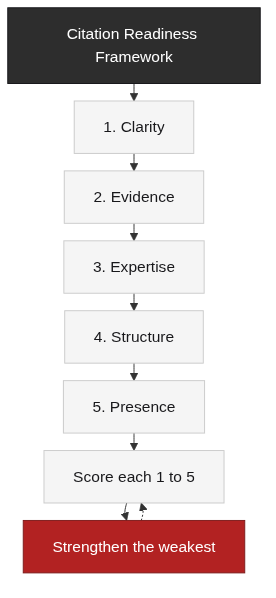
To turn those qualities into something you can assess, use this five-dimension framework. Score each dimension from 1 to 5 to locate your content on a citation-readiness spectrum.
- Clarity — Does the page directly answer the target question? Is there a clear definition or lead paragraph that can stand alone?
- Evidence — Does it contain first-party data, original research, verifiable facts, and explicit sourcing?
- Expertise — Is it written or backed by a credible domain source? Does it offer expert explanation rather than shallow paraphrase?
- Structure — Can the information be extracted easily? Are there lists, tables, definitions, FAQs, and clear heading segmentation?
- Presence — Is there third-party corroboration and a broader web presence? Does the topic have surrounding authority (including digital PR and relevant links)?
Labeling the Evidence
Not every dimension carries the same weight of proof. The ones you can influence directly — clarity, evidence, expertise, structure — are grounded in industry recommendation and inference about how retrieval systems value content. The presence dimension is where observed correlation and industry recommendation overlap: a broader, corroborated web presence is widely observed to correlate with being trusted as a source, but that correlation is not a cause-and-effect guarantee.
The honest framing is this: these dimensions describe what a citable source tends to look like, based on how AI search systems are designed to select and attribute information. They improve your odds. They do not guarantee a citation, and no framework should claim otherwise.
How to Check If You’re Cited and Raise Your Citation Readiness
Now that you know what to aim for, here is how to see where you stand and how to improve.
How to Check If You’re Being Cited
The most reliable way to check for AI citations is manual querying. Ask the target question in ChatGPT, Perplexity, and Google’s AI Overviews, then observe whether your page appears as a source. Repeat the same questions over time, because answers and sources shift. This is time-consuming and limited in scope — you can only check the queries you think to ask — but it is the most direct evidence available.
Third-party tools and platforms are emerging for AI visibility tracking, but this guide deliberately avoids ranking them. The space is young, methodologies vary, and any tool’s coverage is incomplete. Manual checks, combined with your own analytics, are the more honest baseline.
How to Raise Your Content’s Citation Readiness
Improving citation readiness is a content and presence exercise, not a formatting trick. The actionable levers are:
- Structure your information so the answer can be extracted cleanly — lead paragraphs, headings, lists, and tables.
- Publish original data and research that cannot be found elsewhere.
- Attribute your claims with explicit sourcing.
- Offer expert explanation, not shallow paraphrasing.
- Keep the topic focused so the page is clearly relevant to the query.
- Seek third-party corroboration so your claims are reinforced elsewhere.
- Build a broader web presence so the topic has surrounding authority.
Each of these maps to a dimension in the Citation Readiness Framework. None of them, on their own, earns a citation — but together they make your content a more plausible source for a retrieval system to select and attribute.
The Content Citation Checklist
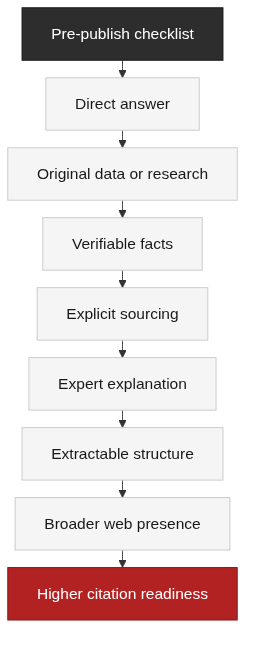
Run this checklist before you publish. It is a self-audit, not a guarantee.
- Does the page directly answer the target question with a clear lead paragraph?
- Does it contain first-party data or original research, rather than only paraphrase?
- Are information sources and citations marked explicitly?
- Does it include verifiable facts with numbers, dates, and named sources?
- Is there expert explanation rather than generic statements?
- Is the information structured for extraction (lists, tables, definitions, FAQ)?
- Is the page highly relevant to the target topic?
- Is there third-party corroboration or external reference?
- Is a broader web presence established (PR, relevant links)?
- Are data dates and sample boundaries clearly marked so freshness can be judged?
Common Mistakes and Why Citation Can’t Be Guaranteed
Avoiding the wrong moves is as important as making the right ones.
The Common Mistakes
- Treating backlinks as the direct cause of citations. Links support presence and authority, but they do not directly trigger a citation. Build content qualities first.
- Assuming one platform’s success transfers to all platforms. Because citation behavior varies by platform, a single-platform win is not a universal signal.
- Chasing format over evidence. A clean structure helps, but format without verifiable content is hollow.
- Ignoring data freshness and sample boundaries. A page that cites outdated or unverifiable data is less trustworthy as a source.
- Promising a specific format will get cited. No one can promise this, and any vendor who does is overstating.
Why Citation Cannot Be Guaranteed
Here is the honest boundary: citation behavior is decided by each platform’s retrieval and selection logic, and that logic changes continuously. A website can raise the probability of being cited by improving clarity, evidence, expertise, structure, and presence. It cannot control the outcome.
The useful distinction is between what you can influence and what you cannot. You can influence the qualities that make content a plausible source. You cannot control whether a platform retrieves, selects, and attributes it on any given day. Building toward citation readiness is a sound strategy; promising citations is not.
Where Your Content Sits on the Spectrum
Use the Citation Readiness Framework to score your content honestly. A page with high clarity, strong evidence, clear expertise, and extractable structure, but little third-party corroboration, sits on the lower end of the presence dimension. Closing that gap — through digital PR, relevant links, and high-quality links that reinforce topical authority — is an indirect but meaningful way to raise overall readiness. This is where link building and digital PR connect to AI search citations: they strengthen the presence dimension, which is one of the five levers you can pull.
Core Takeaways and Your Next Step
Let’s bring the thread together.
The Core Conclusions
An AI search citation is an attribution signal, not a ranking signal. A page gets cited when an AI answer treats it as a trustworthy, extractable source — not because it ranks first. You improve citation readiness through evidence, clarity, structure, and web presence, not by chasing a magic format. And backlinks, while valuable for presence and authority, are an indirect influence on citations, not the direct cause.
The framework to remember: Clarity, Evidence, Expertise, Structure, Presence. Score each one, fix the weakest, and repeat.
Understand Where Citation Sits in Your Brand Presence
Before you optimize anything, understand the bigger picture. Citation is one component of how your brand appears across AI search — it sits alongside brand mentions, visibility, and overall presence. To see how these pieces fit together and where citation fits in your broader brand strategy, start with our guide to AI Brand Visibility. It gives you the context to decide where citation readiness ranks among your priorities.
A Secondary, Deferred Step
Once you understand the full picture, you can explore how a compliance-first, content-driven link building and digital PR approach indirectly strengthens the presence dimension of citation readiness. If that feels like the right next move, TraffiClimb can help you build the relevant, high-quality links and digital PR presence that support it. But treat that as a later step — the educational groundwork comes first.
FAQ
References
Google AI Overviews and sources (Google) — Official guidance on how Google surfaces sources in AI Overviews, used to describe Google’s citation presentation (verify current behavior before relying on it).
OpenAI help center on ChatGPT search sources (OpenAI) — Official guidance on how ChatGPT Search presents and links its sources, used to describe ChatGPT’s citation format (verify current behavior before relying on it).
Perplexity help center on citations (Perplexity) — Official documentation on how Perplexity displays numbered citations and source lists, used to describe Perplexity’s citation format (verify current behavior before relying on it).