
Link Building Outreach: How to Find Prospects, Send Emails, and Earn Backlinks

What Is Link Building Outreach?
Link building outreach is a structured effort to earn a backlink by contacting the people who own or edit the page that could link to you, instead of buying a placement or waiting for one to appear by chance. The contact can be a site owner, an editor, a content manager, or a writer, and the request is almost always an email that connects your page to something their audience already cares about. In that sense, outreach is the human layer between link-worthy content and the sites that could reference it [1].
Outreach is not mass emailing every site with a similar domain, and it is not a link exchange or a paid mention dressed up as an editorial placement. Those approaches produce links that are easy to remove and risky for the site that accepts them. The working definition is narrower: a personalized, tracked conversation that gives a relevant site a reason to link, and that you can repeat at scale because every step is documented.
Where Outreach Fits in a Link Building Campaign
Outreach is the execution layer of a link building campaign, and it only works when the planning above it is done first. A campaign sets goals, chooses target pages, maps the competitive gap, estimates how many links the pages need, and selects the methods before anyone writes an email. The link building campaign guide covers that planning in full, from goals to the quarterly review.
That order matters because outreach converts on the strength of the page and the relevance of the prospect, not on the cleverness of the copy. If the target page is thin or the prospect list is built for volume, the best email in the world produces a low reply rate. When the plan above is solid, outreach becomes a repeatable motion: send, follow up, log, learn, repeat.

Define Target Pages and Link Goals Before You Reach Out
Decide which pages deserve the outreach before you build a prospect list, because the page is what the prospect evaluates. Pick pages that match search intent, stand alone for a reader arriving from another site, and turn the visit into a measurable outcome. A pillar guide or a page with original data earns links more easily than a thin product page.
Set goals in the inputs you control. Useful goals name the target page, the number of new referring domains you want, and the relevance bar for each placement, such as earning a defined number of relevant referring domains for the pillar guide in the next quarter. Ranking goals belong on the review dashboard, not in the outreach plan, because rankings lag link acquisition by weeks or months and depend on factors outside your reach.
Prospect: Build a List of Sites That Could Link
Prospecting is the search for sites whose audience would find your page useful, and it starts where your audience already reads. Practical sources include the backlink profiles of pages ranking for your terms, curated resource lists, industry roundups, and sites that link to pages similar to yours. For each candidate, record the URL, the topic it covers, the pages it already links to, the contact you can reach, and a rough relevance score [3].
Keep the list in a shared table with a status column, because prospecting, qualification, outreach, and tracking all update the same record. A prospect without a recorded topic or contact is a placeholder, not a prospect. Build the list in batches and qualify each batch before you start writing emails.
Qualify Prospects Before You Contact Them
Qualification is the filter that decides who actually receives an email, and it is the cheapest quality improvement in the whole pipeline. A qualified prospect matches your audience, links out to external pages, is reachable, and does not conflict with your brand or content. A site that never links to anyone will rarely start with you, no matter how relevant the topic.
Score prospects instead of judging them in the moment. Three or four criteria are enough: relevance to the target page, whether the site links out, the quality of the linking page, and the context around the link. When resources are tight, cut the list by the relevance score first; a smaller list of well-matched prospects beats a long list of maybes [2].
Research the Contact and the Context
Find the person who actually handles link requests before you write: site owners on smaller blogs, editors or content managers on larger publications, and writers on author-driven sites. The about page, author pages, and contact policy usually tell you who that is and how they prefer to be approached.
Then research the context, not just the person. Read a recent article, note what the site covers and what it has linked to, and check the tone of its existing references. This material is what makes personalization true rather than decorative, and it takes a few minutes per prospect once the site is in front of you.
Structure the Outreach Email
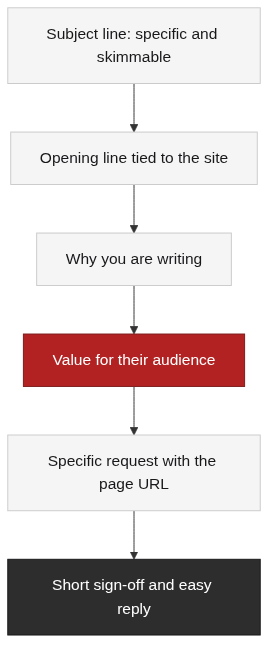
An outreach email follows a fixed skeleton: a subject line, an opening that shows you know the site, a sentence on why you are writing, the value for their audience, a specific request, and a short sign-off. Each part has one job, and the whole email stays comfortably under a screen of text. If a part has nothing to say, cut it instead of padding it.
The subject line earns the open, the opening line earns the read, and the value plus the request earn the reply. Write the request before the rest of the email, because it forces the copy to lead somewhere. The diagram below shows how the parts connect.
Personalize the Message, Not Just the Name
Personalization is evidence that you looked at the site, and it has to be specific enough to be checked. Reference a particular article, a pattern you noticed in what the site links to, or how your page fits a topic the site already covers. A first-name merge without context reads as a template and gets treated like one.
Personalization is a cost, so spend it where it matters. For a prospect with a strong relevance score, invest a sentence or two of real context. For a marginal prospect, the research cost is rarely worth it, which is one more reason to qualify before you research.
Lead With a Value Proposition, Not a Request
A link request is accepted when the site’s audience gets something in exchange, so lead with what the page offers readers rather than with what the link does for you. Original data, a practical guide, a tool, or a reference resource all work when they match what the site already publishes. The value proposition is what separates outreach from begging [4].
Frame the value for the site, not for your metrics. Instead of saying the link will boost your authority, say what a reader who clicks will find and why it is better than the resources the site currently points to. If the page cannot survive that framing, the page needs work before the email does. The high-quality backlinks guide explains how to judge the quality bar, and the relevant backlinks guide shows why fit matters more than volume.
Make the Request Specific and Easy to Accept
Name the page, the context where it could fit, and the exact link text or placement you suggest, so the editor can evaluate the request in one pass. A specific request reads as researched; a vague request reads as spam. If you can, point to a section of your page that complements an existing article on their site.
Lower the cost of saying yes. Use a short, readable URL, skip registration walls and downloads, and avoid asking for more than one thing in the same email. You can suggest a preferred anchor, but never demand one, and never frame the request as a trade or a condition.
Follow Up Without Being a Nuisance
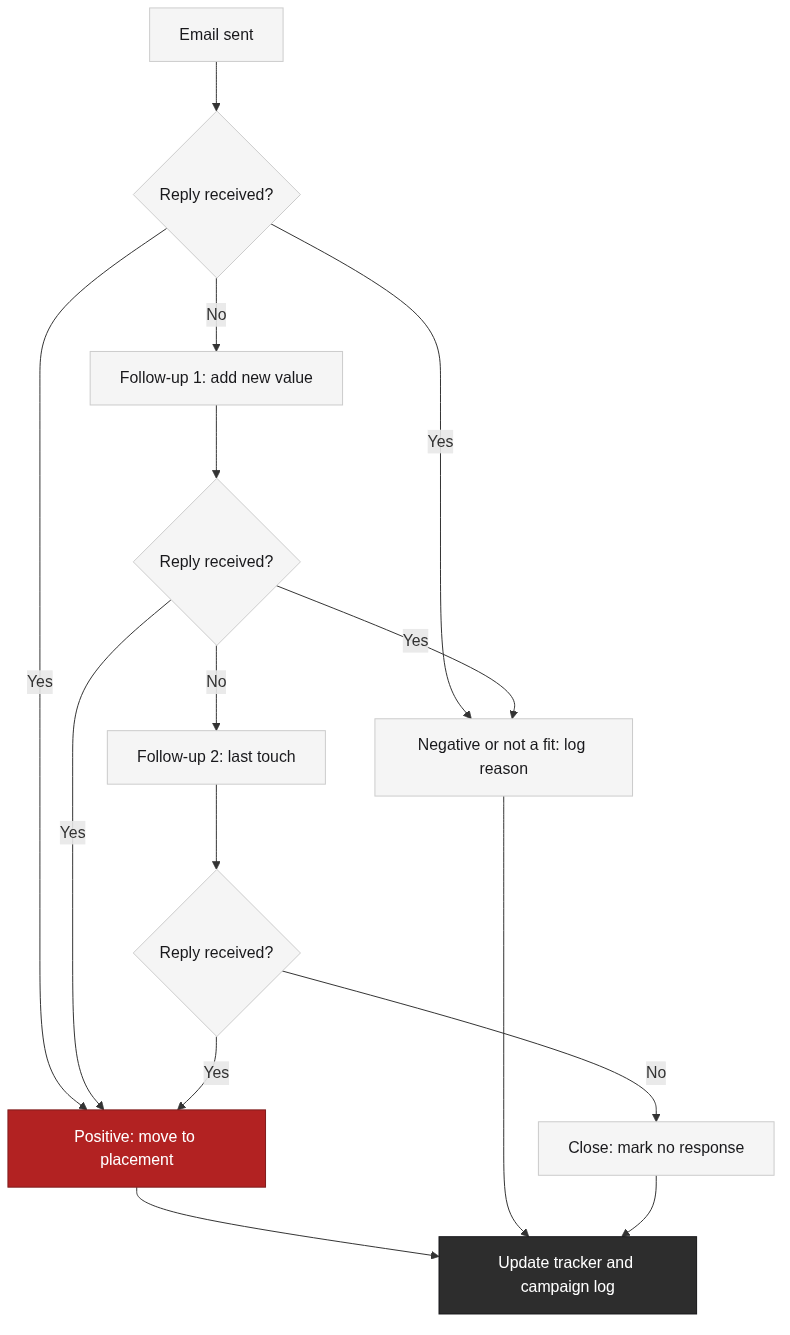
Most replies come after the first follow-up, and most outreach stops after the first email, which is why follow-up is where volume quietly becomes placements. Plan two touches after the first message: one that adds new information, such as a relevant section or a recent update to the page, and one that closes the loop politely.
A follow-up that only says “just bumping this” adds no reason to reply. If you have nothing new, say so briefly and make it easy to decline. After the second follow-up, mark the prospect as closed and move on; chasing past that point costs goodwill and distorts your reply-rate data.
Track Responses and Manage the Pipeline
Treat outreach like a sales pipeline, with a status for every prospect: queued, sent, replied, positive, negative, and closed. Every reply moves the prospect to a new status, and positive replies flow into the placement tracker where the link gets requested, placed, and verified. Logging each step is what makes the process repeatable [5].
The status column is also the source of truth for optimization. If positives are rare, the problem is usually the page or the qualification filter. If replies are rare, the problem is usually the email. If follow-ups go unanswered, the problem is usually the offer. The pipeline tells you which lever to pull.
Why Outreach Fails: Common Mistakes
Outreach fails for a small set of repeatable reasons: targeting sites that will never link, sending a generic template, leading with a request instead of value, burying the ask, skipping follow-up, and never recording results. Most of these are upstream failures, such as the wrong page or the wrong list, showing up as email problems.
The fix is usually not a better template. Re-run the qualification filter, improve the target page, or sharpen the value proposition, and measure again. Treat the first batch as a diagnostic: it tells you which stage of the pipeline is the bottleneck.
Metrics That Tell You Whether Outreach Works
Track the conversion of the pipeline, not just the number of emails sent. The useful ratios are reply rate, positive rate, and placement rate, measured per batch and per prospect segment, with the linking page topic logged next to each placement so the numbers keep their context [5].
Every metric can mislead. A high reply rate with no placements means the email is good but the page or the ask is weak. A low reply rate on a tiny batch tells you little, so compare batches of similar size and targeting. Judge outreach on trends across a few batches, not on a single week.
Improve the Process From the Results
Optimization closes the loop: review the status log, find the stage with the biggest drop-off, and change one thing at a time. If a prospect segment replies but never places, adjust the value proposition for that segment. If a subject line wins opens but not replies, test the request, and keep the rest of the pipeline fixed while you test.
Improvement compounds because every logged reply becomes data for the next batch. Re-run the qualification criteria quarterly, refresh the prospect list, and fold what you learned into the campaign review. That loop is what separates sending emails from running link building outreach.
FAQ
References
Google, “SEO Starter Guide,” developers.google.com. Official documentation describing links among the signals that help pages gain visibility, and why quality matters.
Moz, “Backlinks,” moz.com. Public glossary explaining what backlinks are and why relevance and context determine their value.
Ahrefs, “Link Building for SEO: The Definitive Guide,” ahrefs.com. Public industry guide covering link audits, competitor analysis, and outreach planning.
Backlinko, “Link Building Strategies,” backlinko.com. Public industry guide surveying link building methods and how outreach fits into them.
Search Engine Journal, “Link Building,” searchenginejournal.com. Public industry article covering outreach best practices, measurement, and review.
Next Steps
Link building outreach is a loop: define goals and target pages, build and qualify a prospect list, research the contact, write a specific and personalized email, follow up with new value, track every response, and feed the results back into the next round. The two decisions that protect the whole pipeline are the quality of the target page and the relevance filter on the list, because they decide whether the emails have any chance to convert.
Start with one page and one batch, and run the full loop before you scale. The link building campaign guide shows how outreach fits into a complete campaign plan, and the link building strategies guide covers the method mix this pipeline supports. If you would rather focus on strategy while a specialist runs the execution, TraffiClimb builds premium link building programs for ambitious brands; visit the TraffiClimb website to see how the approach works.