
iGaming Link Building: A Practical Guide for Casino and Sports Betting Brands

Why iGaming Link Building Is Different
The first difference is regulation. Gambling advertising is restricted in many markets, and link placement that looks like paid or exchanged links can create exposure under licensing and advertising rules, not just search policies. A campaign in this vertical must treat compliance as a hard gate from the first candidate, not as a final check [1].
The second difference is the link landscape. Most strong iGaming links come from gambling-focused media, affiliates, industry news, and regulated sports and casino communities. These sites are selective because their own licenses depend on it, so the pitch has to match their editorial standards [2].
The third difference is volatility. iGaming brands change offers, markets, and pages often, so the asset base moves. Links are worth more when they point at stable, compliant pages that can survive a rebrand or a market change.
Which Pages Deserve the Links
Start from the pages that can earn trust under scrutiny, and that survive offer changes. For most iGaming brands, the list looks like this.
- Responsible gambling and player safety pages. These pages matter for licensing and trust, and they are among the few pages that editorial sites will link to without hesitation [3].
- Rules and how-to pages for specific games or bet types. A clear explanation of how a game or a bet works is link-worthy because it answers a real question.
- Game and sports content hubs that explain odds, formats, or events without pushing offers. Educational pages earn links; promotional pages rarely do.
- A small set of brand or industry insights that reflect the brand’s actual position. One credible piece beats ten promotional posts.
The most common mistake is pointing every link at the homepage or the bonus page. Those pages change constantly and read as promotional, so editors avoid them.

Building the Opportunity List in a Restricted Vertical
The opportunity list comes from the pages that already cover gambling, casino, and sports betting topics with an editorial standard, not from a generic backlink export.
- List the gambling-focused publications, affiliates, industry news sites, and regulated community pages that already discuss your games or markets.
- For each candidate, check the site’s editorial guidelines and whether it accepts gambling-related content at all. Many quality sites do not, and filtering them early saves the campaign [4].
- Compare referring domains with competitors on the same games and markets, and keep only the gaps where the linking page has a real audience and a real reason to mention a brand like yours [3].
- Split the list by effort: editorial contributions, digital PR, directory and licensing resources, and community placements. The split decides which tactics run first.
Filter hard at this stage. In this vertical, a link from an unrelated or unregulated page does not help the brand, and it can raise questions about how the link was earned.
Choosing the Tactics That Fit an iGaming Brand
No tactic is inherently right for every brand; fit depends on the games, the markets, and the team. These four cover most iGaming brands, with different entry costs and different constraints.
Editorial contributions to gambling media. A byline on game strategy, responsible gambling, or market trends can earn a natural link back to a relevant page. This fits brands with real expertise to share, and it fails when the contribution exists only to carry a link.
Digital PR around industry insights. A survey, a market observation, or an original data set can earn links from industry news sites. This needs a real insight and a budget for design and outreach. It fails when the story is a thinly disguised bonus promotion.
Directory and licensing resources. Regulator pages, licensing directories, and responsible gambling resources are the baseline for a compliant profile. They are low-effort and low-risk, but they rarely move rankings alone, so treat them as hygiene, not as the campaign.
Community and partnership placements. Contributions to regulated communities, player education pages, and non-promotional partnerships can earn durable links. These are the slowest to build and the most defensible once earned.
Use the link building strategies guide for the method mix, and the resource page link building guide for the tactic most brands should run first. When the profile needs a full read, the referring domains guide explains how to interpret it.
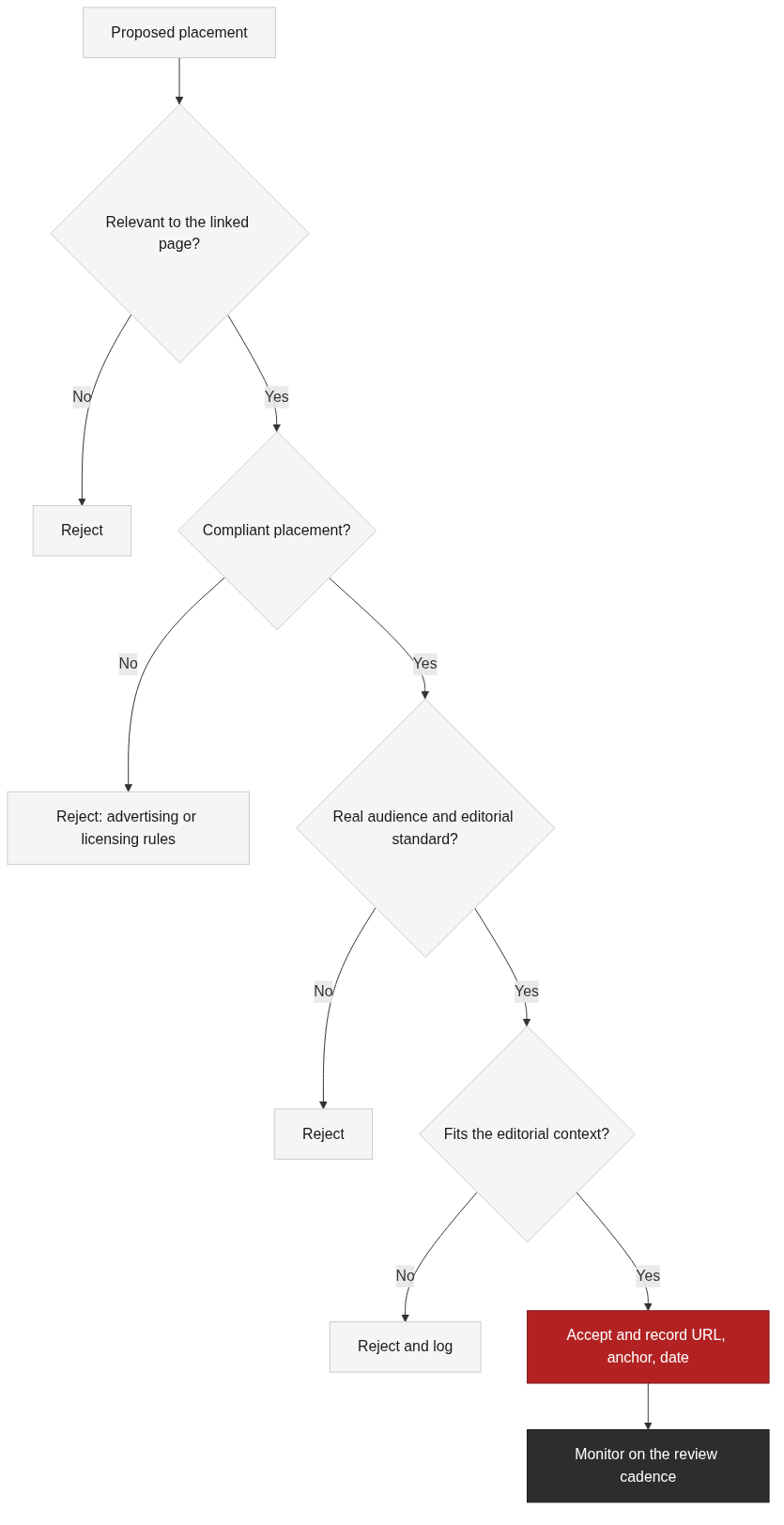
The Quality Gate: What to Accept and What to Reject
Every placement passes the same gate before it counts: the linking page is relevant to the linked page, the placement is editorial and compliant with the relevant advertising and licensing rules, the publisher has real traffic and a real audience, and the anchor fits the context. A link that fails any of these is a liability, not an asset [5].
The pattern that matters most in this vertical is compliance plus context. A link on a responsible gambling resource pointing to a safety page is natural; the same link on an unrelated directory is noise. Judge the linking page the way a regulator or an editor would: does it fit, and would it stand scrutiny? When in doubt, skip it. One bad placement is harder to clean up than one missed link.
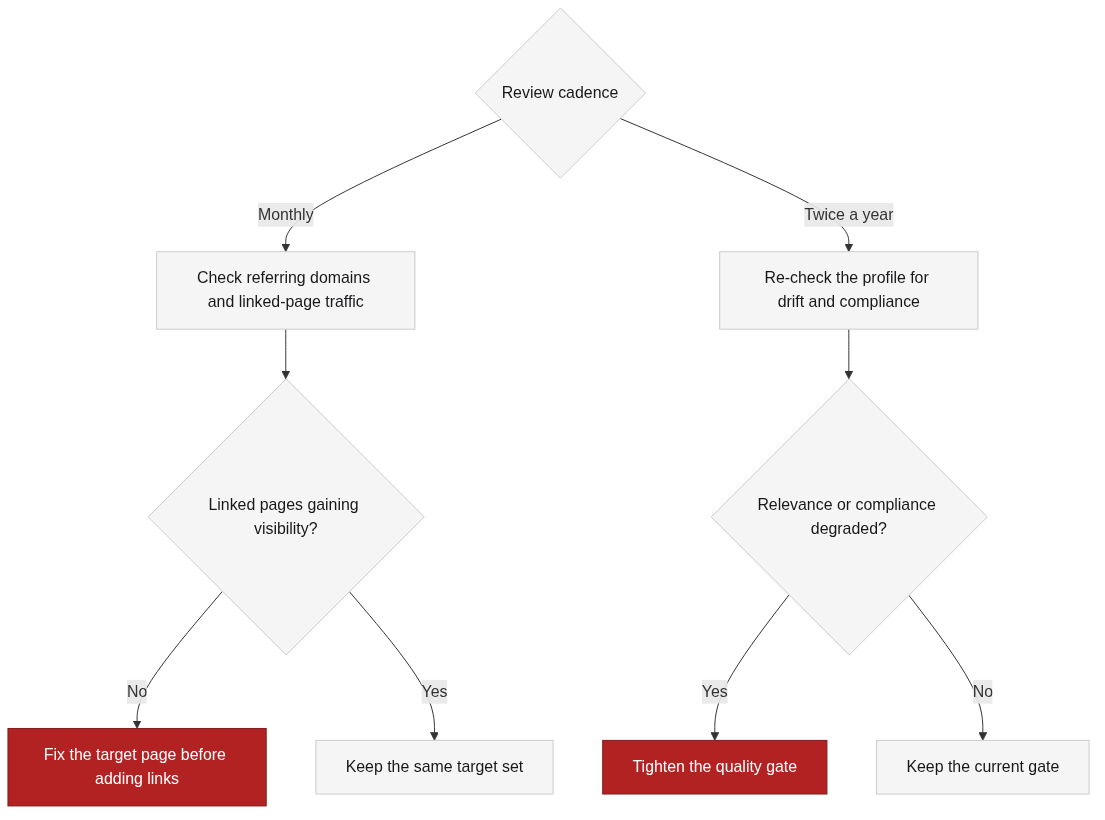
Measuring Whether the Links Are Working
Judge links on the pages they point to, not on aggregate metrics. Track referring domains and their relevance over months, watch how the target pages rank for their own game or market terms, and compare qualified traffic attributed to the linked pages before and after the campaign. A link is working when the right page gains visibility, not when the total backlink count grows [3].
Check the profile for drift twice a year: links that disappeared, pages that changed, and patterns of low-relevance placements. When results lag, the usual cause is the page, not the link volume: a promotional page will not earn trust because more links point at it.
FAQ
References
Google, “SEO Starter Guide,” developers.google.com. Official documentation describing how links help pages gain visibility and why page quality and relevance determine value.
Moz, “Backlinks,” moz.com. Public glossary explaining what backlinks are and why relevance and placement determine their worth.
Ahrefs, “Link Building for SEO: The Definitive Guide,” ahrefs.com. Public industry guide covering competitor analysis, gap analysis, and campaign planning for different site types.
Search Engine Journal, “Link Building,” searchenginejournal.com. Public industry article covering editorial standards, outreach, and the risks of low-quality placements.
Google Search Central, “Spam policies for Google web search,” developers.google.com. Official documentation describing link schemes and practices that Google treats as policy violations.
Next Steps
Start with the pages: pick the responsible gambling and educational pages that deserve links, build a filtered opportunity list, and choose one or two tactics you can actually run. Gate every placement against relevance and compliance, and measure the linked pages on a monthly rhythm. The campaign compounds when the same pages earn more links over time, so keep the target set small and stable.
If you would rather focus on the strategy while a specialist handles the execution, TraffiClimb builds premium link building programs for ambitious brands. Visit the TraffiClimb website to see how the approach works.