
Link Building Packages: What to Look for Before You Buy

What a Link Building Package Actually Is
A link building package is a fixed-scope offer that bundles sourcing, content, outreach, and reporting into a set quantity at a set price.
The quantity is usually expressed in units you can count: referring domains, placements, or published links. The scope fixes what the vendor will do for that quantity, and the price is set in advance so you can budget without surprises. Packages exist because most campaigns share a repeatable core, and a repeatable core can be priced like a product.
The catch is that a package is only as good as its definition of the unit and its quality bar. Two packages with the same price can be completely different products if one counts placements that the other would reject, so the contract language matters more than the marketing page [1].
The Typical Package Structure
Most packages tier by quantity and by inclusion, and the tiers tell you more than the headline price.
Entry tiers usually price a small number of placements on pages of general relevance. Mid tiers add quantity, content work, or a higher relevance bar. Top tiers usually include original content assets, outreach on a defined target list, and priority reporting. The gap between tiers is where vendors hide the real cost: check what changes between tiers and whether the added cost buys placements, content, or just priority.
The unit definition is the first thing to verify. Ask what counts as a placement, whether no-follow placements count, and what happens to rejections. A package that counts everything published instead of everything accepted is pricing the vendor’s activity, not your result [2].
Package vs Custom Campaign: Which One Fits
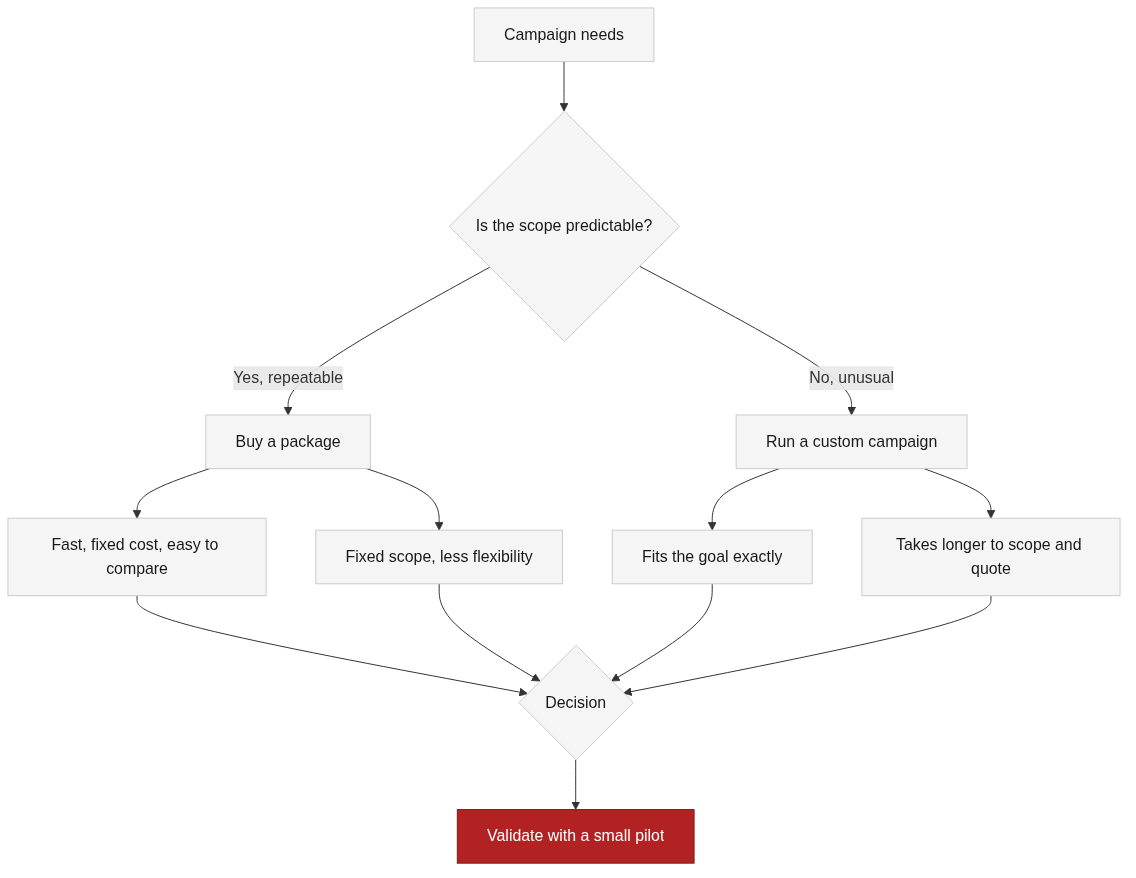
The trade-off between a package and a custom campaign is predictability versus fit, and the right answer depends on how repeatable your needs are.
A package wins when the campaign is predictable: a defined goal, standard target types, and a quantity you can estimate. You get a fixed cost, a fast start, and an easy comparison across vendors. It loses when your needs are unusual: a narrow audience, a strict compliance bar, or a content-heavy campaign, because the fixed scope either does not fit or gets padded with irrelevant placements.
A custom campaign wins when the goal is specific enough that a fixed scope cannot hold it. You pay more in scoping time and price, but the brief, the target list, and the quality bar are yours. For most teams the practical path is a package for the repeatable core and a custom engagement for the parts that are not repeatable [3].
Selection Criteria: What to Check Before You Buy
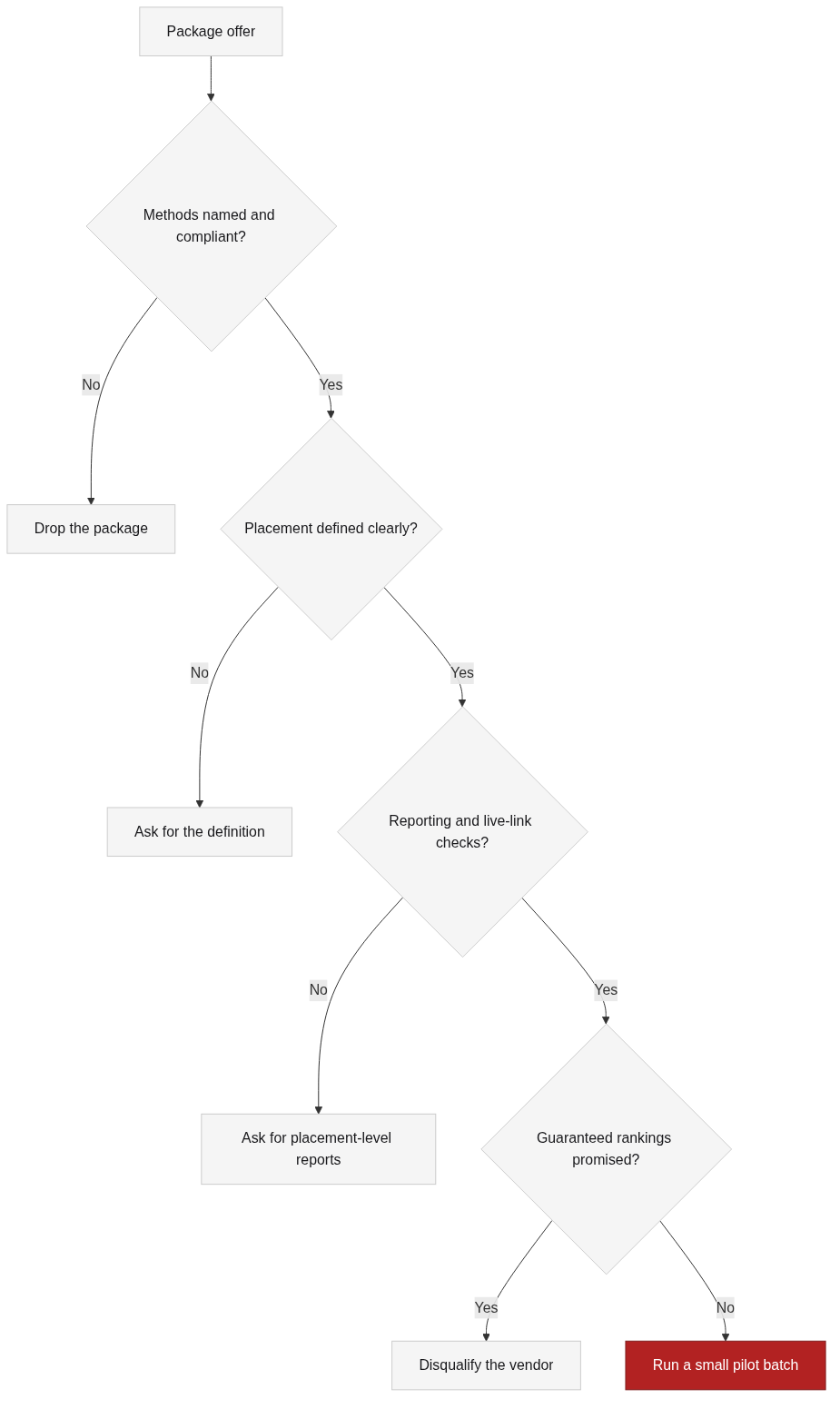
Check five things before you buy any package: method, exclusions, unit definition, reporting, and guarantees.
Method and exclusions tell you whether the package is built on placements you want. A package built on PBNs, link farms, or automated outreach is cheap because the risk is priced out of it, not into it [4]. The unit definition tells you what you are counting, and reporting tells you whether you can verify it: require placement-level detail and live-link checks, not a total count.
Guarantees are the fastest signal. No legitimate process can guarantee rankings, so any package that promises guaranteed rankings is disqualifying. Treat “guaranteed links” with the same suspicion: a guarantee of placements is only meaningful if the quality bar is defined and rejections are excluded.
The Risks Hidden in Cheap Packages
The cheapest packages hide their costs in three places: relevance, survival, and rework.
Relevance risk is placements on pages that pass a generic filter but not your audience’s bar, which adds links without adding value. Survival risk is placements that disappear after publication, which you only notice at the next report. Rework risk is the cost of replacing either kind: another cycle of outreach and content work, paid for by you or by the next package.
Mitigation is the same in all three cases: a written relevance and quality bar, live-link checks, and an all-in cost that counts only accepted, live, relevant placements. A package that cannot produce that accounting is not cheaper; it is simply cheaper to start [5].
How to Compare Packages Across Vendors
Compare packages on the all-in cost per accepted placement, after filtering by method and exclusions.
First, list the vendors whose methods and exclusions pass your bar. Second, normalize their units: what counts as a placement, what happens to rejections, and what the report contains. Third, compute the all-in cost per accepted placement for each package, including any content or setup fees. The package with the lowest headline price is often not the lowest on that number.
Then buy the smallest pilot you can. A small batch against your written brief tells you whether the quality gate holds, whether reporting arrives in a usable form, and whether the package works for your audience. Scale only after the pilot passes, and review the all-in cost quarterly as the competitive set changes [3].

FAQ
References
Moz, “Backlinks,” moz.com. Public glossary explaining what backlinks are and why relevance and placement determine their value.
Search Engine Journal, “Link Building,” searchenginejournal.com. Public industry article covering outreach, placement quality, and reporting.
Ahrefs, “Link Building for SEO: The Definitive Guide,” ahrefs.com. Public industry guide covering campaign planning, method selection, and package considerations.
Google Search Central, “Spam policies for Google web search,” developers.google.com. Official documentation describing link schemes and practices that Google treats as policy violations.
Google, “SEO Starter Guide,” developers.google.com. Official documentation describing links among the signals that help pages gain visibility, and why page quality and time matter.
Next Steps
Decide in this order: define your goal and quality bar, choose package or custom by how repeatable the campaign is, filter vendors on method and exclusions, then compare the all-in cost per accepted placement before piloting. The link building strategies guide explains the method mix any package should name, the resource page link building guide covers a method that fits most campaigns, and the unnatural links guide helps you judge whether a package’s method belongs in your profile.
If you want to compare packages against a program scoped to your goals, TraffiClimb builds premium link building programs for ambitious brands. Visit the TraffiClimb website to see how the approach works.