
White Label Link Building: A Practical Guide for SEO Agencies

What White Label Link Building Actually Is
White label link building is a partnership where your agency sells a link building service under its own brand and a partner executes it invisibly behind your name.
The client sees your proposal, your reporting, and your support. The partner handles the placements: sourcing publishers, creating or adapting content, running outreach, and tracking the results. The partner stays out of the client relationship, and the agency takes responsibility for the outcome and the quality of the work.
That division is the point of the model. It converts a capability you do not have into a product you do have, without the hiring cycle. It also converts your brand into the only asset the client can hold accountable, which is why the partner choice matters more than the price [1].
How the White Label Model Works
The model runs on a simple loop: you sell, the partner produces, and you present.
You scope the campaign from the client’s goals and define the relevance and quality bar in writing. The partner works to that brief and returns placements with supporting details. You review the placements against the quality bar, reject what fails, and present the accepted work to the client under your own brand.
Two details decide whether the loop stays healthy. First, reporting must be raw enough for you to verify: the linking page, the publisher, the anchor, the date, and why each placement passed the filter. Second, the partner must accept rejections as part of the process, because a partner who only reports accepted placements is hiding the quality gate from you [2].

What to Look For in a White Label Partner
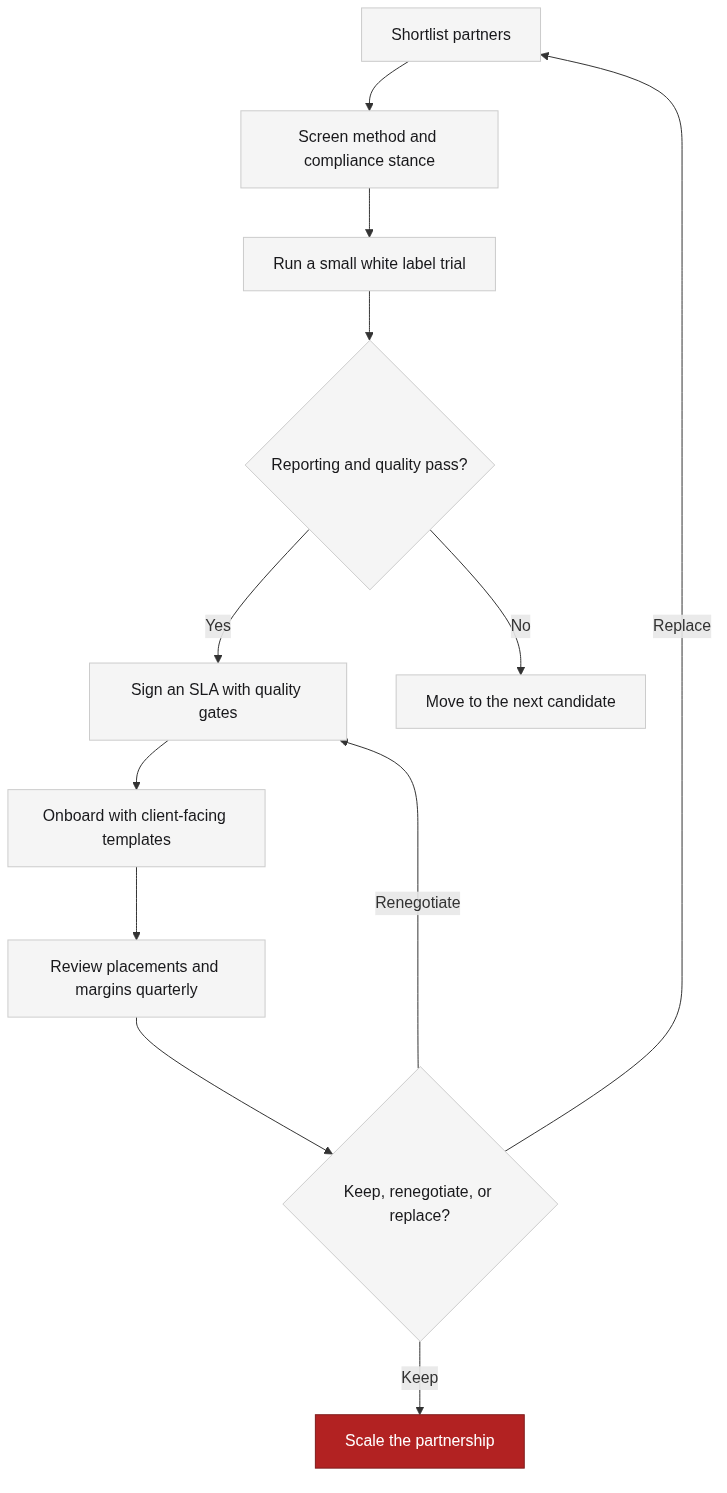
Screen partners on four things before you discuss margins: method, compliance, reporting, and communication.
Method and compliance come first. Ask what produces the placements and what the partner refuses to do. Partners built on PBNs, link farms, or automated outreach put your agency brand at risk in a way you cannot easily undo, so their lower price is not a saving [3]. Reporting matters because you cannot verify what you cannot see; require placement-level detail and live-link checks. Communication matters because you are the interface: the partner must work to your brand voice, your templates, and your deadlines without contact with the client.
Run a small trial before any long commitment. A handful of placements against a written brief tells you whether the quality gate holds, whether reports arrive in a usable form, and whether the partner treats your brand as their own.
How to Present White Label Link Building to Clients
Present the service as your agency’s method, not as a resold vendor, and keep the promises inside what you can verify.
Explain the value in client terms: a defined process for earning relevant links, with reporting you stand behind. Set the quality bar in writing, including what counts as an accepted placement and what happens to placements that fail. Manage expectations on timelines, because outreach runs in waves and results are not guaranteed by any legitimate process [4].
The reporting you present should be your own: placement details, the link pages, and the next steps. If you cannot explain a placement’s value to the client, the problem is the partner’s reporting, not the client’s understanding. Keep the review rhythm explicit, so the client sees the campaign as a managed service rather than a batch of purchases.

Pricing White Label Link Building
White label pricing is a packaging decision: you mark up the partner’s cost into a service the client can compare with your other offers.
The mechanics are simple: your price covers the partner cost plus your margin, and the margin pays for scoping, quality control, reporting, and support. The strategy is the hard part. Price against the value of the placement to the client, not against the partner’s cost sheet, and keep the margin high enough that quality control is never the first thing you cut.
Be careful with the unit. If you sell per placement, define what a placement means and who absorbs rejections. If you sell a retainer, tie it to a minimum placement flow. The pricing model should match the client’s campaign shape, exactly as it would if you built the capability in-house [5].
Risks and How to Avoid Them
The model concentrates three risks: quality, brand, and dependency, and each has a mitigation.
Quality risk is the partner placing links that fail your filter, which damages the client’s profile and your credibility. Mitigate it with a written quality bar, rejection rights, and live-link checks on every report. Brand risk is the client discovering or suspecting a resold service, which breaks trust. Mitigate it by owning the communication, the templates, and the explanation of every placement. Dependency risk is building your offer on a partner you cannot verify or replace. Mitigate it with transparent reporting, an exit clause, and a second partner you can scale into.
None of these risks are reasons to avoid the model. They are reasons to treat the partner relationship like a product decision: trialed, contracted, and reviewed quarterly instead of assumed.
FAQ
References
Moz, “Backlinks,” moz.com. Public glossary explaining what backlinks are and why relevance and placement determine their value.
Search Engine Journal, “Link Building,” searchenginejournal.com. Public industry article covering outreach, placement quality, and reporting.
Google Search Central, “Spam policies for Google web search,” developers.google.com. Official documentation describing link schemes and practices that Google treats as policy violations.
Google, “SEO Starter Guide,” developers.google.com. Official documentation describing links among the signals that help pages gain visibility, and why page quality and time matter.
Ahrefs, “Link Building for SEO: The Definitive Guide,” ahrefs.com. Public industry guide covering campaign planning, pricing considerations, and method selection.
Next Steps
Decide in this order: define the service you want to sell, screen partners on method and compliance, run a small trial with a written quality gate, then sign an SLA only after the trial holds. The link building strategies guide explains the method mix any partner should be able to name, the referring domains guide supports the gap analysis you will present to clients, and the unnatural links guide helps you judge whether a partner’s method belongs in your profile.
If you want to compare a white label offer against working directly with a specialist, TraffiClimb builds premium link building programs for ambitious brands. Visit the TraffiClimb website to see how the approach works.