
Link Building Checklist: A Step-by-Step Campaign Checklist

Before You Start: Goals and Target Pages
The first phase decides whether the rest of the campaign has a point, so it earns the slowest pace.
- Write the business outcome in one sentence, such as more organic traffic to a specific page or visibility for a new guide. If the outcome cannot be stated, the campaign will drift toward activity for its own sake [1].
- Translate the outcome into link-level targets: new referring domains, a relevance bar, and a quality bar for placements. Targets you control, like these, are useful; rankings are not, because they depend on factors outside your reach.
- Choose the pages that will earn the links, and check each one against search intent, quality, and a conversion point. A page that is thin or outdated amplifies weakness instead of fixing it, so upgrade it before you start [2].
- Set the review rhythm and the stop condition now. Decide what evidence would end or pivot the campaign, such as a page that cannot earn placements after two outreach waves.
Skip the full plan only when you already run campaigns on a fixed process; otherwise every skipped check here shows up later as wasted outreach.
Research: Competitors, Gaps, and Link Needs
Research answers three questions: who competes for your terms, which links they have that you do not, and how much work closing that gap is.
- Pick five to ten competitors whose audience and intent match yours, mixing direct competitors with content competitors that rank for the same terms [3].
- Export their referring domains and linked pages, then deduplicate so the comparison counts unique sources.
- Build the gap list: referring domains that appear in competitor profiles and not in yours, grouped by the page that earned each link.
- Filter the gaps by relevance, quality, and risk. Drop links from irrelevant pages, sitewide placements, and risk patterns such as link networks; the unnatural links guide explains how to spot them [4].
- Estimate the link need from the SERP: the difference between your referring domains and the middle of the competing distribution, treated as a range, not a single number.
The most common mistake in this phase is collecting everything and deciding nothing. A gap list that has not been filtered is raw data, and it will not survive contact with an outreach list.

Plan: Methods, Timeline, and Budget
Planning converts the research into a schedule and a budget that the team can actually run.
- Select two or three methods that match your assets and capacity, and sequence them so the cheap wins come first, such as link reclamation before digital PR.
- Set the timeline in waves: audit and asset work, outreach batches, then a review before the next batch. The review between batches is what lets the campaign adapt.
- Budget the real costs: internal hours, tooling, and external services, and cut outreach volume before relevance filtering when money is tight.
- Assign an owner to each method. A campaign with no owner for a method is a campaign that will not run that method.
- Write the target list with the context you will pitch: the page, the reason it fits, and the asset that backs it up.
When resources are thin, drop a method entirely instead of running all of them badly; a focused campaign with two methods outperforms a stretched one with four.
Execute: Outreach and Quality Checks
Execution is where the checklist earns its keep, because every placement passes the same gate before it counts.
- Run outreach in small batches and personalize each pitch to the target page and its audience. A pitch that was not written for the site is noise, and editors treat it that way [5].
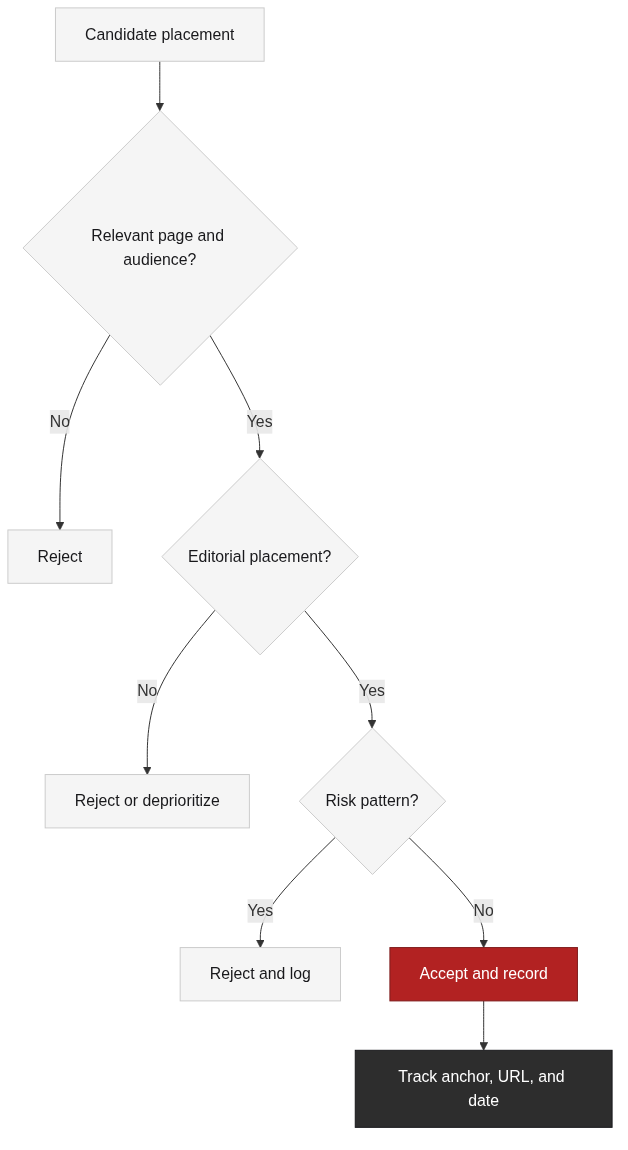
- Apply the placement quality gate to every offer: relevant page, editorial placement, trustworthy publisher, and no risk pattern. Reject anything that fails, and log the reason.
- Record each accepted placement: the live URL, the anchor text, the linking page topic, and the date. The record is what makes measurement possible later.
- Check the live link after it publishes, because placements disappear, change, or lose context between acceptance and publication.
- Watch for the risk accumulation: a handful of weak links is not an emergency, but a pattern of them across the profile is a reason to tighten the filter [4].
The gate exists to protect the profile, not to slow the campaign down. When in doubt about a placement, the safe answer is to skip it, because one bad placement costs more than one missed link.
Review: Metrics, Cadence, and Adjustments
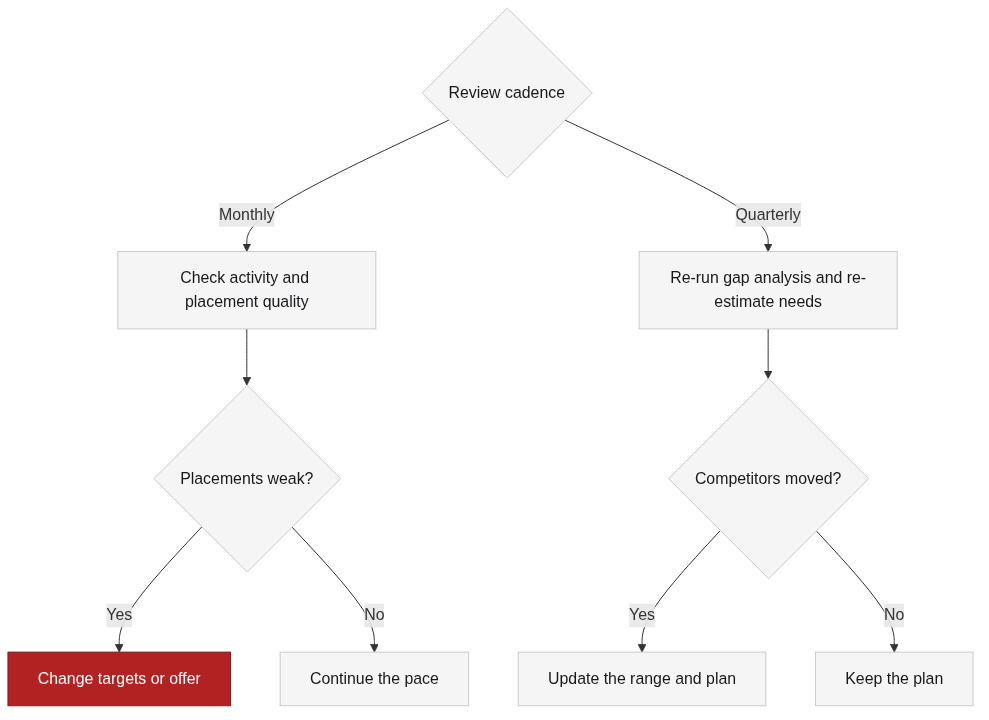
The review phase closes the loop and feeds the next cycle, and it runs on two rhythms.
- Monthly, check activity and placement quality: new referring domains, the relevance of the linking pages, and whether placements stayed live.
- Quarterly, re-run the gap analysis and re-estimate the link needs, because the competitive set changes and the estimate is a working range [3].
- Compare placements against each other over months instead of judging them one by one, and use the pattern to decide where the next outreach batch goes.
- When results are off, check page quality and target relevance before adding more links. The usual failure is the asset or the filter, not the volume [1].
- Log what changed in this cycle, so the next campaign starts with the lessons instead of rediscovering them.
Stop the campaign when the stop condition fires, and record why. A campaign that ends on evidence is a successful experiment, even when the evidence says the page was not ready.
FAQ
References
Google, “SEO Starter Guide,” developers.google.com. Official documentation describing links among the signals that help pages gain visibility, and why page quality and time matter.
Moz, “Backlinks,” moz.com. Public glossary explaining what backlinks are and why relevance and placement determine their value.
Ahrefs, “Link Building for SEO: The Definitive Guide,” ahrefs.com. Public industry guide covering competitor analysis, gap analysis, and campaign planning.
Google Search Central, “Spam policies for Google web search,” developers.google.com. Official documentation describing link schemes and practices that Google treats as policy violations.
Search Engine Journal, “Link Building,” searchenginejournal.com. Public industry article covering outreach and campaign execution.
Next Steps
Run the checklist in order and treat each phase as a gate: goals and target pages, research into competitors and gaps, a plan with methods and budget, execution with a placement quality gate, and a review on two rhythms. The checklist makes the campaign repeatable, and the review makes it self-correcting.
The link building strategies guide explains the method mix behind phase three, the referring domains guide supports the research phase, and the resource page link building guide covers a method that fits most campaigns.
If you would rather focus on the strategy while a specialist handles the execution, TraffiClimb builds premium link building programs for ambitious brands. Visit the TraffiClimb website to see how the approach works.