
How Many Backlinks Do I Need to Rank? A Practical Way to Estimate

Why There Is No Universal Answer
The number of backlinks a page needs depends on the competition for its terms, and that competition changes with the niche, the audience, and the year. A page in a quiet niche can gain visibility with a handful of relevant referring domains, while a page in a competitive niche needs a profile that matches pages with years of history [1]. Any answer that ignores the SERP is a guess, so the estimation starts there, not with a round number.
The right question is not “how many links” but “how many referring domains do the pages above me have, and how does my profile compare?” Links from the same site count once for this purpose, because a profile of unique domains describes breadth, which is the dimension that correlates with how pages compete [2].
Read the SERP and the Competing Pages
Find your terms in a search engine and identify the pages that occupy the positions you care about. Pick five to ten pages that serve the same intent as yours, and note what they have in common: content format, depth, freshness, and the sites that link to them. The comparison is only meaningful when the pages compete for the same query, so exclude results that answer a different question than your page does [3].
Do not judge the SERP by the first result alone. The top spot can belong to a site with unusual brand strength or an old page that would not be a fair target. Use the set of pages in the visible results and look for the pattern, not the outlier.

Count Referring Domains, Not Total Links
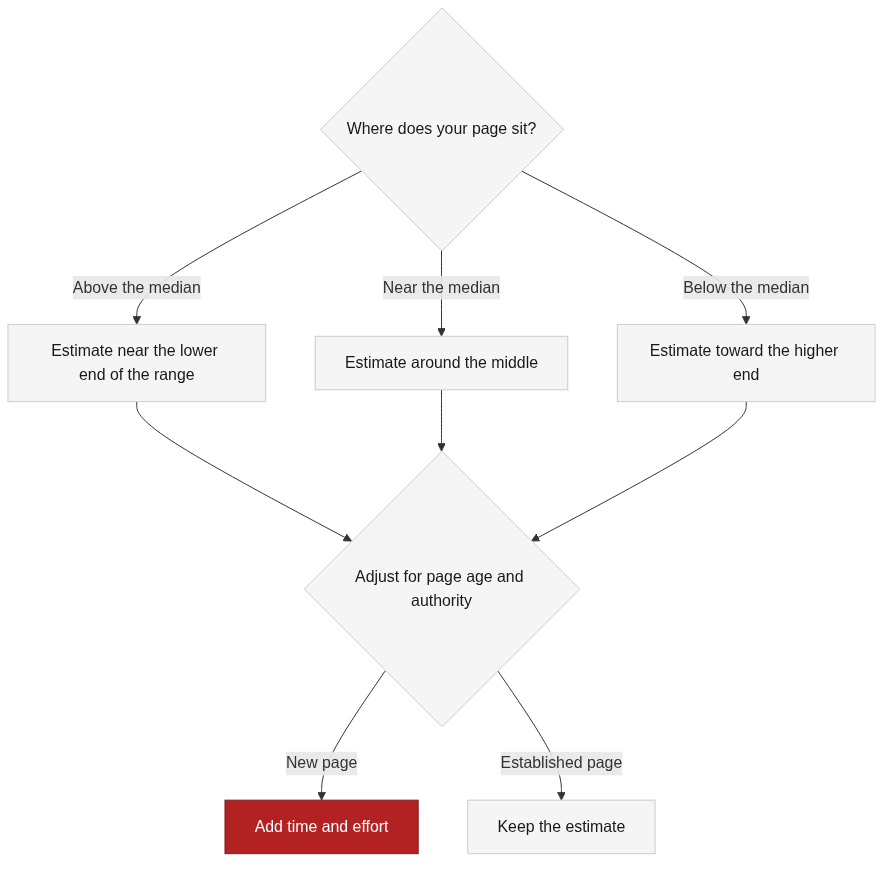
For each competing page, count its unique referring domains and write down the distribution. The middle of that distribution is your most useful reference point: it tells you what a typical competing page looks like, while the top of the range shows the ceiling that only the strongest results reach. Tools that report backlinks often include many links from the same site, and those inflate the total without changing the competitive picture [3].
Count your own page the same way. Your unique referring domains are the baseline, and the difference between your count and the competing pages is the working gap. If your page already has a comparable number, the constraint is quality or relevance, not volume.
Estimate From the Gap
Estimate your link needs as a range around the gap, not as a single number. A reasonable starting point is the difference between your referring domains and the middle of the competing distribution, with a wider range toward the top for terms where the leader is far ahead. Treat the range as a working estimate and re-test it against the SERP, because the set of competing pages changes over time [4].
Adjust the range for the position you are targeting. If you want to compete for the top of the results, plan for the higher end of the range; if you want to move into the visible results, the lower end is enough to start. The estimate tells you the size of the work, and the position tells you how much of it to attempt.
Adjust for Quality, Age, and Context
Not all referring domains are equal, so adjust the estimate for the quality of the links you can realistically earn. Editorial links from relevant pages carry more weight than listings or directory links, which means a smaller number of strong links can compete with a larger number of weak ones [2]. If your campaign produces mostly editorial placements, the count can sit at the lower end; if it relies on weaker sources, expect to need more.
Page age and authority shift the estimate too. A new page starts with no history, so it needs both links and time for the signals to accumulate [1]. An established page with existing authority needs fewer new domains to move. Acknowledge the difference in the plan: the estimate is the volume, and the timeline is the other half of the calculation.
Turn the Estimate Into a Plan
Divide the estimated gap by the timeline you can sustain, and set a monthly target for new referring domains. A steady monthly flow beats a burst that stops, because the profile grows in a way you can review and adjust. The monthly target is a management number, not a promise: it exists so the campaign has a pace, and it changes when the evidence changes [5].
Review the estimate on a fixed cadence. If the gap is narrowing, keep the pace; if the page is not moving, check page quality and relevance before adding more links; if competitors moved, re-estimate the range. The estimate is useful because it makes the plan measurable, and it stays useful because it is updated instead of defended.

FAQ
References
Google, “SEO Starter Guide,” developers.google.com. Official documentation describing links among the signals that help pages gain visibility and why pages need time to accumulate them.
Moz, “Backlinks,” moz.com. Public glossary explaining what backlinks are and why relevance and the breadth of referring domains matter.
Ahrefs, “Link Building for SEO: The Definitive Guide,” ahrefs.com. Public industry guide covering link research, SERP analysis, and comparing backlink profiles.
Backlinko, “Link Building Strategies,” backlinko.com. Public industry guide surveying methods and how to size link building effort by competition.
Search Engine Journal, “Link Building,” searchenginejournal.com. Public industry article covering campaign planning, measurement, and review.
Next Steps
Estimating how many backlinks you need comes down to a comparison: the SERP, the competing pages, their referring domains, your profile, and the gap. Turn the gap into a range, divide it by a sustainable timeline, and review the estimate on a fixed cadence so the plan tracks reality.
The link building strategies guide shows how the estimate fits into a full campaign, the referring domains guide explains the difference between referring domains and backlinks, and the resource page link building guide covers a method for closing the gap with reference content.
If you would rather focus on the strategy while a specialist handles the research and execution, TraffiClimb builds premium link building programs for ambitious brands. Visit the TraffiClimb website to see how the approach works.