
Competitive Link Analysis: How to Find and Analyze Competitor Links

What Competitive Link Analysis Actually Answers
A competitive link analysis answers a small set of questions: which domains link to competitors, which competitor pages attract those links, what the links look like, and which patterns repeat across the profile. It does not tell you which site is “winning” or which keyword will rank first, because rankings depend on many factors beyond links [1]. Keep the analysis scoped to what feeds your plan: the referring domains you could target, the assets that earn links, and the patterns worth copying or avoiding.
The value comes from the comparison, not the raw counts. A competitor profile with many referring domains can still be full of weak placements, while a smaller profile built from relevant editorial links tells you more about what your audience rewards [2]. Decide the comparison question before you open any tool, so the data collection stays focused.
Pick the Right Competitors to Analyze
Choose five to ten competitors whose audience and content intent match yours, because links only transfer insight when the context is comparable. Include direct competitors that sell the same thing, but do not stop there: add content competitors that rank for your target terms even if they do not compete commercially, because they are often the pages that actually earn the links you want [3].
For each competitor, note the pages you will analyze. In most cases that means their pages covering your target terms, plus the pages that visibly attract links, such as data studies, tools, or deep guides. A page-level view matters because links attach to pages, not to brands: a strong domain can hide a weak page, and the reverse is true as well.

Collect the Backlink Profile: Referring Domains and Linked Pages
Pull the backlink profile for each competitor page with a link research tool and export the data you will actually use: referring domains, linked pages, anchor text, and placement context. These four fields support most of the analysis, and each answers a different question. Referring domains tell you the breadth of the profile and which sites matter. Linked pages tell you what format earns links. Anchor text shows how competitors are described. Placement context shows whether the link sits inside content or in a template.
Verify the data before you draw conclusions, because link research tools measure different slices of the web. Cross-check the top referring domains against the live pages and read the context of the strongest links yourself. A tool tells you a link exists; the page tells you whether it is editorial or decorative [3].
Do not collect everything. A full export of every link across many competitors becomes noise, so filter early by relevance and by the pages you mapped in the previous step. The goal is a profile you can read, not a spreadsheet that impresses.
Read the Link Patterns
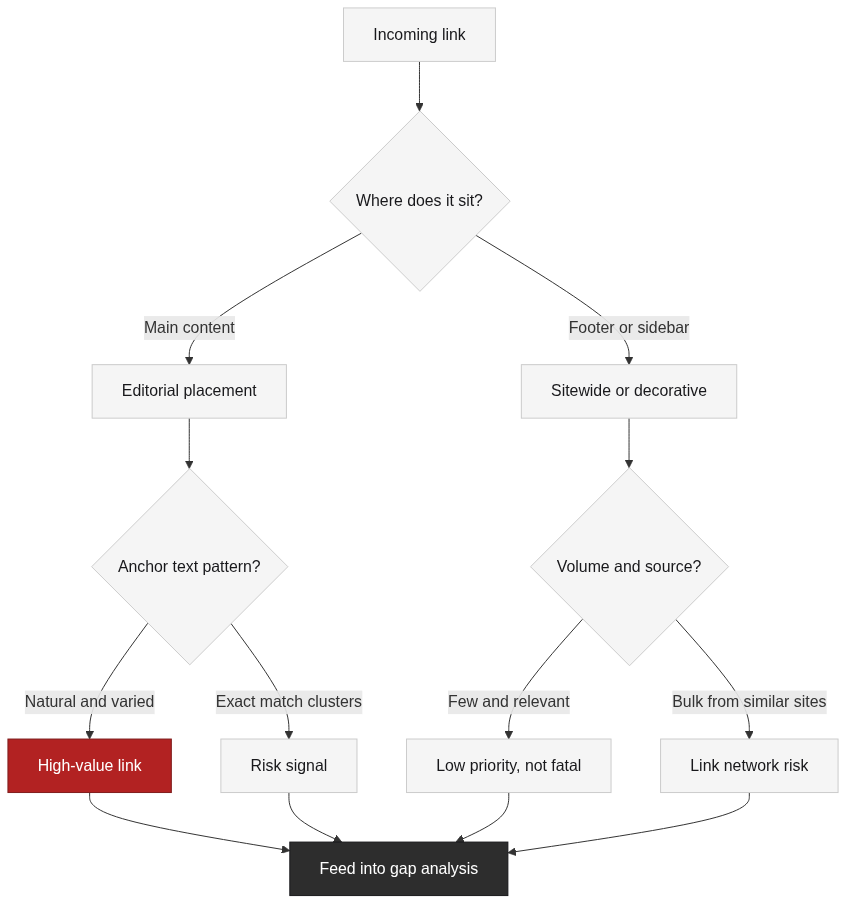
The pattern matters more than any single link. Start with placement: editorial links inside main content carry more weight than footer or sidebar links, and a profile built from template-wide placements is weaker than the count suggests [2]. Then look at anchor diversity: natural profiles mix branded, topical, and generic anchors, while clusters of exact-match anchors from unrelated pages are a risk signal.
Read the linked page format as a pattern too. If competitors earn links with original data, comparison tables, or interactive tools, that is the format your audience references. If their links come from guest posts or digital PR, the pattern points to relationships rather than assets. Group the links into these patterns instead of judging each one, and the analysis starts to tell you where the opportunity is.
Flag risk patterns explicitly. Bulk links from similar low-quality sites, obvious paid placements without disclosure, and pages built mainly to pass links belong in a separate list, because they are not opportunities to copy [4]. A competitor with a risky profile teaches you what to avoid, not what to chase.
Turn Findings Into a Gap Analysis
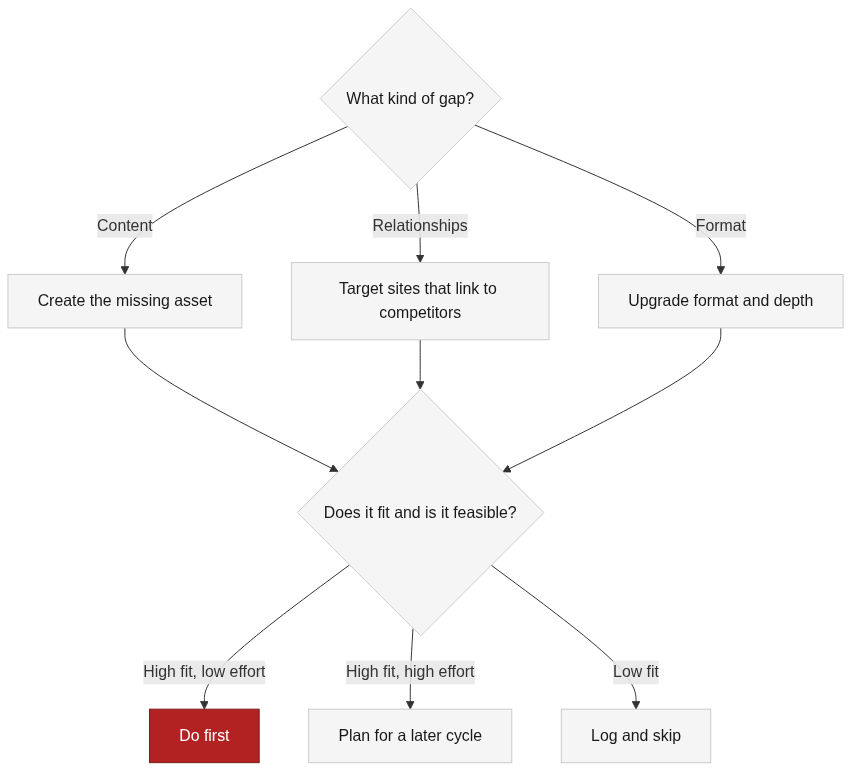
The deliverable of a competitive link analysis is a gap analysis: the difference between what competitors have and what you can realistically build. Sort the findings into three kinds of gaps. A content gap means competitors earn links with an asset you lack, such as original research, a calculator, or a deeper guide. A relationship gap means sites that link to competitors have never seen your page, so outreach is the path. A format gap means your page answers the query but in a format people do not reference, such as an article where a dataset or table would be linked instead [5].
Prioritize the gaps by fit and effort, not by size. A gap belongs in the plan when the linking sites match your audience and when you have the resources to close it. A large content gap that requires data you cannot produce is real but out of reach for this cycle, so log it and move on. The analysis is useful when it produces a short, prioritized list; it is noise when it produces a long wishlist.
Keep the Analysis Current
A competitive link analysis is a snapshot, and it should be re-run on a cadence that matches your campaign. Quarterly is a reasonable rhythm for most sites: it captures new entrants, new assets, and shifts in the competitive set without turning research into a full-time job. Between cycles, track only the pages you are actively targeting, and check whether new referring domains appeared for competitors that matter.
Resist the urge to re-analyze every time a campaign stalls. When the plan is not working, the first check is your own page quality and the relevance of your targets, not a fresh export of competitor data [1]. The analysis feeds decisions; it does not replace them.
FAQ
References
Google, “SEO Starter Guide,” developers.google.com. Official documentation describing links among the signals that help pages gain visibility, and why rankings depend on many factors.
Moz, “Backlinks,” moz.com. Public glossary explaining what backlinks are and why relevance and placement determine their value.
Ahrefs, “Link Building for SEO: The Definitive Guide,” ahrefs.com. Public industry guide covering link research, competitor analysis, and how to verify backlink data.
Google Search Central, “Spam policies for Google web search,” developers.google.com. Official documentation describing link schemes and practices that Google treats as policy violations.
Search Engine Journal, “Link Building,” searchenginejournal.com. Public industry article covering competitor link research and turning findings into campaign decisions.
Next Steps
A competitive link analysis pays off when it ends in a short list: the competitors you will study, the patterns that explain their links, and the gaps you can realistically close. Keep the analysis scoped to your audience and your resources, and re-run it on a fixed cadence so the plan stays anchored in current evidence.
The link building strategies guide shows where competitive research sits inside a full campaign, the resource page link building guide explains how to turn the format gaps you find into linkable pages, and the broken link building guide covers a method that works when the gap analysis points to pages worth restoring or replacing.
If you would rather focus on the strategy while a specialist handles the research and execution, TraffiClimb builds premium link building programs for ambitious brands. Visit the TraffiClimb website to see how the approach works.