
Link Building Campaign: How to Plan and Run a Successful Campaign in 2026

Start With Goals, Not Tactics
Set the business outcome first and translate it into link-level targets, because tactics chosen in isolation produce activity without direction. A common pattern is to pick “guest posting” or “digital PR” because a competitor does it, then spend three months generating links that support nothing. The campaign goal should name the pages it serves and the result those pages need: more organic traffic to a money page, visibility for a new guide, or a cluster of pages competing for the same set of terms.
Once the outcome is clear, define what success looks like in links. Useful targets include the number of new referring domains, the minimum relevance of the linking pages, and the quality bar for placements. These targets work because they are inputs you control, unlike rankings, which depend on many factors outside your reach. A goal like “earn 15 relevant referring domains for the pillar guide in the next quarter” tells the team what to do; a goal like “rank first” tells them nothing.
The boundaries matter as much as the numbers. If your target pages do not deserve links yet, no campaign will rescue them, so fix the pages before you start. And if the only stakeholder is measuring rankings on a weekly basis, reset the expectation early: ranking movement lags link acquisition by weeks or months, and judging a campaign by a single month misleads everyone.
Choose the Pages That Earn the Links
A link building campaign needs pages that are genuinely useful and internally consistent, because a link sends a reader somewhere and that destination decides whether the placement holds value [2]. Rank your existing content and pick the pages that match search intent, have clear keyword potential, and convert the visit into something measurable: a signup, a download, or a step toward a purchase. In most cases that means starting with one pillar page, then extending to the support pages in the same cluster.
The page quality bar is non-negotiable. If the page is thin, outdated, or contradicts another page on your site, earning links to it amplifies the weakness instead of fixing it. Upgrade the page first: add the missing sections, make the claims verifiable, and make sure the page can stand alone for a reader who arrives directly from another site.
Do not spread a small campaign across many pages. A few pages with focused relevance beat a long list of pages that each get one link, because relevance and context are what make links defensible [2]. When resources are tight, choose the single page most likely to move the business metric, run the campaign there, and add pages in later cycles.

Map Competitors and Find the Gap
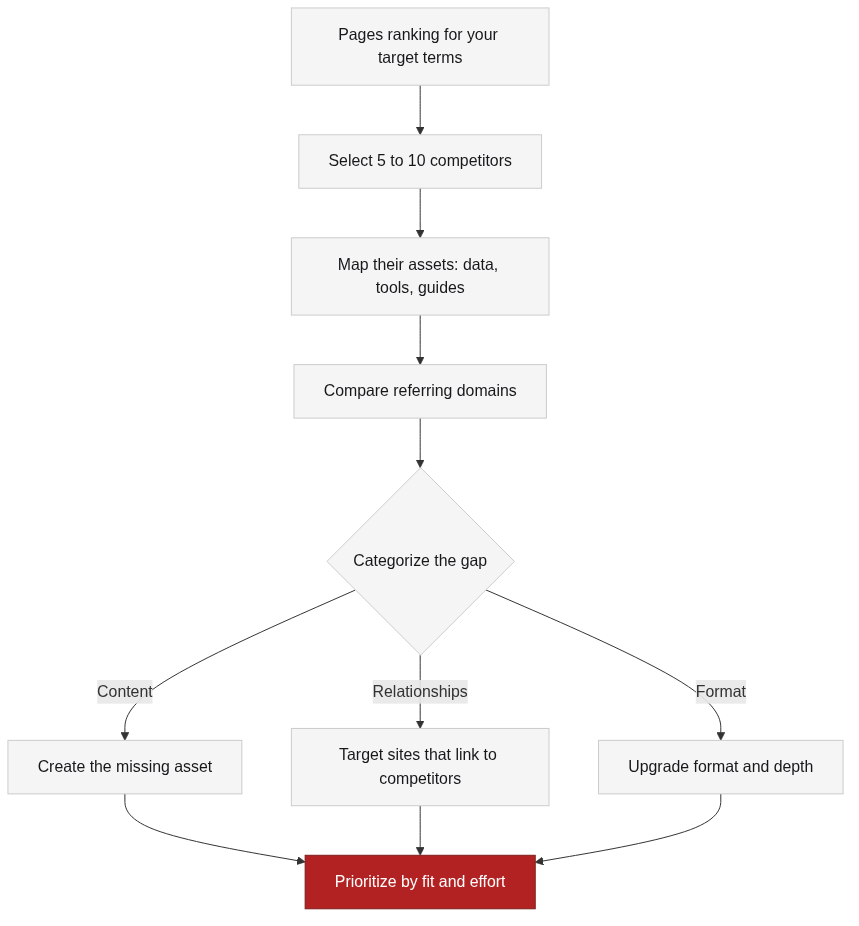
Competitor analysis tells you what kind of links and assets already exist for your target terms, and gap analysis tells you which of those you can realistically close. Start by looking at the pages ranking for the terms you care about and select five to ten that are comparable to yours in audience and intent. For each one, note what makes it link-worthy: original data, a tool, expert quotes, detailed how-to content, or a resource that other sites reference.
Then compare link profiles rather than just domains. The useful comparison is between the referring domains of those pages and yours, broken into three kinds of gaps. A content gap means the winning pages have an asset you lack. A relationship gap means sites that link to competitors have never seen your page. A format gap means your page answers the query but in a format people do not reference, such as a PDF where a table or calculator would work better [3].
Not every gap is worth closing. A gap only matters when it belongs to sites your audience actually visits and when you have the resources to fill it. If competitors earn links from industry press that requires a data story, and you have no data, that gap is real but out of reach for this cycle. Log it, and prioritize the gaps you can close with the assets you already have.
Estimate How Many Links You Actually Need
Estimate the link requirement by measuring the gap between your current referring domains and the pages that already rank for your terms, then treat that number as a working range, not a promise. Count the unique referring domains of the top pages you mapped, subtract your own, and you have the visible distance to close. Adjust the estimate by difficulty: a relevant editorial link from a page your audience reads is worth more than several general listings, so the raw count matters less than the fit.
Plan link velocity instead of a single total. A steady flow of placements over several months is more sustainable and easier to review than a burst that stops as soon as outreach ends. Small teams should set a realistic monthly target they can actually execute and measure, rather than copying a competitor’s profile size.
The estimate should be revisited, because it changes as your pages improve and as the competitive set moves. Re-run the gap analysis quarterly and adjust the remaining work; a range that is updated honestly is more useful than a number that everyone treats as gospel [3].
Select Methods by Goal and Resources
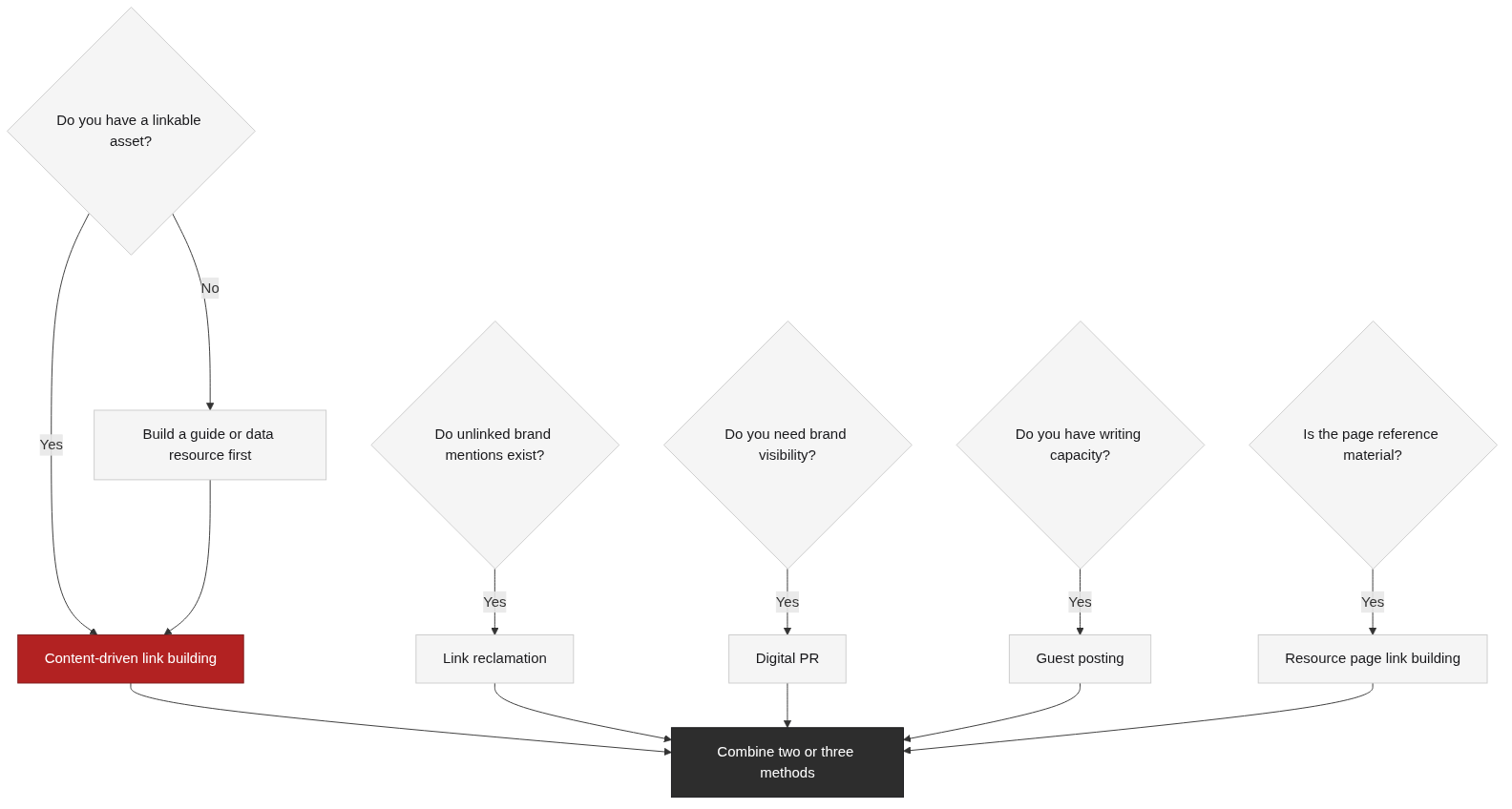
Choose two or three methods that match your assets, audience, and capacity, and sequence them so the cheap wins come first. The main options map to conditions: content-driven link building when you have a linkable asset, digital PR when you need brand visibility and have a story or data, guest posting when you have writing capacity and know the sites your audience reads, resource page link building when your page is reference material, and link reclamation when unlinked mentions already exist [4].
The order matters. Start with methods that reuse content you already have, such as link reclamation or upgrading an existing resource, because they cost time rather than production. Move into outreach-heavy methods like guest posting and digital PR once the asset is strong enough to pitch. If you have no linkable asset yet, build one before outreach, because pitching a weak page wastes the same effort as pitching a strong one and returns less.
Set the risk boundary in advance. Paid link schemes, private blog networks, bulk directories, and automated link building are excluded from a defensible campaign, and the compliance line belongs in the plan rather than discovered later. When capacity is the constraint, cut the number of methods instead of lowering the relevance filter, because the first thing to degrade under pressure is the quality check that made the campaign defensible.
Build the Timeline and Budget
The timeline should run in waves, with audit and asset work first, outreach in batches, and a review cadence that forces decisions. A typical shape starts with a discovery and audit phase, moves into creating or upgrading the asset, then runs several outreach batches, each followed by a placement review. The waves exist so the campaign can adapt: if the first batch of placements is weak, the next batch changes the offer or the target list instead of repeating the same mistake.
Budget the real costs rather than the visible ones. Internal hours cover strategy, writing, outreach, and review; tooling covers site crawling, link monitoring, and outreach or relationship management; external services cover design, content production, or a specialist team. When the budget is thin, reduce outreach volume first and keep the relevance filtering intact, because a smaller campaign with better fit outperforms a bigger one that skips the quality checks.
Put a stop condition in the plan. Decide in advance what evidence would end the campaign or pivot it: a target page that cannot earn placements after two waves, an asset that does not attract references, or a competitor set that moved faster than expected. Without a stop condition, the campaign keeps spending because nobody wants to declare the experiment over.
Measure, Review, and Adjust
Track the metrics that reflect the goal, and interpret each one with its limits in mind. New referring domains show activity but not relevance, so log the linking page topic alongside the count. Organic traffic to the target pages is the closest proxy for the business outcome, but it moves slowly and mixes many causes. Referral traffic from placements is the earliest signal of fit, and placement retention tells you whether the links last [5].
Every metric has a failure mode. A page with no referral clicks can still pass relevance signals, and one with heavy traffic can still be a poor fit if the audience never engages. Rankings lag the work by weeks or months, so judge them as a trend, not a single snapshot [1]. When the results look off, check the target page quality first, then the relevance filter, then the outreach offer; these three account for most campaigns that underdeliver.
Review the campaign on two rhythms. Monthly, check the activity metrics and the quality of recent placements, and adjust the next outreach batch. Quarterly, re-run the competitor and gap analysis and decide whether the target pages, methods, and budget still match the goal. The review is what turns a series of placements into a campaign, because it feeds what you learned back into the next cycle [5].
FAQ
References
Google, “SEO Starter Guide,” developers.google.com. Official documentation describing links among the signals that help pages gain visibility, and why quality matters.
Moz, “Backlinks,” moz.com. Public glossary explaining what backlinks are and why relevance and context determine their value.
Ahrefs, “Link Building for SEO: The Definitive Guide,” ahrefs.com. Public industry guide covering link audits, competitor gap analysis, and campaign planning.
Backlinko, “Link Building Strategies,” backlinko.com. Public industry guide surveying link building methods and how to prioritize them.
Search Engine Journal, “Link Building,” searchenginejournal.com. Public industry article covering campaign planning, measurement, and review.
Next Steps
A link building campaign is a loop, not a checklist: set goals, choose the pages, map the gap, estimate the work, select the methods, run the waves, and feed the reviews back into the next cycle. The two decisions that protect the whole campaign are the goal at the start and the quality bar throughout, because they keep the activity pointed at the business outcome instead of at link counts.
Start with the goal and the single page that deserves the effort, and run one full cycle before you expand. The link building strategies guide covers the method mix in more depth, the resource page link building guide explains the cheapest entry point for reference content, and the broken link building guide walks through a method that works when you maintain a linkable resource.
If you would rather focus on the strategy while a specialist handles the execution, TraffiClimb builds premium link building programs for ambitious brands. Visit the TraffiClimb website to see how the approach works.